Posts Tagged ‘history’
 Hidden heroes
 October 31st, 2012 |
  Author:
 The BBC have just broadcast and put on YouTube an excellent hour long documentary about two people whose wartime work is credited with shortening the war and saving millions of lives. Yet because of the cold war and the climate of secrecy, credit came late or not at all.
‘Code-Breakers: Bletchley Park’s Lost Heroes‘ details the work of young mathematician Bill Tutte who broke the German’s top-secret Lorenz code and Post Office engineer Tommy Flowers who built the first electronic computer ever – to replace ‘Heath Robinson’, the mechanical device used to process the code-breaking.
Bill Tutte and Tommy Flowers were both ‘scholarship boys’ who benefitted from the best educational and research opportunities available to their generation. Earlier conflicts may not have been able to discover and develop such talents. (And it’s questionable whether comparable educational opportunity is available today.)
It’s hinted towards the end of the program that the extended secrecy about their achievements is connected to the assumption that the Soviets continued to use the captured German Lorenz system into the 1950s. You can only imagine Tommy Flowers’ frustration, biting his tongue every time someone referred to ENIAC as the first computer!
You have to marvel at the beautiful minds of these two men – dealing with complex matrices and patterns and the logic associated with understanding them – without the tools we take for granted today. One of my favourite scenes is Bill Tutte at his desk with a hand drawn grid on a large sheet of paper tracking the pattern of the characters in the coded messages.
To quote John Lennon
“Life is what happens while you’re busy making other plans”.
Yes. The original plan today was for self indulgence – to spend all afternoon playing in the QRP ARCI Fall QSO Party. Needless to say, it didn’t happen. Not by a long shot.
There was grocery shopping to get done, lawn mowing and leaf clean up to get done, baking to be done for the Sacred Heart Music Ministry bake sale tomorrow. All things that had to get done, which left me not much time on the radio.
After dinner, I have gotten on the air and have made some contacts on 20 and 80 Meters. 40 Meters would be nice but the RTTY’ers are once again swallowing up the band all the way from 7.040 to 7.100 MHz. Wow, I remember in my RTTY contesting days in the 90’s we didn’t dare come below 7.060 MHz. Times have changed.
I will go back down to the shack in a bit; but wanted to share something I found in the basement while calling “CQ QRP’ looking for contacts.
I found some old licenses. These three each have one of the call signs that I have held.
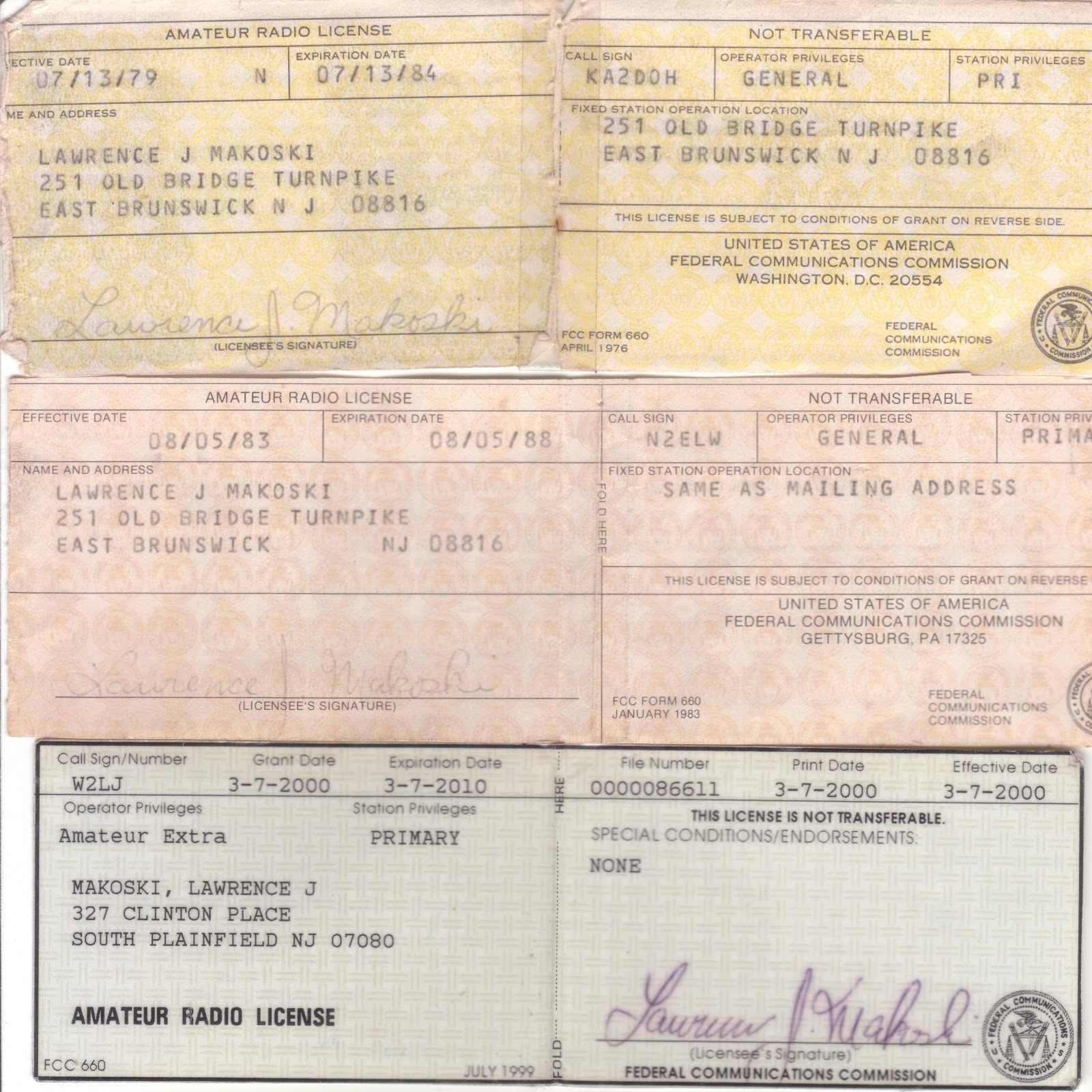
The top one is a KA2DOH one, and this is the license I received after upgrading to General in the Summer of 1979. The N2ELW one is from when I applied for a General Class call in 1983. Got this one in August of 1983 and shortly thereafter upgraded to Advanced on October 18th, 1983. The reason I remember that date so well is that’s the date of my parent’s Wedding Anniversary. If they were both alive, they’d be celebrating their 60th this year. Both of these licenses were from back in the days when the license term was only five years.
The W2LJ one is the license that I carried before I renewed two years ago. I found the CSCE’s (for you non-US Hams, those are Certificates of Successful Completion of Exams) from when I upgraded to Extra all the way back on March 1st, 1993. Next year will be 20 years as an Extra and this year will mark my 34th as a Ham – sure doesn’t feel that long!
72 de Larry W2LJ
QRP – When you care to send the very least!

Inspiration
In my links section, I have a link to W6AQ, Dave Bell’s e-book, “Worlds Best Hobby”. I’ve mentioned the book on the blog here, before. I’d like to make a couple of points about it.


RIP Neil Armstrong
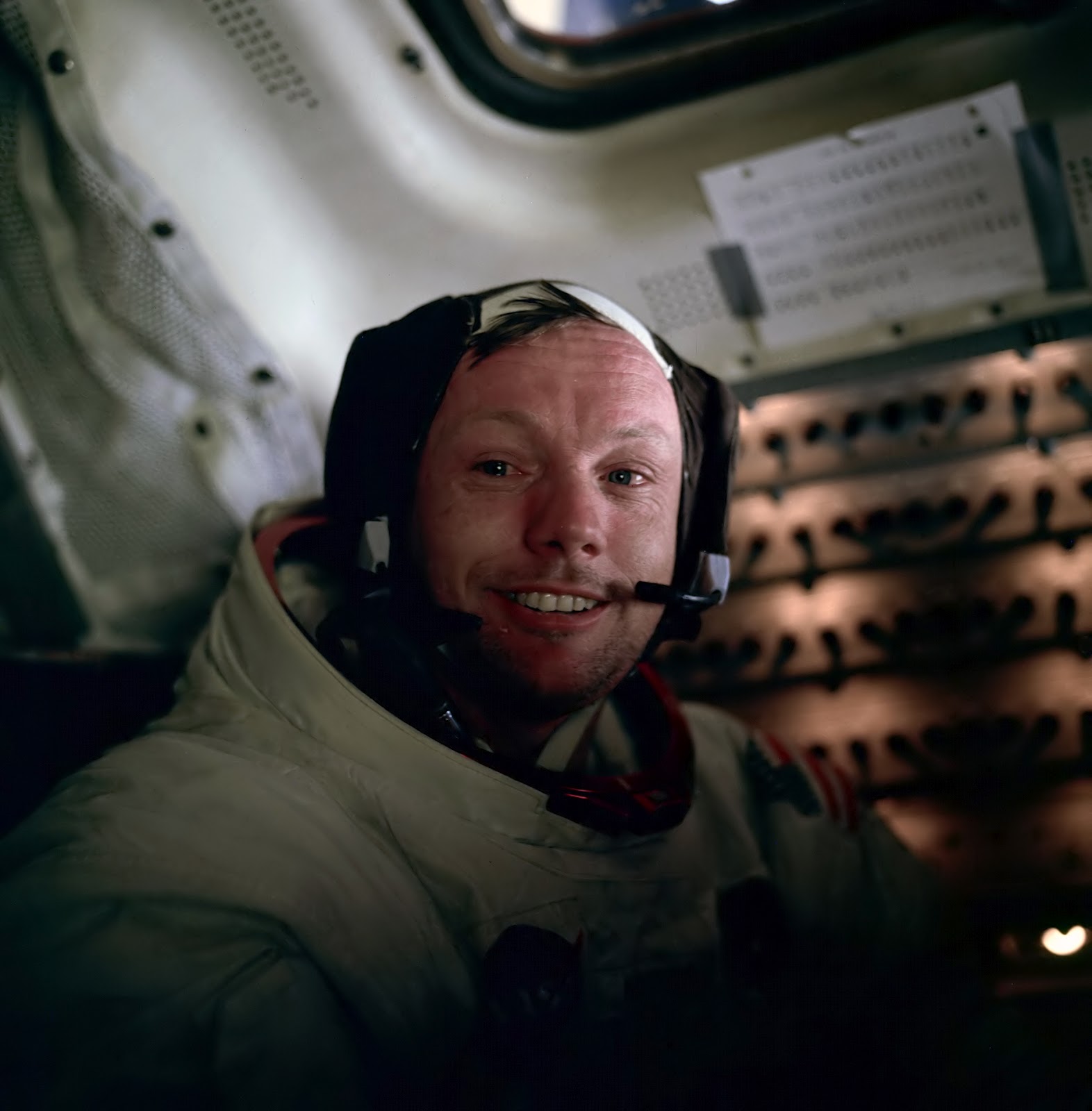
Neil Armstrong, the first man to set foot on the surface of the Moon, died today at the age of 82. The cause of death was from complications from heart bypass surgery which occurred earlier this month.
Neil Armstrong was a humble hero, who did not seek the limelight; and was always eager to praise those who shared in the efforts to land an American on the moon.
You will be sorely missed, Neil. You were larger than life to those of us who grew up with Mercury, Gemini and Apollo.
72 de Larry W2LJ
QRP – When you care to send the very least!

Today was a very good day
Amateur Radio-wise, that is!
At the VE session this morning, we were able to welcome three new Hams into the fold. Well, make that two and one revert. One of the candidates was a Ham years ago; but let his license lapse. So maybe it would be more accurate to say that we welcomed three potentially active Hams into the fold.
I guess I am from another era; as I get frustrated (a bit) when the first question out of a new Ham’s mouth is something to the effect of, “So where can I get a good price on a dual band handheld?” Man, when I was studying for my Novice ticket, the LAST thing I wanted was an HT. All I had my sights on was HF and working the bands. In fact, I didn’t get my first VHF radio until nearly a year after I was licensed.
I got my ticket in December of 1978. Spent November and December and part of January assembling my station, which was a “pre-owned” Drake 2-NT transmitter (which was my Christmas gift from my parents that year) and a Heathkit HR-1680 receiver which I saved up for and built all by myself. That receiver was the very first of many Heathkits that I was to build. Between buying, building and making an antenna, I had my first QSO on January 29th, 1979. And it was an HF QSO. I still have that QSL card, framed in my basement. Can’t recall the entire call of the poor victim that I plied my nasty fist on, but I do remember his name was Adam and he was KA9something.
My first VHF radio was a Tempo1 handheld, the very first to have a synthesized VFO, not relying on crystal control. I bought it a year later, after I had upgraded to General, specifically to assist in the 1980 Winter Olympics Torch Run. Those were the Lake Placid “Do you believe in miracles?” Olympics and the torch run traveled right through Central NJ on its way to Lake Placid. I was with a local club providing communications in an ARRL led effort. I still have the Public Service Commendation hanging on the shack wall that commemorated that event.
But for me, VHF and UHF were never a Number One favorite. Don’t get me wrong, I have spent A LOT of time on UHF and VHF repeaters – making friends, doing public service and all kinds of stuff. But in W2LJ’s mind, when Ham Radio pops up in a little thought balloon, it’s always a picture of an HF radio, making worlwide contacts. Just me, I guess.
I had another treat this afternoon, working my good friend, Bob W3BBO, who also took the plunge and just very recently got a K3. He finished building his this past week and this was our very first K3 to K3 QSO.

The pursuit of The Elser-Mathes Cup
 The story of the Elser-Mathes Cup may be familiar to many of you. For those of you who are not in the know, you can get all the details from the article by Fred Johnson Elser, W6FB/W70X, in the November 1969 issue of QST. To summarize, the establishment of the Elser-Mathes Cup in 1929 was directly inspired by the leaps and bounds up to that point in radio technology combined with Hiram Percey Maxim’s fascination with the planet Mars. The cup is to be awarded in recognition of the first amateur radio two-way communication between Earth and Mars. I would bet that the cup’s initial establishment was somewhat tongue-in-cheek. Although Fred Johnson Elser’s QST article, on the tail of the success of Apollo 11, gave the cups existence and purpose a good deal more veracity.
How close are we to finally awarding the Elser-Mathes Cup? Lets look at some recent milestones:
Earth-Moon-Earth Bounce
In January 1953, Ross Bateman, W4AO, and Bill Smith, W3GKP successfully bounced at 2M signal off the Moon.
Signal reception of Voyager 1

On March 31, 2006, German radio amateurs successfully received transmissions from Voyager 1 which was already well outside the Solar System (~7,436,464,581 miles away from Earth).
Earth-Venus-Earth Bounce

On March 25, 2009, German radio amateurs achieved another first by bouncing a 2.4 GHz CW signal off of Venus – which at its closest point to Earth is a mere 24,000,000 miles away and 162,000,000 miles at its furthest.
Earth-Mars-Earth Bounce?
Mike Brink, ZR6BRI, has definitely done his homework to show the feasibility of radio amateurs bouncing a signal off of Mars (which has a distance from Earth that varies from 36,000,000 miles to 250,000,000 miles).
However, bouncing a signal off of Mars will not win The Elser-Mathes Cup. The amateur contact must be two-way.
 Could the Mars Science Labratory (Curiosity) fulfill the role as the second party of an amateur QSO?
Curisoity does have UHF communication capability. One of Curiosity’s antennas is nicknamed “Big Mouth” and is used to send large data sets to one of three orbiters around Mars: the Mars Reconnaissance Orbiter (which will probably do most of the work), Mars Odyssey Orbiter, or the European Space Agency’s Mars Express orbiter. The orbiter then relays the data via the Deep Space Network (DSN) back on Earth using X-Band.
“Big Ear” is Curiosity’s high-gain, directional X-Band antenna that can be used to communicate directly with the DSN on Earth. “Little Ear” is an omni-directional, X-Band antenna that is designed to be used primarily to receive low data rate transmissions from the DSN.
Putting aside the fact that Curiosity’s X-Band frequencies are outside the authorized US amateur frequency allocation and given the German amateurs success with Voyager and Venus – amateur communication with Curiosity looks possible (but probably not with my Arrow II antenna).
So, if it is possible for Joe Amateur (along with a heap load of expensive gear) to have a QSO with Curiosity – what would prevent the actual hacking of Curiosity?
Damon Poeter’s August 9th article “How to Hack NASA’s Curiosity Mars Rover” takes a look at this proposition. Mr. Poeter all but dismisses the possibility of a private citizen contacting Curoisty and instead focuses at actually hacking through NASA’s control system. Then on August 10th, Mr. Poeter submits “Unknown Actor Soliciting Partners for Mars Rover Hack”. Now, possibily, there are individuals who are actually trying to hack their way through NASA by soliciting help in determining what frequencies are used to communicate with the orbiters above Mars.
Here on an IT secuirty forum, a question is asked concerning the secuirty of Curiosity. One of the responses is from a former controller who is somewhat familiar with NASA’s general communications protocal with spacecraft and identifies the transmission of bogus communications to Curiosity as a possibility. Although the post’s author identifies that the capability to conduct such an act would have to be another country (…. and everyone loves pointing the finger at China).
It is easy to forget that radio amateurs have been intercepting space communications for sometime, with Sputnik’s signal on 20.007 MHz and Apollo 11 communications being primary examples.
All this being said, I think The Elser-Mathes Cup will continue to gather dust for a bit longer.













