Posts Tagged ‘engineering’
 One-step dipole pruning
 January 2nd, 2011 |
  Author:
 Dad and I built a 10-meter rotable dipole some 12-13 years ago using pieces of a large Wilson tribander that I had begged off of a local ham. It was an interesting mechanical design, using a 3/4-inch CPVC tee fitting as the center insulator and mounting bracket. The third leg of the tee slipped over a piece of EMT conduit that we had crimped. The EMT, in turn telescoped into a RadioShack-type TV mast, which was bracketed to our deck. It was a fun antenna back when 10 meters was fun.
That CPVC tee lasted a good deal longer in the UV and wind than we ever imagined. Granted, the antenna was stored in my folks’ garage for 7-8 years while I was in college and graduate school. But, I reinstalled it when we moved to Maryland. Last week brought high winds to the Mid-Atlantic region and the fitting gave up the ghost:
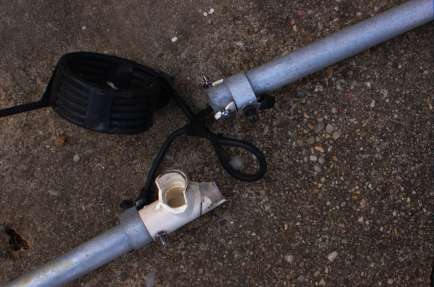
Fortunately, it takes all of a half-hour and another 33-cent fitting to replace it. I did think of running a piece of pipe, dowel, or fiberglass across the element for extra strength. But, I’ll do that if it fails again soon. The process of repairing the antenna reminded me of the technique we used to tune it, which we thought was very clever at the time.
We used the “magic” 468 to set the initial length of the antenna optimized for 28.400 MHz, which was totally wrong since 468 is intended for bare wire, not tapered aluminum. Then, we installed it and measured the VSWR across the band (in the shack). Next, we took the frequency of the minimum VSWR and divided that by the design frequency. Then, took the antenna down and scaled the length of the antenna by the quotient from the previous step. Finally, we reinstalled the antenna and measured the VSWR across the band. It hit dead-on. Dad was impressed that my first two QSOs were KL7 and ZS! It was, of course, ten meters when ten meters was good.
This may be old-hat to a lot of folks, but we thought we were geniuses at the time, although it was purely an act of shade-tree engineering! For those who don’t mind watching sausage made, I will now muse on the validity of the technique.
Suppose you have a “magic factor,” M (=468 or whatever), that defines the frequency of minimum VSWR for an antenna of length l:
 Rearranging that will be useful later:

If we take the partial derivative of each side in the first equation, and substitute M from the second equation we get the following relationship:

Cross-multiplying/-dividing and abusing the partial derivative notation to be a small perturbation yields:
 This is subtly different from the original technique, which can be derived from this using some small-number approximations. But, the point is that there exists a simple technique to prune a dipole to resonance. delta-f is the offset between the design and actual VSWR minimum frequencies, f is the design VSWR minimum, l is the design length, delta-l is the amount that needs to be added (pruned).
W1GHZ 1296 MHz RX working!
I spent about two hours last night assembling the W1GHZ 1296RSU and 1152LO boards from his paper “Multiband Microwave Transverters for the Rover—Simple and Cheap.” Once again, I trekked over to W3APL beacon site at lunch and put the pair through their paces on RX with the IC-290H as the IF radio. It worked! Here’s a clip:
One of the interesting things about the 1296-MHz beacon is that it’s FSK, not CW. You’ll notice this after about 15 seconds when it starts sending its callsign. The higher pitch tone is “keyed” and the lower is “unkeyed.” Brian, ND3F, was at the beacon site with us last week to check out a problem (turned out to be a dead power supply fan). He told us that it’s common for microwave beacons to operate in FSK mode so you always have a carrier to tune across (and swing your antenna across). Who knew?!
Anyhow, it’s time to start building the other trappings, including enclosures, sequencers, filters, PAs, and T/R switches! Apart from the PA parts and some connectors, the other components are on-hand and ready.
Raytracing
Today we have a little bit of fun ham-related tinkering from work. This is two different frequencies transmitted from the same site.
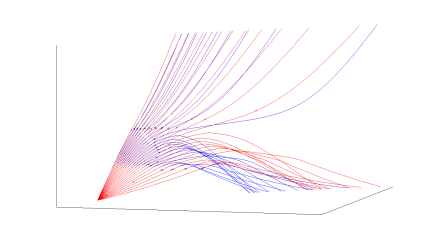
There are lots of neat details in a ray-trace: skip focusing, Pedersen rays, mode-splitting, … One thing that’s fun about writing your own models is that you can modify (intentionally or not) the model physics to do unphysical things…
The second run shows X and O modes for a single frequency and a failed attempt at modeling an MF signal into an E-F region duct. (The ducting, by the way, has nothing to do with my actual work. I was simulating it for ham purposes, although it helped me uncover a problem.) The signals do get to the duct, but they bend the wrong way. This has been fixed in the code, but it serves to remind that modelers have complete control. The background ionosphere is relatively unphysical in this one as well…
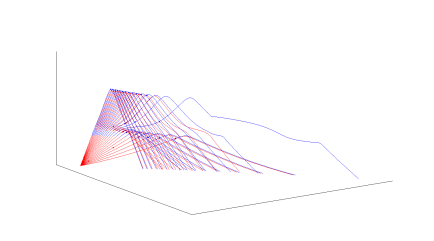
The raytrace code used above is small, simple, and written in MATLAB. I doubt that it will ever be released publicly, but if so I will note it here on the blog.
W1GHZ 903 MHz RX working!
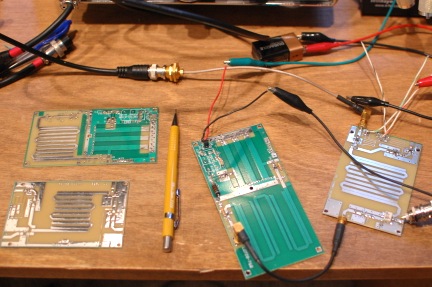
Although I built the W1GHZ 903-MHz transverter and 756-MHz LO boards last winter, I didn’t have time or inclination to test them until this week. These were purchased as a part of the first (October 2009) group buy orchestrated by W8ISS. Instead of the INA-10386 MMIC recommended by W1GHZ, the W8ISS kits featured a Sirenza SGA-3586Z MMIC as the LNA, as suggested by the 4s_microwave group. A better part (with NF < 2 dB), recommended to me by W9SZ, is the the SGA-4586Z, which I used on my 903 board and will use on my 1296 board. This requires the bias resistor (R3, 51 ohms, on the 1296 board) to be changed to 100 ohms.
Since there is a lot of foliage between me and the W3APL beacon, I took the liberty of carting the transverter and IF rig to the beacon site (sorry no photos) on my lunch break yesterday. Sure enough, it worked like a charm with the beacon pounding in on 147.0615 MHz. The nominal beacon frequency is 903.055 MHz, so I don’t know if the difference is in my LO or the not-GPS-locked beacon drifting around. At any rate, I’m pleased enough to continue the project…
The 1296RSU transverter and 1152-MHz LO boards are on the left in the photo above. They have not yet been populated, but that’s an evening’s work.
W3LPL-inspired 160/80 RX splitter
In an earlier post, I described my K9AY loop system. QRX for an update on the outdoor portion. But, after returning from a short and much-needed vacation at the beach yesterday afternoon, I whipped-up this little guy:
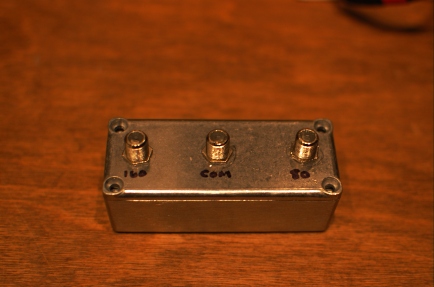
One of the big problems I have living in the city is overload from broadcast stations in the AM band. (This is especially true in the heavily-populated, full-of-hot-air DC area—Ed.) But, I digress. I also wanted to protect the preamp and receiver when I was transmitting on the higher bands into nearby antennas. So, some sort of filtering was in order.
I contemplated a number of topologies. But, the W3LPL filters were a good choice because they’re cheap and very good. A good reference on what I did is the NCJ article by K3NA and W2VJN about the VP6DX receiving antenna system. The Ducie Island system is considerably more complex than mine. But, they had more stringent requirements, more land for Beverages, and more money than I do.
Following the K3NA/W2VJN/W3LPL topology, I constructed a little diplexer filter for 160 and 80 meters that splits my K9AY to two receiver ports. This splitter is the first thing after the K9AY coax passes through the station ground bulkhead, requiring a preamp on each port. Since I don’t have a TX antenna for 160 yet, that port will go to the SoftRock-160.
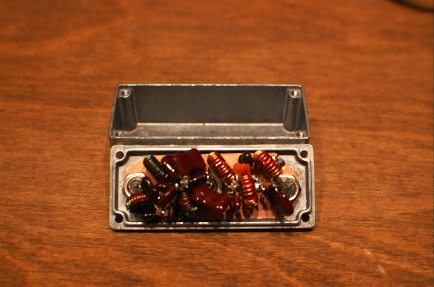
I’ve only tested the 80-meter portion (since I didn’t get the 160 portion done until this morning before work). But, it works like a champ and there is no overload from broadcast stations. Although there are some curious mixes coming from some of the big AM stations in the area that seem to be external to the receiver (this has been confirmed by N3OX—pretty amazing stuff); but, that might deserve its own post at a later date.
Keyboard Trays, QRP Rig, and SoftRocks
Time, as they say, has been of the essence of late. So, when I do have time to play radio, I rarely have a chance to write about it. Here are some photos of my latest tinkerings.
Keyboard Trays
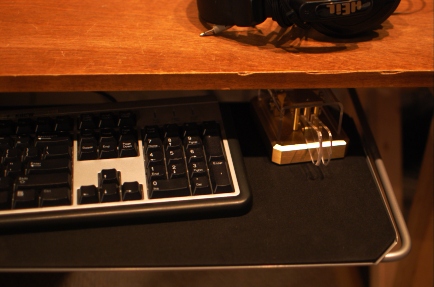
Sarah has always talked about using a keyboard tray at work as a part of an ergonomic workstation. Until recently, my work invovled enough variety of computer and non-computer time that I did not think about it. But, after coming home from work with stiff shoulders and wrists, I decided something should be done. While I was at it, I upgraded the HF and VHF/SDR operating positions at K8GU with pull-out trays, as well. These were $10 each at IKEA and pretty easy to install, although I told Sarah that I was grateful that she didn’t witness my contortions to hold them up with my knees while driving the first screws.
Liberating my inner QRPer
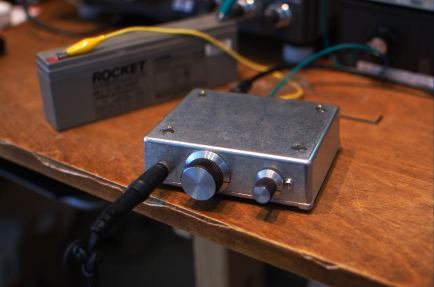
Back in high school, I built a Small Wonder Labs SW-40 that I had seen in a QST article. It lived in a variety of enclosures, but spent the last decade in the ugly PC board half-enclosure that looked like a redneck pickup truck at right. I decided to put it into a proper enclosure, being the diecast box at left.
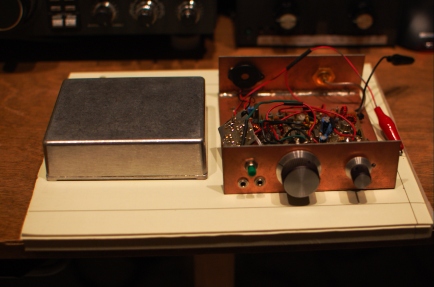
Despite the fact that I made the radio impossible (no room for front panel controls) to assemble the first time I drilled the board mounting holes, I’m pleased with the result. Four dabs of gray epoxy cover the errant holes. I probably could sand and polish those now. The power connector is a pair of Anderson Power Poles.
VHF Softrock and Enclosures
Readers of the blog have seen the screen capture from my new Softrock Ensemble II VHF. Tony does not advertise these on his site because they are not 100% supported with documentation yet. Robby, WB5RVZ has done a great service to the community by preparing step-by-step instructions for most of the SoftRock series. I’m not a step-by-step kind of guy, so I just used his photos showing the locations of the 0.1 uF and 0.01 uF chip capacitors and built the rest my way: mount all chip caps, all SMT ICs, all through-hole ICs and sockets, all through-hole resistors and diodes, all through-hole capacitors, all inductors, and all connectors. It worked right away.
I also have two v6.0 SoftRocks that I built a few years ago while I was in grad school. One of these (for 160) has been a bare board all these years and the other (for 40 and 80) has been living in an ugly little RadioShack black plastic project box. I decided to upgrade them to diecast boxes with external power connectors (also PowerPoles—I’m slowly switching the station over) and a switch for 40 and 80 meters. Here’s the happy family of little radios…
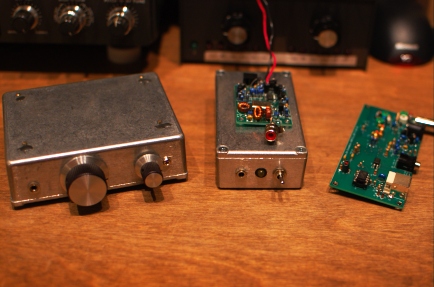
The 160-meter SR v6.0 is on top of the diecast box holding the SR v6.0 40/80. The Ensemble II VHF is on the right. It’s unfortunately too long for either size diecast box. I don’t like the commercially-available box for it. So, we’ll have to see…
144-MHz SoftRock
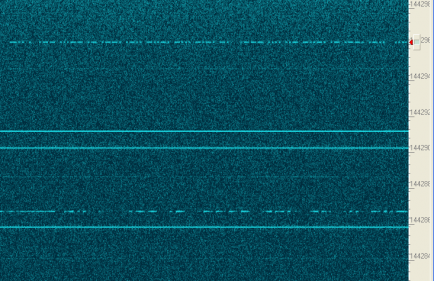
144-MHz SoftRock Ensemble II VHF by KB9YIG and VE3NEA Rocky 3.6. Yup, that’s W3APL/B (off the back of the beam) and WA1ZMS/B in the same waterfall. How cool is that?! More later… This has many implications for many projects!













