Posts Tagged ‘Electronics’
 Arduino Frequency Display For Kenwood TS-520S HF Ham Radio PART 2
 March 19th, 2014 |
  Author:
 This is (PART 2A & 2B) of the project “Arduino Frequency Display For a Kenwood TS-520S HF Ham Radio”. This part covers small signal amplification of a 0.2 volt peak-to-peak 5.5 MHz signal into Schmitt triggered NAND gate for cleanup before being cleanly counted by the Arduino. All parts: (PART 4), (PART 3), (PART 2), (PART 1)
(PART 2A)
(PART 2B)
Here are the datasheets for the two chips I used in (PART 2)
74HCT132 Quad 2-input NAND Schmitt trigger (PDF)
NE592 video Amplifier (PDF)
Thanks for joining!
Photo Gallery
CLICK PHOTO for gallery view and click a SECOND time for hi-resolution image. Click thumbnails on lower right and lower left of gallery to navigate gallery photos.
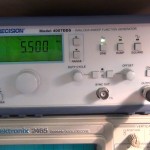
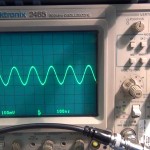
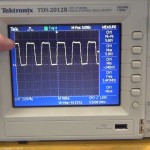
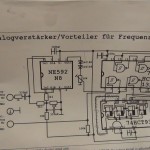
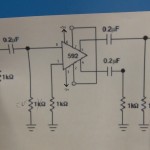
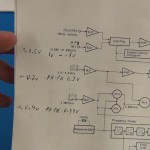
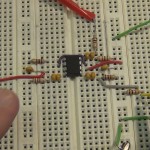
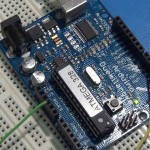
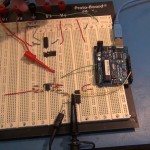
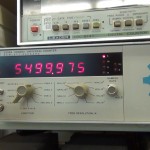
Thanks for joining!
Intermediate is go

We have started another intermediate class both in class and distance learning. This course is primarily run on Edmodo. We have run a couple of classes on Edmodo and we think we have the concept correct now. So we have our weekly quizzes set and our 3 week homework assignments all loaded and ready to go.
In class students are also welcomed to join the distance learning students so missing a lesson is no longer such an issue.
Over the coming weeks I will be creating some companion videos showcasing the practical elements of our in lesson activities.
So far we have 5 in class and around 30 distance learning joining us for the next 10 weeks.
Bloody Proprietary Connectors
I came across this video rant by David L. Jones on the EEVblog concerning proprietary cables on consumer devices. I agree with him completely. Warning: some language not suitable for kids.
Unfortunately, if you look at ham radio gear, we are in even worse shape than the consumer market. Heck, even the freaking microphone connectors are unique to each manufacturer.
Foxx 3 TRX build
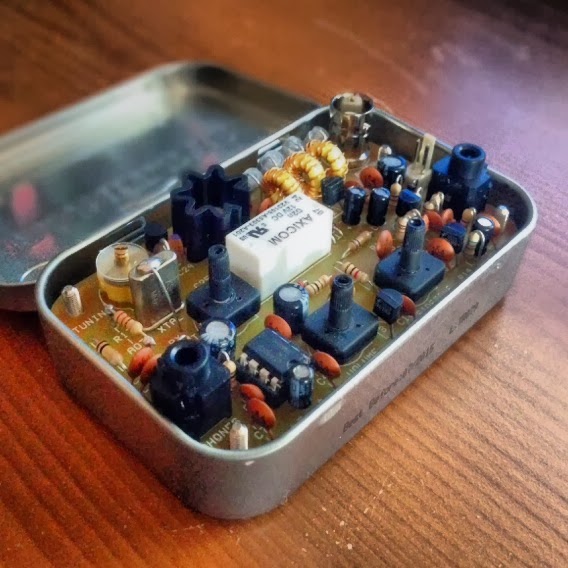 So it was my birthday recently and to celebrate the turning of another year and that I had indeed taken a day off – I decided to build a FOXX 3 QRP CW transceiver. These little kits are available from Kanga-products.co.uk and are designed to fit in a Altoids tin.
The kit comes pre bagged up in separate bags, and its just a case of soldering the correct component to the correct area on the circuit board. The kit itself is a 1 Watt QRP transceiver that can be bought on various bands. Mine was for the 20m band.
The board has a clear and easy to read Silkscreen and the pads are suitably wide enough to allow anyone with different levels of skill to create the kit. Each step allows you to test each part of the board, so you learn how each part of the kit relates to the transceiver as a whole.
I had a great time building it, it’s a simple, easy and great fun little kit. I hope to take it out and about – so hopefully you can hear my tiny signal on 20m soon.
Where to find the $20 Software Defined Radio?
A while back I wrote a blog post about the availability of $20 software defined VHF/UHF radios in the form of re-purposed USB digital television dongles.
Now-days, with the improvements in software and documentation, the hardest part is finding the right dongle. What you order from EBay, and what you receive, can be two different things and only some of the dongles are suitable for use as VHF/UHF software defined radios.
So, I was pleased to see that at least one hobbyist electronics supplier has sought out and supplies a suitable device for SDR at a fair price :

Adafruit has available the USB dongle and “antenna” suitable for experimentation for $22.50, not far from the EBay (direct from China) price.
Click here to go directly to the product page: Software Defined Radio Receiver USB Stick – RTL2832 w/R820T
No, I didn’t receive a free evaluation unit and I don’t work for Adafruit … I’m just glad to see these useful devices available from a local company with an increased chance of you “Getting what you paid for.”
Adafruit also helpfully stock the adapter cables to convert the less common MCX antenna connector into the much more common BNC connector: MCX Jack to BNC RF Cable Adapter
An Amazing Moment in Space Weather – Massive Solar Eruption June 2011
While many are talking about how Solar Cycle 24 is the weakest since the Maunder Minimum (the period starting in about 1645 and continuing to about 1715 when sunspots became exceedingly rare, as noted by solar observers of the time — see this Wiki entry), there are moments when activity on the Sun strongly increases, providing brief moments of excitement.
Here is a case in point, witnessed by the Solar Dynamics Observatory (SDO; see SDO Mission) on June 7, 2011, when the Sun unleashed a magnitude M2 (a medium-sized) solar flare with a spectacular coronal mass ejection (CME). The large cloud of particles mushroomed up and fell back down looking as if it covered an area almost half the solar surface.
SDO observed the flare’s peak at 1:41 AM ET. SDO recorded these images in extreme ultraviolet light that show a very large eruption of cool gas. It is somewhat unique because at many places in the eruption there seems to be even cooler material — at temperatures less than 80,000 K.
This video uses the full-resolution 4096 x 4096 pixel images at a one minute time cadence to provide the highest quality, finest detail version possible. The color is artificial, as the actual images are capturing Extreme Ultraviolet light.
It is interesting to compare the event in different wavelengths because they each see different temperatures of plasma.
Credit: NASA SDO / Goddard Space Flight Center
Video: http://g.nw7us.us/1aOjmgA – Massive Solar Eruption Close-up (2011-06-07 – NASA SDO)
Visit: SunSpotWatch.com