Posts Tagged ‘CW’
 More BK Building
 November 18th, 2014 |
  Author: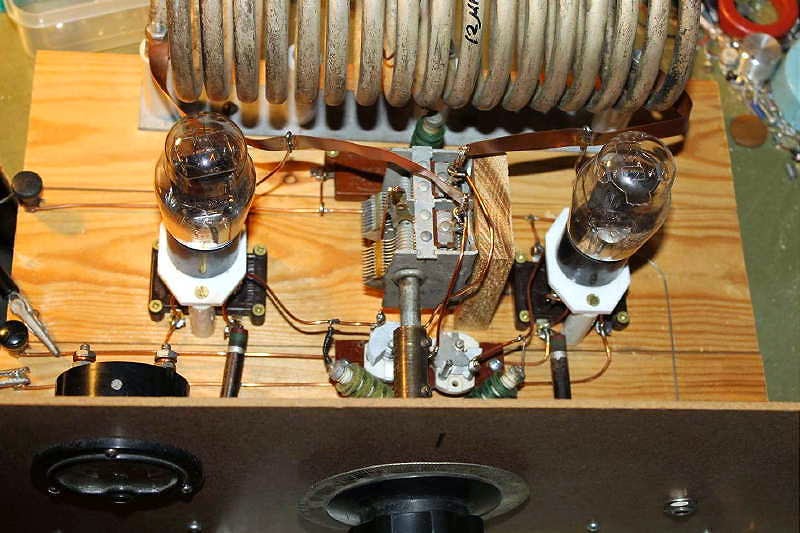
 |
| 1935 ARRL Handbook. Source: http://www.arrl.org/ |
Although John did not have every period-appropriate component available to him, it didn't discourage him from building his BK rig. For too many, this is often a stumbling block that leads to nothing being built....as the boy's of '29 no doubt would have done, he put something together completely from his junkbox.
It will be super to have another left-coast station in this years '29 Party...and a Canadian station to boot!
Anyone else building for the BK? ....there's still a few weeks left.
BK Building…
 |
| March 1926 QST. Courtesy: ARRL |
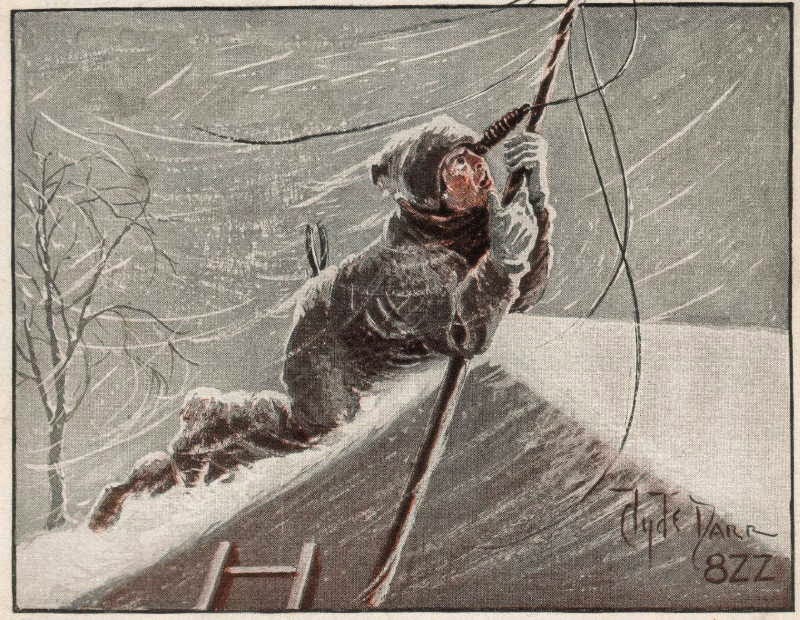
Every year as contest time approaches, I anxiously follow our local weather patterns in hope that the winds remain quiet for the event. For the past few years, the wind has been non-existent...right until zero-hour, when, almost as if a switch were thrown, the wind ramps up to gale-like conditions. Now if you've never heard a self-excited oscillator directly connected to a wind-blown antenna, then be sure to take a listen to this year's BK. These '29 rigs are often not very pretty-sounding, even into a dummy load, but couple them to the wind and things get very 'nostalgic-sounding' quickly. Frequency shifts in the order of several hundred Hertz between letters are not uncommon, making copying a weak signal difficult and almost impossible if listening with a narrow filter. The amplifier will effectively isolate the effects of a shifting antenna impedance from the oscillator stage, making life very much less stressful, come BK time.
My plan is to follow the wisdom of the '29ers themselves, carefully explained in "More Power With Better Frequency Stability" by George Grammer and published in the February 1931 edition of QST. I'm always impressed at how quickly those folks back in the 20's figured out so many of the important "basics of radio" that have withstood the test of time. It must have been an exciting time to be a ham! A glance through any of the numerous radio magazines from the late 20's and early 30's reveals a vibrant market for the homebrewer, with every type of component available. Whether the average ham could afford to buy them in the hungry-thirties is another question.
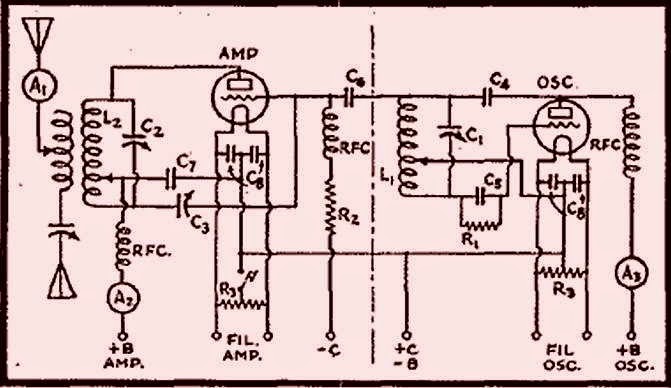
I've chosen to use another type '10' power triode as my amplifier, as shown below.
 |
| Courtesy: ARRL |
I see the main challenges being coupling conveniently from the oscillator as well as neutralizing the triode amplifier...I wonder, will neutralizing it on 40m (for example) also make it stable on 80m?
As well, since the type '10' uses a directly-heated cathode, if I wish to let the oscillator run while I key the amplifier, a separate filament supply will be required for each tube. With this in mind, I've got the ball rolling this week with the construction of a dedicated '29 rig filament supply. The supply uses two center-tapped 5V transformers with their secondaries in series and brought out to the back panel. This will allow me to use tubes with 2.5V, 5V, 7.5V and 10V filaments...up to 3A.
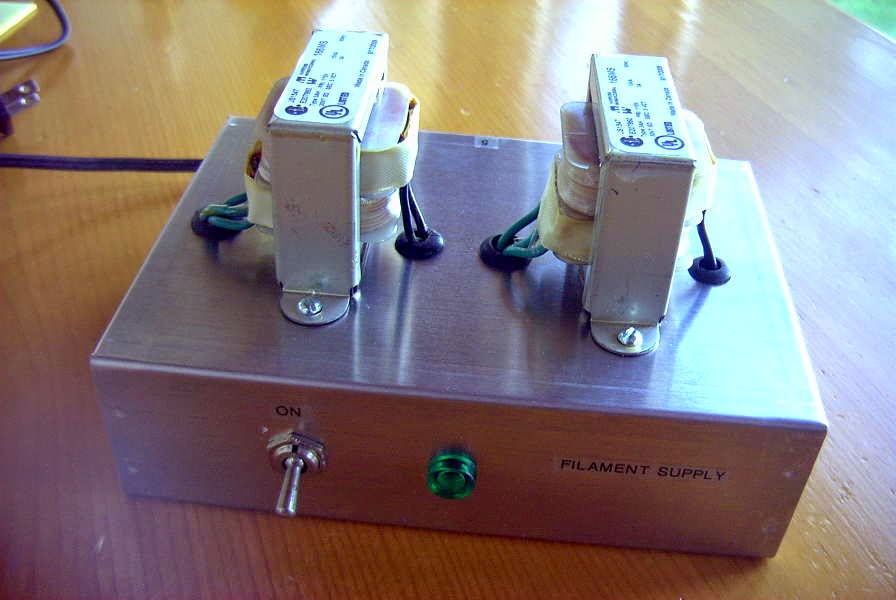 |
| New filament supply |
Are you building or planning anything for this year's BK Party?
“CQ BR” – The Bug Roundup!
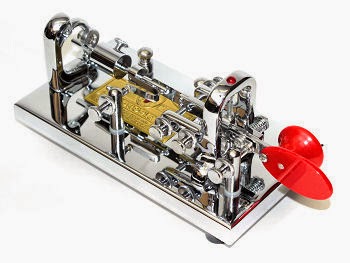
Sponsoring the event is the Samuel F. Morse Amateur Radio Club (W6SFM) of Sacramento, CA. Detailed information may be found at their website, located here.
The club page describes the event as :
"a special time to bring bug operators together on the air. In the same spirit as ARRL's Straight Key Night, participants are encouraged to make simple, conversational, “chewing-the-fat” QSOs using their bug type key. This is an opportunity to exercise, share and exhibit your personalized fist. This is NOT a contest. Call "CQ BR" so folks know you are a Bug Roundup Participant."
You may have guessed by now that I love CW and always have, since learning the 'code' as an eleven-year old in Scouts! Our Scoutmaster had procured several sets of beautiful boxed Aldis signalling lamps, the same as shown below:
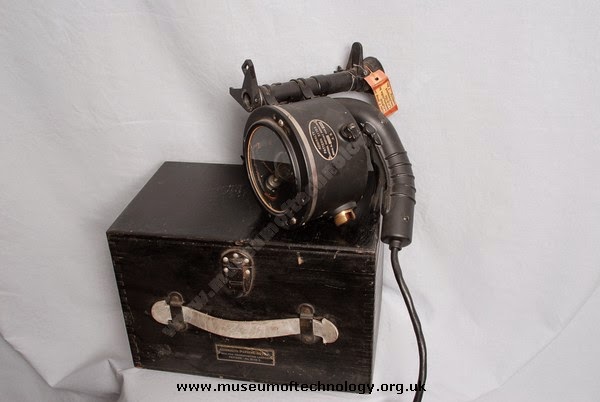 |
| Image Courtesy: http://www.museumoftechnology.org.uk |
Our leader worked in the Marine Building, the tallest building at the time, in downtown Vancouver.
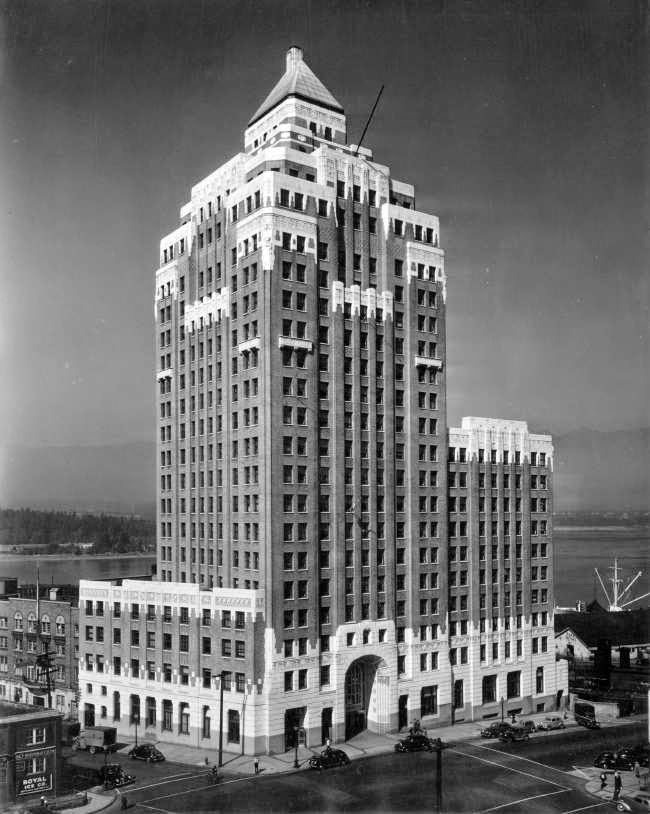 |
| Marine Building circa 1947. Courtesy: http://searcharchives.vancouver.ca/ |
It nice to see events like this and the ARRL's "Straight Key Night" along with clubs like the, "SKCC" , "FISTS", "FOC" and "The CW Operators' Club", all doing their best to keep CW alive. Hopefully you will have some time to play in the 'BR' this weekend.
NAQCC Transitions
Big changes this month at the North American QRP CW Club (NAQCC).
Paul Huff, N8XMS of Livonia, Michigan becomes the new club President. He’s takes the reins from founder Thomas Mitchell, WY3H who recently retired the post. Meanwhile, John Smithson, N8ZYA of Charleston, West Virginia has assumed the Vice President role from the other club founder, John Shannon, K3WWP – who also retired his position.
Launched in 2004, the NAQCC promotes QRP and CW operation through numerous on-air activities. With more than 7,000 world-wide members, the club is very popular and continues to enjoy steady growth. Membership remains free and you can dive as deeply into the action as you care to go, without running out of interesting things to do and goals to achieve.
The monthly club newsletter keeps members informed, educated and entertained and has become one of the premier ham radio club publications available online.
Congratulations to Paul and John as they lead the NAQCC into the next decade of low-power radio fun and adventure!
Filed under: Ham Radio, Syndicate Tagged: club, cw, naqcc, qrp 


630m Crossband Summary
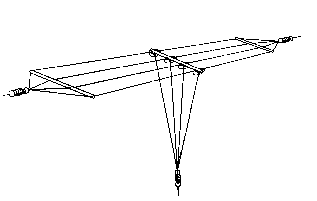
Friday evening's 630m crossband activity was 'interesting' in many respects. Propagation, which had been improving slowly, chose to follow Murphy's Law. The K-index, holding at a quiet '1', rose to level '3' by the time our event had concluded, as the geomagnetic activity ramped up. Additionally, lightning pocketed various areas of the continent, making listening noisy for many.
From here on Mayne Island (CN88iu), good two-way CW crossband contacts were made with the stations in the following order:
- N7IO (Seattle, Washington)
- VE7CA (North Vancouver, BC)
- KK7UV (Missoula, Montana)
- NW7E (Bend, Oregon)
- KU7Z (Ogden, Utah)
- VA5LF (Saskatoon, Sakatchewan)
- K7SF (Portland, Oregon)
- VE7BKX (North Vancouver, BC)
- K6TOP (Los Gatos, California)
- ABØCW (Westminster, Colorado)
- NO3M (Saegerton, Pennsylvania)
- KB5NJD (Duncanville, Texas)
- W7MTL (Independence, Oregon)
- KØSBV (Tucson, Arizona)
- WB6DCE (Seaside, California)
- KO6BB (Merced, California)
- K6CLS (Palo Alto, California)
- WY3B (Kaneohe, Hawaii)
- AA7U (La Grande, Oregon)
I was also more than excited to exchange signal reports with Pennsylvania and Texas. Considering conditions, this distance was far beyond my expectation but both of these stations have very efficient, dedicated 630m antenna systems.
John, VE7BDQ, worked the following stations on crossband:
- VE7CA (North Vancouver, BC)
- W7DRA (Seattle, Washington)
- N7IO (Seattle, Washington)
- NW7E (Bend, Oregon)
- KK7UV (Missoula, Montana)
- KU7Z (Ogden, Utah)
- VA7JWS (Delta, BC)
- VA5LF (Saskatoon, Sakatchewan)
- WB6W (Oysterville, Washington)
- K5HK (Reno, Nevada)
- KØSBV (Tucson, Arizona)
- WY3B (Kaneohe, Hawaii)
It was gratifying to see all of these fellows making the effort to listen for our signals or to attempt the QSO.
This exercise taught me a few things about our new band.
- It is not necessary to have huge antennas and acreage to make this band work. Good solid contacts can be easily made with small backyard antenna systems.
- With good systems on both ends, transcontinental QSO's can be made.
- There really should be more interest by Canadian amateurs in their newest band as so much work has been put into securing this portion of the spectrum as a ham band. It was very disappointing not to work any stations in VE6, VE4 or VE3 land.
- There is already much interest in this band by U.S. amateurs, many of them anxiously awaiting the day that they can also call it a ham band.
I would like very much to continue this type of crossband activity to try and generate more interest in our new band. I'm presently considering a weekly, one-night crossband operation, similar to Friday's event, perhaps running for one hour per week. The main difficulty will be in getting the word out to those that might wish to participate.
’29 Style Transmitters…What To Build? – Part 1
 Most hams in the late 20's and early 30's seemed to be using simple transmitters...one or two tubes at the most. No doubt the poor economics of the time made it difficult to build anything really elaborate but it didn't seem to stop them from getting on the air with whatever they could put together.
The Hartley oscillator is just as easy on the pocketbook as the TNT, and in the opinion of most, capable of an even better-sounding note once properly optimized.
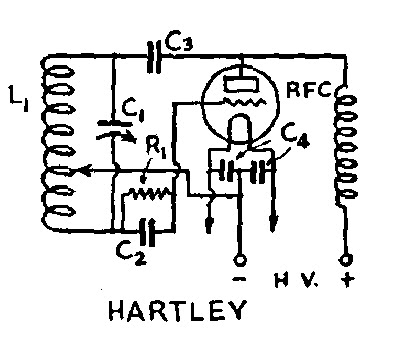
This transmitter is optimized for best note-quality and plate efficiency by finding the correct tap point on L1. Hear my own Hartley's tone while transmitting on 160m.
The third common transmitter of the early 30's was the TPTG (Tuned-Plate-Tuned-Grid).

The TPTG style is a step-up from the TNT and similar in design. Although the added expense of a second variable capacitor made it less popular than the previous two styles, optimizing performance was somewhat easier since the grid circuit could be more readily adjusted for the oscillator's 'sweet-spot' without having to add or remove turns on the grid coil.
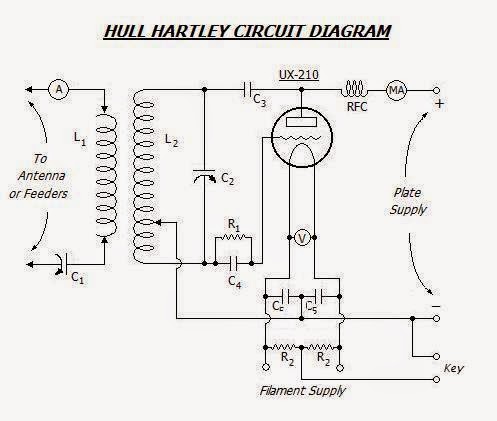
All of the triodes mentioned in my previous blog will work well in the above circuits. Keying is normally accomplished as shown below, by connecting the balanced filament resistor on the directly-heated cathode to ground.
Disturbing the Force
Smartphones keep getting bigger. Out of the noise about the rising popularity of phablets, one notable observation bubbled to the surface, and that by tech pundit and radio amateur Leo Laporte, W6TWT. Laporte likes the large phones and when chided that it would appear he was holding a waffle to his head when making a telephone call he responds, “who uses a smartphone to make telephone calls anymore?”
That sounds funny, and seems to go against the grain, however, it’s spot on accurate. We very rarely use mobile devices to “talk” with someone after the manner of the ancient rotary phone. We send texts, photos, and Tweet’s. We Facetime, Hangout, Facebook, Instagram and Snapchat. Fact is, we do almost everything with our mobile devices EXCEPT use them as wireless telephones. It’s not a telephone, it’s a personal communicator and the demand for larger screens simply reflects the rapid changes we observe in the way we communicate with each other in the 21st century.
I find that notable because there’s an oddity in the ham radio world that might be explained by it.
Contest organizers and RBN data detectives tell us that CW activity has been on the rise for nearly a decade. We can infer by the increase in QST advertising of paddles, keys, and other such devices that the sale of Morse instruments is at nearly a fever pitch. And yet, despite that, you talk to guys who live in the code trenches and they will lament the serious lack of activity. Sure, some of that may just be the imagination of old men who dream of the better day that never really was, but that doesn’t negate the many credible observations that casual CW use, especially rag chewing, is getting harder to come by.
So what’s really happening?
Hard to say for certain but there is one possibility that would explain the observed rise and fall, at the same time, of CW. It is possible that the way we communicate in the new age has changed from the way we used to do it. The efficacy of CW is legendary and highly advantageous in a contest or when chasing DX. It’s just possible that we’re using CW more for short, rapid exchanges of information — and less for casual operation.
This would explain why the RBN is telling us one thing (way more CW activity) while the good old boys who do nothing but pound the brass tell us something different (CW is dying). Both are right, and wrong. (I told you it was an oddity).
It also explains why way back in our long ago a spiral bound ARRL logbook would last an entire year or more while these days, many of the brethren are putting 2,000 Q’s in the log over a good weekend.
Short, rapid fire CW exchanges = text messaging. Get used to it. Besides, who needs to be loquacious in the 21st century?
(But if you really want to chew the rag using CW, meet me on 7.120 and we’ll do it 20th century style!)
OMG WTF? LOL 73















