Posts Tagged ‘couragecenter’

Handiham World for 14 September 2011

Welcome to Handiham World!

cartoon family holding hands
Helping others learn about ham radio or work on their radio equipment and antennas has always been an important part of amateur radio.  Indeed, being a mentor, one who helps other operators succeed in reaching their amateur radio goals, is a long-cherished tradition. Sometimes we hear this kind of helper called an “Elmer”.  If you are curious about how that came to be, you can find an excellent explanation on the ARRL website.  
But that’s not exactly what I’m thinking about today. This is something that’s a little bit more subtle, and it has to do with figuring out when people might need help, and in how best to communicate with them.  
Okay, so here’s the deal:  It is easy to make mistakes by assuming that others know the things that you know. Of course sometimes we also assume that we know something, when in fact we really don’t have the whole story or even have the facts completely wrong.  Furthermore,  people perceive things differently, so I might look at a situation and come to one conclusion while you look at that very same situation and come to another conclusion. Mistakes, sometimes huge ones, happen all the time because of such misunderstandings. They happen everywhere, too. Government, industry, educational institutions, engineering projects, public safety… You name it; mistakes can happen anywhere when people fail to communicate clearly and make assumptions that perhaps we shouldn’t be making quite so readily!
Consider these points:

Common sense is relative.  Odd as it sounds, so-called “common sense” can be quite different from person-to-person, culture to culture, age to age… In fact, I am almost tempted to think there really is no such thing as “common sense”. I can remember being told one time that I was lacking in common sense and yet another time that I had an exceptional amount of common sense! How can both of those statements possibly be true? Of course what really happened was that a person who understood something in a certain way and discovered that I did not understand or perceive the situation in the same way he did then felt that I didn’t have any common sense. In his universe, everyone would understand that situation or concept exactly as he did. Naturally the opposite happened when another guy told me that I had lots of common sense, but what he really meant was that I was pretty smart because I understood the situation or concept exactly the same way that he did. Common sense is determined by life experience. People will have different life experiences because they have been born and raised in different geographical areas at different times and in different cultures. When you are talking about electricity and electronics, you cannot simply assume a “common sense” understanding of even the most basic underlying concepts. Yes, we might assume that everyone understands basic electrical safety, such as never putting one’s body between a voltage source and ground, but does a person from a culture where electricity isn’t common understand that? Does a small child? How about an elderly person visiting the ham shack?  Or even your neighbor from down the block?  The fact of the matter is that you simply cannot assume that everyone has the same common knowledge that you do or that you yourself necessarily have the common knowledge that might be considered very basic in the world of academia or engineering. In other words, you have to be cautious and thoughtful when communicating amateur radio concepts as a mentor. The person with whom you’re working does not necessarily understand things – even basic things – about electricity and electrical concepts the same way you do.

When people say that they understand, it isn’t necessarily so.  I’ll bet all of us have been in the situation where we have been sitting in a classroom listening to the teacher telling us all about a concept that is complicated and new to us. The other people in the classroom seem to be following along with the lecture and understanding the concepts, so a person who doesn’t quite get what is going on can feel self-conscious about asking a question. Even if the teacher stops to ask if there are any questions, a self-conscious person might simply nod their understanding and hope whatever the teacher talked about doesn’t show up on the final exam! You can’t always assume that people are following along with your brilliant explanation of the FCC rules and regulations during that Technician licensing class you are teaching for the club. An experienced mentor will be watching for signs of puzzlement or misunderstanding and ask if perhaps there is another way that they can explain the concept. By the way, this goes for projects outside the classroom, too. If you are directing the organization of Field Day for your radio club, you cannot necessarily assume that everyone understands their roles exactly the same way that you do. You have to be flexible and willing to spend some extra time making sure that such a project runs smoothly and safely even though it may mean checking back twice with your other volunteers, just to make sure that everyone is “on the same page”.

You have to make some assumptions, but be careful!  One of the worst bosses I ever had in my working career was a grumpy old sourpuss who always insisted that you should NEVER assume anything. I always felt that that was ridiculous advice because no one could ever get through their day without making hundreds of assumptions. For example, when I get out of bed in the morning, I place my feet on the floor. I have assumed that the floor is there and that I will not fall into a hole into the basement. I assume that when I turn on the water tap that water will flow. And – when it comes to electricity – I assume that when I flip on a switch or plug in a power cord that the circuit will be live and that electricity will flow. Sometimes assumptions are pretty sure things. I have never gotten out of bed and fallen through a hole in the floor to the basement, so I feel very safe indeed in assuming that the floor will be there. On the other hand, I have flipped on electrical switches and found that there was no power. Power outages happen for one reason or another, and we have all experienced them. The point here is that there are assumptions that a person can make with a high degree of confidence and others with perhaps only what we will call a high expectation. Other assumptions may be so wild and crazy as to be downright silly. An example would be to assume that you will win the lottery, so there’s no point in putting any money away for retirement. Making careless assumptions can get you into trouble when dealing with amateur radio and electricity. You should ALWAYS assume that an electrical circuit is live until you have disabled it with certainty so that you can safely work on it. When acting as a project leader for your radio club, you cannot necessarily assume that others will show up to participate, or that the right tools will be carried to the project site by other volunteers. You have to have a plan! Spelling things out carefully for those who will be helping you can be a huge timesaver when you actually get on site and ready to put up that big antenna.

What I am getting at here is that when you are acting as an Elmer and mentoring new amateur radio operators or when you are leading a project for your radio club, you have to keep an open mind. Even though I have been an amateur radio operator for decades and have worked with many other ham radio operators in many capacities, I am still surprised sometimes by how we can fail to communicate simply because we assume that others know what we know or that we know something  that we really don’t know! There is no single way to overcome this failure in communication, but we can minimize its effects by remembering to really press people to let us know that they truly understand what we are talking about.  Be patient.  Listen!  Observe.  Repeat: Go over the plan or concept again if it is important.  Assume what seems most reasonable up to a point, but check to be sure thereafter.
As you might expect, this is not an exact science.  The best mentors are those who are willing to learn as well as to teach.  
For Handiham World, I’m…

Patrick Tice
[email protected]
Handiham Manager

Handiham World for 07 September 2011

Welcome to Handiham World!

I don’t know how it is for you, but in our household Labor Day here in the USA marks the unofficial end of summer.  Yes, I know that by the calendar September is still really a summer month. Autumn isn’t official until Friday, 23 September 2011.  But if you are an early riser like me, you can notice quite a difference week to week as the morning daylight retreats and it is really quite dark when you make that first pot of coffee or take the dog out.  analemma:  Permission is granted to copy, distribute and/or modify this document under the terms of the GNU Free Documentation License, Version 1.2 or any later version published by the Free Software Foundation; with no Invariant Sections, no Front-Cover Texts, and no Back-Cover Texts. A copy of the license is included in the section entitled GNU Free Documentation License. 
Image: The analemma as depicted for the northern hemisphere.  A typical globe of the world has an analemma to help describe the Earth’s progress through its seasons. 
The reason for this quick change in daylight hours is, of course, that the Earth is reaching that portion of its orbit around the Sun where the tilt of its axis favors direct sun over the equator instead of here in the northern hemisphere.  We call this the Autumnal Equinox, and it means that our daylight hours are roughly equal to our night time hours – depending on location, of course.  If you look at the analemma on a globe of the world, you can see that it looks like a rather tall figure “8”, with the very top of the 8 representing the summer solstice in the north and the very bottom representing the winter solstice in the north (or summer solstice in the southern hemisphere.)  The center of the 8, where the lines cross, represents the two equinoxes, autumn and spring. The thing about the length of the days is that as we make the trip around the top of the figure 8 the days are long and there is little change, but once we start our wild ride down the steep slope of the 8, the roller coaster really seems to speed up and the days get shorter fast!  
For amateur radio, this has some interesting implications.  Since the days are getting shorter, there is less direct sunshine, which in turn means less absorption on the lower HF bands like 160 and 75 meters.  Those bands are also hard to use in the high summer months of July and August because of the thunderstorm static.  Thunderstorms are ultimately driven by sunshine that heats the ground and builds huge clouds from rising air. The jet stream pulls storms through the upper Midwestern United States all summer long, creating a cacophony of noise on the HF bands. As the sun appears to retreat to the south at this time of year, the storms and RF noise also retreat. This makes the HF bands much more useful.  During the winter months the long nights will mean better conditions for long-distance contacts on 160, 75, and 40 meters. If you have not considered getting on these bands, you might think about it now while the weather is still pleasant enough to allow for some serious antenna work. Most of us use either simple wire antennas or verticals for these bands because of their wavelength and the obvious problems one encounters constructing directional antennas for such frequencies. A one half wave dipole for 3.9 MHz would be around 120 feet from end to end, which makes it pretty impractical to try to put on a tower and rotate!
So what that means is that for a few bucks and a little elbow grease, you can get on the air and have an antenna that isn’t that different from what everyone else is using.  This is certainly not the case for highly competitive bands like 20 meters, where some stations are equipped with large directional antennas on tall towers.  You will get a chance to be as competitive as you like on the lower frequency HF bands, but you have to get your antenna work done now!
For Handiham World, I’m…
Patrick Tice
[email protected]
Handiham Manager

Help us win the Dr. Dave Challenge!

Thanks to everyone who has helped us with donations to the Dr. Dave Challenge so far.  I don’t have an update this week due to the high volume of phone calls and the holiday weekend. Money is tight these days and we desperately need your support.  Now, thanks to a generous challenge grant by Dr. Dave Justis, KN0S, we have a chance to help fill the budget gap.  Dr. Dave will donate $5,000 to the Handiham System if we can raise a matching amount.  That means we need to really put the fund-raising into high gear!  If you can help, designate a donation to Handihams, stating that it is for the “Dr. Dave Challenge”.  We will keep you posted in our weekly e-letter as to the progress of the fund. 
Nancy can take credit card donations via the toll-free number, 1-866-426-3442, or accept checks sent to our Courage Center Handiham address:
Courage Handiham System
3915 Golden Valley Road
Golden Valley, MN  55422

Be sure to put a note saying “Dr. Dave Challenge” somewhere in the envelope or on the note line of the check.  If you donate online as detailed toward the end of your weekly e-letter, be sure to designate to Handihams and then send me an email letting me know you donated to the Dr. Dave fund: [email protected]
Thank you so much for your support!

W0GLU License Plate

W0GLU amateur radio license plate - Minnesota circa 1971- Gift of Miriam Kiser.

This vintage automobile license plate was issued to Rex Kiser, W0GLU, in 1971 by the State of Minnesota. It has renewal stickers for 1972 and 1973. Rex is now a silent key, but had literally decades of volunteer experience for the Handiham program. The license plate was a gift to us from Miriam Kiser, Rex’s wife.
Rex’s specialty was repairing and modifying amateur radio equipment for the use of our members with disabilities. He soon became our crew leader, taking charge of shop activities. Back in the early days, the modifications to equipment included mounting clothespins on band-switch knobs so that people with muscle weakness could get enough leverage to change bands by themselves. The Handiham System also kept a “fleet” of loaner CW transceivers, Ten-Tec Century 21 models. These would be modified by Rex and his crew for use by blind hams. The mod included cutting away part of the plastic bezel covering the radio’s frequency display dial and putting tactile bumps on the dial to mark frequency intervals. The blind user could put his or her fingertips through the hole in the bezel and feel the raised markings on the frequency display dial. This was about as analog a frequency display as you can get! It was only in later years that frequency displays started going digital and the door began opening to voice frequency announcements.
In later years, Rex and his crew installed voice modules in radios like the venerable Kenwood TS-440SAT, a very popular radio that appeared in the late 1980’s. The VS-1 speech module made it the most blind-friendly HF radio of its day, and the built in automatic antenna tuner in the SAT version freed blind users from the hassle of fiddling with manual tuners. Needless to say, Rex and his crew knew these radios inside and out!
W0GLU was also a regular net control station on the PICONET, which meets daily except Sundays on 3.925 MHz. I would describe Rex as a well-rounded ham radio operator who enjoyed many aspects of radio and electronics. Injured serving his country during WW2, shrapnel pierced his spinal column and he never walked again. That didn’t keep Rex from driving his own car and maintaining his considerable upper body strength. I was surprised when he decided to take up adapted skiing with his disabled vets group, but I shouldn’t have been. As I said, Rex was a well-rounded guy, interested in helping others by volunteering and in living a good and worthy life.
Rex Kiser, W0GLU – A great ham radio operator who inspires us still.

Image: Rex poses for the camera in the Handiham repair shop.

Handiham World for 31 August 2011

Welcome to Handiham World!

Front view of ranch house with guys climbing on garage roof.
Photo: Where’s the antenna?  Believe it of not, there is a “W0OXB Special” antenna in this photo, and it tunes 160 meters through 6 meters!  There are a lot of trees on the property, so hanging the antenna was not a problem. The foliage also confuses the eye and effectively hides the wire antenna, which is in excess of 200 feet long and fed with 450 Ohm ladder line to a 4:1 current balun.  If you look closely, you will see the feedline just to the left of the guy standing on the garage roof. 
Last Saturday I had fun participating in a good old-fashioned “antenna party”.  These antenna raising projects are loosely coordinated through our local radio club, and I hadn’t been along on one for quite some time.  We had plenty of help, but as the old saying goes, “many hands make light work”.   It was certainly instructive to help, and I learned more about how to launch wires and pull them high up into the tree branches, how to use a guide rope to pull the center insulator and feedline away from branches, and especially the detail work on the center insulator strain relief and weather sealing.  One tip from Dave, W0OXB: If you use high quality UV-resistant rope to tie off the ends of the antenna, there is really no need for end insulators.  Putting on end insulators is just asking for them to get stuck in the tree branches.  
Anyway, this story isn’t really about the antenna party.  It’s about the final result, which (for those of you who can see the photo) is an all but completely invisible wire antenna capable of operating on the HF bands, including 160 meters!  The QTH sporting the new antenna is on a corner lot, and the antenna runs diagonally across it, supported by mature trees.  The 450 Ohm ladder line comes down from the center of the antenna, angling over the single-story garage’s roof and to a current balun mounted on the soffit of the house, somewhat protected from the weather.  Although this kind of feedline would be painfully obvious, coming as it does down from a point over the front yard, a clump of birch trees effectively hides it from anyone but the most determined observer.  The result is an excellent, versatile antenna that can be used on multiple bands without being an eyesore.
The single biggest obstacle to effective HF operation today is the difficulty many amateur radio operators have getting an antenna up in the air!  If only it were as simple as just ordering an antenna and installing it… But it isn’t easy at all.  There are antenna restrictions of all sorts, and they are not all formal regulations, either.  The restrictions that get the most attention in the amateur radio media are those that are codified in municipal ordinances or that are part of homeowner association covenants. The ARRL offers resources on working through such restrictions, and each instance is likely to be somewhat unique.
There are other, but no less real, obstacles to getting an HF antenna up. Consider these:

Aesthetics. The antenna will be unsightly. Yes, you and I know that a good antenna is a thing of beauty, but your spouse and neighbors may not like seeing that monstrosity in the blue sky above your ham shack.  This is an especially relevant concern these days when traditional TV antennas have pretty much disappeared because of TV cable and small satellite TV dish antennas.  The TV antenna free clean look of the typical suburban roofline makes that HF antenna stick out like a sore thumb!

Power lines!  They run where they run, and that is often exactly in the wrong place when HF antenna installation is concerned.  Older neighborhoods typically have lines running along alleyways at the rear or side of a property. Power lines might also line the street in front of the house.  The “drop” from the main power pole to the house sometimes crosses large sections of the property.  You cannot safely run wire antennas above or below power lines, and running your antenna parallel to a power line may result in a higher than average interference from power line noise.

No antenna supports.  Your lot may just not have any natural place to support a wire antenna.  The trees may be too small or in the wrong places.  

Budget!  Your budget may not be generous enough to have a tower in the back yard. Like it or not, you may have to make do with less.

Space.  Actually, it’s the lack thereof!  Most city lots are a challenge when you are talking about getting wire antennas up for bands like 160 and 75 meters, but some are really, really small.  

Well, what are the options?  Before deciding on your own, it might be best to get another opinion.  That’s part of the process for my club’s “MAP”, or “Member Assistance Program”.  We didn’t all just show up at the guy’s house last Saturday with a bunch of wire and tools.  Prior to the antenna party, a separate “antenna assessment” had been done.  This is usually completed weeks before the actual installation, and it involves a visit by a knowledgeable team leader.  The MAP team leader will walk through the property, measuring the distances between likely antenna supports and planning different installation scenarios. If the situation is hopeless, you might as well find it out from someone who will have other ideas and be able to offer you some alternatives. You might be surprised at how you really can fit an antenna into the space available, but without the practiced eye of the team leader you might have never known.

Vertical antennas can fit in small spaces and when positioned in the back yard can also be invisible from the street in front. Most designs do require at least some radials, but a few don’t.  You might consider one of the new 43 foot verticals fed with a current balun at the base.  I see in the September QST that LDG now has one for under $200.  This antenna design, available from LDG and other companies, allows you to operate on 80 through 6 meters with one antenna.  True, you will not get on the “top band” (160 m), but you will have good coverage on the other bands and will be able to make use of most bands on your HF radio. If a wire antenna won’t fit, a vertical might.

Sometimes there are just no options outdoors, but an attic antenna might be possible.  These are generally good for 14 MHz and above, because there will not be enough space to fit antennas for the lower frequencies in an attic space.  I really don’t like attic antennas much, because they are often hard to install in unfinished attic spaces.  The space may be cramped and unlighted, and you may need to step carefully on rafters so as not to put your foot through the ceiling below. Running feed lines can also be challenging.  Attic antennas are most suited to digital low power operation, such as QRP CW or PSK-31. 

Mobile or portable operation might be viable choices.  There are small antennas designed for backpacking into the wilderness – you might be able to operate with one of them set up in whatever space you have available, even at home. Be prepared for some difficult copy and some tough times breaking pileups, though.  These are not the most efficient antennas, and because they usually are inductively loaded, they have narrow – almost single frequency – bandwidth without tuning. One special type of portable antenna is the simple end-fed wire.  It can be thrown up into a tree at a campsite and tuned with an antenna tuner.  Some tuners are automatic and match a wide variety of antennas. Mobile antennas suffer from the same limitations.  They are physically short and have very sharp tuning.  They are also not terribly efficient.  Still, they can offer you a way to get on the air.

Remote base operation is an option for Handiham members with computers with Microsoft Windows® and high-speed internet. Sometimes a mixture of operation from a home station and a remote base station is the way to go.  For example, you may have room for an antenna that operates on 14 MHz and above, but not enough room for a wire antenna that would be effective on 3.9 MHz.  To get on that 75 meter net you like, you can then use either of the W0ZSW or W0EQO remote base stations.  The remotes are a Handiham member service. Both stations have excellent wire antennas and are located in RF-quiet areas. 

I guess the point is that you can get on the HF bands one way or the other. Getting help while assessing your antenna situation is a good first step. Even if your local club does not have a member assistance program, you can still speak up at the club meeting and ask if there might be any volunteers who might know about antennas and who could help you decide how to best use your available space.  If stealth is an issue and you need to camouflage the antenna, the club members will usually have some ideas and suggestions.  Just don’t give up!  If you want to get on the HF bands, there is a way to do it.

For Handiham World, I’m…

Patrick Tice
[email protected]
Handiham Manager

Handiham World for 24 August 2011

Welcome to Handiham World!

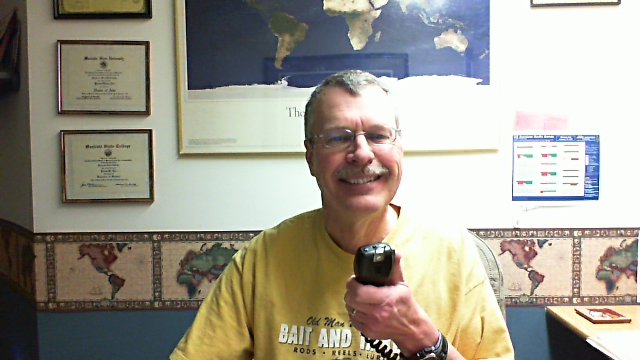
Pat holds microphone in the ham shack at the WA0TDA QTH.
We’re back!
In praise of summer nets:
August is usually not a high activity month in ham radio anyway, so what the heck, maybe not that many people noticed if the local radio club didn’t have regular meetings during the summer.  They were probably all on vacation or harvesting the vegetables from their gardens.
Still, key members of radio clubs are waking up and thinking to themselves, “Holy cow, it’s almost September and the club’s first meeting of the new ham radio season is almost here. We’ve got to start on the club newsletter!  Plan the business meeting agenda!  Who’s in charge of the club program?  Yikes, how are we going to get all this stuff done?”
Yes, it’s that time again, time to plan for the Autumn and Winter months, when ham radio interest will be higher than the snow bank outside my window here in Minnesota. Last week I attended a planning meeting with some of my fellow radio club members. We talked about the upcoming membership meeting, the newsletter, and what direction the club would take in the upcoming months. We are already planning to teach a General Class course this Autumn.  My local club, the Stillwater (MN) Amateur Radio Association, has a strategy of offering Technician training in the Spring to coincide with Skywarn training prior to the summer severe weather season and a General Class upgrade course in the Autumn when our Technicians from the previous Spring may be interested in learning more about amateur radio and the HF bands.  Many clubs take a three month summer break like ours, though June, with ARRL Field Day, is still quite busy.  It is just the regular meetings and the newsletter that “go on vacation” for the summer break. Other club activities, like the local HF and VHF nets, remain active throughout the year.
One of the tricks to remember about keeping your radio club active and healthy is to ALWAYS have something going on, even during the summer.  Regularly scheduled activities are going to provide the continuity that will keep members from drifting away over the summer and never coming back.  Now, I’m not talking about elaborate dog and pony shows here.  You don’t have to organize special meetings or events.  Simply having an evening net, even an informal gathering without a net control, can be good enough.  Scheduled nets are good, too.  Some clubs have a regular monthly breakfast or lunch, all of which is informal and completely optional, which is just perfect for summertime when plans can change at a moment’s notice.  At the Handiham Radio Club we have our daily EchoLink net.  The important thing is to keep club members connected with simple, easy, optional, low-commitment activities that require almost no planning or effort.  
While large, elaborate activities like summer hamfests or special event stations are fun and can sometimes be the highlight of the summer, not all club activities need be so ambitious.  If you set the standard too high, an elaborate event can burn volunteers out.  If such events take place once in a while, that is one thing.  If they are scheduled every summer and the same volunteers are expected to manage them again and again, you should not be surprised to find that one summer will come along when everyone is just too busy to plan or be part of the event.  The easy to plan informal on the air get-together or regular net can be the glue that holds your club together over the summer.  Don’t sell it short!
For Handiham World, I’m…
Patrick Tice
[email protected]
Handiham Manager


But first – Help us win the Dr. Dave Challenge!

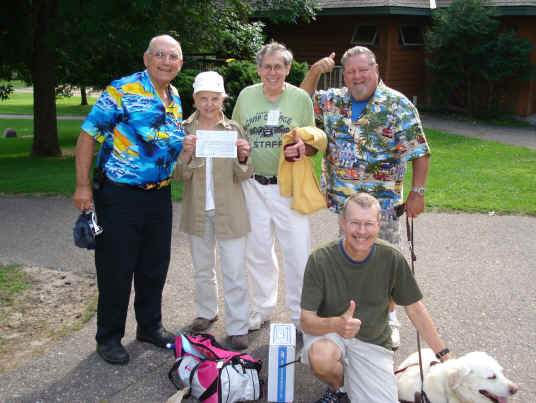
Bill, K9BV; Lucy, KE6QNX, Dr. Dave, KN0S, Bill, N6HBO & Guide Dog Heldy, and Pat, WA0TDA (kneeling in front.) Thumbs up for a pass for Lucy at the VE session.
Photo: Bill, K9BV; Lucy, KE6QNX, Dr. Dave, KN0S, Bill, N6HBO & Guide Dog Heldy, and Pat, WA0TDA (kneeling in front.) Thumbs up for a pass for Lucy at the VE session. 

Thanks to Chris Peterson, KG0BP, for taking advantage of his employer’s regular automatic donation system. Chris has been helping us out with regular contributions.  In fact, quite a few companies have such donation programs, and they can make supporting non-profit causes like the Handiham System easy and quick. Check with your employer to see if this option might be available to you.  Thanks also to Bob, N0HBC. Money is tight these days and we desperately need your support.  Now, thanks to a generous challenge grant by Dr. Dave Justis, KN0S, we have a chance to help fill the budget gap.  Dr. Dave will donate $5,000 to the Handiham System if we can raise a matching amount.  That means we need to really put the fund-raising into high gear!  If you can help, designate a donation to Handihams, stating that it is for the “Dr. Dave Challenge”.  We will keep you posted in our weekly e-letter as to the progress of the fund. 
Nancy can take credit card donations via the toll-free number, 1-866-426-3442, or accept checks sent to our Courage Center Handiham address:
Courage Handiham System
3915 Golden Valley Road
Golden Valley, MN  55422

Be sure to put a note saying “Dr. Dave Challenge” somewhere in the envelope or on the note line of the check.  If you donate online as detailed toward the end of your weekly e-letter, be sure to designate to Handihams and then send me an email letting me know you donated to the Dr. Dave fund: [email protected]
Thank you so much for your support!

Handiham World for 03 August 2011

Welcome to Handiham World!
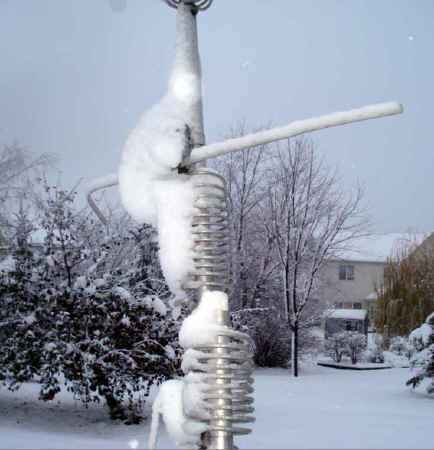
Coils on Butternut vertical covered with snow.
Photo: Butternut vertical at the WA0TDA QTH is covered with snow.  Maybe this “cool” picture will help us all get through this spell of hot, humid summer weather!

Handiham Radio Camp begins on Monday, 8 August.  The weather across most of North America has been uncommonly hot, often setting new temperature records.  Fortunately we did get a nice weather break today here in Minnesota as the humidity dropped a bit and the morning temperature was in the low 60’s Fahrenheit.  Of course we would like to see nice, comfortable weather during our week at Camp Courage, but there is another reason I look forward to less heat and humidity in the atmosphere: there will be less interference from thunderstorms!  Thunderstorm static is a common problem for amateur radio operators who enjoy making contacts on the lower frequency HF bands. The 75 m band is still somewhat usable during the summer months, but it does take patience to put up with all of the static from storms that are sometimes hundreds of miles away. Add to that the long summer days when absorption gets really high and makes signals so attenuated that they really have a hard time competing with the static crashes and you really have quite a challenging radio environment. Believe it or not, some amateur radio operators still even make contacts on the 160 m band during the summer. That is the absolute worst of our HF bands during the high summer season because it is most affected by absorption and QRN. 

Sometimes it makes sense to simply shift gears and try some other bands and modes of operation. I really like staying in touch with my friends on the EchoLink-enabled repeaters and even through EchoLink on my computer or smart phone. Summertime can be an excellent time to start listening on the VHF bands, too. June is typically a good month to experiment with making single side band contacts on the 6 m band. As summer continues to unfold and you get into July and August, you may find that it is possible to make single side band contacts on the 2 m band. If you like CW, you may find others who share your interest on VHF over the summer months. Summertime conditions, while bad for HF operation, can sometimes make for excellent long-distance contacts on VHF.
Another excellent summertime amateur radio activity is to do an antenna assessment and make a list of everything that needs doing to keep your station on the air before the cold winter months arrive. Believe me, I have done antenna work in every single month of the year and it is much easier to strip wires, put on connectors, climb ladders or towers, and handle aluminum tubing during the summer! A big antenna installation almost has to be done in the summer months when there is good weather and adequate daylight after dinner, when help may be available from other radio club members. 
Speaking of antennas, I had to take down two of my wire antennas earlier this week. There was a dead tree in the backyard and I had made arrangements with a tree guy to come over and cut it down as well as do some trimming of the other trees around our property here at the home QTH.  Well, I was surprised when the tree guy called and told me he had an opening on Monday, so he would be able to come right over that morning and do the work. “Sure”, I said, before remembering that both of my wire antennas either ran through the tree that needed to come down or close to it. So I ended up having to rush outside and try to get the antennas down in the half-hour to 45 minutes before the tree crew arrived. That turned out to be a decision point, because I had already taken part in an antenna assessment earlier this summer and with help from my local radio club will get a new, longer wire antenna installed. That made it easy to just go get my extendable tree branch pruner and cut the old antennas right down without doing any climbing. That leaves me with my trusty Butternut nine band HF vertical ground-mounted in the backyard. The good news was that I had already completed my summer maintenance on the vertical and it was ready to go for use as my main HF antenna. It had needed replacement of one section of cracked aluminum tubing and the addition of new radials. Had I not followed my summer plan of getting antenna maintenance started early, I might have been off the air right now except for the VHF and UHF bands.
I guess the moral of the story is that it pays to have a plan and to get things done earlier rather than later when at all possible. You never know what might be coming up later today, next week, next month, or next year. It doesn’t hurt to build in a little planning and redundancy when it comes to amateur radio!
For Handiham World, I’m…
Patrick Tice
[email protected]
Handiham Manager

But first – Help us win the Dr. Dave Challenge!
Thanks to Diane WI8K,  Dan N8OJW,  and Gary KB9ZUV for your help this past week. We appreciate your support. Dr. Dave, KN0S, climbs the antenna tower at Radio Camp.
Money is tight these days and we desperately need your support.  Now, thanks to a generous challenge grant by Dr. Dave Justis, KN0S, we have a chance to help fill the budget gap.  Dr. Dave will donate $5,000 to the Handiham System if we can raise a matching amount.  That means we need to really put the fund-raising into high gear!  If you can help, designate a donation to Handihams, stating that it is for the “Dr. Dave Challenge”.  We will keep you posted in our weekly e-letter as to the progress of the fund. 
Nancy can take credit card donations via the toll-free number, 1-866-426-3442, or accept checks sent to our Courage Center Handiham address:
Courage Handiham System
3915 Golden Valley Road
Golden Valley, MN  55422

Be sure to put a note saying “Dr. Dave Challenge” somewhere in the envelope or on the note line of the check.  If you donate online as detailed toward the end of your weekly e-letter, be sure to designate to Handihams and then send me an email letting me know you donated to the Dr. Dave fund: [email protected]
Thank you so much for your support!

FCC seeks comments on change to allow exam credit for expired Amateur Radio licenses

FCC Logo

The FCC is going to entertain the possibility of allowing examination credit for expired ham radio licenses and is seeking comments on the matter. As we know, if your license expires and is beyond the two year grace period, you must start all over again with the Technician exam and work your way back up to whatever your former license level was, taking every exam. The Anchorage VEC has requested this change.
DA 11-1318
Released: July 29, 2011

Handiham World for 27 July 2011

Welcome to Handiham World!

Pat holding microphone in the ham shack.

It is less than two weeks to Handiham Radio Camp, which begins on Monday, 8 August.  As you might imagine, Nancy and I have been busy with last minute paperwork and communications from everyone who is planning to be at camp. We have made considerable progress, but lots of work still needs to be done as we get the equipment ready and answer questions while still trying to provide services to our Handiham members who will not be at camp. Last week I got my son Will, KC0LJL, sent off to Japan, where he will be teaching English for a year. Needless to say, I have not been bored for lack of things to keep me busy!

Today the Internet went down here at my home office and I’m slowly bringing it back on line.  Yesterday Don, N0BVE, went out to camp and got our Internet connection working there, and also got the W0EQO repeater back on Echolink. Last night and today Lyle, K0LR, and I have been working on the W0ZSW remote base, bringing it back on line after the camp Internet outage.  The camp Internet failed during a severe thunderstorm last Saturday.
All of this makes me wonder if good old  Murphy has us in his sights for Internet problems!  The long and short of it is that it does serve to remind us that as useful as the Internet can be, especially with VoIP connectivity for our repeaters and nets, it is still brittle and can suffer outages.  All the time the Internet was out here at home, guess what was still working?  Yup, you’ve got it: My VHF and HF radios, right here next to me in the ham shack. 
Now, don’t conclude that I am about to sing the praises of trusty, time-proven RF while I go on a rant about how unreliable the Internet is and how we amateurs should avoid using it in favor of RF only.  I think the thing we should conclude is that we need redundancy in our communications, and that means the ability to use RF while still having Internet-enabled methods of communications enabled and ready to use.  After all, the Internet-enabled systems we have built to enhance our radio networks have generally been reliable. If disaster strikes, we need to be ready to use whatever works.  Keep an open mind when it comes to this stuff, folks.  
One consideration is to try using digital modes on HF.  Some of these, such as PSK-31, are more reliable than SSB communications and can work well at lower power levels and with less elaborate antenna systems.  I just got an email from our ARRL Division Director K0GW, who mentioned that ARRL has approved a new way to pick up your DXCC;  there will be a new “Digital” DXCC.  This will include RTTY as well as the many other digital modes. No matter what you think of chasing awards like DXCC, I think this is a very good move on the part of the League.  It will ramp up on the air activity, stimulate interest in digital modes, and help to build up a cadre of digital operators.  That will ultimately be good for emergency operations, as more of us will become proficient in digital modes.  Remember, PSK-31 does not need the Internet to get through!
In other thoughts:

Wouldn’t it be nice to get QST in digital format?  That just could be an option in the future.  A plan for the next steps in providing QST digitally (in addition to the print edition) was approved at the recent ARRL Board meeting. The change in accessibility brought about by the personal computer and digital reading devices is simply enormous. Worldradio Magazine has led the way with an entirely digital version, which allows blind computer users to access the articles with screenreading software at virtually the same time they are available to everyone else. 

Curious about Morse code?  Coming to Radio Camp? Keep reading for news about learning code. 

For Handiham World, I’m…
Patrick Tice
[email protected]
Handiham Manager

But first – Help us win the Dr. Dave Challenge!
We need your help. Dr. Dave, KN0S, climbs the antenna tower at Radio Camp.
Money is tight these days and we desperately need your support.  Now, thanks to a generous challenge grant by Dr. Dave Justis, KN0S, we have a chance to help fill the budget gap.  Dr. Dave will donate $5,000 to the Handiham System if we can raise a matching amount.  That means we need to really put the fund-raising into high gear!  If you can help, designate a donation to Handihams, stating that it is for the “Dr. Dave Challenge”.  We will keep you posted in our weekly e-letter as to the progress of the fund. 
Nancy can take credit card donations via the toll-free number, 1-866-426-3442, or accept checks sent to our Courage Center Handiham address:
Courage Handiham System
3915 Golden Valley Road
Golden Valley, MN  55422

Be sure to put a note saying “Dr. Dave Challenge” somewhere in the envelope or on the note line of the check.  If you donate online as detailed toward the end of your weekly e-letter, be sure to designate to Handihams and then send me an email letting me know you donated to the Dr. Dave fund: [email protected]
Thank you so much for your support!

Handiham World for 20 July 2011

Welcome to Handiham World!

Handiham HQ building

It looks like we will meet our goals for Radio Camp this summer. We have a healthy level of participants, and most have completed their paperwork and made their travel plans. Quite a bit remains to be done in preparation, though. We have an excellent tower and beam antenna on a hill behind the camp’s “Rotary Building”, where we plan to set up an HF station using a Kenwood TS-570SAT and a TS-2000. Having these rigs to choose from should help make more operators comfortable. Since the beam has not been used this past year and things have been moved around, I will need to locate the rotor control box and dress the wiring back into the shack for a test run. One thing I have learned about antenna systems over the years is that unexpected problems can show up at the most awkward times. It pays to do a little footwork in advance. In this case, I will need to do real footwork, too. The main Handiham Headquarters building rests in a storybook-like clearing surrounded by forest at the base of a hill. Built on and into the side of the hill is the Rotary Building, named for its benefactors, the Rotary Clubs. Long ago, when the Handiham System was very young, there was a ham radio station in the Rotary Building, which was used during the shorter “May Convocations” that would ultimately evolve into the full-fledged Radio Camps.

So you can imagine that there would need to be an antenna system near the Rotary building, and sure enough, there was. A 50 foot self-supporting tower and beam antenna were installed up at the top of the hill behind the building. The entire system fell into disrepair when the Radio Camps moved to Courage North, and it wasn’t until recent years that the antenna and wiring were refurbished as part of an Eagle Scout project by Peter Widin, KC0ENI. This excellent resource will once again be used at Radio Camp, and should provide us with the opportunity to work some real DX! What is different this year is that we plan to install a permanent station in the library of the Rotary building, an excellent gathering space with plenty of room for operating skills participants. In preparation for the use of this area, I have completed the installation of wireless Internet and done some preliminary planning of the station setup. Although we could set up temporarily as in the past, this year we will have one of the familiar equipment desks that we have used at Courage North. This cabinet will provide a place to lock up the stored equipment when non-ham radio users are in the space.

Meanwhile, back on the Woodland side of camp, which is where we will enjoy living in the modern cabins during the week, I have checked the Internet and done my walk through of the buildings. I am thinking that we may have only one HF station, if that, set up at the Woodland cabins. After all, we will have stations on the pontoon boat, at the Rotary Building, and at the Headquarters. We do plan to have a JAWS computer with Echolink and the Remote Base software available as a training tool. Since there are wireless Internet hotspots available in Woodland, the Rotary, Lakeside dining hall, the Lakeside Gazebo, and Handiham HQ, there should be no shortage of places for us to use the Internet-enabled stations. Furthermore, the camp repeater will be on the air and it is Echolink-enabled. One of our goals is to teach the use of these new tools to as many of our campers as possible. If we are successful in getting our new IRLP node that has been configured by Lyle, K0LR, set up on our Woodland Internet connection, we will be able to use that to connect to IRLP node 9008, the Vancouver BC system.

By the way, this month marks 60 years since the FCC created the Novice class license. I was reminded of this by Ron, K3PID, my co-editor of our local radio club newsletter, who was asking club members to send in stories about their Novice days. I thought that was such a good idea that I would like to steal it, so how about some of those Novice stories? I will tell you one of my own next week.

Patrick Tice
[email protected]
Handiham Manager

Thanks for your support!

The Owatonna Steele County (Minnesota) Amateur Radio club recently sent in a gift of $50 in support of the Dr. Dave Challenge Grant. Dr. Dave Justis, KN0S, has challenged us to raise at least $5,000, which he will match.

Help us win the Dr. Dave Challenge!

We need your help.

Dr. Dave, KN0S, climbs the antenna tower at Radio Camp.

Money is tight these days and we desperately need your support. Now, thanks to a generous challenge grant by Dr. Dave Justis, KN0S, we have a chance to help fill the budget gap. Dr. Dave will donate $5,000 to the Handiham System if we can raise a matching amount. That means we need to really put the fund-raising into high gear! If you can help, designate a donation to Handihams, stating that it is for the “Dr. Dave Challenge”. We will keep you posted in our weekly e-letter as to the progress of the fund.

Nancy can take credit card donations via the toll-free number, 1-866-426-3442, or accept checks sent to our Courage Center Handiham address:

Courage Handiham System
3915 Golden Valley Road
Golden Valley, MN 55422

Be sure to put a note saying “Dr. Dave Challenge” somewhere in the envelope or on the note line of the check.

Thank you so much for your support!


Subscribe FREE to AmateurRadio.com's
Amateur Radio Newsletter

 
We never share your e-mail address.


Do you like to write?
Interesting project to share?
Helpful tips and ideas for other hams?

Submit an article and we will review it for publication on AmateurRadio.com!

Have a ham radio product or service?
Consider advertising on our site.

Are you a reporter covering ham radio?
Find ham radio experts for your story.

How to Set Up a Ham Radio Blog
Get started in less than 15 minutes!


  • Matt W1MST, Managing Editor