Posts Tagged ‘Contests’
 CW Sweepstakes 2011
 November 8th, 2011 |
  Author:
 So, K3KU, who won last year’s Maryland-DC certificate in A-power (150-watts, no DX cluster) for Sweepstakes CW posted to the contest club e-mail reflector a few weeks ago noting that although he had won that I had nipped at his heels with 7 additional hours of operating left on the table. I responded to the reflector that he had operated long and made more contacts and therefore deserved the win…but, that I was highly motivated by that fact this year.
I tried not to let Sweepstakes consume my home life before the contest since contesting is a major disruption for a married couple, let alone a couple with a four-month baby. So, I did not start setting up and testing the logging software, etc, until Saturday morning of the contest. As long-time readers know, I replaced TR Log for DOS in the Spring with TR4W on Windows XP. I also replaced the real-time keying interfaces (basically an NPN transistor and a resistor attached to a serial or parallel port) with a K1EL WKUSB. This combination worked flawlessly for the most part, although there were a few glitches I need to fix.
Last year, 80 meters was excellent. And, for a city lot station, I have a pretty good setup on 80 (full-size vertical and a K9AY RX antenna). So, even when I had a slow start on 40 meters with the second radio on 20 meters, I had high hopes for a bottomless pit on 80…that never happened. And, something—perhaps related to the lawn mower incident— is wrong with the K9AY. So, I had a solid S9 buzz on 80. When I worked K3AU (op K2YWE), he sent ‘A’ as his precedence and a serial number that was 20% higher than mine. In fact, every time I heard him, that geometric relationship in our scores held. I was worried but plowed forward. The high bands were clearly in good shape because there was always a clear run frequency on 40 and 80.
I operated from the start at 2100 UT on Saturday pretty much straight through until 0700 (3 am local, actually 2 am after the Standard/Daylight time change) on Sunday morning. Slept for about 4.5 hours (an even multiple of 90 minutes, I might point out) and was back at it again. Having not spent much time on 20 the night before, I was keen to get there and was well-rewarded for doing so after scraping up what I could on 80 and 40.
I never really worry about multipliers in SS. Like the “Soviet Russia” jokes go, “In Sweepstakes, multipliers work you.” But, the fact that K3AU was kicking my butt and the fact that I had only 70 sections (out of the possible 80) on Sunday morning was a bit of a motivator to set score aside and make an effort to get “the Sweep” of all 80. My normal (low-sunspot) strategy is to call CQ all day Sunday on 40 meters with the second radio S&Ping on 20 and vice versa. With two more bands definitely in play, this was a different experience. Since I finished the W3NQN filters, I now felt confident that I wasn’t going to destroy my receivers operating SO2R on 15 and 10. However, I soon noticed that there was quite a bit of RF getting into the computer. When I was CQing on 20, keyboard entry to the computer was choppy. It’s very difficult to line-up a second-radio contact when you can’t enter the call! Some ferrite will fix this.
So, I ended up using the second radio mostly as a multiplier monitor. First, I found KE0A (North Dakota) on 10 meters with a roaring pileup. I kept CQing on 40 and 20 with 10 in my right ear until the pileup died. I dumped my call in and worked him on the first try while running off a dozen or so guys on the left radio. SO2R WIN #1! The same thing happened with the elusive VY1EI (who deserves a massive medal—Northwest Territories). However, VY1EI’s pile-up management technique involved moving around in frequency. So, I just waited for him to move and I had the good fortune of being able to study his habits for a half hour without losing rate on the other radio. SO2R WIN #2!
With VY1EI in the log, I only needed Nebraska for the Sweep. And, I was rewarded when W0PQ answered my CQ on 20 at 2242 UT. So, with the Sweep out of the way, I pressed on trying my best to stay motivated and keep the rate up.
Although running (calling CQ) is mentally easier, I found search & pounce much more effective from a rate standpoint for a lot of the contest. I probably should have done even more. TR4W guessed that I made 441 QSOs by running and 294 by S&P. It also says that I called CQ 3870 times. That’s a pretty bad return on investment. Anyhow, here are the numbers from 3830 for the interested:
                    ARRL Sweepstakes Contest, CW

Call: K8GU
Operator(s): K8GU
Station: K8GU

Class: Single Op LP
QTH: MDC
Operating Time (hrs): 21
Radios: SO2R

Summary:
 Band  QSOs
------------
  160:    0
   80:  182
   40:  330
   20:  170
   15:   31
   10:   22
------------
Total:  735  Sections = 80  Total Score = 116,000

Club: Potomac Valley Radio Club
Those numbers include 10 dupes (at least two of which duped me several times). But, the score is calculated as 725 x 80 (x 2). Last year, I lost 12 QSOs with two additional penalty QSOs. I’m not optimistic about this year. Last year’s #3 finisher in Maryland-DC is claiming 738 x 80 in 24 hours (and an effort to improve his accuracy). And, K3KU is claiming 716 x 79 also in 24 hours. So, I may have to settle for a spot down in the rankings again this year. After the contest, K2YWE fessed up that his K3AU effort was actually a last-minute switch to Unlimited…so, at least I have a chance despite some mediocre performance on my part this year! It all comes down to the log-checking.
This Spewed Out of the Internet #20
 There’s lots of information spewing forth from the interwebznet. Here are a few items of interest.
The amateur radio community is buzzing with excitement from the excellent propagation on the HF bands during the CQ Worldwide DX Contest last weekend. For example, see the radio-sport.net post or my post.
One of our local Boy Scouts passed his Technician exam on the Saturday before the contest, showed up in the FCC database on Friday and was working DX on 10 Meters on Saturday. He managed to snag some good ones, including Australia.
The ARRL is reporting that Logbook of the World is having trouble keeping up with the influx of radio logs. Although it would be nice if they could put a little more compute horsepower on the system, I think it is great that LoTW is seeing this kind of volume.
The Interstate Highway Rest Area Society is making a pitch to encourage hams to monitor 146.52 MHz when mobile. I usually try to do this and every once in a while I will stumble onto a great QSO that way. This group is also promoting ham radio activation of highway rest areas. Yes, really, it is not a hoax.
73, Bob K0NR
DXpedition QSLing
This post might better be titled “supporting things that you value.” A recent large-scale DXpedition to a “new one” just started sending out QSL cards in the past few weeks. I have seen a bit of traffic leaking onto the regional contest club’s e-mail reflector about QSLing this operation and today someone complained that QSL requests that included donations were being processed rapidly and that he had not yet seen his. He was thoroughly chastised by a number of people on the reflector (including one of the DXpedition operators who went on at some length about the cost of the DXpedition) before the thread was (wisely) quashed by the moderator.
I composed a short reply very early in the melee, but decided (also wisely) not to contribute it because it really had little to do with contesting. So, I’m writing here in hopes that someone finds it interesting.
When I was a new ham, I won a copy of the ARRL Operating Manual at a hamfest. It sounds inane now, but I read the thing cover to cover. In the chapter on DXpeditions, the author writes, “A donation should never be a condition for receiving a QSL card.” That has stuck with me through the years. The fundamental question is: why spend tens of thousands of dollars on the effort only to hold the operators who worked you hostage for a donation that might cover your QSLing costs if you’re lucky?
But, life is rarely black and white and most DXpeditions understand the futility of that question, so the situation outlined above rarely happens. In the present scenario, the DXpedition stepped into the gray by prioritizing donors ahead of non-donors. I have no problem with this. In fact, as I began to write in my reply, it is a matter of supporting things that are important to you. If having a card for the “new one” is important so you get on the Honor Roll for this year’s DXCC Yearbook, how much is that worth?
This falls into the same category as people who used to complain about the results of contests sponsored by CQ magazine being unavailable for free online. Well, if you want the results, buy the magazine!
Enough ranting…did somebody mention that CW Sweepstakes is this weekend? SWEEPSTAKES!
Another Great HF Slacker Weekend
 I had previously admitted to being an HF slacker…that is, I only really enjoy the high frequency bands when the DX is loud and plentiful on 15 and 10 Meters. For almost a half decade, I’ve listened to the True HF Enthusiasts say things like “move to the lower bands when the solar activity is weak.” Fortunately, things are starting to change.
This weekend was the CQ Worldwide DX Contest (SSB) and the propagation was outstanding on the higher bands. I heard some people say that 10 Meters was never this good before but I suspect their memories may be faulty. But make no mistake, conditions were really awesome. Here’s a report from radio-sport.net.
I was up at our cabin in the mountains, running the FT-950′s 100 watts into a trap dipole at about 30 feet. Clearly, this is not your Big Gun Station but I was able to make 177 contacts, operating most of Saturday and a few hours on Sunday. Mostly, I was just chasing DX and trying to pick up a few new countries. I have to admit that my memory had a little rust problem concerning international call sign prefixes (where is C5A anyway?) but the N1MM software helped me out.
In the end, I did contact a dozen or so new countries, ranging from Mongolia to Croatia. I sure hope these guys upload their logs to Logbook of the World. I really don’t want to be chasing down those QSL cards manually. As I said, I am an HF Slacker.
73, Bob K0NR
Revisiting the 50-MHz Transverter
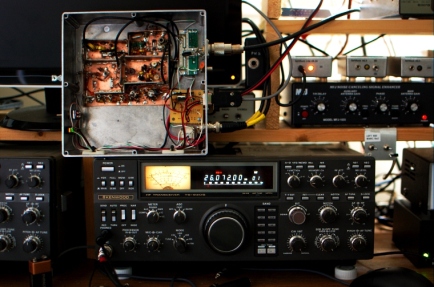
I recently resurrected the 50-MHz transverter project and have made good headway getting it working. On Friday night, I began the process of tapping holes in the PA module heat spreader. But, despite using plenty of “cutting fluid” (3-in-1 oil), I managed to break a (well-used) tap on the first hole. Since the maximum (linear) power out of the driver stage is 200 mW, I embraced my inner QRPer and put the PA project aside to give the transverter a try in the CQ WW VHF contest.
The 6-meter Yagi had come down in favor of Yagis for 222 and 432 when the loaner FT-736R showed up. So, I scampered up onto the roof and moved Yagis around. I had hoped that this moment would be accompanied by changing out RG-8 coax for LMR-600 and LDF4-50A that are taking up space in the shop and shack. But, I was not ready to commit to cutting that and I still don’t have LMR-600UF for the rotator loops. Plus, I should replace the rotator at the same time. That amounted to too much work for the available time. I really just need to bite the bullet and install a rotating mast for the VHF antennas that’s not so precarious.
Got everything hooked up late on Saturday afternoon, but had to tend to some domestic concerns and was QRT until later in the evening when I heard my neighbor W4EE calling CQ on six SSB. Did not know that he had six! Apparently, this is a new thing for him, too. He was surprised that I didn’t vibrate his radio off the desk like I usually do! Told him I was running 200 mW and everything made sense.
Ended up working a few other locals on Sunday including N3UM, who moved me from 6-meter CW to 2-meter SSB for a quick chat. He just completed the N1DPM active bias mod to his Mirage B2518G, so was eager for an audio report. Sounds good! He said my B3016G sounded good on-frequency, but I haven’t gotten the mod actually inserted into mine yet. Probably that Kenwood (TS-700S) audio making up for the amp’s inferiority…
Eventually, I will be posting more details on the circuit here. This is one of those projects that I would not encourage anyone to duplicate as I have constructed it. However, there may be useful features.
Field Day W3AO/KE3Q QSO standings
As I wrote previously, for 2011 Field Day, I made a game of trying to contact W3AO and KE3Q on as many bands and modes as possible. Here are the official standings from KD4D who managed the PVRC competition:
| Call | HF | 6M | 2M | UHF | GOTA | Digital | Satellite | Total |
| K1DQV | 11 | 2 | 2 | 2 | 0 | 3 | 0 | 20 |
| K8GU | 11 | 0 | 1 | 4 | 1 | 1 | 0 | 18 |
| W3GG | 12 | 1 | 0 | 0 | 0 | 5 | 0 | 18 |
| K1HTV | 10 | 2 | 2 | 0 | 0 | 3 | 0 | 17 |
| NA3M | 12 | 0 | 0 | 0 | 0 | 3 | 0 | 15 |
So, K1DQV was at the top of the heap (with a 2-meter CW contact, I might add). Anyhow, I’m quite pleased with the results and happy to report that W3AO is claiming the all-time high QSO total for Field Day this year. Congratulations.
K8GU Field Day 2011
I had not been a big fan of Field Day for many years until last year. Although ARRL technically terms it “an operating event,” it has most of the features and flavor of a contest. But, the bands are crowded, there are a few more drunks and lids than your standard contest. Your local club thinks it’s a great idea to put up a tower and an ancient tribander, but they only do a half-witted job of it making a lot of work for something that could have been smoked by a doublet in the trees. Or, you show up at a random Field Day site, introduce yourself, and offer to operate CW—only to be handed a J-38 or a blank stare.
Last year was different. Sarah’s branch chief at work is a ham and she’s married to a ham. Somehow, it came up that I was a ham and soon we had an invitation to Field Day at her mother’s place near the water of the Chesapeake Bay on Maryland’s Eastern Shore. I was reluctant, but they assured me it would be OK. They have a tower trailer for a triband Yagi and trees for dipoles on the low bands and they operate 1A. It was fun. Sarah enjoyed herself, too, which is a welcome change for a ham radio event!
For a variety of reasons (namely the impending birth of our first child), we elected not to go to the Eastern Shore this year. After talking to a few guys at the PVRC/W3LPL open house last weekend who implored me to come to their operation (W3AO, the FD of epic proportions) instead, I decided I needed to do something. Since W3AO was making a run on the all-time Field Day high score record this year, I opted to make a game of running 1D and working W3AO (and their GOTA station, KE3Q) on every band and mode available. The goal was to not disrupt our weekend too much and to have fun, possibly contending for a plaque offered by PVRC for the most band/mode QSOs with W3AO/KE3Q.
Here’s how things shook out (yellow = QSO, blue = no QSO, red = no QSO possible with W3AO/KE3Q, hashed = no QSO possible with K8GU, but possible with W3AO):
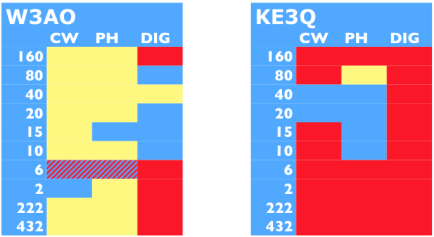
So, I did pretty well with W3AO, all things considered. I was not QRV on RTTY until Sunday morning (forgot that I did not set that up on the “new” PC yet). By that time, I missed the really good opportunities to work them on 20 and 80. I don’t know if I ever would have on 15 and 10. I did see them spotted on PSK31 (a mode I will never enjoy—one QSO was enough) on 15, but could not hear (erm, see) them here.
It was a bummer not to have 6 meters here and despite 3-4 requests, the 2-meter phone operator(s) refused to QSY to CW with me, even though one told me I was his first QSO in an hour! It did take almost 10 minutes for them to find a key to work me on 222 and 432 CW! Thanks for going the extra mile! I believe my total of 17 QSOs ties K3DI’s record, plus one more with KE3Q, for 18 total.
I worked KE3Q right away on 75 meters, but never heard them again. I did see QRS Skimmer spots for them on 40 and 20 CW in the middle of the night and at the very end of event, respectively. But, I do not believe they were QRV on CW on any other bands.
Having 6 meters and digital from the start probably could have increased my totals a bit. A satellite QSO or two would also have been good. But, I did not have it in me to get that set up in addition to building microwave gear and getting the baby’s room ready. Plus the 432-MHz amp I bought recently has been held hostage by the deadlock between Canada Post and their workers. So, I only have 10 watts on that band until that arrives, making the annual Field Day “Battle for Bandwidth on the Birds” that much more exciting with a small antenna oriented for terrestrial work.
It was a good time, although I think I’ll be itching to go out into the “field” again next year…thanks for the QSOs and the QSYs!













