Posts Tagged ‘Contesting’
 IARU HF World Championship contest
 July 10th, 2016 |
  Author: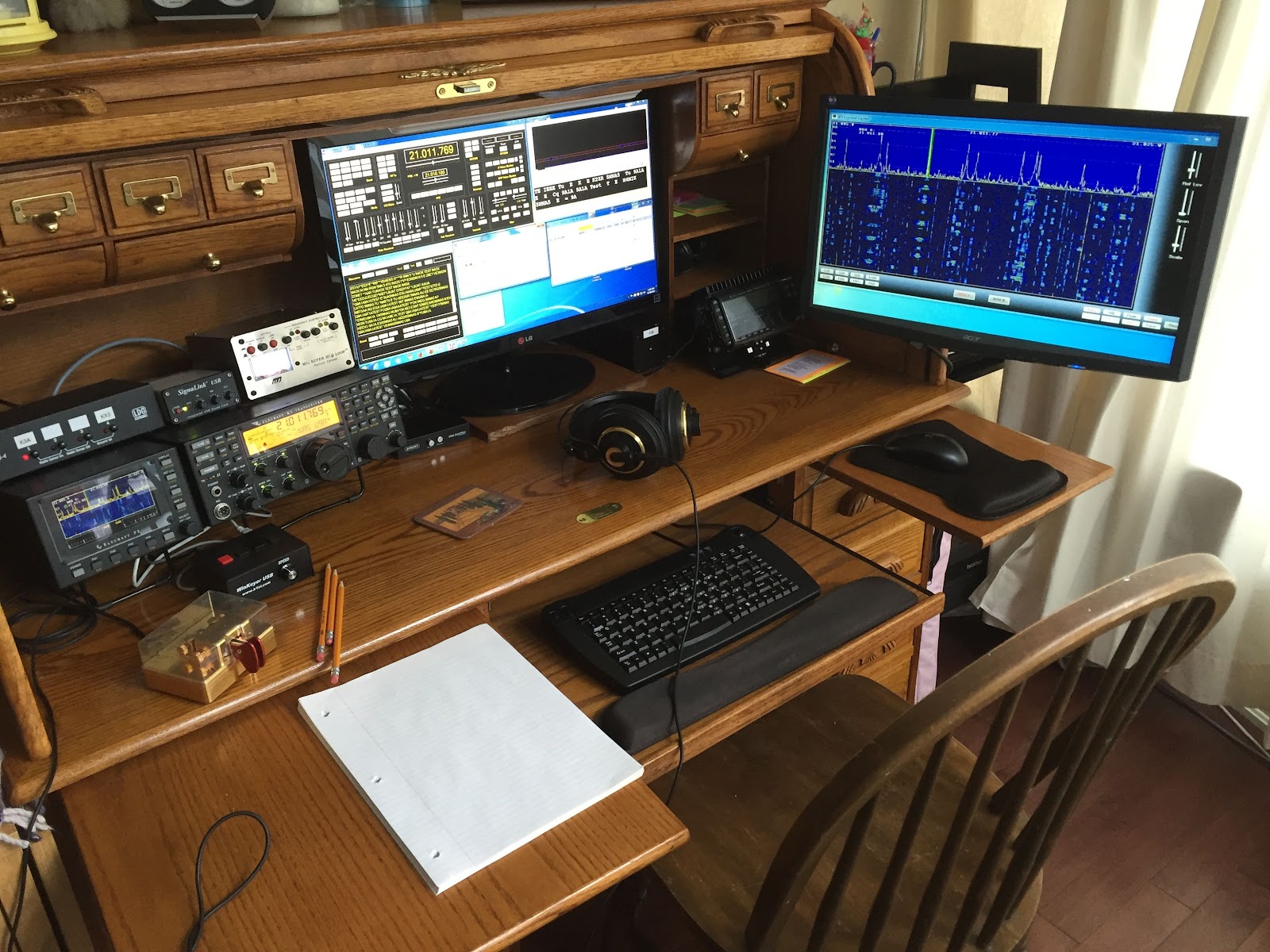
IARU HF World Championship contest
Just a reminder
that next Monday, June 20th, is the first day of Summer. And you know what that means ..... Skeeter numbers will start to be issued that day!
Beginning this year, the Hunt has been moved to the third Sunday in August in order to even out spacing a bit between FOBB, the Skeeter Hunt and the NoGA Peanut Power Classic. Also, there are some rule changes for 2016 in order to more fully incorporate NPOTA into the Skeeter Hunt. Make sure to check them out at www.qsl.net/w2lj.
 72 de Larry W2LJ
QRP - When you care to send the very least!
Beginning this year, the Hunt has been moved to the third Sunday in August in order to even out spacing a bit between FOBB, the Skeeter Hunt and the NoGA Peanut Power Classic. Also, there are some rule changes for 2016 in order to more fully incorporate NPOTA into the Skeeter Hunt. Make sure to check them out at www.qsl.net/w2lj.

QRP - When you care to send the very least!
Just a reminder
that next Monday, June 20th, is the first day of Summer. And you know what that means ..... Skeeter numbers will start to be issued that day!
Beginning this year, the Hunt has been moved to the third Sunday in August in order to even out spacing a bit between FOBB, the Skeeter Hunt and the NoGA Peanut Power Classic. Also, there are some rule changes for 2016 in order to more fully incorporate NPOTA into the Skeeter Hunt. Make sure to check them out at www.qsl.net/w2lj.
72 de Larry W2LJ
QRP - When you care to send the very least!
Beginning this year, the Hunt has been moved to the third Sunday in August in order to even out spacing a bit between FOBB, the Skeeter Hunt and the NoGA Peanut Power Classic. Also, there are some rule changes for 2016 in order to more fully incorporate NPOTA into the Skeeter Hunt. Make sure to check them out at www.qsl.net/w2lj.
QRP - When you care to send the very least!
A visit with a QRP contest station
160m Spring Stew Perry Contest - QRP style
I had the opportunity to visit with Paul Stroud AA4XX as he worked the early hours in the 160m Spring Stew Perry Contest. Paul is an avid CW operator dedicated to QRP and QRPp operations. When he works contests he often participates using the Knightlites club call WQ4RP (Note the QRP in the call).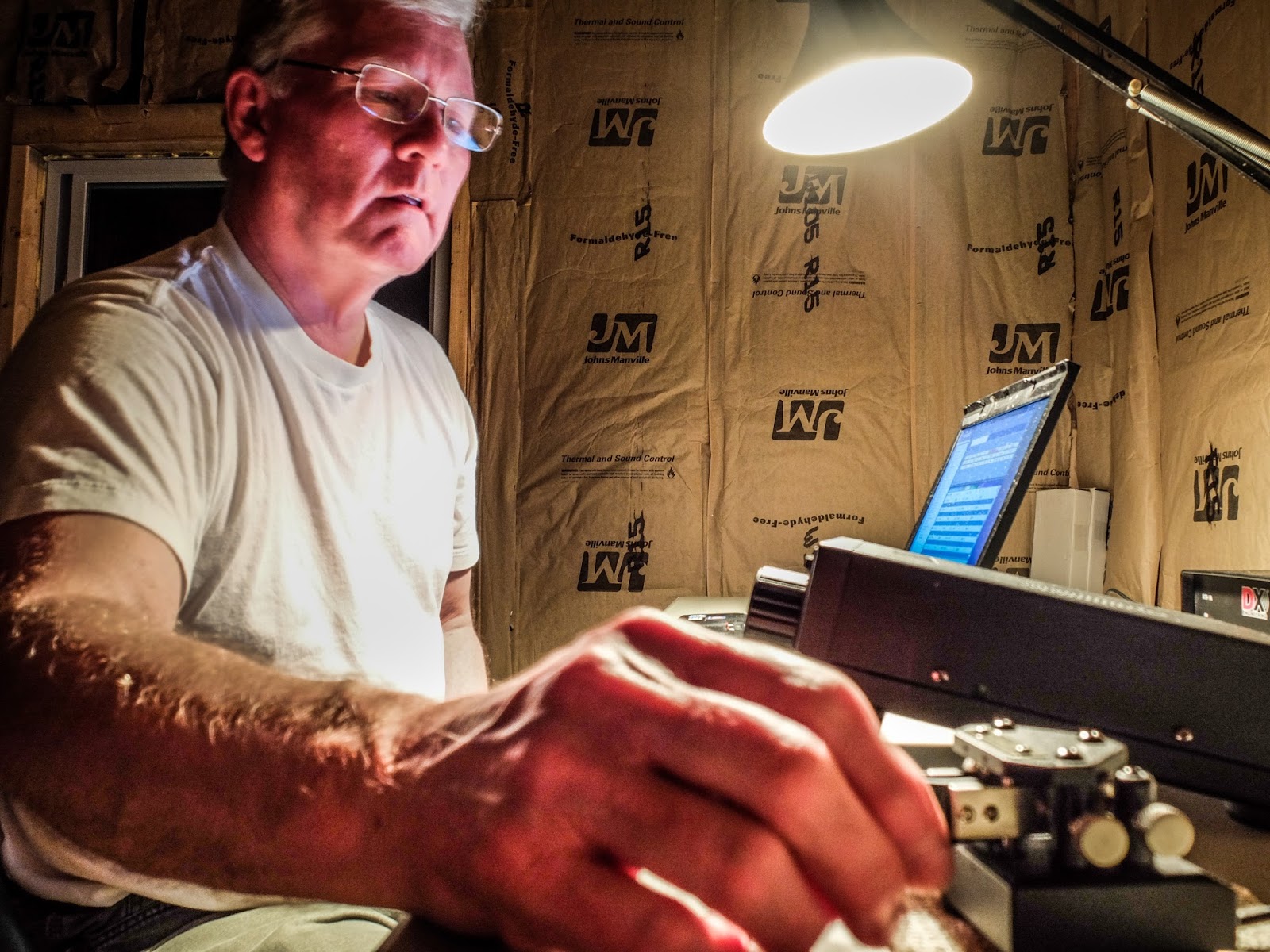 |
| AA4XX operating as WQ4RP during the 160m Stew Perry Spring Top Band contest |
160m Top Band
160m (top band) is challenging due to the physical logistics of a suitable antenna. I had the opportunity to assist with a portion of raising the 160m vertical loop antenna at the "Excalibur antenna site" and installing the 24 elevated radials that help make this antenna so effective. There's a lot of wire in the ground system. The antenna site is located in the woods, off grid, and away from electrically noisy homes.Power to the remote shack is supplied by a quiet Honda 1kW generator operating a couple dozen feet from the shack. Due to the lower power requirements of QRP Paul can run the generator on eco-mode allowing its small fuel tank to provide 8 hours of operation between fill-ups.
Paul uses a Ten Tec Argonaut VI, running 5 watts output into the Excalibur 160m vertical loop. He uses N1MM+ logger software and a WinKeyer interfaced to the software. He also employs a SDR (software defined radio) feeding CWSkimmer signals across the band. An antenna splitter simultaneously feeds the SDR and the Argonaut. The SDR receiver is switched out during transmit by a DX Engineering RTR-1A Receive switch. His CW key is a N3ZN ZN-QRP model.
The N1MM+ logging software keeps track of which stations have already been worked and the CWSkimmer interface displays calling stations on the band being heard by his antenna.
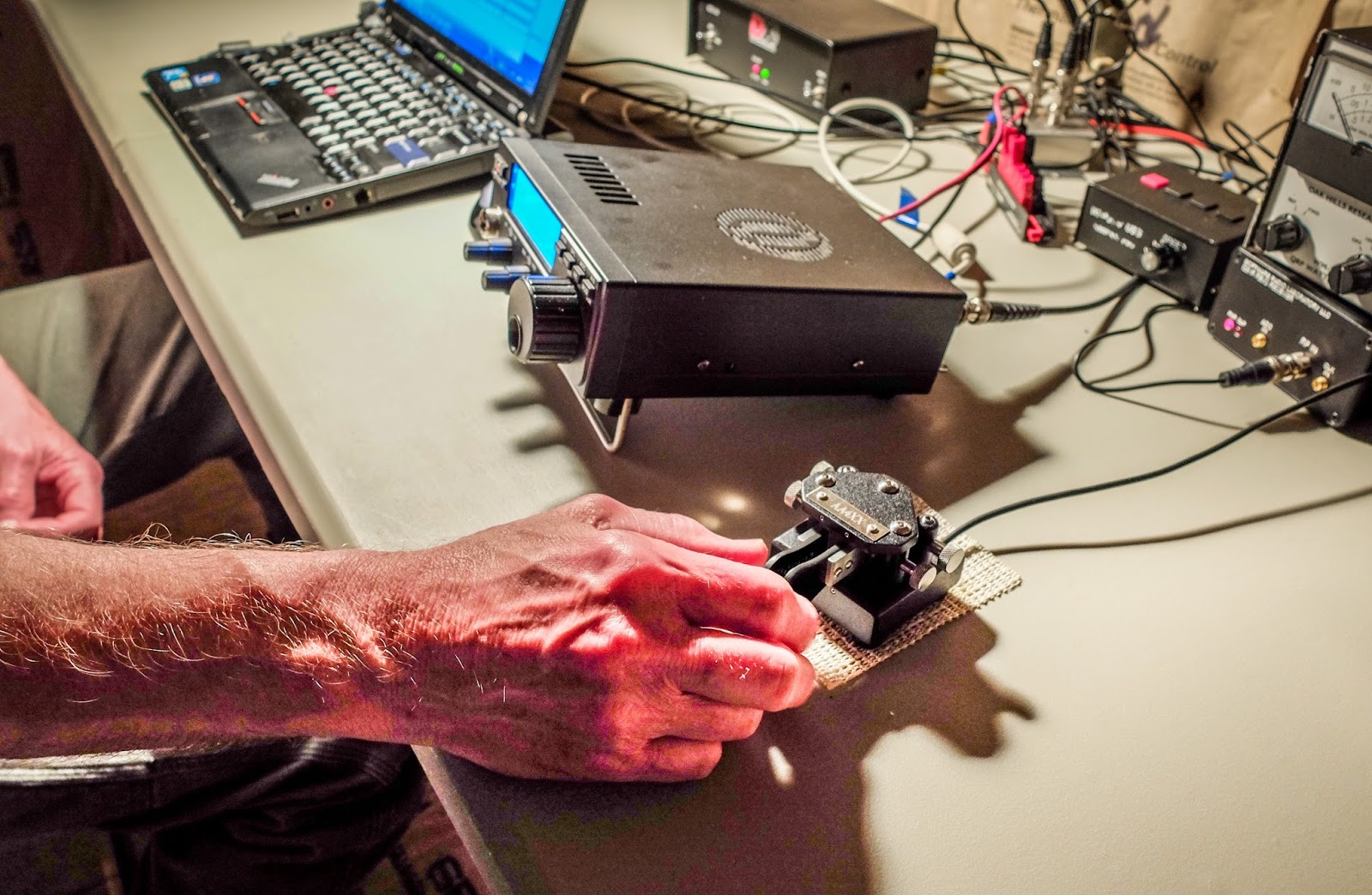 |
| The remote QRP station setup for contesting |
In the Stew Perry contest the only information exchanged was grid squares. I'm still relatively new to CW and watching Paul casually copy grid squares sent at 30wpm was impressive. I would have had to ask the caller to re-send their grid squares 5 times but Paul makes it look easy.
Instructions for the newbie
Paul explained to me the in's and out's of operating in a contest. Speed and timing the openings were important, as was persistence. The integration of the software and receiving tools optimized his operating but experience and skill seems to be the biggest factors to success. I could have sat down there using the same tools but I would have been dumfounded with the logging controls and the speed the other stations were sending information. However, not all stations were sending at mach speed. When Paul worked a station sending at a slower or faster speed he would use the interface to Winkeyer to speed up or slow down the sending simply using the Page-up / Page-down keys. He would change frequency to a new station in the skimmer display by clicking on it.
Due to the limited amount of information exchanged during the contest most of the sending is accomplished via macros programmed into the contesting software. Paul rarely had to touch the CW key during the time I was there and his primary physical interaction with the radio seemed to be changing bandwidth or bandpass settings (he tends to keep bandwidth at 500Hz).
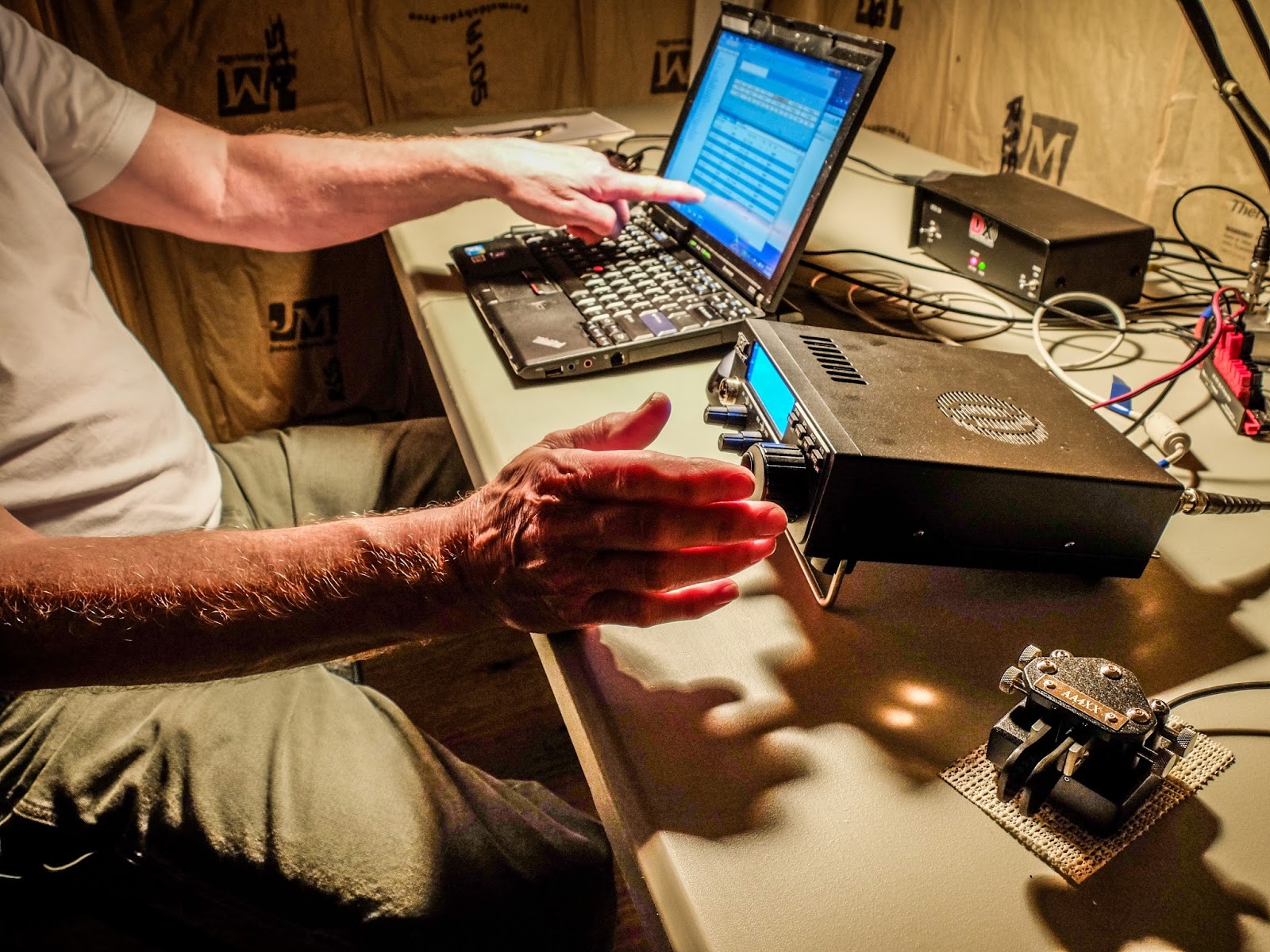 |
| Paul demonstrating the contesting software and usage |
Why QRP?
This contest was not a QRP-only contest although there were multipliers for working QRP. There were plenty of big gun stations operating and the Reverse Beacon spots showed some of them with 56dB SNR reports pounding the ionosphere with their big amps.
The strongest signal spot last night for WQ4RP was 35db with the average at around 18dB. Paul has worked QRO in the past but the challenge of QRP operation is now in his blood. During a previous 160m CW contest this winter he and Dick Hayter N4HAY worked 3 stations in Hawaii with Excalibur which thrilled them given the current propagation on 160m. QRP adds a bit more challenge and those multi-thousand mile per watt contacts on the top band make it all the more special
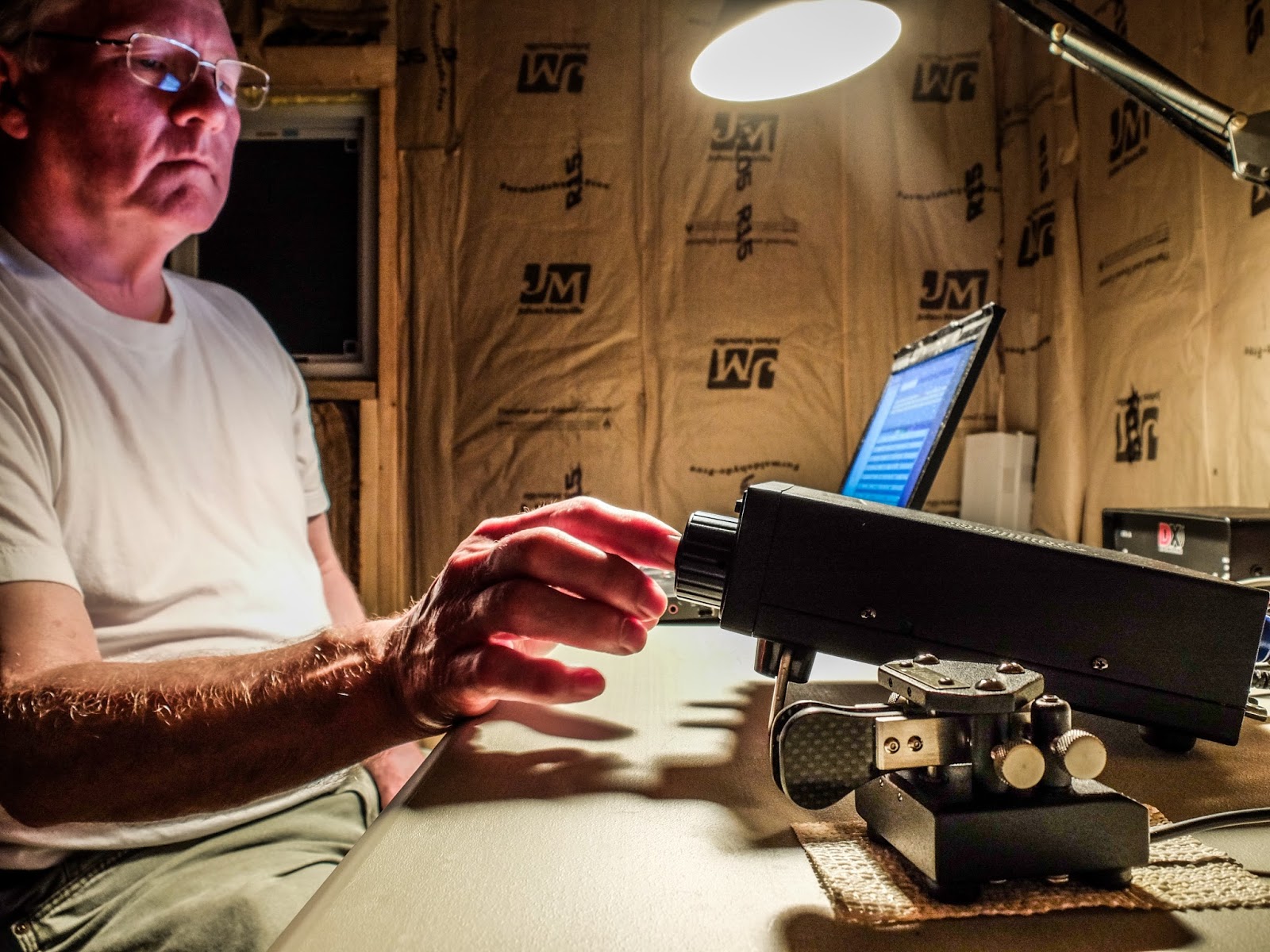 |
| Finding the next station to work. (N3ZN QRP CW key in the foreground) |
Why contest?
As a new CW operator I'm still getting my feet wet and enjoying the process of improving my CW copy skills doing more ragchews than adding stations to the log or chasing DX. I casually contest with the SKCC weekend sprints and it can be fun to see how many stations I work but I'm not ready for real contesting.
During the time I observed, I could sense Paul's excitement seeing the propagation progress across the band and when a distant station in Russia was heard he looked forward to the challenge to getting that one in the log using QRP. He let the stations running big amps get their fill before jumping in. Ultimately he wasn't able to work that station but he later worked a GW3 station in Wales which was a first for him on 160m. The rewards of contesting seem to be in the accomplishment of something difficult and achieving something new. I can understand that.
What's next?
With summer coming on 160m will turn noisy from atmospheric static and the opportunities for top band contacts fewer. Attention will turn to other bands and challenges for a while. Maybe Paul will decide it's time to get that 40m Moxon back up on the tower as the sunspot cycle decreases this summer.
I enjoyed the opportunity to watch real CW contesting first hand. It is technically challenging and requires skills I do not yet possess and I look forward to progressing in my CW/QRP journey to the point where I can assist Paul in a contest.
That's all for now
So lower your power and raise your expectations
73/72
Richard, AA400
ARRL DX CW contest done for 2016
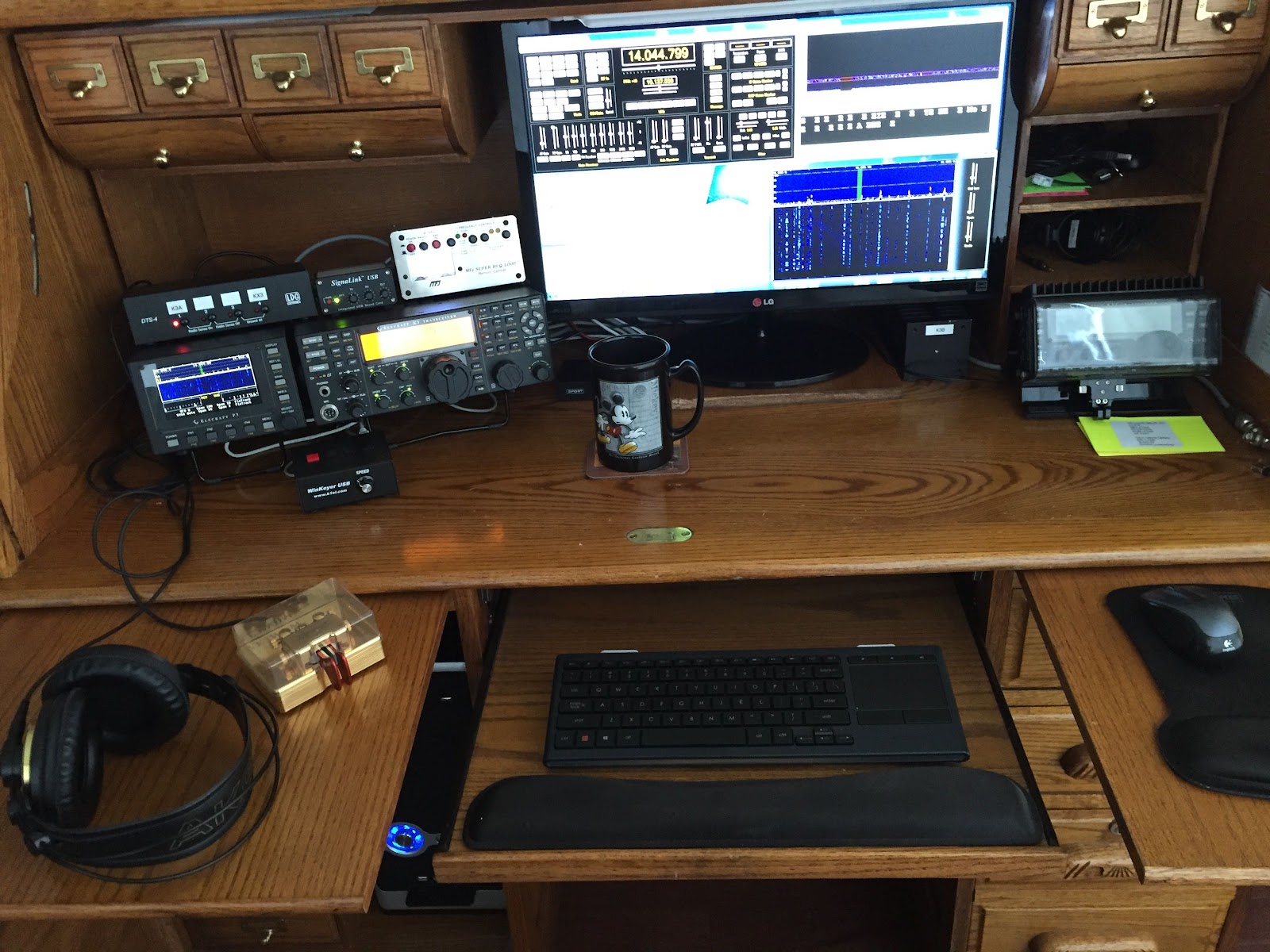 |
| The roll top radio desk |
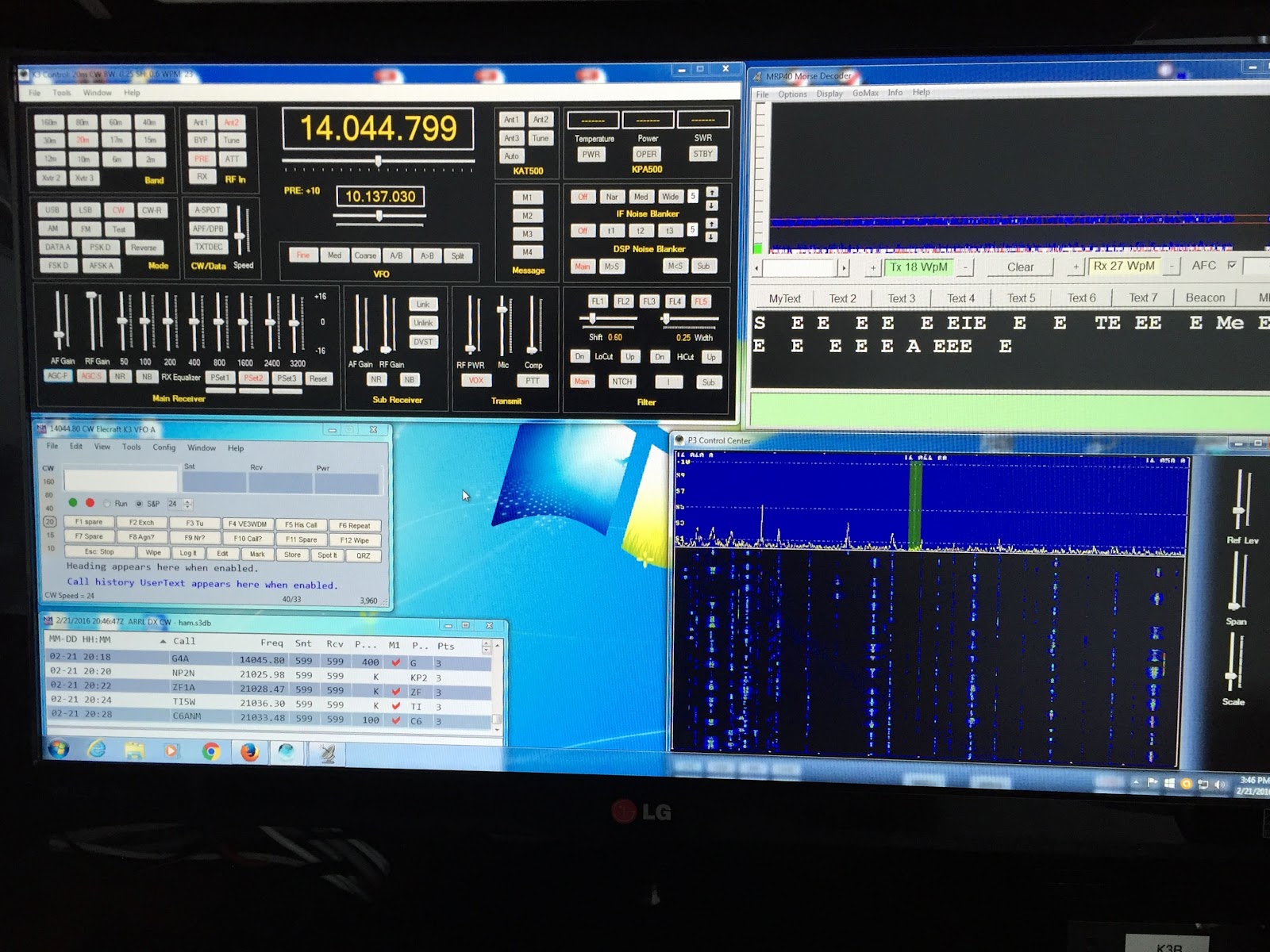 |
| The contest desktop |
CQ 160m CW Weekend

This past weekend's CQ 160m CW Contest saw the normally quiet band bursting to life with signals stacked up, one atop the other, from 1800 -1870 kHz.
At times it was very difficult to find a clear frequency to send 'CQ' and much of the contest was spent in the 'search and pounce' (S&P) mode. When a clear frequency was found I was able to have several short runs but running for any length of time while in the low power category is not realistic. I think my best hourly rate peaked at '60' for a short time as propagation would improve momentarily ... often, ten or more CQ's would go unanswered and then the next one would have two or three responses, continuing on for several minutes until the propagation would shift. These sudden 'holes' in the D-layer absorption seem to occur when conditions are marginal and it's as if the propagation switch is suddenly thrown from 'poor' to 'really good' for a few short minutes.
Overall, conditions from western B.C. were poor on Friday night and much improved on Saturday night. Although several DX stations were heard and called on Friday night, none were worked. These same stations came right back when called, on Saturday evening.
My 160m antenna is very simple, consisting of a 'half-sloper' and about fifty in-ground radials. Since the tower and antenna are mounted right at the ocean's edge, this year I threw two extra radials into the ocean ... whether or not these made any difference is difficult to say but they certainly wouldn't make things worse.

Because of the proximity to the ocean and the half-sloper producing vertical polarization, my antenna always seems to favor stations at the ends of the single-hop F2 distance ... those along the east coast and into the Caribbean as opposed to mid-continent signals. I often find myself sending several repeats to stations in the central states while those on the far coast will reply on the first call ... even stations that I can barely copy, will often come right back, which seems puzzling.
Overall, about 10 hours were spent in the contest ... ending up with 223 contacts in 51 sections and 9 DX entities. Some of the DX stations worked were PJ2, HK1, ZF2, C6, KP2 and 4V1. Checking my 160m DXCC list after the contest, I was surprised to see that 4V1TL in Haiti was a new country for me, making the contest time well worth it. Claimed scores for this, and any contest, can be viewed on the 3830 Scores website.
As the solar cycle continues to decline, 160m conditions should only get better and better, with the next few years hopefully producing a few Europeans in the 160m log once again.













