Posts Tagged ‘amateurradio.com’
 Review session
 November 12th, 2014 |
  Author:
 The last class of our Technician License course was held last night. We had what I guess you could call a review session. Drew W2OU provided me with two practice exams, which I printed out and distributed to the class members. We treated last night as the actual exam session. So not only did they get practice, but they also now know what to expect for next week.
After each exam was completed, we went over the tests together as a group. It appears that on both exams, no one got more than six answers incorrect. Since a passing grade allows for nine incorrect answers, it would appear that we are looking at a bunch of new Amateur Radio ops as of next Tuesday night.

To break things up a bit, we showed an Amateur Radio video in between the two exams. In all, I thought last night's session was exceptional. Our class members have proven to be eager, bright, inquisitive, and open to what we have been presenting to them.
It has been an honor and a privilege to work with them, as well as with my two fellow instructors, Marv K2VHW and Drew W2OU. These two are amazing Amateur Radio ops and have an amazing amount of experience behind them. The fact that Marv K2VHW is a retired broadcast engineer from WABC with a couple of Emmy Awards under his belt doesn't hurt, either!
I am looking forward to next week, and I just sent the group a final e-mail, detailing what to bring next week and basically telling how proud of them that we are. It's great to be able to help increase the ranks of Amateur Radio. I also reminded them to relax. This is supposed to be fun, and besides, in the scheme of things, it's not like we're looking to cure cancer or end world hnger.
Oh, and by the way, I did work John K4BAI in Georgia, one of the 40 Meter Foxes last night. I tried to work Kevin W9CF in Arizona, but I think the good props between NJ and AZ were over by the time I got home and wolfed down dinner. I see from his Fox log that Kevin worked some NJ stations, but that was while I was still in class. By the time I was trying to work him, he was 229 - 339 at best and I just couldn't make myself be heard. There is nothing more frustrating than calling a station who is sending a CQ in the clear, only to have them resume calling CQ after you send your call!
72 de Larry W2LJ
QRP - When you care to send the very least!
After each exam was completed, we went over the tests together as a group. It appears that on both exams, no one got more than six answers incorrect. Since a passing grade allows for nine incorrect answers, it would appear that we are looking at a bunch of new Amateur Radio ops as of next Tuesday night.

To break things up a bit, we showed an Amateur Radio video in between the two exams. In all, I thought last night's session was exceptional. Our class members have proven to be eager, bright, inquisitive, and open to what we have been presenting to them.
It has been an honor and a privilege to work with them, as well as with my two fellow instructors, Marv K2VHW and Drew W2OU. These two are amazing Amateur Radio ops and have an amazing amount of experience behind them. The fact that Marv K2VHW is a retired broadcast engineer from WABC with a couple of Emmy Awards under his belt doesn't hurt, either!
I am looking forward to next week, and I just sent the group a final e-mail, detailing what to bring next week and basically telling how proud of them that we are. It's great to be able to help increase the ranks of Amateur Radio. I also reminded them to relax. This is supposed to be fun, and besides, in the scheme of things, it's not like we're looking to cure cancer or end world hnger.
Oh, and by the way, I did work John K4BAI in Georgia, one of the 40 Meter Foxes last night. I tried to work Kevin W9CF in Arizona, but I think the good props between NJ and AZ were over by the time I got home and wolfed down dinner. I see from his Fox log that Kevin worked some NJ stations, but that was while I was still in class. By the time I was trying to work him, he was 229 - 339 at best and I just couldn't make myself be heard. There is nothing more frustrating than calling a station who is sending a CQ in the clear, only to have them resume calling CQ after you send your call!
72 de Larry W2LJ
QRP - When you care to send the very least!
Priorities
Tonight is the beginning of the 2014/2015 QRP Fox Hunt Season. Yay!
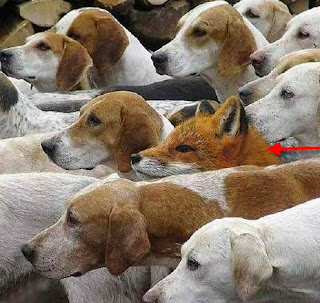

I may not be there for a huge part of it. Boo!
But as always, there is a bright side, so this is not a "pity party". As the Hunt starts tonight, I will be with Marv K2VHW and Drew W2OU as we hold "Review Night" for our Technician License Class students. Next Tuesday is the Big Night and after that, I should be able to participate in the Hunts until January. Beginning in January, we will be starting another Technician License Class for the Clark, NJ Office of Emergency Management, who has CERT members wanting to earn their tickets. Ergo, no Fox duty for me this year - there's just too many slots that I would not be able to fill. I will have to be content with being a Hound, with limited hunting time, at that.
So the bright side is ushering new Hams into the fold. Even if a majority of the Clark CERT members become "emergency communicators" only, there is always a chance that the hobby will grab on hold to some of these individuals and they will come to enjoy Amateur Radio for Amateur Radio's sake. And that is what we old veteran Hams live for.
That's another reason why, during these classes, we try as hard as we can to impress upon the students the MANY facets of Amateur Radio, whether it be DXing, rag chewing, CW, kit building, restoring antique radios, digital communications, satellites, VHF/UHF, contesting ........ whatever. The list is almost endless and there's sure to be something of interest for just about everyone.
Now for tonight. The QRP Fox Hunts run from 9:00 to 10:30 PM EST (local time). I should get home around 9:30 or 9:45 PM. Assuming I take the time to wolf down (pun intended) something for dinner, that will leave me roughly 30 - 45 minutes to grab a scent, and find and work two Foxes. Think I can do it? Wish me luck (and propagation!).
72 de Larry W2LJ
QRP - When you care to send the very least!

Zombie Shuffle Recap – 2014
Tough work week and last night, I felt like a Zombie!
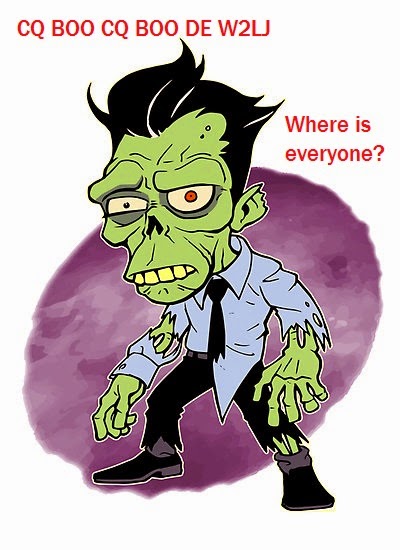
I joined the Zombie Shuffle, already in progress at about 0020 UTC (7:20 PM Local Time). I got on 20 Meters and worked four fellow Zombie Hunters in pretty rapid succession. I thought it was going to be a great night.
I was a tad mistaken.
From there, it got slow - real slow - shuffle slow - slower than shuffle slow. This Zombie ended up doing a moon dance - looking like he was walking backwards. The perceived lack of participation or lack of good band conditions was a bit of a disappointment.
I stayed on for two hours and worked 13 stations - which somehow seemed appropriate. At that point, while the KX3 was merrily calling "CQ BOO" for me, I actually started to nod off for a few seconds. Being the conscientious, law abiding Amateur Radio operator that I am, I decided it was not a good thing for the Control Operator to fall asleep behind the key. So I accessed the local control point, pulled the big switch and made my way upstairs to get some much needed ZZZZZZZs.
Thanks to fellow Zombies WA5TCZ, KG9DW, KA5T, N5GW, N8RVE, W3KC, W1PID, W3ATB, AB9CA, N1ABS, VE3CBK, WA8REI and WB8WTU for the contacts - lotta good friends there, It was a pleasure to work you all! Five on 20 Meters, six on 40 Meters and two on 80 Meters (which was beautifully quiet without hardly any background QRN - oh if there had only been more Zombies there!).
By the way, I was one of the Elvis stations again this year - so if you worked me, I was worth extra pointage. And as always - special thanks to Paul NA5N and Jan N0QT for running another spectacularly fun event, my own tiredness notwithstanding!
Kaboom!
Most of you have undoubtedly heard by now that the Antares rocket, launched from NASA's Wallops Island Launch Facility in Virginia, blew up 6 seconds after lift off.
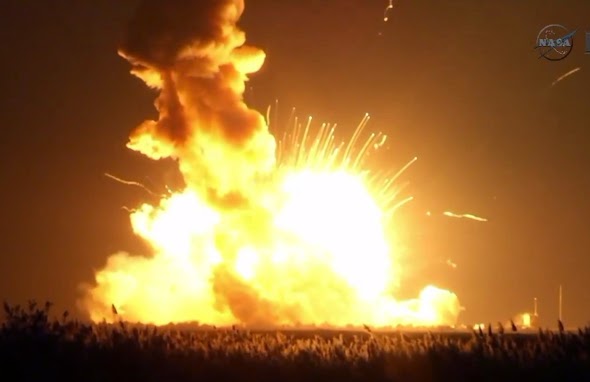
Unfortunately, the rocket was carrying various OSCAR satellites, specifically the GOMX-2 and RACE CubeSats. Fortunately, it appears that no ground personnel were injured or killed by the mishap.
According to the ARRL:
"The 2U GMX-2 CubeSat was intended to test a de-orbit system designed by Aalborg University in Denmark. Karl Klaus Laursen, OZ2KK, is listed as the “responsible operator” on International Amateur Radio Union frequency coordination documents. The Amateur Radio payload proposed using a 9.6 k MSK data downlink on 437.250 MHz. Also on board was an optical communications experiment from the National University of Singapore. The mission also hoped to flight qualify a new high-speed UHF transceiver and SDR receiver built by an Aalborg University team.
The Radiometer Atmospheric Cubesat Experiment (RACE) CubeSat was a joint project between The Texas Spacecraft Laboratory (TSL) at the University of Texas-Austin and NASA’s Jet Propulsion Laboratory (JPL). It carried a 183 GHz radiometer, a new science instrument designed by JPL. The primary objective of the RACE mission was to collect atmospheric water vapor measurements. The spacecraft was equipped to transmit using GMSK at 38.4 k and CW telemetry on a downlink frequency of 437.525MHz, as coordinated with the IARU. TSL’s Edgar Glenn Lightsey, KE5DDG, was listed in the IARU coordination documents as the responsible operator."
The Antares rocket is a design of the Orbital Space Sciences group. It was on a re-supply mission to the International Space Station and had 5000 pounds of cargo as well as more than two dozen satellites on board. Mankind has been launching payloads into earth orbit for 57 years now. This just goes to show, that as much as this is "rocket science" - that stuff still happens.
On a related note, I was able to visually witness a very nice pass of the ISS this Monday evening. It was about a 60 or 70 degree pass just around local sunset. The ISS was very bright and showed up on the horizon right on cue. Wonderful how that works, isn't it? As I watched it fly overhead, just over the waxing crescent moon, I was reminded of the many passes of RS10/11 and RS12/13 in the 90s. I used to work those LEOs a lot, and had many pleasurable contacts over them.
72 de Larry W2LJ
QRP - When you care to send the very least!
Unfortunately, the rocket was carrying various OSCAR satellites, specifically the GOMX-2 and RACE CubeSats. Fortunately, it appears that no ground personnel were injured or killed by the mishap.
According to the ARRL:
"The 2U GMX-2 CubeSat was intended to test a de-orbit system designed by Aalborg University in Denmark. Karl Klaus Laursen, OZ2KK, is listed as the “responsible operator” on International Amateur Radio Union frequency coordination documents. The Amateur Radio payload proposed using a 9.6 k MSK data downlink on 437.250 MHz. Also on board was an optical communications experiment from the National University of Singapore. The mission also hoped to flight qualify a new high-speed UHF transceiver and SDR receiver built by an Aalborg University team.
The Radiometer Atmospheric Cubesat Experiment (RACE) CubeSat was a joint project between The Texas Spacecraft Laboratory (TSL) at the University of Texas-Austin and NASA’s Jet Propulsion Laboratory (JPL). It carried a 183 GHz radiometer, a new science instrument designed by JPL. The primary objective of the RACE mission was to collect atmospheric water vapor measurements. The spacecraft was equipped to transmit using GMSK at 38.4 k and CW telemetry on a downlink frequency of 437.525MHz, as coordinated with the IARU. TSL’s Edgar Glenn Lightsey, KE5DDG, was listed in the IARU coordination documents as the responsible operator."
The Antares rocket is a design of the Orbital Space Sciences group. It was on a re-supply mission to the International Space Station and had 5000 pounds of cargo as well as more than two dozen satellites on board. Mankind has been launching payloads into earth orbit for 57 years now. This just goes to show, that as much as this is "rocket science" - that stuff still happens.
On a related note, I was able to visually witness a very nice pass of the ISS this Monday evening. It was about a 60 or 70 degree pass just around local sunset. The ISS was very bright and showed up on the horizon right on cue. Wonderful how that works, isn't it? As I watched it fly overhead, just over the waxing crescent moon, I was reminded of the many passes of RS10/11 and RS12/13 in the 90s. I used to work those LEOs a lot, and had many pleasurable contacts over them.
72 de Larry W2LJ
QRP - When you care to send the very least!
GB2FFC – JOTA 2014
Last weekend South Kesteven Amateur Radio Society (SKARS) operated the GB2FFC special event station at the First Foston Scout Group for the 2014 Jamboree on the Air (JOTA) weekend.
JOTA is an annual event in which Scouts and Guides all over the world make contact with each other by means of amateur radio, giving them an opportunity to experience wireless communication and electronics.

This was a first for both SKARS and the Scout group and we set up a SSB voice station and a data mode station primarily running PSK. The QTH was the Scout hut in the village of Foston, between Newark-on-Trent and Grantham (IO92PX)
Nigel (M0CVO) and Sean (M6ENN) ran the SSB voice station as well as supervising the popular Morse key trainer. This allowed the children to tap out their names using a crib sheet and gave them a certificate to acknowledge their achievement. Working voice proved challenging due to the high noise level in the hut due to the other scout activities. Despite this they still managed to work stations mainly on 20 and 40m. Nigel ran a Kenwood TS-480SAT into one of his own M0CVO DBD-2040 loaded dipoles at approximately 100W

I operated the data station consisting of my FT-857D and interfaces connected to a laptop running PZTLog feeding a M0CVO Magitenna at 30W. I also had my Czech morse key connected to the TR9500 acting as a sounder and they really like the military style key.
Explaining the PSK datamode and what the program was doing to young children was quite challenging. The Scout group were also running JOTI (Jamboree on the Internet) which consisted of laptops running an IRC chat application allowing world wide groups to talk to each other so the distinction between that and the slower PSK station was a bit difficult for some of them to grasp. Thankfully there were two very intelligent and enthusiastic Scouts who got the idea and understood the QSO process and were soon explaining it to the other Scouts leaving me free to type and push the macro buttons. One of them described it as 'awesome!'


GB2FFC ran from 09:00-15:00 UTC on the Saturday and 12:00-15:00 UTC on the Sunday and made 88 QSOs in total, mostly other amateurs but we did manage a number of other JOTA stations in both modes. The whole event was great fun and we were made very welcome by the Scout group. The enthusiasm was infectious so hopefully it will be the start of a regular annual club event helping out the Scouts for JOTA - plans were already being sketched out for next year, maybe involving camping!
Here are the PSK QSO maps for the weekend. Saturday was on 20m and 15m and were just European, Sunday I was operating mostly on 10m hoping for some transatlantic contacts, and did make a couple in the short time we had - didn't quite manage to connect with some South American and Asian stations but they could be seen and decoded to the delight of the children.


JOTA is an annual event in which Scouts and Guides all over the world make contact with each other by means of amateur radio, giving them an opportunity to experience wireless communication and electronics.
This was a first for both SKARS and the Scout group and we set up a SSB voice station and a data mode station primarily running PSK. The QTH was the Scout hut in the village of Foston, between Newark-on-Trent and Grantham (IO92PX)
Nigel (M0CVO) and Sean (M6ENN) ran the SSB voice station as well as supervising the popular Morse key trainer. This allowed the children to tap out their names using a crib sheet and gave them a certificate to acknowledge their achievement. Working voice proved challenging due to the high noise level in the hut due to the other scout activities. Despite this they still managed to work stations mainly on 20 and 40m. Nigel ran a Kenwood TS-480SAT into one of his own M0CVO DBD-2040 loaded dipoles at approximately 100W
I operated the data station consisting of my FT-857D and interfaces connected to a laptop running PZTLog feeding a M0CVO Magitenna at 30W. I also had my Czech morse key connected to the TR9500 acting as a sounder and they really like the military style key.
Explaining the PSK datamode and what the program was doing to young children was quite challenging. The Scout group were also running JOTI (Jamboree on the Internet) which consisted of laptops running an IRC chat application allowing world wide groups to talk to each other so the distinction between that and the slower PSK station was a bit difficult for some of them to grasp. Thankfully there were two very intelligent and enthusiastic Scouts who got the idea and understood the QSO process and were soon explaining it to the other Scouts leaving me free to type and push the macro buttons. One of them described it as 'awesome!'
GB2FFC ran from 09:00-15:00 UTC on the Saturday and 12:00-15:00 UTC on the Sunday and made 88 QSOs in total, mostly other amateurs but we did manage a number of other JOTA stations in both modes. The whole event was great fun and we were made very welcome by the Scout group. The enthusiasm was infectious so hopefully it will be the start of a regular annual club event helping out the Scouts for JOTA - plans were already being sketched out for next year, maybe involving camping!
Here are the PSK QSO maps for the weekend. Saturday was on 20m and 15m and were just European, Sunday I was operating mostly on 10m hoping for some transatlantic contacts, and did make a couple in the short time we had - didn't quite manage to connect with some South American and Asian stations but they could be seen and decoded to the delight of the children.
Interesting discussion
going on over at QRP-L about portable antennas. The catalyst for the "debate" is this article.
http://www.sotabeams.co.uk/blog/5-most-popular-hf-portable-antennas/
Lot's of good input by lots of people who know what they are talking about. And as always, for portable operations (my emphasis), it seems to boil down to efficiency vs. ease of use.
Both Steve Weber KD1JV and Ron Polytika WB3AAL, who have done a lot of operating from the Appalachian trail, point out that while classic dipoles may be the most efficient antenna to use, there are practical logistical problems associated with them. There may not always be trees available, and even when there are trees available, there may be so many and so close together, that hoisting up a dipole may not be practical. I have to agree with Steve that hoisting a dipole or doublet in the classic sense, in a portable situation (especially when you are by yourself) can be an experiment in frustration.
Steve is a proponent of the End Fed Half Wave, while Ron likes a version of the portable vertical that he has designed and yields quite acceptable results for him. I have used both and personally prefer the end fed wire for the ease of deployment. Don't get me wrong. I have verticals antennas and love them. My Butternut at home and my Buddistick on top of the Jeep have both done very well for me. But as always, the ground plane is crucial. Close to 60 radials at home and the Jeep's metal body acting as a ground plane for the Buddistick make all the difference in the world.
The thing that surprises me though, is that when speaking of dipoles or doublets, everyone always seems to think of them in the classic flat top or Inverted Vee configuration, which of course, requires three supports. I have used doublets, such as the NorCal doublet as a sloper and as a vertical dipole with a modicum of success. My first Flight of the Bumblebees effort used the NorCal Doublet as a sloper and I was quite pleased with the results.
What it boils down to, of course, is that you have to try different things and see what works best for you. There is no single correct answer to the question of "What is the best portable antenna?" What will work in one situation may be totally unsuitable for another. No archer carries only one arrow in his quiver. Hams who are adroit in portable operations always seem to be carry more than one antenna configuration into the field with them, as long as they meet the requirements for portability and ease of use. And I think all Hams who love portable operations are on a constant quest for the "Holy Grail", an antenna that is lightweight, quick and easy to deploy, and will work as many bands as possible.
72 de Larry W2LJ
QRP - When you care to send the very least!
http://www.sotabeams.co.uk/blog/5-most-popular-hf-portable-antennas/
Lot's of good input by lots of people who know what they are talking about. And as always, for portable operations (my emphasis), it seems to boil down to efficiency vs. ease of use.
Both Steve Weber KD1JV and Ron Polytika WB3AAL, who have done a lot of operating from the Appalachian trail, point out that while classic dipoles may be the most efficient antenna to use, there are practical logistical problems associated with them. There may not always be trees available, and even when there are trees available, there may be so many and so close together, that hoisting up a dipole may not be practical. I have to agree with Steve that hoisting a dipole or doublet in the classic sense, in a portable situation (especially when you are by yourself) can be an experiment in frustration.
Steve is a proponent of the End Fed Half Wave, while Ron likes a version of the portable vertical that he has designed and yields quite acceptable results for him. I have used both and personally prefer the end fed wire for the ease of deployment. Don't get me wrong. I have verticals antennas and love them. My Butternut at home and my Buddistick on top of the Jeep have both done very well for me. But as always, the ground plane is crucial. Close to 60 radials at home and the Jeep's metal body acting as a ground plane for the Buddistick make all the difference in the world.
The thing that surprises me though, is that when speaking of dipoles or doublets, everyone always seems to think of them in the classic flat top or Inverted Vee configuration, which of course, requires three supports. I have used doublets, such as the NorCal doublet as a sloper and as a vertical dipole with a modicum of success. My first Flight of the Bumblebees effort used the NorCal Doublet as a sloper and I was quite pleased with the results.
What it boils down to, of course, is that you have to try different things and see what works best for you. There is no single correct answer to the question of "What is the best portable antenna?" What will work in one situation may be totally unsuitable for another. No archer carries only one arrow in his quiver. Hams who are adroit in portable operations always seem to be carry more than one antenna configuration into the field with them, as long as they meet the requirements for portability and ease of use. And I think all Hams who love portable operations are on a constant quest for the "Holy Grail", an antenna that is lightweight, quick and easy to deploy, and will work as many bands as possible.
72 de Larry W2LJ
QRP - When you care to send the very least!














Also, a very Happy 239th Birthday to the Marines! Semper Fi, Marines!
Lastly, a Happy Veteran’s Day to my Dad. I was rummaging through some papers in my desk when I came across the Certificate of Condolence that the White House sent upon his passing in 2001. My Dad was a WWII Army Vet who loved to talk about some of the European “sites” he saw during his tour in Europe (including the Passion Play at Oberammergau). He never spoke about combat, though – not uncommon for his generation, it seems. I also came across his wallet sized copy of his Discharge Papers. He was not an Amateur Radio operator, but he was a graduate of the Signal Corps RADAR and Repeater School (which probably explains in some way, my love for Amateur Radio). I also noticed for the first time that he was a recipient of medals for Combat in the European Theater, as well as a Good Conduct medal and one other. He NEVER spoke about those.
For all the Vets who have passed – Eternal rest, grant unto them Oh Lord, and may Perpetual Light shine upon them. May their souls and the souls of all the Faithful Departed, rest in peace. Amen.
72 de Larry W2LJ
QRP - When you care to send the very least!