Posts Tagged ‘amateurradio.com’
 QRPTTF – 2015
 April 26th, 2015 |
  Author:
 As Mr. Lennon wrote, "Life is what happens when you're busy making other plans."
I had planned to get to Washington Rock State Park around Noon. The park, which is on the first ridge of the Watchung (Wach Unc in Lene Lanape) moutnains, meets the QRPTTF theme requirement for being a place somehow related to Native Americans. What actually happened was that my daughter was invited to a sleepover/birthday party, and I had to have her at her friend's house at 2:00 PM. So much for the early start.
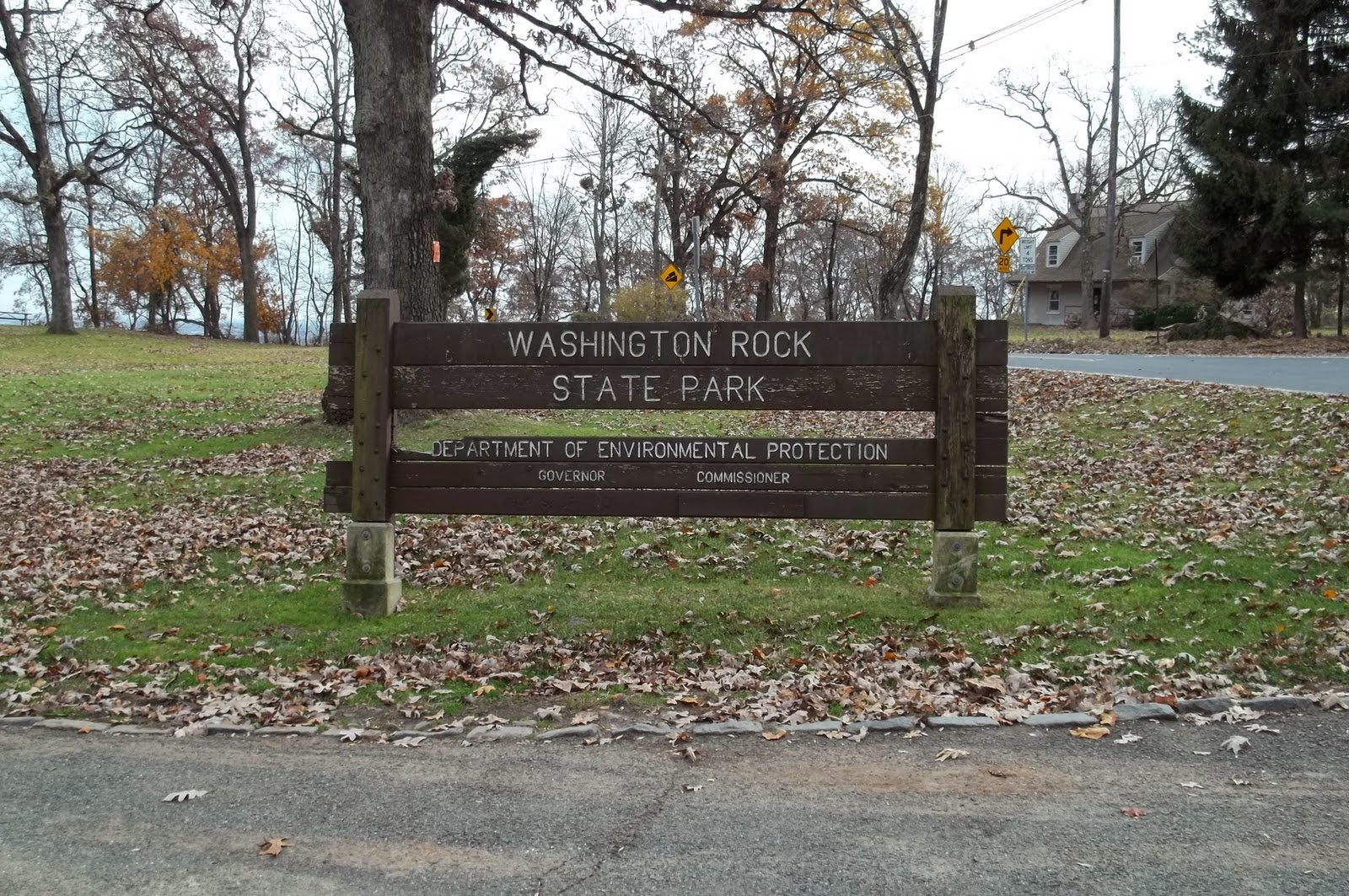
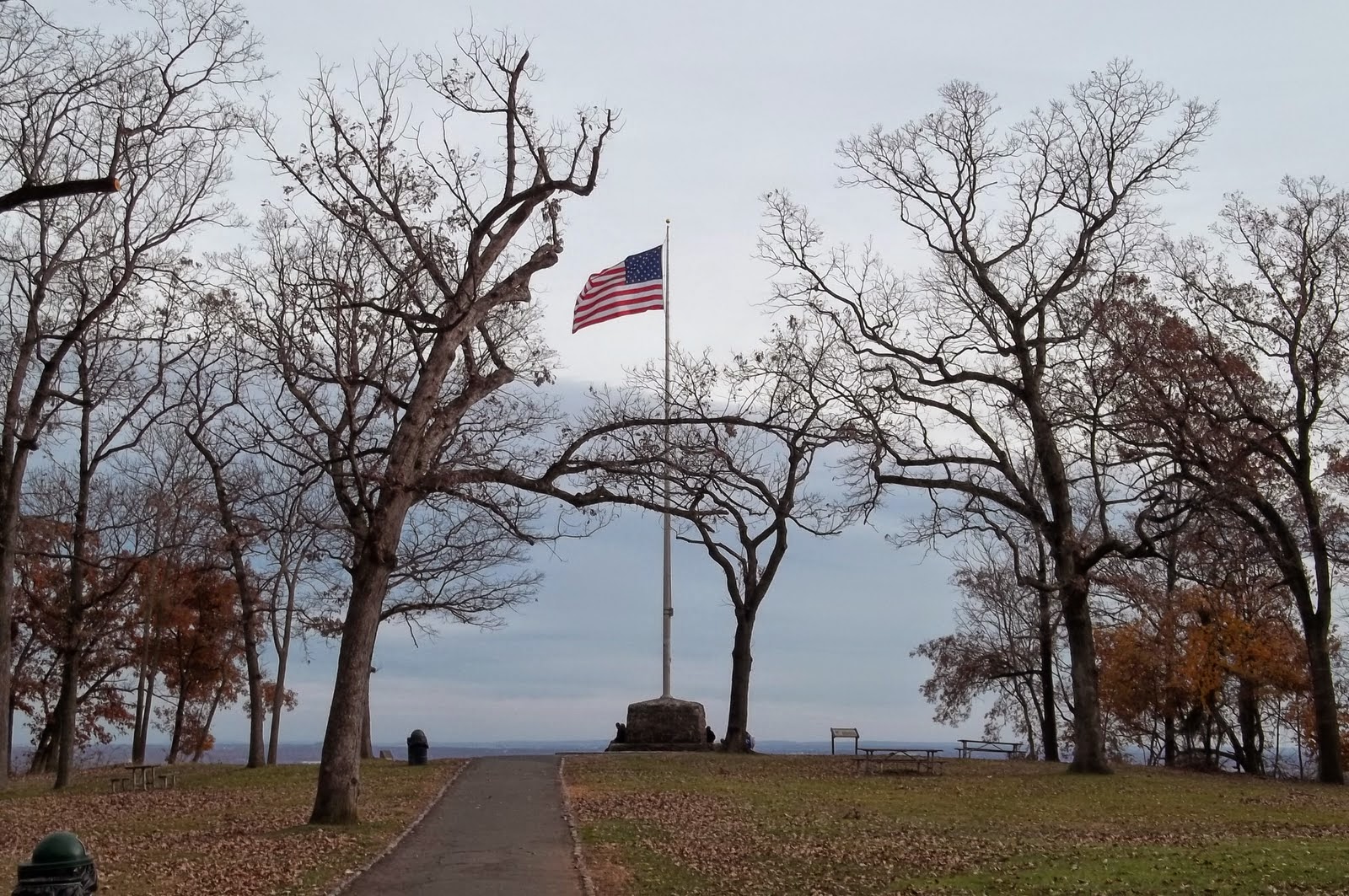
Set up did go like the knife through hot butter, after I made it to the park. The new Joplin ARC antenna launcher got my antenna hoist line up over a 40 foot high tree branch on the first shot. The EARCHI was up, literally in minutes.
I got on the air at about 1830 UTC and I spent about 15 minutes calling CQ QRP on 15 Meters with no takers. I had a feeling that 15 Meters was going to be good today. It wasn't, at least for me. So I meandered over to 20 Meters and was answered by Craig N8KMY at 1855 for my first QRPTTF QSO.
It didn't start out as a QRPTTF QSO. He called me because in his words, he couldn't believe that I was QRP. He is located in northern MI and told me that I was one of the loudest signals on the band for him. He repeatedly asked me to confirm that I was only running 5 Watts.
He was as loud to me as I was to him, so that's where the fun began. First he lowered his power from 40 Watts to 20 Watts, when I told him there was no difference in his signal, he continued to lower his power down to 10 Watts, and then, eventually 5 Watts. He was astounded when I told him (quite honestly) that there was no difference between his signal at 40 Watts or 5 Watts. A new QRP convert? I certainly hope so! Craig seemed enthusiastic enough.
Getting him down to 5 Watts qualified as a QRPTTF contact. We had a nice ragchew for about 25 minutes. A bit longer than I had intended, but it's never a bad thing to promote QRP, and bring a new soul into the fold, right? So it was worth it.
Besides, as it turned out, the bands weren't exactly rip-roaring with QRPTTF activity. I ended up making only 8 QSOs. Six on 20 Meters and two on 40 Meters.


I worked, in addition to N8KMY, NK9G, WQ8RP, K7RE, K4UPG (Kelly, my fellow QRP Polar Bear - Grrrrrrrr), WB3T, KS8M and AA5TB.
What made the day, was when my fellow SPARC members, Marv K2VHW (my official QRPTTF 2015 photographer) and Drew W2OU came for a visit. They kept me company in between QSOs and also stayed with me until I packed up for the return trip home. Around 5:00 PM, it started getting chilly again and QRPTTF signals were becoming about as scarce as hen's teeth. So only though I put in only 2 & 1/2 hours behind the key, I decided to call it an event and head home.
The important thing was that I had fun and enjoyed my time playing radio today. It feels like I don't get to do this anywhere near enough.
72 de Larry W2LJ
QRP - When you care to send the very least!
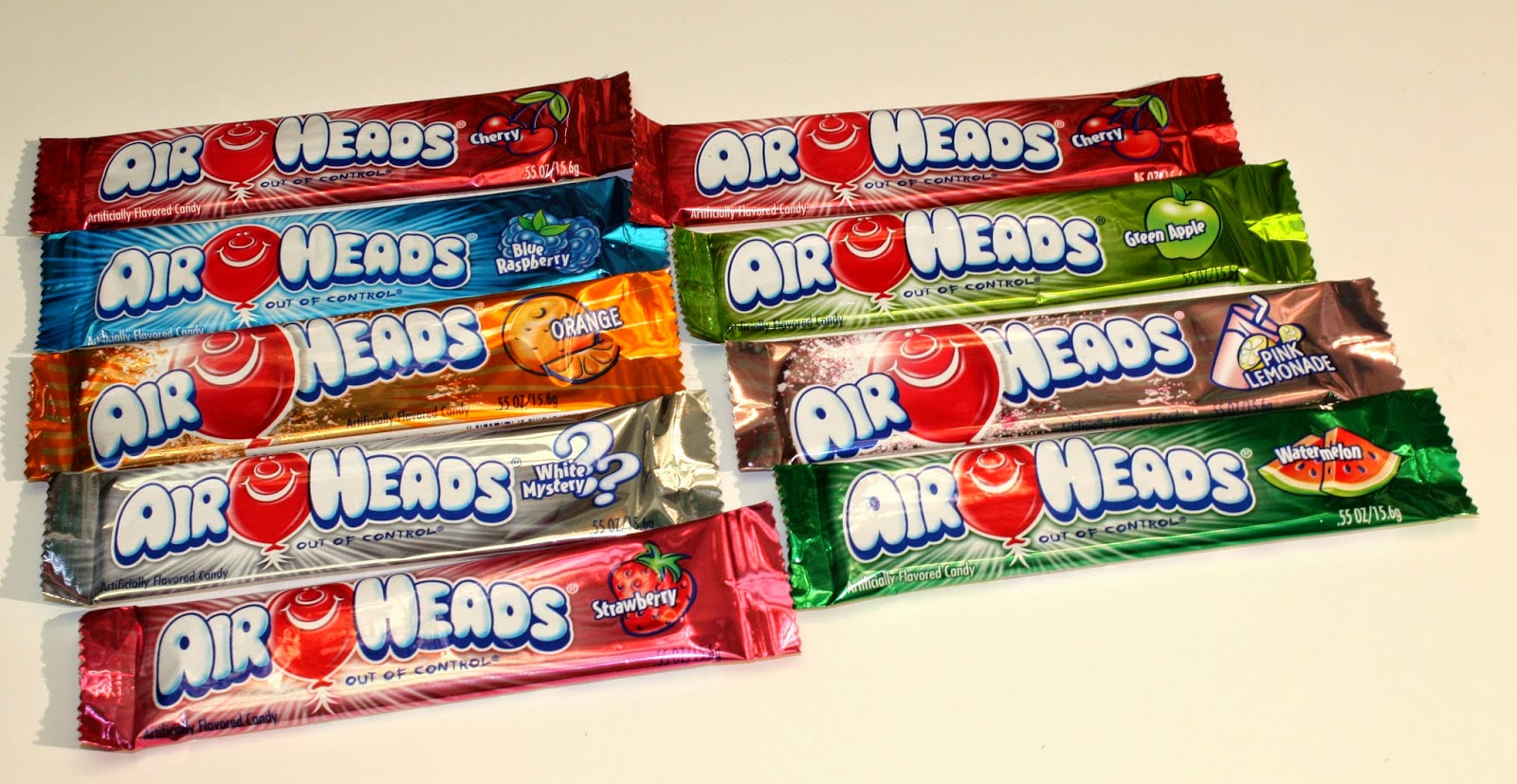
They named a candy after me!
A lot better today!
That had me shaking my head even more.
I'm glad I didn't give in to the temptation to chuck it all for today, because I had the best QRP lunch time that I've had in a while - numbers and predictions be damned!
I started out on 17 Meters which seemed to be in great condition. Low noise level and some loud signals. I worked EA6NB, Jaime in the Balearic Islands. From there I wandered around a bit and worked W4B a Special Event Station for Earth Day in Florida.
After that, I switched bands and called CQ near the 20 Meter QRP Watering Hole and was answered by Dick K5TF in Atlanta, GA. Dick had a gorgeous signal. He was pushing 5 Watts out of his K2 to a Hexbeam (secretly, I am lusting for one of these babies. Bob W3BBO and I always dream about getting one for our stations and my good friend and fellow DXer/QRPer Steve WX2S is in the process of installing one). Not only was Dick's signal excellent, but his fist was a dream to copy. The words were appearing in my brain as if I were reading a teleprompter. It was a very enjoyable, but short chat.
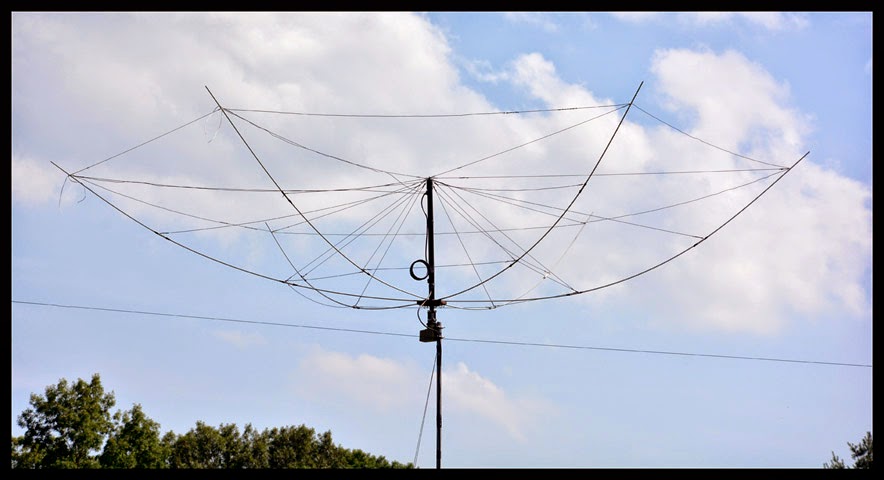
From there, I decided to spend the last bit of time that I could squeeze out of lunch break by calling CQ at the 15 Meter QRP Watering Hole on 21.060 MHz. I was greeted there by Alberto WP4L for another 2X QRP chat. Alberto was pushing 5 Watts out of his Yeasu FT-450 and sounded like he was just down the street. And I might add, another excellent fist that was bliss to copy.
If the flare that Marv e-mailed me about helped provide the kind of band conditions that I experienced today, then I hope we get them all the time! Loud signals, quiet background noise - what more could you want or ask for? The only bad thing was having to stop so that I could come back inside in order to finish the work day out.
72 de Larry W2LJ
QRP - When you care to senf the very least!
Rookie Roundup
Club member Dave KD2FSI, who qualifies as a Rookie by time, volunteered to set up the station. I say Dave qualifies as a Rookie by time, because by the rules of the contest, he does - he was licensed less than three years ago. However, he is certainly not a Rookie by experience. He has already upgraded to General and is a very busy Ham, diving headfirst into many different facets of the hobby, portable operations being one of his favorite. I wish I could take credit for steering him in that direction, but Dave discovered that joy on his own, without my help.
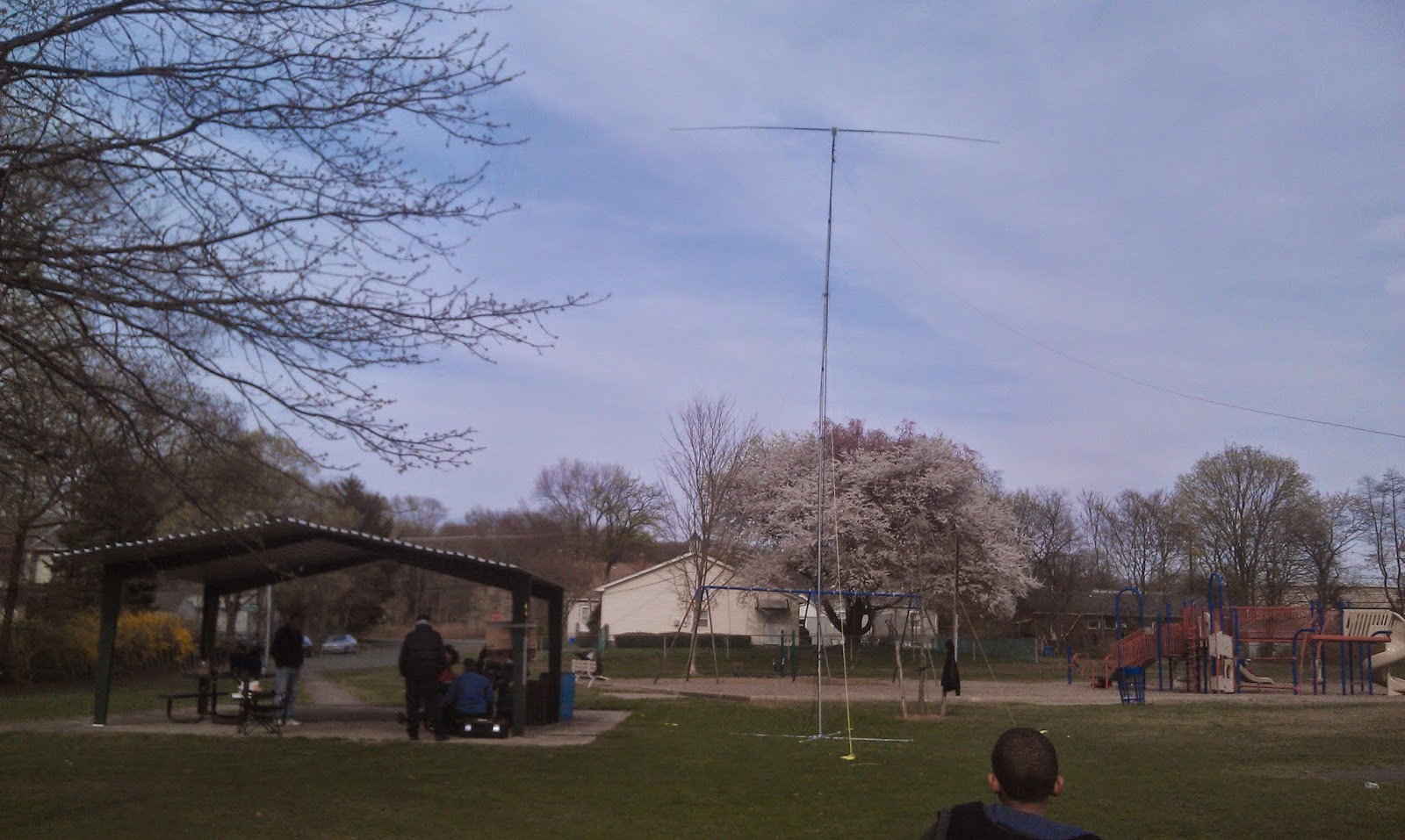
We had agreed to meet at Putnam Park in town at Noon, in order to set up for the 2:00 PM start. By the time I got there, Dave already had things quite well in hand.
Marv K2VHW and Drew W2OU served with distinction in the coaching perspective. Marv is quite the instructor. He has a gift and a natural talent for teaching and was able to make our Rookies feel like Old Pros in no time.
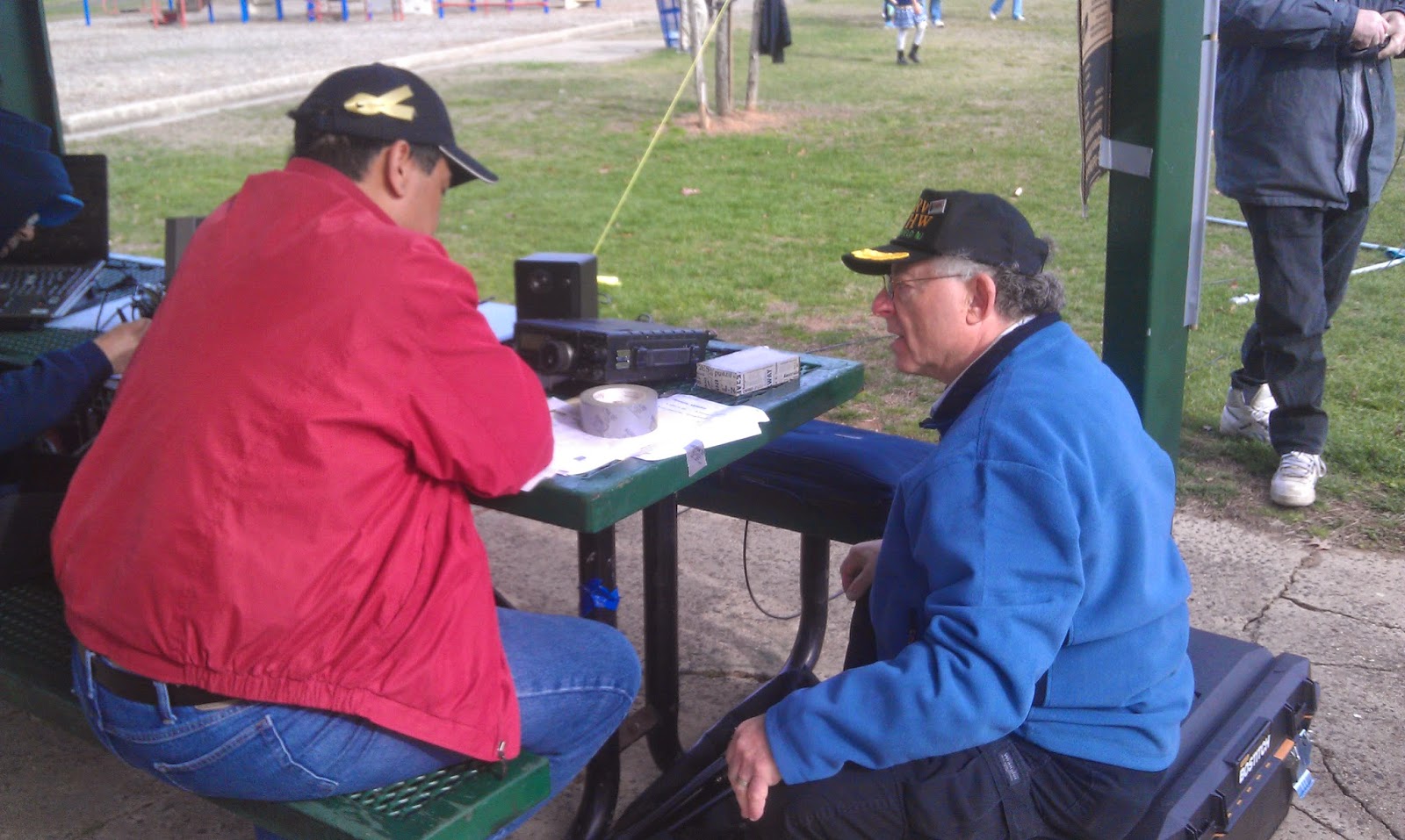
Here's a picture of Marv explaining to Mario the ins and outs of making a SSB Contest QSO. Mario made his very first HF QSO today, and the process was amazing to watch. The first few QSOs were halting and tentative, but due to Marv's excellent guidance, Mario was having a blast within short order.
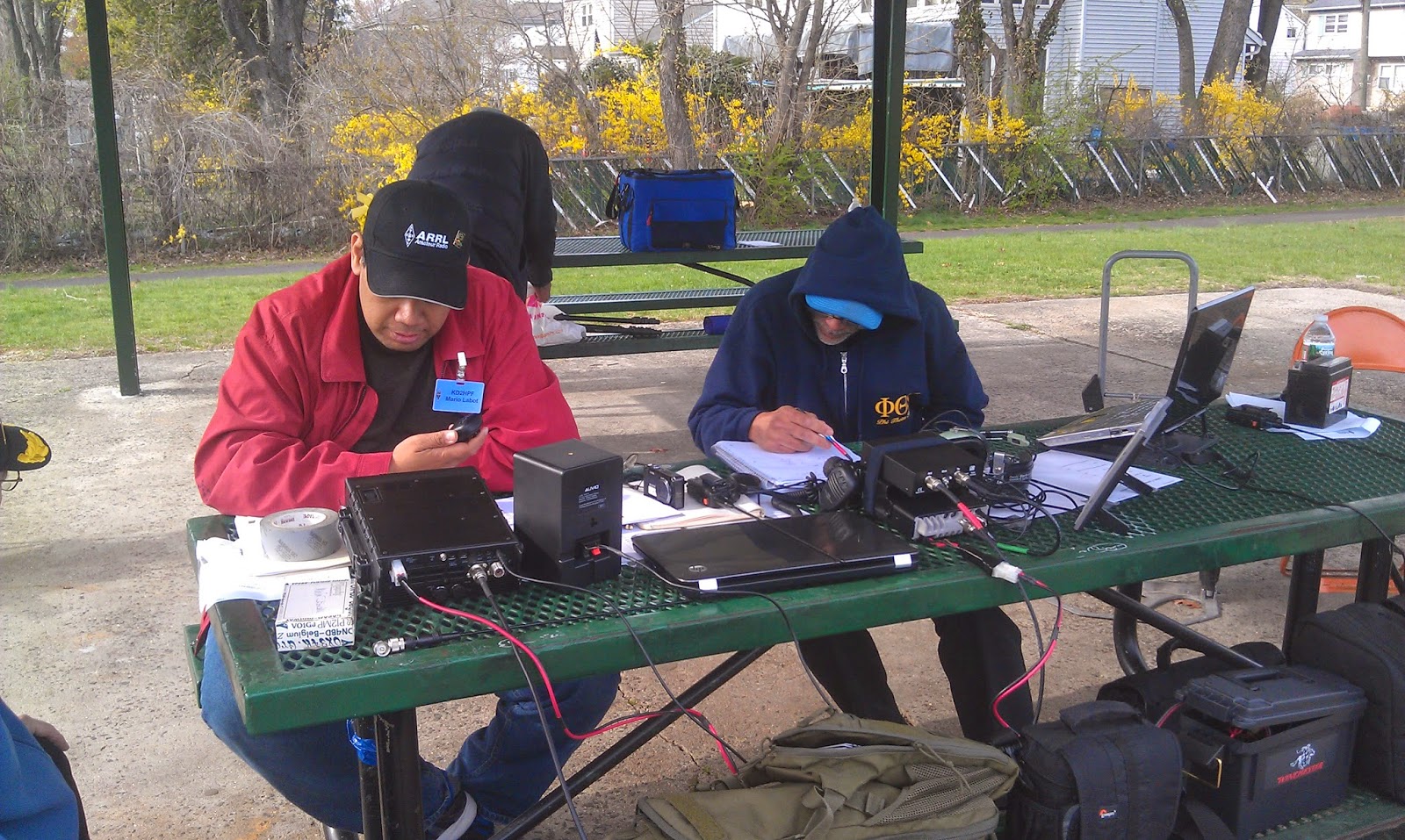
Within a short amount of time, our Rookies were able to handle QSO and logging chores while we stood in the background as control operators for NJ2SP.
The opportunity seemed golden. HF operating under portable ops conditions. With QRPTTF next weekend, how could I not bring the QRP gear along? It's always good to perform a test run, no?
I bungeed my 31' Jackite pole to a nearby post and set up the EARCHI antenna as a sloper.In between my stints as an HF coach, I went to town working stations on 20, 17, 15 and 10 Meters. A lot of the contacts were MM contest QSOs, but there was one ragchew in there, also. I worked
9A7R
ZW8T
OX3XR
CO8EH
WD4MSM - ragchew
KP2F
TM9B
EG8TRV - Special Event Station
HA8VK
Not bad for the time I had, in between helping with QSO procedures, serving as a helping set of ears, and talking with some of our other newly licensed Techs about equipment, making recommendations, etc.
The Rookies had a blast as well. 10 Meters was open to Texas and the West Coast and our newbies were amazed that "talking to a guy in Idaho" was as easy as talking to a guy on the local 2 Meter repeater - and that the guy in Idaho sounded better than the guy on the 2 Meter repeater!
In all it was a fun day. I'm not sure who had more fun - our new Techs in getting their feet wet in HF, or us veterans watching their fun and excitement. It was definitely rewarding, and I hope we pushed some people a little more deeper into this fine hobby.
72 de Larry W2LJ
QRP - When you care to send the very least!
Capturing our spirit
The devil is in the details and some might complain that some of the details in this commercial are not paid attention to - no call signs for instance. And some of the concepts are a bit stretched - did he buy that amplifier himself? But the basics are sound, and I think this little boy, Sam, captures our Amateur Radio spirit to a "T". At least I think so. What do you think?
Inverted High Frequency Loss with LMR-450G
By John ‘Miklor’ K3NXU
PERFORMANCE TESTS – LMR-450G
The recently announced LMR-450G cable has aroused much curiosity since its characteristics have not been collectively available by any one source. By multiple inquiries to several manufactures (only three at this time) and numerous lab tests, we hope to put many of the existing questions to rest.
DESCRIPTION
The physical make up of this cable varies slightly from most conventional RF cables. The center conductor is a semi-stranded copper alloy surrounded by Telfon, which will absorb and distribute cable ‘hot spots’ caused by excessive standing wave. The double silver braid and foil outer coating which provides a 98.6% shield is what the inverted high frequency loss characteristics are attributed. The loss is substantially less as the frequency increases, making this cable especially attractive for UHF, cellular, PCS and microwave applications.

Measuring cable loss under lab conditions
LOSS PER 100′
30 MHz 2.4 db
50 MHz 2.1 db
150 MHz 1.6 db
450 MHz 1.1 db
800 MHz .51 db
1200 MHz .37 db
1950 MHz .31 db
The cable’s most unique property is attributed to the outer jacket material Neo-glow, an RF sensitive composite plastic which will visibly indicate RF ‘hot spots’ in the cable. Adjusting the cable length to the antenna system for the ‘perfect’ impedance match is crucial at high frequency, thus the importance of a low SWR for peak performance.

From 100 Watts and up this cable will brighten up your world.
PROPER INSTALLATION
The low level emission of light from LMR-450G cable can be enhanced by wearing lightly tinted sunglasses with UV protection, which enhances the light radiation from the cable. Select an approximate length of cable needed for the installation which must be multiples of a 1/4 wavelength for the desired frequency. The exact length can be determined by using the formula 467 / Freq (MHz) plus approximately 18 inches.
The initial tests should be run with a 50 ohm dummy load at one end of the cable. With a minimum of 7 watts from the transmitter, you will see a faint glow from the cable indicating the ‘hot spots’ to be eliminated. These are the points along the cable where the RF is at its maximum. It is at these points where the RF connectors should be mounted. Trimming the excess cable may be required at both ends of the cable to produce the most effective match. Use caution not to trim too much cable as the loss characteristics improve with longer cable lengths.
SUMMARY
This could be the beginning of the long awaited high frequency “SUPER” cables. Only available in limited quantities at this time; contact your local cable supplier for more details.


Inverted High Frequency Loss with LMR-450G
By John ‘Miklor’ K3NXU
PERFORMANCE TESTS – LMR-450G
The recently announced LMR-450G cable has aroused much curiosity since its characteristics have not been collectively available by any one source. By multiple inquiries to several manufactures (only three at this time) and numerous lab tests, we hope to put many of the existing questions to rest.
DESCRIPTION
The physical make up of this cable varies slightly from most conventional RF cables. The center conductor is a semi-stranded copper alloy surrounded by Telfon, which will absorb and distribute cable ‘hot spots’ caused by excessive standing wave. The double silver braid and foil outer coating which provides a 98.6% shield is what the inverted high frequency loss characteristics are attributed. The loss is substantially less as the frequency increases, making this cable especially attractive for UHF, cellular, PCS and microwave applications.
Measuring cable loss under lab conditions
LOSS PER 100′
30 MHz 2.4 db
50 MHz 2.1 db
150 MHz 1.6 db
450 MHz 1.1 db
800 MHz .51 db
1200 MHz .37 db
1950 MHz .31 db
The cable’s most unique property is attributed to the outer jacket material Neo-glow, an RF sensitive composite plastic which will visibly indicate RF ‘hot spots’ in the cable. Adjusting the cable length to the antenna system for the ‘perfect’ impedance match is crucial at high frequency, thus the importance of a low SWR for peak performance.
From 100 Watts and up this cable will brighten up your world.
PROPER INSTALLATION
The low level emission of light from LMR-450G cable can be enhanced by wearing lightly tinted sunglasses with UV protection, which enhances the light radiation from the cable. Select an approximate length of cable needed for the installation which must be multiples of a 1/4 wavelength for the desired frequency. The exact length can be determined by using the formula 467 / Freq (MHz) plus approximately 18 inches.
The initial tests should be run with a 50 ohm dummy load at one end of the cable. With a minimum of 7 watts from the transmitter, you will see a faint glow from the cable indicating the ‘hot spots’ to be eliminated. These are the points along the cable where the RF is at its maximum. It is at these points where the RF connectors should be mounted. Trimming the excess cable may be required at both ends of the cable to produce the most effective match. Use caution not to trim too much cable as the loss characteristics improve with longer cable lengths.
SUMMARY
This could be the beginning of the long awaited high frequency “SUPER” cables. Only available in limited quantities at this time; contact your local cable supplier for more details.













