Posts Tagged ‘amateurradio.com’
 Made my first satellite QSO
 October 2nd, 2015 |
  Author:
 As well as flying a high altitude balloon another of my aims this year was to finally make a satellite QSO. Pleased to say last night I finally achieved it!
Last month Abdel Mesbah M0NPT chairman of the Hucknall Rolls-Royce ARC came to South Kesteven ARS to give an informative talk on operating amateur radio satellites. Abdel was the first UK operator to receive the AMSAT-UK 73 on 73 award for making 73 confirmed contacts via the FUNCube satellite AO-73. http://amsat-uk.org/2015/01/28/abdel-m0npt-73-on-73-award/
Abdel explained all the current active satellites, how to work through them and gave hints and described techniques for achieving success on this more challenging mode of operation.
Spurred on I opted to target the SO-50 satellite which until very recently this was the only satellite carrying a FM transponder. The satellite receives on 145.850 MHz and retransmits them on 436.800 MHz (+/- 10 kHz Doppler shift). Operation requires the use of CTCSS (PL) tones of 74.4 Hz which starts a 10 minute timer and then a 67 Hz tone used for the contact. More details of how to operate and a video are on the AMSAT-UK website
I initially tried using just a suitably programmed Baofeng UV-5R with a NA771 whip and could clearly hear the downlink on higher passes, I called a few times with no luck.
I hadn't monitored SO-50 much before and sadly it seems to suffer from very poor operating, with stations calling over contacts in progress, or stations continually calling CQ CQ seemingly oblivious to any reply and those that just keep calling "hola hola hola" for whatever bizarre reason! I would be lucky to get through the QRM with just the whip so I needed a better antenna.
Despite being extremely busy at the National Hamfest last weekend I did manage to get hold of a dual band Yagi that was reasonably lightweight for hand held use and capable of being easily dismantled for transporting. (The Moonraker YG27-35 Dual Band) it has a single feed point and two adjustable gamma match sliders and was easy to adjust using my analyser.
It has a single feed and I tried it with the Baofeng and reception of the downlink was excellent, again on a couple of passes I tried answering calls with no success.
Last night I decided to try again but with the FT-857D set at 10W output. I put it on a small workbench in the garden and powered it from my portable SLA battery. I ran split operation with the 2m Tx VFO set at 145.850MHz with 67Hz CTCSS, the 70cm Rx VFO set at 436.800Mhz I was able to adjusted it down in 5kHz steps during the pass. I got the wife to take a picture while I was operating.

As I started to hear the downlink I heard Abdel M0NPT calling and answered him, I was shocked when he came back and we exchanging details - that was it I had made my first QSO via an amateur radio satellite! Then amazingly other stations started calling me and I was able to also work DO2SYD.
I did manage to record it on a small dictaphone (did have a bit of a brain fade with my callsign at one point!)
I could get hooked on this... There is also the new LilacSat-2 (CAS-3H) satellite with a FM transponder to try to work!So much to do, so little time...
Last month Abdel Mesbah M0NPT chairman of the Hucknall Rolls-Royce ARC came to South Kesteven ARS to give an informative talk on operating amateur radio satellites. Abdel was the first UK operator to receive the AMSAT-UK 73 on 73 award for making 73 confirmed contacts via the FUNCube satellite AO-73. http://amsat-uk.org/2015/01/28/abdel-m0npt-73-on-73-award/
Abdel explained all the current active satellites, how to work through them and gave hints and described techniques for achieving success on this more challenging mode of operation.
Spurred on I opted to target the SO-50 satellite which until very recently this was the only satellite carrying a FM transponder. The satellite receives on 145.850 MHz and retransmits them on 436.800 MHz (+/- 10 kHz Doppler shift). Operation requires the use of CTCSS (PL) tones of 74.4 Hz which starts a 10 minute timer and then a 67 Hz tone used for the contact. More details of how to operate and a video are on the AMSAT-UK website
I initially tried using just a suitably programmed Baofeng UV-5R with a NA771 whip and could clearly hear the downlink on higher passes, I called a few times with no luck.
I hadn't monitored SO-50 much before and sadly it seems to suffer from very poor operating, with stations calling over contacts in progress, or stations continually calling CQ CQ seemingly oblivious to any reply and those that just keep calling "hola hola hola" for whatever bizarre reason! I would be lucky to get through the QRM with just the whip so I needed a better antenna.
Despite being extremely busy at the National Hamfest last weekend I did manage to get hold of a dual band Yagi that was reasonably lightweight for hand held use and capable of being easily dismantled for transporting. (The Moonraker YG27-35 Dual Band) it has a single feed point and two adjustable gamma match sliders and was easy to adjust using my analyser.
It has a single feed and I tried it with the Baofeng and reception of the downlink was excellent, again on a couple of passes I tried answering calls with no success.
Last night I decided to try again but with the FT-857D set at 10W output. I put it on a small workbench in the garden and powered it from my portable SLA battery. I ran split operation with the 2m Tx VFO set at 145.850MHz with 67Hz CTCSS, the 70cm Rx VFO set at 436.800Mhz I was able to adjusted it down in 5kHz steps during the pass. I got the wife to take a picture while I was operating.

As I started to hear the downlink I heard Abdel M0NPT calling and answered him, I was shocked when he came back and we exchanging details - that was it I had made my first QSO via an amateur radio satellite! Then amazingly other stations started calling me and I was able to also work DO2SYD.
I did manage to record it on a small dictaphone (did have a bit of a brain fade with my callsign at one point!)
I could get hooked on this... There is also the new LilacSat-2 (CAS-3H) satellite with a FM transponder to try to work!So much to do, so little time...
Hamfest Balloon – Some analysis
I contacted some local and national newspapers about the flight but with little response. The Register IT news website did put an article on http://www.theregister.co.uk/2015/09/28/pigs_in_spaaaace
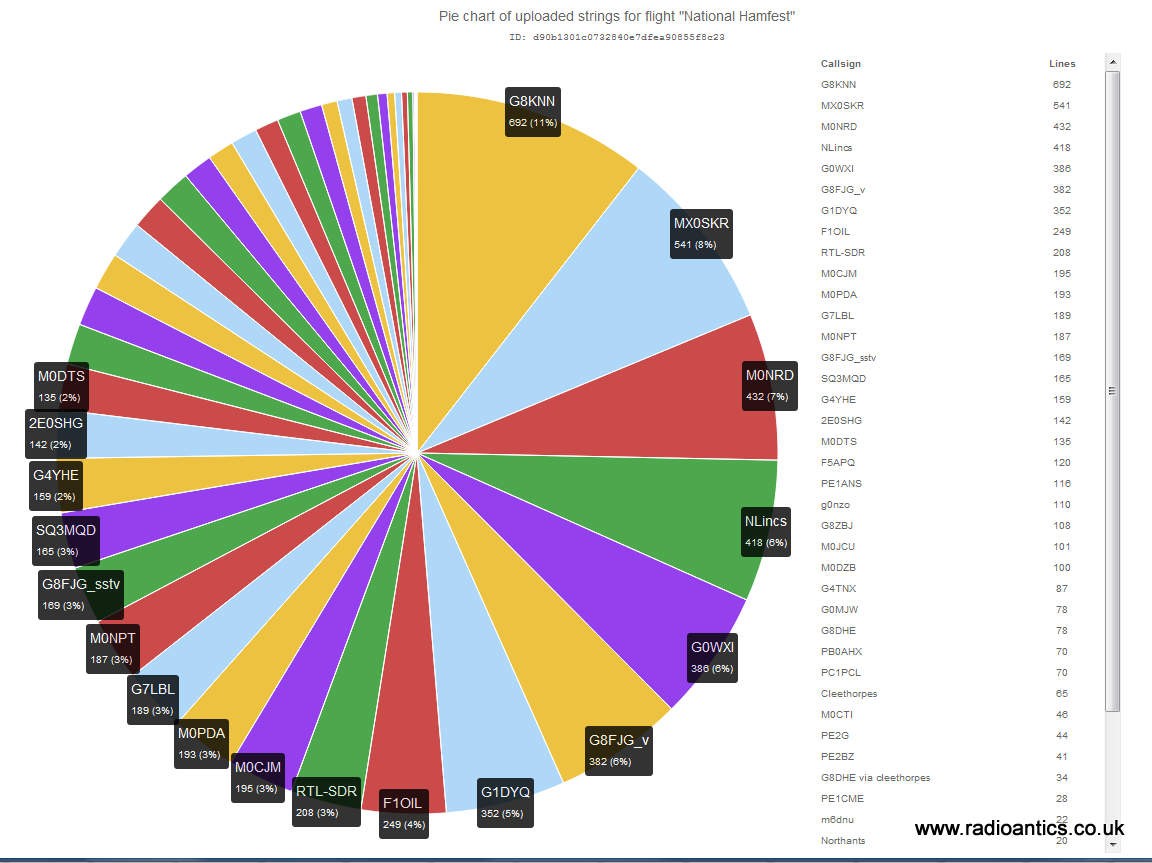
I checked out the telemetry statistics on http://habitat.habhub.org/stats/ and was impressed with the number of people who tracked (as can be seen in the pie chart below) I know that several interested parties have since visited the UKHAS wiki and have been asking questions on the IRC channel on how to do a flight and/or develop their own trackers. Naturally I have also been thinking about some possible future flights.
While the novelty of flying something into space, be it a toy pig or an egg is satisfying I would like to make any future flight serve some purpose, whether collecting more data or ideally doing some experiment with radio even if it within the constraints of the UK draconian regulations when operating in the air!
One set of data I did extract was the temperature profile during the flight. PINKY had two sensors, one internal to the Styrofoam box, the other external. PIGLET also had a temperature/pressure sensor but it was giving odd readings during the flight so have ignored that.
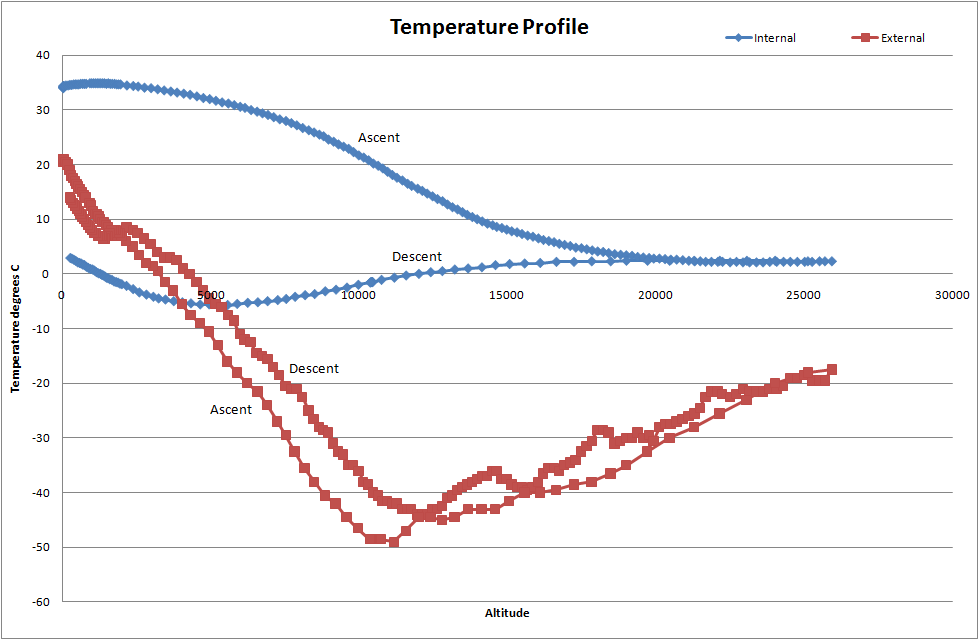
The graph shows internal/external temperature recorded by PINKY against altitude, there are two plots for each showing the ascent profile and the decent. The lowest temperature recorded by the external temperature was -49.5°C (-57.1°F) and the foam did a good job of insulating the internal electronics, though it drop below 0°C during the decent.
One thing I will do on the next flight (if it happens) is take a lot more photographs, using a 32GB memory card I could have held a lot more images. Also I will look at embedding the GPS coordinates (geotagging) into the image files.
I will also put on board a video camera, I did purchase a cheap dash cam type for £20 one off eBay for the Eggsplorer-1 but didn't use it because of sea-landing, I need to sort out powering it as the internal battery wouldn't last for the duration of the flight.
I have still to investigate the issues with the LoRa as to why it failed. This weekend Dave Akerman is flying three balloons in succession with LoRa tracker modules. They will be set up to work in a mesh, receiving and repeat each others telemetry. Sounds an interesting experiment, I will have to set my LoRa gateway back up and attempt to receive them.
Hamfest Balloon – Some analysis
I contacted some local and national newspapers about the flight but with little response. The Register IT news website did put an article on http://www.theregister.co.uk/2015/09/28/pigs_in_spaaaace
I checked out the telemetry statistics on http://habitat.habhub.org/stats/ and was impressed with the number of people who tracked (as can be seen in the pie chart below) I know that several interested parties have since visited the UKHAS wiki and have been asking questions on the IRC channel on how to do a flight and/or develop their own trackers. Naturally I have also been thinking about some possible future flights.
While the novelty of flying something into space, be it a toy pig or an egg is satisfying I would like to make any future flight serve some purpose, whether collecting more data or ideally doing some experiment with radio even if it within the constraints of the UK draconian regulations when operating in the air!
One set of data I did extract was the temperature profile during the flight. PINKY had two sensors, one internal to the Styrofoam box, the other external. PIGLET also had a temperature/pressure sensor but it was giving odd readings during the flight so have ignored that.
The graph shows internal/external temperature recorded by PINKY against altitude, there are two plots for each showing the ascent profile and the decent. The lowest temperature recorded by the external temperature was -49.5°C (-57.1°F) and the foam did a good job of insulating the internal electronics, though it drop below 0°C during the decent.
One thing I will do on the next flight (if it happens) is take a lot more photographs, using a 32GB memory card I could have held a lot more images. Also I will look at embedding the GPS coordinates (geotagging) into the image files.
I will also put on board a video camera, I did purchase a cheap dash cam type for £20 one off eBay for the Eggsplorer-1 but didn't use it because of sea-landing, I need to sort out powering it as the internal battery wouldn't last for the duration of the flight.
I have still to investigate the issues with the LoRa as to why it failed. This weekend Dave Akerman is flying three balloons in succession with LoRa tracker modules. They will be set up to work in a mesh, receiving and repeat each others telemetry. Sounds an interesting experiment, I will have to set my LoRa gateway back up and attempt to receive them.
Hamfest HAB Flight – Mission Debrief

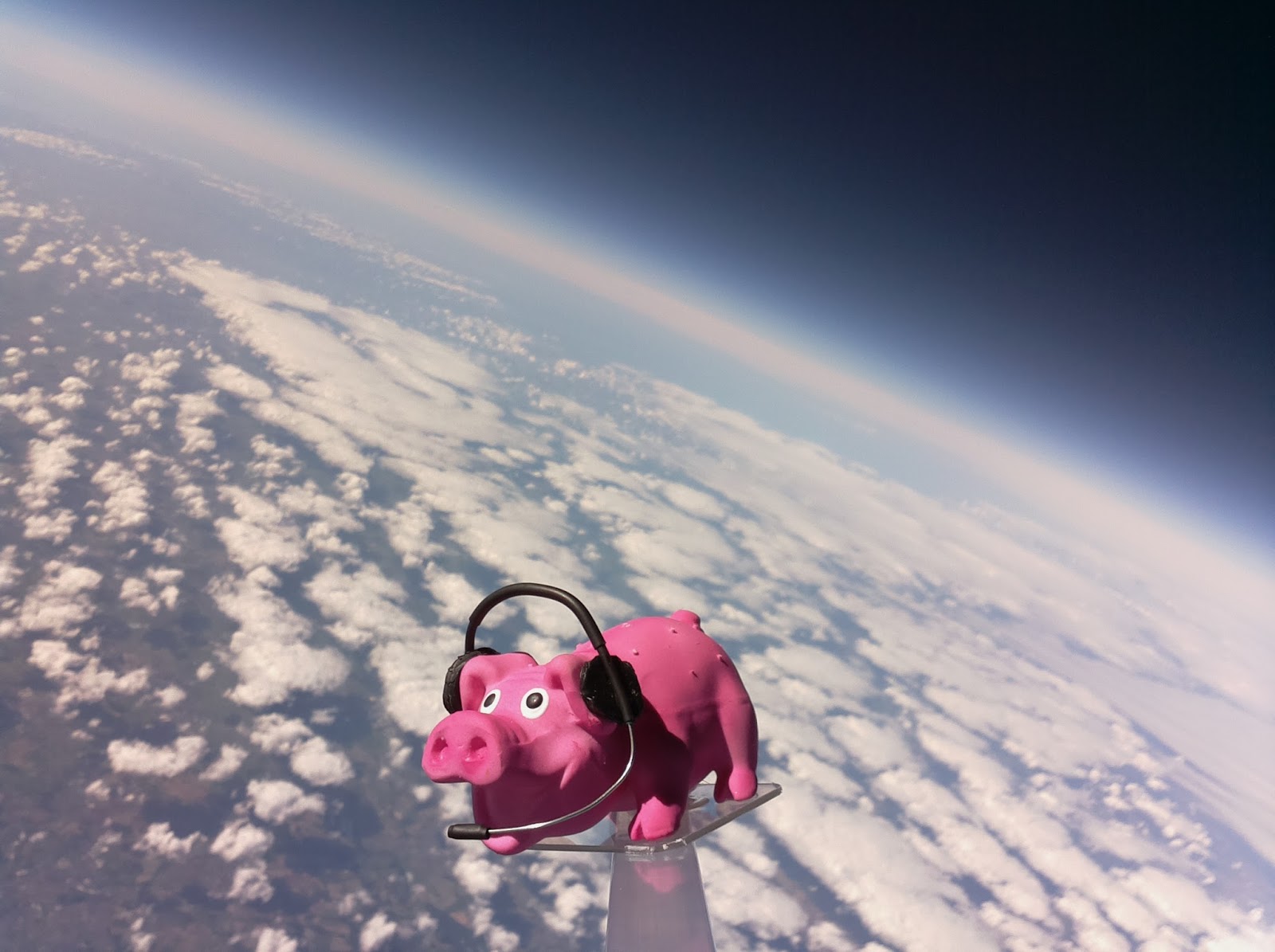
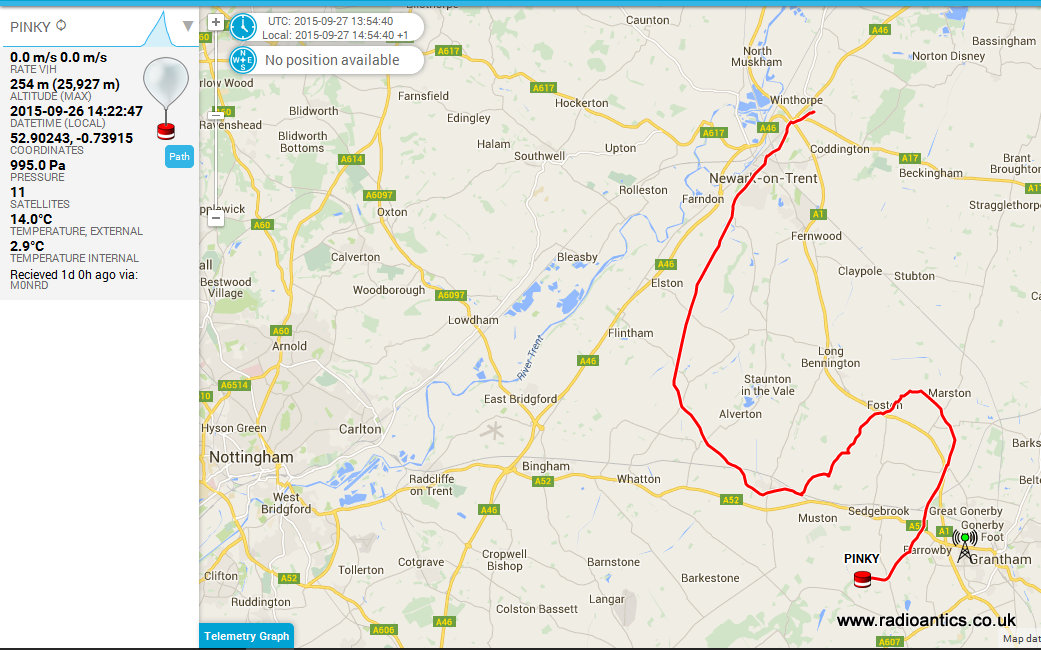
The National Hamfest high altitude balloon flew on Saturday and Pinky Pig reached a maximum altitude of nearly 26km (25,927m / 96,873 feet) as pictured above.
The flight originally planned for Friday had to be postponed due to wind direction and restrictions but I had sort approval for both days and was able to fly on Saturday. The conditions were perfect on launch day, clear blue sky with little cloud and almost no wind. Flight prediction put it landing around 25km away.
Both payload trackers worked flawlessly, PINKY the high speed RTTY successfully sent SSDV as well as telemetry and the backup tracker PIGLET sent the slow speed RTTY telemetry. Trackers from all over the UK as well as France, Holland and Poland received data and uploaded data to the UKHAS website.
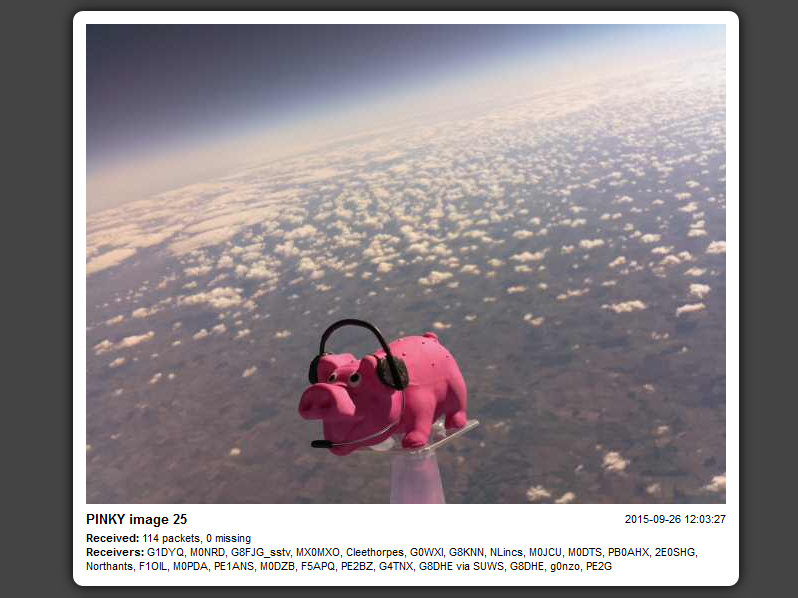
The received SSDV images can be seen at http://ssdv.habhub.org/PINKY
The flight path can be seen below
The flight can be seen visualised in Google Earth below and while the 26km altitude was impressive it was around 4km less than I'd planned.

The launch certainly created a great deal of interest at the Hamfest, on the Friday we setup the club tent for South Kesteven ARS with a tracking station and demonstrated the payloads to interested visitors. Stewart (M0SDM) used his Land Rover with a push up mast for a pair of collinear X-50s so we could receive and decode. The mast and the Land Rover generated just as much interest.
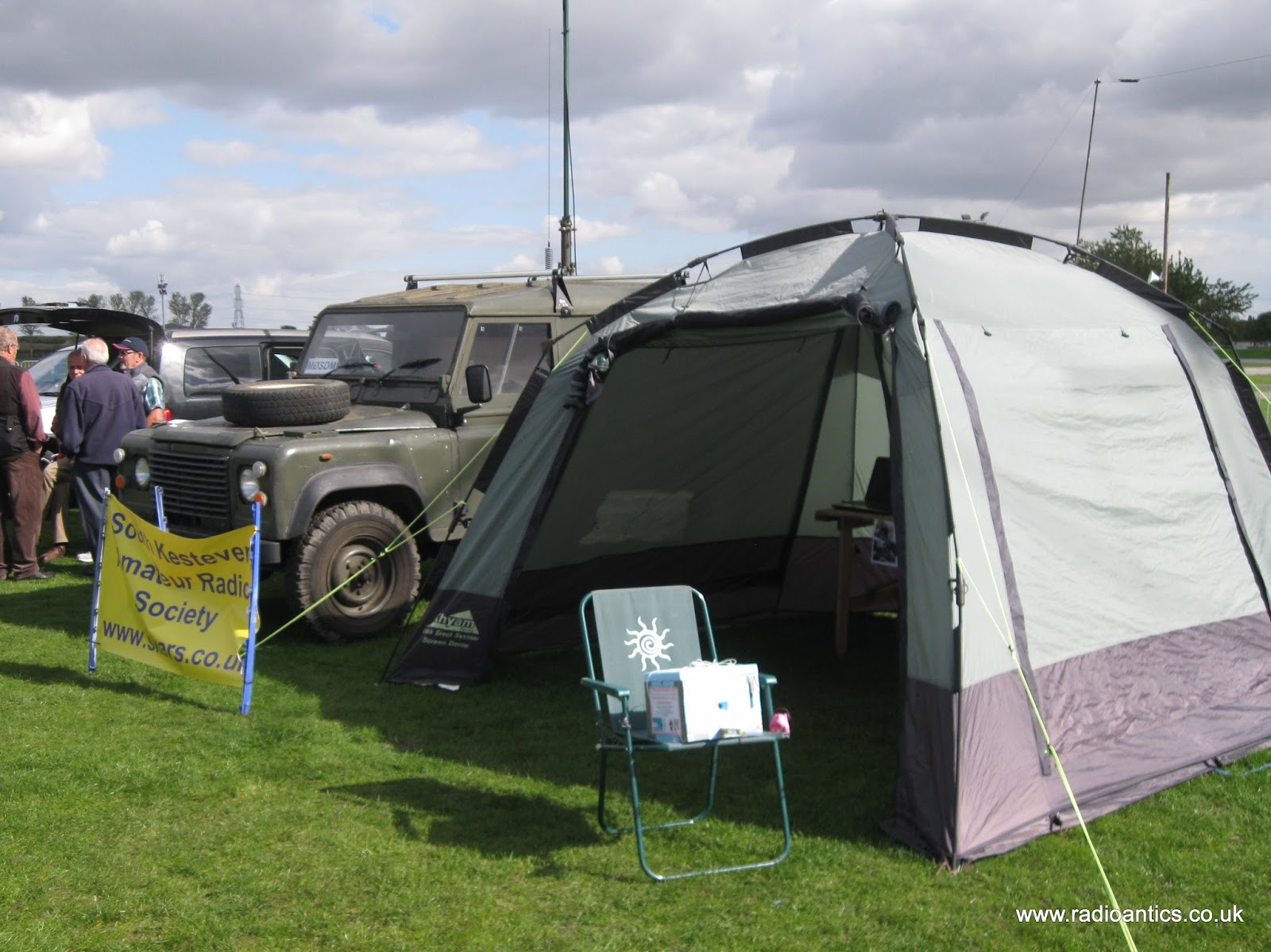
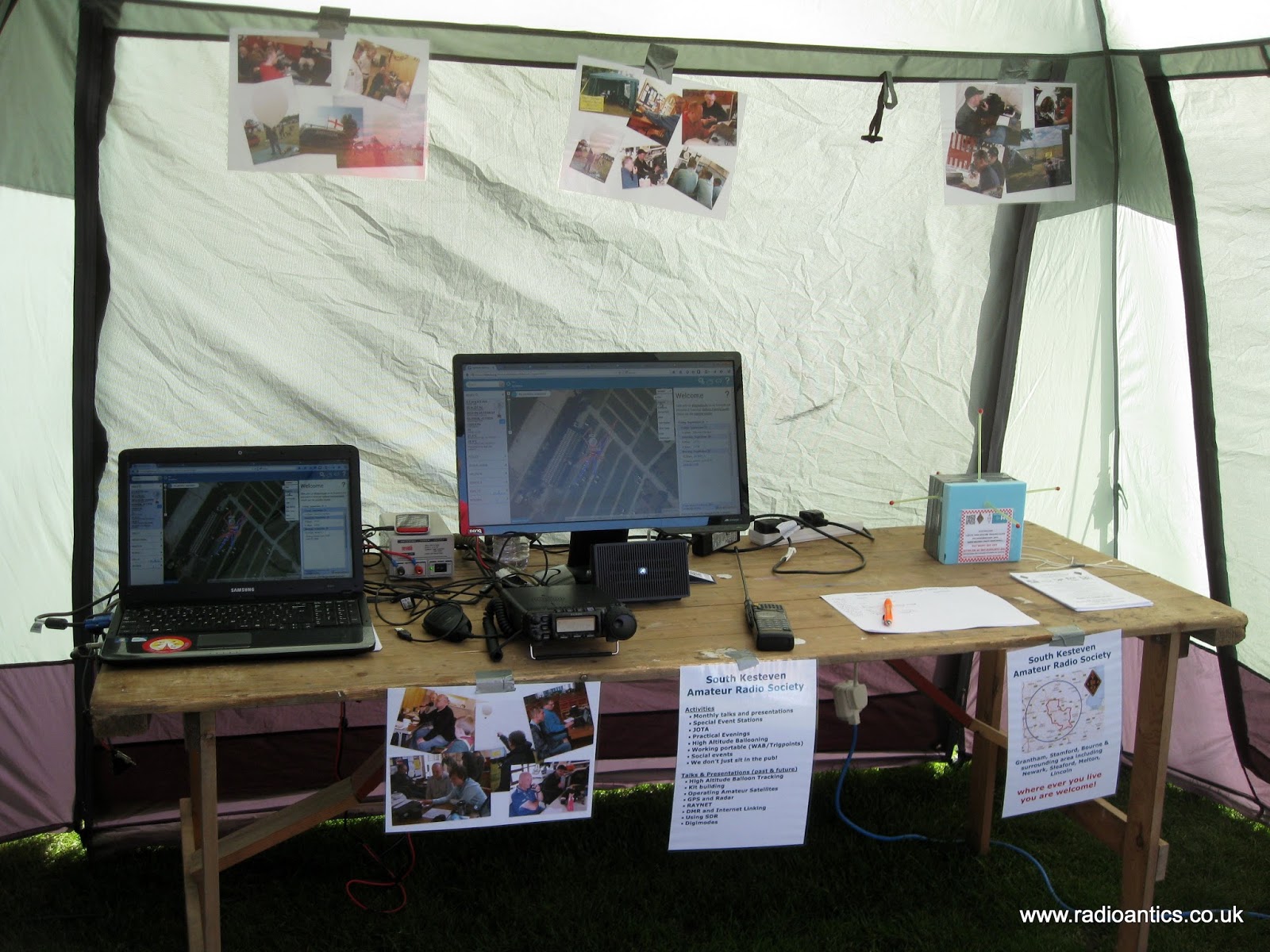
On the Saturday I was assisted by my brother David (M6GTD) and just before noon began filling the balloon watched by a large crowd, as can be seen on Dave's (M0TAZ) blog http://m0taz.co.uk/2015/09/national-hamfest-2015/
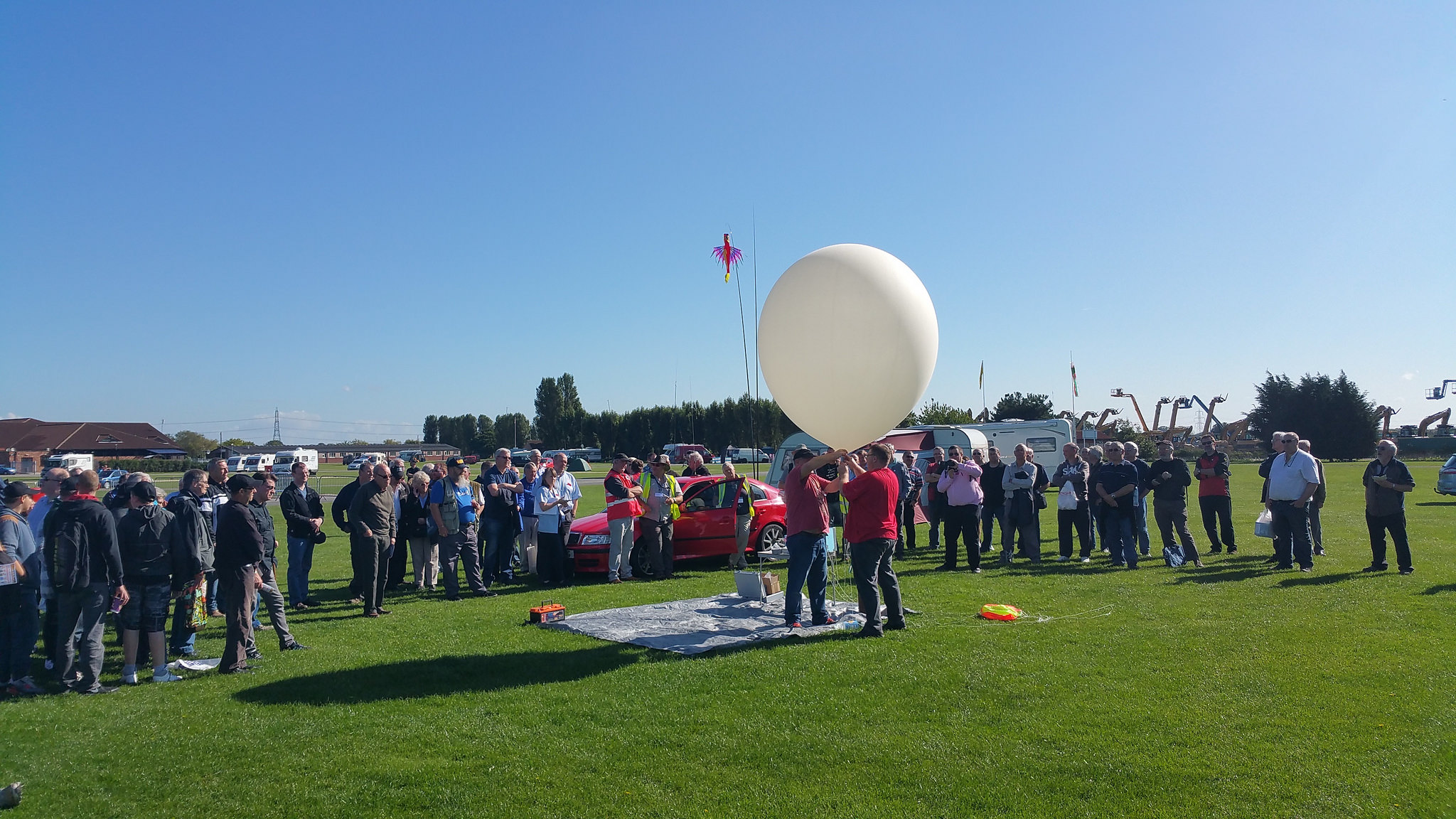 |
| Picture by Dave M0TAZ |
Once filled to give the correct lift I sealed it off and checked everything was working then without a breath of wind slowly let the balloon rise, taking the weight of the payloads and once I was sure there were no aircraft flying nearby I let her go. The sky was clear and the balloon went up near vertically and could be seen for quite a long time as it ascended. Representatives of the RSGB and RadCom were in attendance to take photos and did a quick interview.
The tracking station was then full of people as the telemetry and pictures started to be received. It was great to see the huge interest in the balloon.
As the balloon started to near the planned maximum altitude I began to get ready to set off to recover it then suddenly I was told it had burst sooner than expected. I got a hurry up at which point the laptop and mobile connection decided to stop working! However I knew where to head off with my poor brother trying to sort it out as I drove.
Stewart telephoned and gave me directions of where the live prediction and tracking had put the landing spot. My wife also set off from home to come and assist. In the car we were receiving a signal but were struggling to decode and couldn't get on the internet to check the tracking.
I eventually pulled up near the landing zone, while trying to decode the weak signal another car pulled up with two radio amateurs who had been tracking the balloon. I was a little preoccupied and they eventually said they were off and wished us luck. I then realised we were the wrong side of the hill and turned around and drove up to the top and the signal strength increased.
Stewart had phoned to tell me to find the Viking way footpath, as we reached ground zero we saw the other amateurs car and they were setting off down the footpath! It was my flight I wanted to be the first to find it!
My wife then pulled up and was about to set off after them! Then I started getting successful decodes! With the new landing position in the GPS my wife raced off in hot pursuit as I sorted out the car and then followed her with my brother. It was a reasonable walk of around 800m and as we got near it became apparent the other team had been using the online tracker and had only got the last received position which had been sent from around 254m altitude. However the payload was still transmitting strongly and we were decoding it and it was reporting it was in fact at 115m altitude - they were therefore several hundred meters in the wrong direction.
Our accurate location gave us the edge and a quick hop up a bank into a stubble field and a 200m jog my brother spotted the parachute... we had found Pinky and Piglet and got there first!
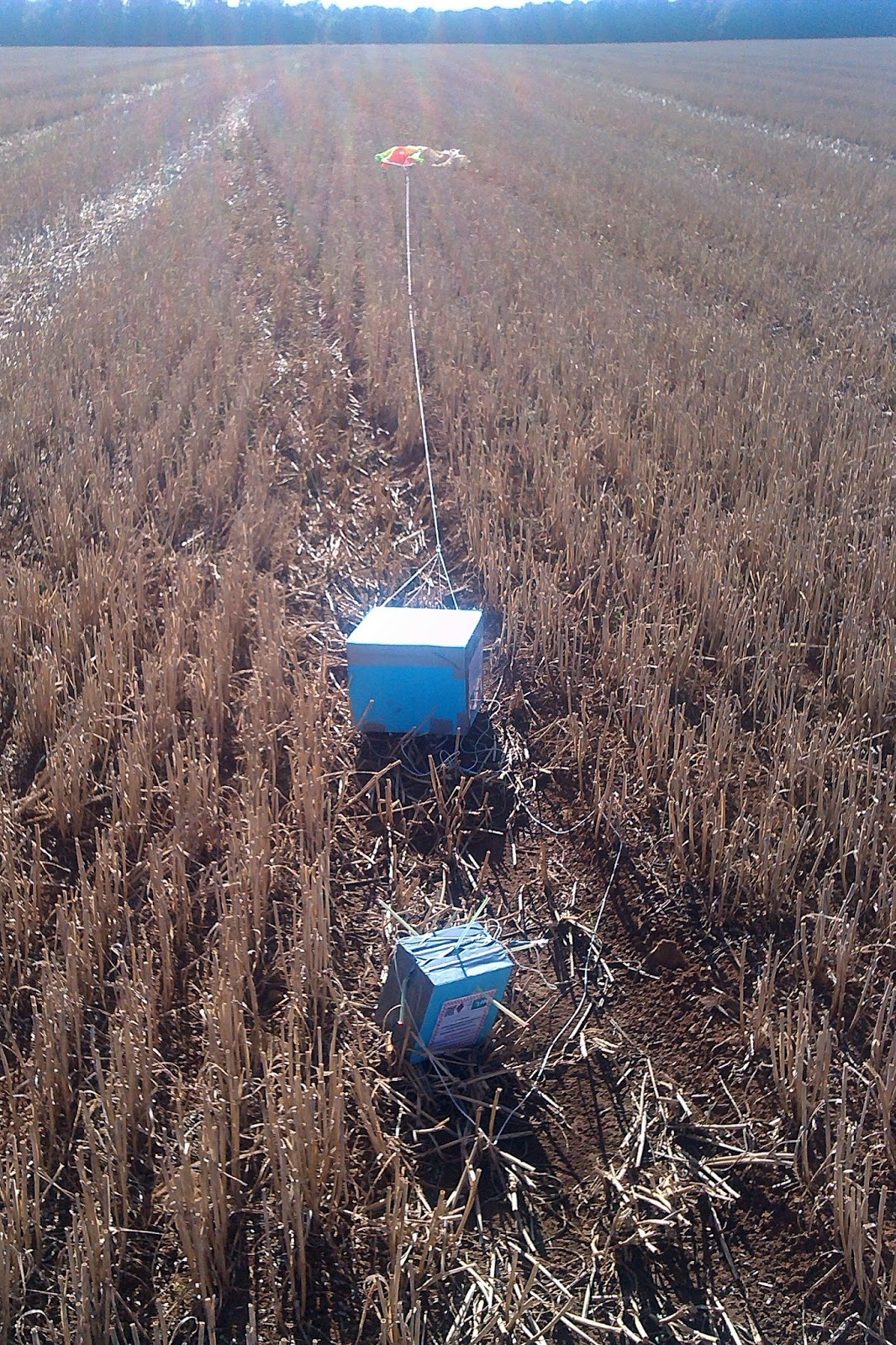
I was surprised to find most of the balloon still attached, it hadn't so much burst as split in a single tear

The payloads had no damage, other than the antenna being bent by the landing

PIGLET had landed as planned and tested, I had put the battery pack at the top of the box the top heavy center of gravity causing it to roll on landing so the antenna would be upright. It was in a perfect orientation hence the strong signal.

The other chase team turned up and congratulated us then left... my apologies but I was in my own little happy place to be sociable. We then then had the obligatory team photograph before setting back to the Hamfest.
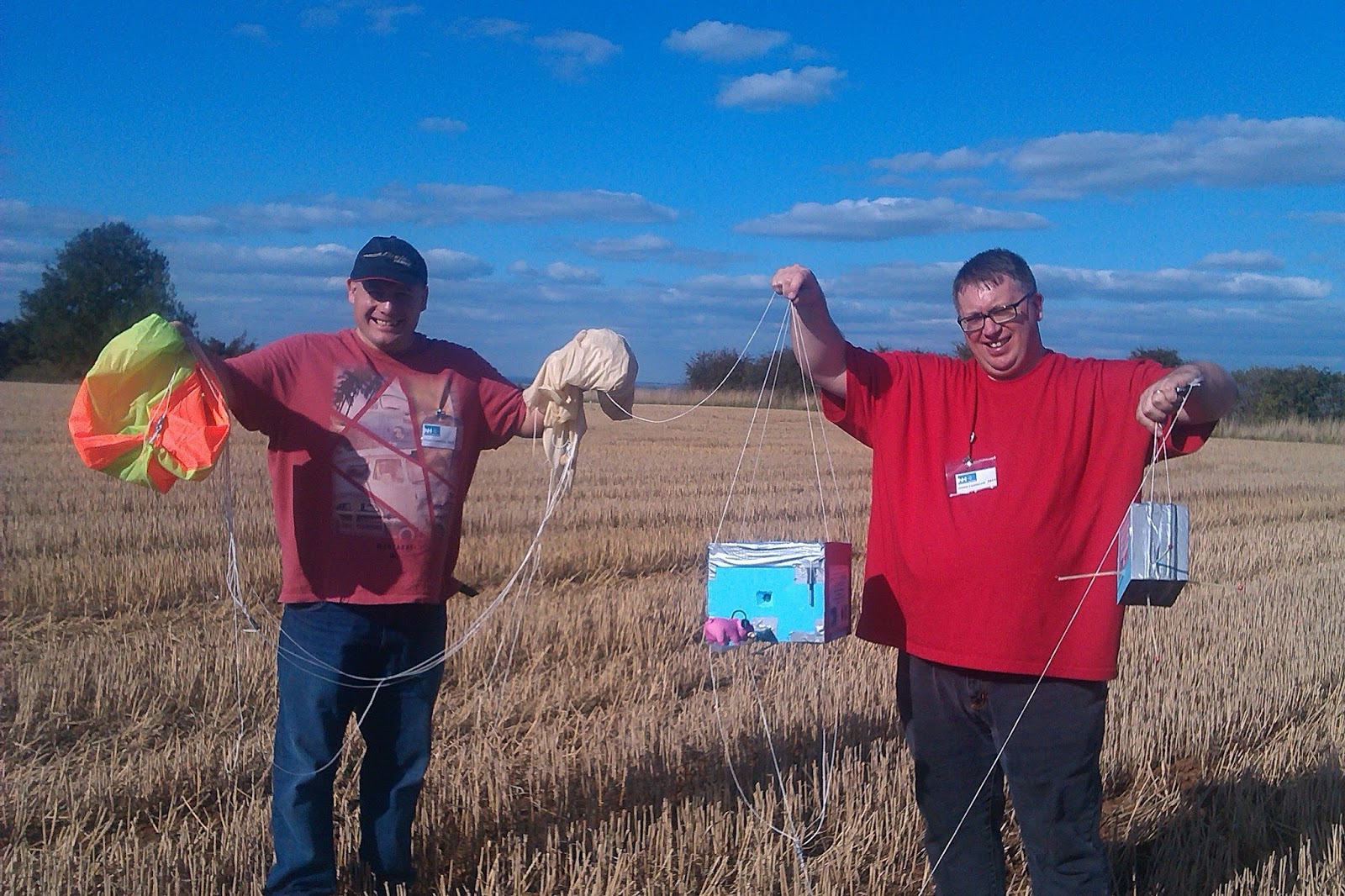
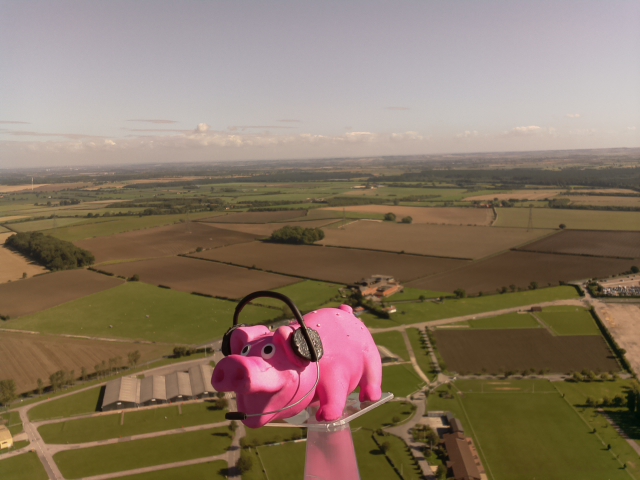
It has been an excellent experience and adventure. The pictures are better than I could have hoped for! Thanks to my understanding wife, my brother David and Stewart for setting up the antennas for the tracking station and manning it on his own while we went off to recover the payload.
Thanks to the organisers of the National Hamfest and Graham Boor (G8NWC) for asking me to do the flight and helping fund the venture and I hope it succeeded in publicising the event and the hobby.
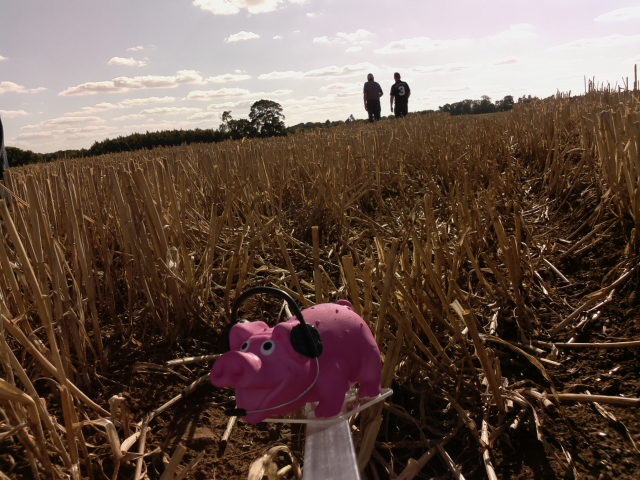
I have now downloaded all the photographs from the onboard camera and they can been in my Flickr album at https://www.flickr.com/photos/nerdsville/sets/72157658732989849

Updated - I realised I didn't put the actual landing position on this post, so here it is


Hamfest HAB Flight – Mission Debrief
The National Hamfest high altitude balloon flew on Saturday and Pinky Pig reached a maximum altitude of nearly 26km (25,927m / 96,873 feet) as pictured above.
The flight originally planned for Friday had to be postponed due to wind direction and restrictions but I had sort approval for both days and was able to fly on Saturday. The conditions were perfect on launch day, clear blue sky with little cloud and almost no wind. Flight prediction put it landing around 25km away.
Both payload trackers worked flawlessly, PINKY the high speed RTTY successfully sent SSDV as well as telemetry and the backup tracker PIGLET sent the slow speed RTTY telemetry. Trackers from all over the UK as well as France, Holland and Poland received data and uploaded data to the UKHAS website.
The received SSDV images can be seen at http://ssdv.habhub.org/PINKY
The flight path can be seen below
The flight can be seen visualised in Google Earth below and while the 26km altitude was impressive it was around 4km less than I'd planned.
The launch certainly created a great deal of interest at the Hamfest, on the Friday we setup the club tent for South Kesteven ARS with a tracking station and demonstrated the payloads to interested visitors. Stewart (M0SDM) used his Land Rover with a push up mast for a pair of collinear X-50s so we could receive and decode. The mast and the Land Rover generated just as much interest.
On the Saturday I was assisted by my brother David (M6GTD) and just before noon began filling the balloon watched by a large crowd, as can be seen on Dave's (M0TAZ) blog http://m0taz.co.uk/2015/09/national-hamfest-2015/
|
| Picture by Dave M0TAZ |
Once filled to give the correct lift I sealed it off and checked everything was working then without a breath of wind slowly let the balloon rise, taking the weight of the payloads and once I was sure there were no aircraft flying nearby I let her go. The sky was clear and the balloon went up near vertically and could be seen for quite a long time as it ascended. Representatives of the RSGB and RadCom were in attendance to take photos and did a quick interview.
The tracking station was then full of people as the telemetry and pictures started to be received. It was great to see the huge interest in the balloon.
As the balloon started to near the planned maximum altitude I began to get ready to set off to recover it then suddenly I was told it had burst sooner than expected. I got a hurry up at which point the laptop and mobile connection decided to stop working! However I knew where to head off with my poor brother trying to sort it out as I drove.
Stewart telephoned and gave me directions of where the live prediction and tracking had put the landing spot. My wife also set off from home to come and assist. In the car we were receiving a signal but were struggling to decode and couldn't get on the internet to check the tracking.
I eventually pulled up near the landing zone, while trying to decode the weak signal another car pulled up with two radio amateurs who had been tracking the balloon. I was a little preoccupied and they eventually said they were off and wished us luck. I then realised we were the wrong side of the hill and turned around and drove up to the top and the signal strength increased.
Stewart had phoned to tell me to find the Viking way footpath, as we reached ground zero we saw the other amateurs car and they were setting off down the footpath! It was my flight I wanted to be the first to find it!
My wife then pulled up and was about to set off after them! Then I started getting successful decodes! With the new landing position in the GPS my wife raced off in hot pursuit as I sorted out the car and then followed her with my brother. It was a reasonable walk of around 800m and as we got near it became apparent the other team had been using the online tracker and had only got the last received position which had been sent from around 254m altitude. However the payload was still transmitting strongly and we were decoding it and it was reporting it was in fact at 115m altitude - they were therefore several hundred meters in the wrong direction.
Our accurate location gave us the edge and a quick hop up a bank into a stubble field and a 200m jog my brother spotted the parachute... we had found Pinky and Piglet and got there first!
I was surprised to find most of the balloon still attached, it hadn't so much burst as split in a single tear
The payloads had no damage, other than the antenna being bent by the landing
PIGLET had landed as planned and tested, I had put the battery pack at the top of the box the top heavy center of gravity causing it to roll on landing so the antenna would be upright. It was in a perfect orientation hence the strong signal.
The other chase team turned up and congratulated us then left... my apologies but I was in my own little happy place to be sociable. We then then had the obligatory team photograph before setting back to the Hamfest.
It has been an excellent experience and adventure. The pictures are better than I could have hoped for! Thanks to my understanding wife, my brother David and Stewart for setting up the antennas for the tracking station and manning it on his own while we went off to recover the payload.
Thanks to the organisers of the National Hamfest and Graham Boor (G8NWC) for asking me to do the flight and helping fund the venture and I hope it succeeded in publicising the event and the hobby.
I have now downloaded all the photographs from the onboard camera and they can been in my Flickr album at https://www.flickr.com/photos/nerdsville/sets/72157658732989849
Updated - I realised I didn't put the actual landing position on this post, so here it is
Hamfest HAB Launch likely to be postponed to Saturday
Given the latest flight path prediction, weather forecast and approval restrictions I will unfortunately have to likely postpone the National Hamfest high altitude balloon till Saturday.
The forecast for tomorrow is strong gusty winds at ground level which isn't ideal for launching, but that is the least of the issues.
The current flight predictions for tomorrow are not good. The prediction model used is accurate and for the size of balloon I have and the amount of helium at my disposal even a maximum fill giving the maximum ascent rate and assuming the calculated decent rate for the parachute it is still putting the likely landing right on the coast. Earlier in the week the landing wasn't quite as marginal but as the model's data set have been updated it has drifted further eastward, it is odds on it will actually land out to sea.
However the real show stopper was when I received the CAA approval for the launch this morning. They have put a restriction not permitting a launch if the balloon and payload is likely to go on a North Easterly or Easterly path that could interfere with operations on local military airfields.
This is the predicted flight path, generated by the CUSG Landing predictor at predict.habhub.org and the flight path currently goes directly over RAF Cranwell but not at a high enough altitude.
Saturday is forecast to be a much calmer day with a predicted path as shown below
There would be no issues with the airfields for that flight path and has the advantage of going almost straight up and landing close by.
Apologies to those wanting to track on Friday, but the situation is out of my control and I would be foolhardy to ignore the prediction and it is very unlikely it will change significantly to allow a flight tomorrow so I hope you can all track on Saturday. I will still be at the Hamfest tomorrow with the equipment if you want to know more about what it is all about.
The forecast for tomorrow is strong gusty winds at ground level which isn't ideal for launching, but that is the least of the issues.
The current flight predictions for tomorrow are not good. The prediction model used is accurate and for the size of balloon I have and the amount of helium at my disposal even a maximum fill giving the maximum ascent rate and assuming the calculated decent rate for the parachute it is still putting the likely landing right on the coast. Earlier in the week the landing wasn't quite as marginal but as the model's data set have been updated it has drifted further eastward, it is odds on it will actually land out to sea.
However the real show stopper was when I received the CAA approval for the launch this morning. They have put a restriction not permitting a launch if the balloon and payload is likely to go on a North Easterly or Easterly path that could interfere with operations on local military airfields.
This is the predicted flight path, generated by the CUSG Landing predictor at predict.habhub.org and the flight path currently goes directly over RAF Cranwell but not at a high enough altitude.
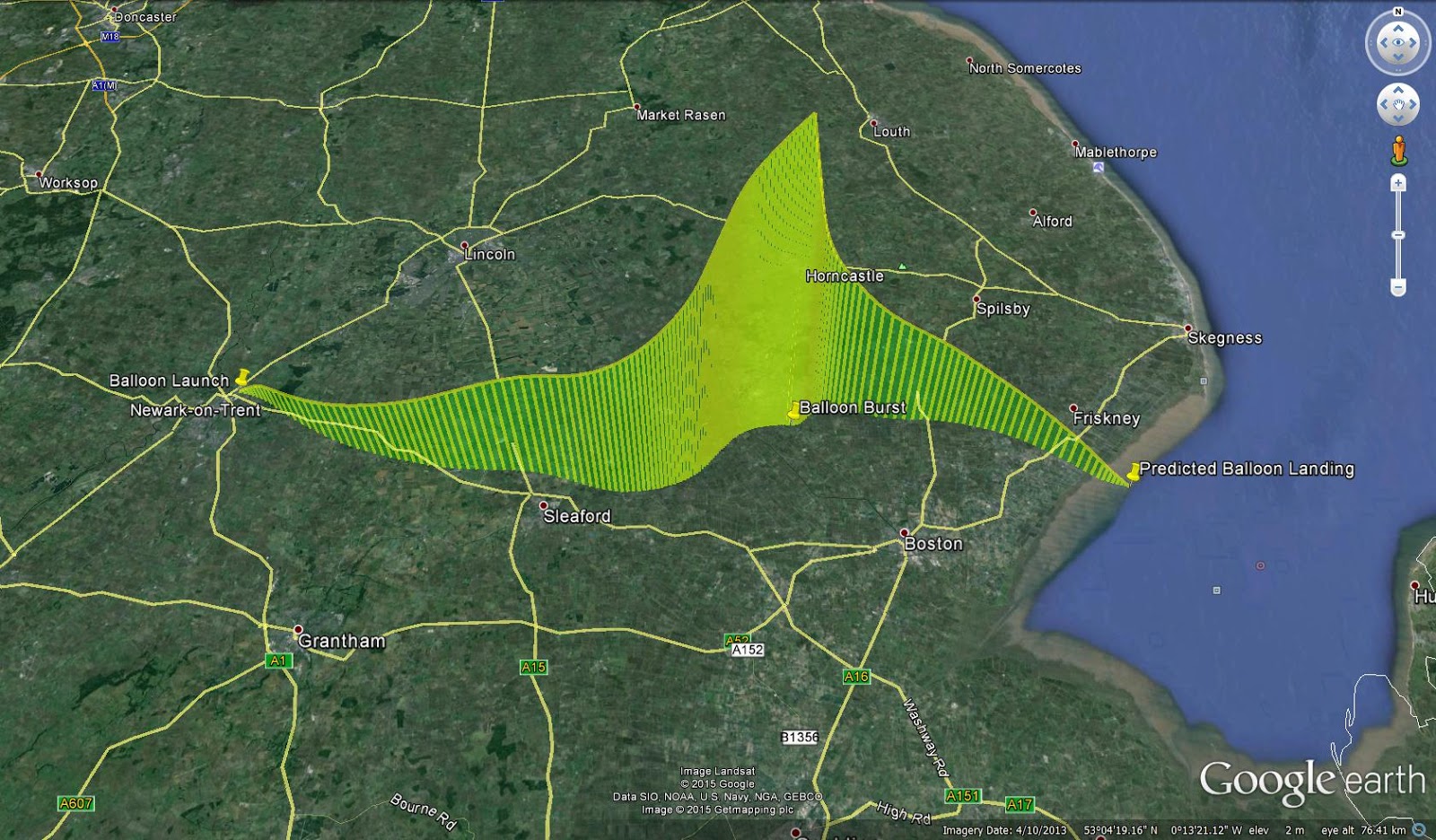 |
| Flight prediction for Friday |
 |
| Flight prediction for Saturday |
There would be no issues with the airfields for that flight path and has the advantage of going almost straight up and landing close by.
Apologies to those wanting to track on Friday, but the situation is out of my control and I would be foolhardy to ignore the prediction and it is very unlikely it will change significantly to allow a flight tomorrow so I hope you can all track on Saturday. I will still be at the Hamfest tomorrow with the equipment if you want to know more about what it is all about.
Hamfest HAB Launch likely to be postponed to Saturday
Given the latest flight path prediction, weather forecast and approval restrictions I will unfortunately have to likely postpone the National Hamfest high altitude balloon till Saturday.
The forecast for tomorrow is strong gusty winds at ground level which isn't ideal for launching, but that is the least of the issues.
The current flight predictions for tomorrow are not good. The prediction model used is accurate and for the size of balloon I have and the amount of helium at my disposal even a maximum fill giving the maximum ascent rate and assuming the calculated decent rate for the parachute it is still putting the likely landing right on the coast. Earlier in the week the landing wasn't quite as marginal but as the model's data set have been updated it has drifted further eastward, it is odds on it will actually land out to sea.
However the real show stopper was when I received the CAA approval for the launch this morning. They have put a restriction not permitting a launch if the balloon and payload is likely to go on a North Easterly or Easterly path that could interfere with operations on local military airfields.
This is the predicted flight path, generated by the CUSG Landing predictor at predict.habhub.org and the flight path currently goes directly over RAF Cranwell but not at a high enough altitude.
Saturday is forecast to be a much calmer day with a predicted path as shown below
There would be no issues with the airfields for that flight path and has the advantage of going almost straight up and landing close by.
Apologies to those wanting to track on Friday, but the situation is out of my control and I would be foolhardy to ignore the prediction and it is very unlikely it will change significantly to allow a flight tomorrow so I hope you can all track on Saturday. I will still be at the Hamfest tomorrow with the equipment if you want to know more about what it is all about.
The forecast for tomorrow is strong gusty winds at ground level which isn't ideal for launching, but that is the least of the issues.
The current flight predictions for tomorrow are not good. The prediction model used is accurate and for the size of balloon I have and the amount of helium at my disposal even a maximum fill giving the maximum ascent rate and assuming the calculated decent rate for the parachute it is still putting the likely landing right on the coast. Earlier in the week the landing wasn't quite as marginal but as the model's data set have been updated it has drifted further eastward, it is odds on it will actually land out to sea.
However the real show stopper was when I received the CAA approval for the launch this morning. They have put a restriction not permitting a launch if the balloon and payload is likely to go on a North Easterly or Easterly path that could interfere with operations on local military airfields.
This is the predicted flight path, generated by the CUSG Landing predictor at predict.habhub.org and the flight path currently goes directly over RAF Cranwell but not at a high enough altitude.
|
| Flight prediction for Friday |
|
| Flight prediction for Saturday |
There would be no issues with the airfields for that flight path and has the advantage of going almost straight up and landing close by.
Apologies to those wanting to track on Friday, but the situation is out of my control and I would be foolhardy to ignore the prediction and it is very unlikely it will change significantly to allow a flight tomorrow so I hope you can all track on Saturday. I will still be at the Hamfest tomorrow with the equipment if you want to know more about what it is all about.













