Posts Tagged ‘amateurradio.com’
 A word of advice
 February 23rd, 2016 |
  Author:
 This past Saturday, I served as a Volunteer Examiner at the finish line of a "Ham Cram". The Middlesex County Office of Emergency Management offered the day long session in order to allow CERT members from various municipalities throughout the county the chance to earn their Technician licenses. There were twelve participants, and at the end of the day, half of them had earned their licenses.
All of these people were all enthusiastic and determined to become Amateur Radio operators. So what went wrong? Why wasn't there a higher success rate? What went wrong was a lack of lead time and mis-communication. Some had learned of the Ham Cram session only three days beforehand. The information about the session was directed to the participants through their local municipal OEM directors. Middlesex County OEM did their due diligence by sending out the information in plenty of time, but we all know that information that goes through the chain-of-command can travel particularly slowly, especially if the "powers that be" aren't all that familiar with the information they are passing on. Not realizing that this information was time sensitive proved to be a major handicap.
For those of you who are not familiar with the term, or the concept, a Ham Cram is defined as a six or more hour long session where prospective Hams are crammed with the info they need to earn their license. Think of the all-nighters you may have endured before a particularly tough exam in college. The concept is the same.
The problem with the Ham Cram concept is that many people think they can walk into one as a blank page, and will then walk away as a book filled with all the knowledge they need to pass the license exam.
For the Ham Cram concept to work (and it works remarkably well if implemented correctly), the students need to get their hands on a license manual and read and study for six to eight weeks prior to the Cram session. The Ham Cram session educator needs something to work with. It's highly improbable that someone can walk "cold" off the street and earn their ticket after only six hours of cursory study - unless of course, you have a photographic memory.
Again, going back to the "all-nighter" session in college. That exam prep marathon came after an entire semester of classes. You were, in essence, reviewing what you had hopefully learned throughout the proceeding months. We all know that if you waited until that evening to crack open a book, then you were toast.
Or if you want to think of it another way, the Ham Cram instructor is like a diamond cutter. With a raw diamond he can produce a work of art. Give him a piece of coal and he'll be out of his element. So if you know of a prospective Ham and he or she is talking about participating in a Ham Cram, then the sagest advice you can impart upon them is that they should begin the studying process WAY in advance (weeks/months). Then they'll arrive at the Ham Cram as a rough diamond ready to be polished into a prized jewel.
72 de Larry W2LJ
QRP - When you care to send the very least!
All of these people were all enthusiastic and determined to become Amateur Radio operators. So what went wrong? Why wasn't there a higher success rate? What went wrong was a lack of lead time and mis-communication. Some had learned of the Ham Cram session only three days beforehand. The information about the session was directed to the participants through their local municipal OEM directors. Middlesex County OEM did their due diligence by sending out the information in plenty of time, but we all know that information that goes through the chain-of-command can travel particularly slowly, especially if the "powers that be" aren't all that familiar with the information they are passing on. Not realizing that this information was time sensitive proved to be a major handicap.
For those of you who are not familiar with the term, or the concept, a Ham Cram is defined as a six or more hour long session where prospective Hams are crammed with the info they need to earn their license. Think of the all-nighters you may have endured before a particularly tough exam in college. The concept is the same.
The problem with the Ham Cram concept is that many people think they can walk into one as a blank page, and will then walk away as a book filled with all the knowledge they need to pass the license exam.
For the Ham Cram concept to work (and it works remarkably well if implemented correctly), the students need to get their hands on a license manual and read and study for six to eight weeks prior to the Cram session. The Ham Cram session educator needs something to work with. It's highly improbable that someone can walk "cold" off the street and earn their ticket after only six hours of cursory study - unless of course, you have a photographic memory.
Again, going back to the "all-nighter" session in college. That exam prep marathon came after an entire semester of classes. You were, in essence, reviewing what you had hopefully learned throughout the proceeding months. We all know that if you waited until that evening to crack open a book, then you were toast.
Or if you want to think of it another way, the Ham Cram instructor is like a diamond cutter. With a raw diamond he can produce a work of art. Give him a piece of coal and he'll be out of his element. So if you know of a prospective Ham and he or she is talking about participating in a Ham Cram, then the sagest advice you can impart upon them is that they should begin the studying process WAY in advance (weeks/months). Then they'll arrive at the Ham Cram as a rough diamond ready to be polished into a prized jewel.
72 de Larry W2LJ
QRP - When you care to send the very least!
I got to be the Flea on the Hound last night
Last evening's QRP Fox hunt was of the 80 Meter flavor. Our esteemed Foxes were Brian K0DTJ in California and Dave N1IX in New Hampshire. "Conventional Wisdom" told me that I'd probably have a good shot at working Dave in NH, but probably not so much for Brian in CA.
This time, Conventional Wisdom did not disappoint.
I worked Dave pretty quickly. According to my log, I nabbed him at 0203 UTC. And as I suspected, Brian was nowhere to be heard. Actually, Brian and his pack of Hounds were nowhere to be heard, except for an occasional "Woof" and "Arf" from a Hound here and there.
I ended up spending the evening listening to Dave handle his pileup. It was a treat as N1IX is an accomplished Amateur Radio Op, to say the least. He handled all calls rapidly and without error. He also QRS'ed (slowed his code speed for those of you not familiar with the Q Code) from time to time when it was warranted. Dave is a member of the A-1 Operators Club, which is no surprise, and his inclusion is well deserved.
Towards the end of the hunt, Dave had fewer and fewer Hounds baying at him, and as a result, he was calling "CQ FOX" quite a lot. QUITE a lot. And, at the same time, his signal strength to me was actually increasing.
So at 0311 UTC, I decided to do something that I've never done before. I dialed the KX3's power output down to the flea power neighborhood - 100 milliWatts (that's 1/10th of 1 Watt for those of you, who like me, sometimes scratch your head when it comes to scientific notation), and gave Dave another call. In the past, I've only called a Fox a second time if I wasn't positive about being in the log, and I've certainly have never done it QRPp.
Thanks to Dave's excellent ears and superb station, I made it into "Official" log at 0311 at 100 milliWatts of power. According to QRZ, Dave lives 233 miles from me as the proverbial crow flies. So that means the QSO was accomplished last night as a rate of 2330 Miles per Watt.
Not too shabby, and you just GOTTA love this QRP stuff!
72 de Larry W2LJ
QRP - When you care to send the very least!
This time, Conventional Wisdom did not disappoint.
I worked Dave pretty quickly. According to my log, I nabbed him at 0203 UTC. And as I suspected, Brian was nowhere to be heard. Actually, Brian and his pack of Hounds were nowhere to be heard, except for an occasional "Woof" and "Arf" from a Hound here and there.
I ended up spending the evening listening to Dave handle his pileup. It was a treat as N1IX is an accomplished Amateur Radio Op, to say the least. He handled all calls rapidly and without error. He also QRS'ed (slowed his code speed for those of you not familiar with the Q Code) from time to time when it was warranted. Dave is a member of the A-1 Operators Club, which is no surprise, and his inclusion is well deserved.
Towards the end of the hunt, Dave had fewer and fewer Hounds baying at him, and as a result, he was calling "CQ FOX" quite a lot. QUITE a lot. And, at the same time, his signal strength to me was actually increasing.
So at 0311 UTC, I decided to do something that I've never done before. I dialed the KX3's power output down to the flea power neighborhood - 100 milliWatts (that's 1/10th of 1 Watt for those of you, who like me, sometimes scratch your head when it comes to scientific notation), and gave Dave another call. In the past, I've only called a Fox a second time if I wasn't positive about being in the log, and I've certainly have never done it QRPp.
Thanks to Dave's excellent ears and superb station, I made it into "Official" log at 0311 at 100 milliWatts of power. According to QRZ, Dave lives 233 miles from me as the proverbial crow flies. So that means the QSO was accomplished last night as a rate of 2330 Miles per Watt.
Not too shabby, and you just GOTTA love this QRP stuff!
72 de Larry W2LJ
QRP - When you care to send the very least!
I got to be the Flea on the Hound last night
Last evening's QRP Fox hunt was of the 80 Meter flavor. Our esteemed Foxes were Brian K0DTJ in California and Dave N1IX in New Hampshire. "Conventional Wisdom" told me that I'd probably have a good shot at working Dave in NH, but probably not so much for Brian in CA.
This time, Conventional Wisdom did not disappoint.
I worked Dave pretty quickly. According to my log, I nabbed him at 0203 UTC. And as I suspected, Brian was nowhere to be heard. Actually, Brian and his pack of Hounds were nowhere to be heard, except for an occasional "Woof" and "Arf" from a Hound here and there.
I ended up spending the evening listening to Dave handle his pileup. It was a treat as N1IX is an accomplished Amateur Radio Op, to say the least. He handled all calls rapidly and without error. He also QRS'ed (slowed his code speed for those of you not familiar with the Q Code) from time to time when it was warranted. Dave is a member of the A-1 Operators Club, which is no surprise, and his inclusion is well deserved.
Towards the end of the hunt, Dave had fewer and fewer Hounds baying at him, and as a result, he was calling "CQ FOX" quite a lot. QUITE a lot. And, at the same time, his signal strength to me was actually increasing.
So at 0311 UTC, I decided to do something that I've never done before. I dialed the KX3's power output down to the flea power neighborhood - 100 milliWatts (that's 1/10th of 1 Watt for those of you, who like me, sometimes scratch your head when it comes to scientific notation), and gave Dave another call. In the past, I've only called a Fox a second time if I wasn't positive about being in the log, and I've certainly have never done it QRPp.
Thanks to Dave's excellent ears and superb station, I made it into "Official" log at 0311 at 100 milliWatts of power. According to QRZ, Dave lives 233 miles from me as the proverbial crow flies. So that means the QSO was accomplished last night as a rate of 2330 Miles per Watt.
Not too shabby, and you just GOTTA love this QRP stuff!
72 de Larry W2LJ
QRP - When you care to send the very least!
This time, Conventional Wisdom did not disappoint.
I worked Dave pretty quickly. According to my log, I nabbed him at 0203 UTC. And as I suspected, Brian was nowhere to be heard. Actually, Brian and his pack of Hounds were nowhere to be heard, except for an occasional "Woof" and "Arf" from a Hound here and there.
I ended up spending the evening listening to Dave handle his pileup. It was a treat as N1IX is an accomplished Amateur Radio Op, to say the least. He handled all calls rapidly and without error. He also QRS'ed (slowed his code speed for those of you not familiar with the Q Code) from time to time when it was warranted. Dave is a member of the A-1 Operators Club, which is no surprise, and his inclusion is well deserved.
Towards the end of the hunt, Dave had fewer and fewer Hounds baying at him, and as a result, he was calling "CQ FOX" quite a lot. QUITE a lot. And, at the same time, his signal strength to me was actually increasing.
So at 0311 UTC, I decided to do something that I've never done before. I dialed the KX3's power output down to the flea power neighborhood - 100 milliWatts (that's 1/10th of 1 Watt for those of you, who like me, sometimes scratch your head when it comes to scientific notation), and gave Dave another call. In the past, I've only called a Fox a second time if I wasn't positive about being in the log, and I've certainly have never done it QRPp.
Thanks to Dave's excellent ears and superb station, I made it into "Official" log at 0311 at 100 milliWatts of power. According to QRZ, Dave lives 233 miles from me as the proverbial crow flies. So that means the QSO was accomplished last night as a rate of 2330 Miles per Watt.
Not too shabby, and you just GOTTA love this QRP stuff!
72 de Larry W2LJ
QRP - When you care to send the very least!
1 Watt and a Wire… in the Attic
You can't always get what you want, but you try sometimes...
Recently I've dialed my normal 5 watts down to 1watt (one watt, singular) for all my contacts. To throw some water on the fire I've decided to use my attic antenna which weaves all around my metal ductwork and electrical wiring. Mostly this was to prove a point to myself but it may be enlightening to deed restricted hams that they can use a qrp radio and an attic antenna successfully.
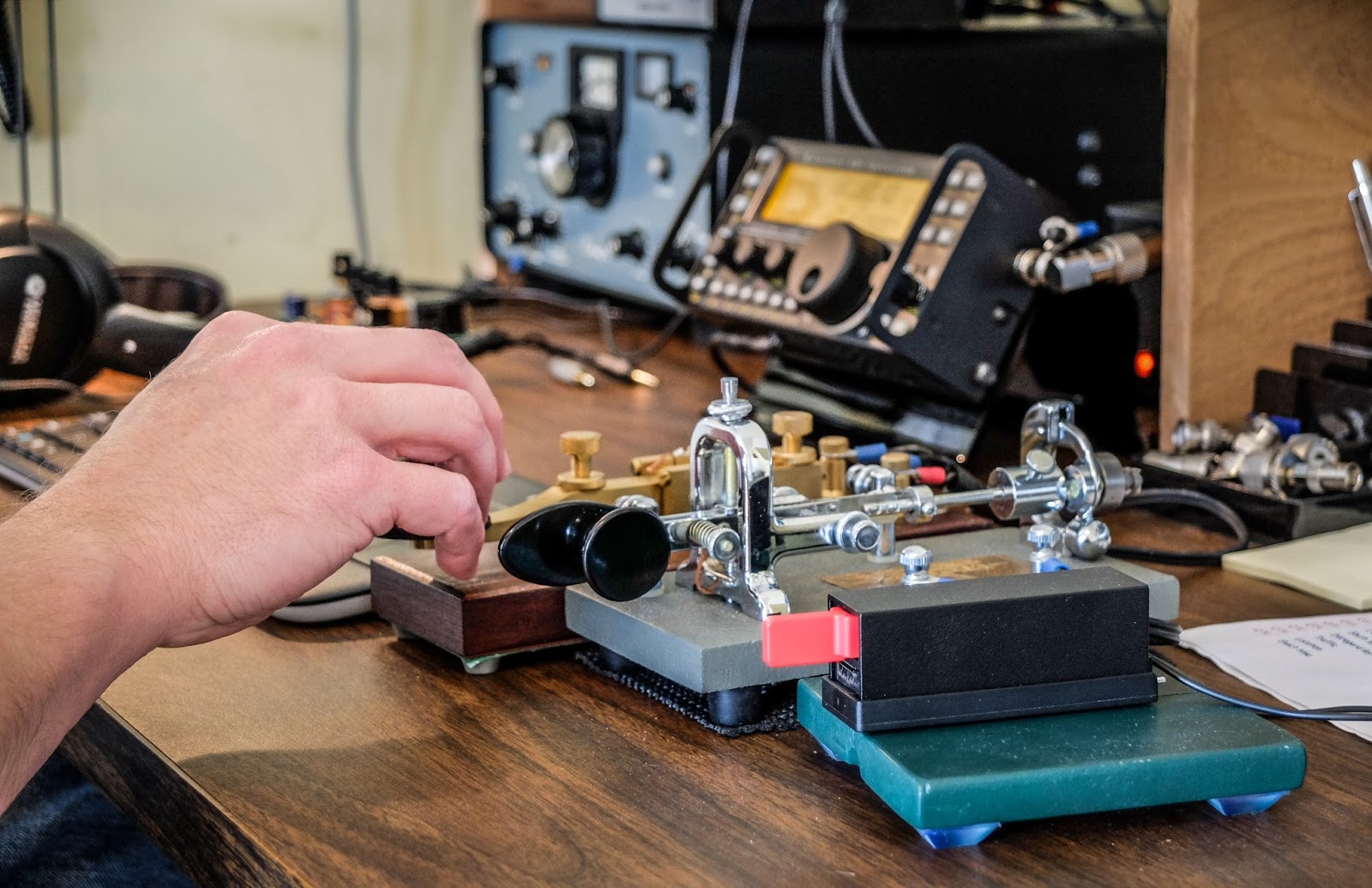 |
| Key lineup... Palm Single (paddle), Vibroplex Bug (circa 1970s), Kent Hand key |
It only seems pointless until you try
Calling CQ with 1w QRPp into a poor attic antenna isn't as pointless as it would seem. I didn't have to wait long when calling CQ before I got an answer most of the time.
Now am I going to bust a pileup with 1 watt ? Possibly not but I think that my assumptions about both how much power I need and how big an antenna I need are usually out of proportion with reality.
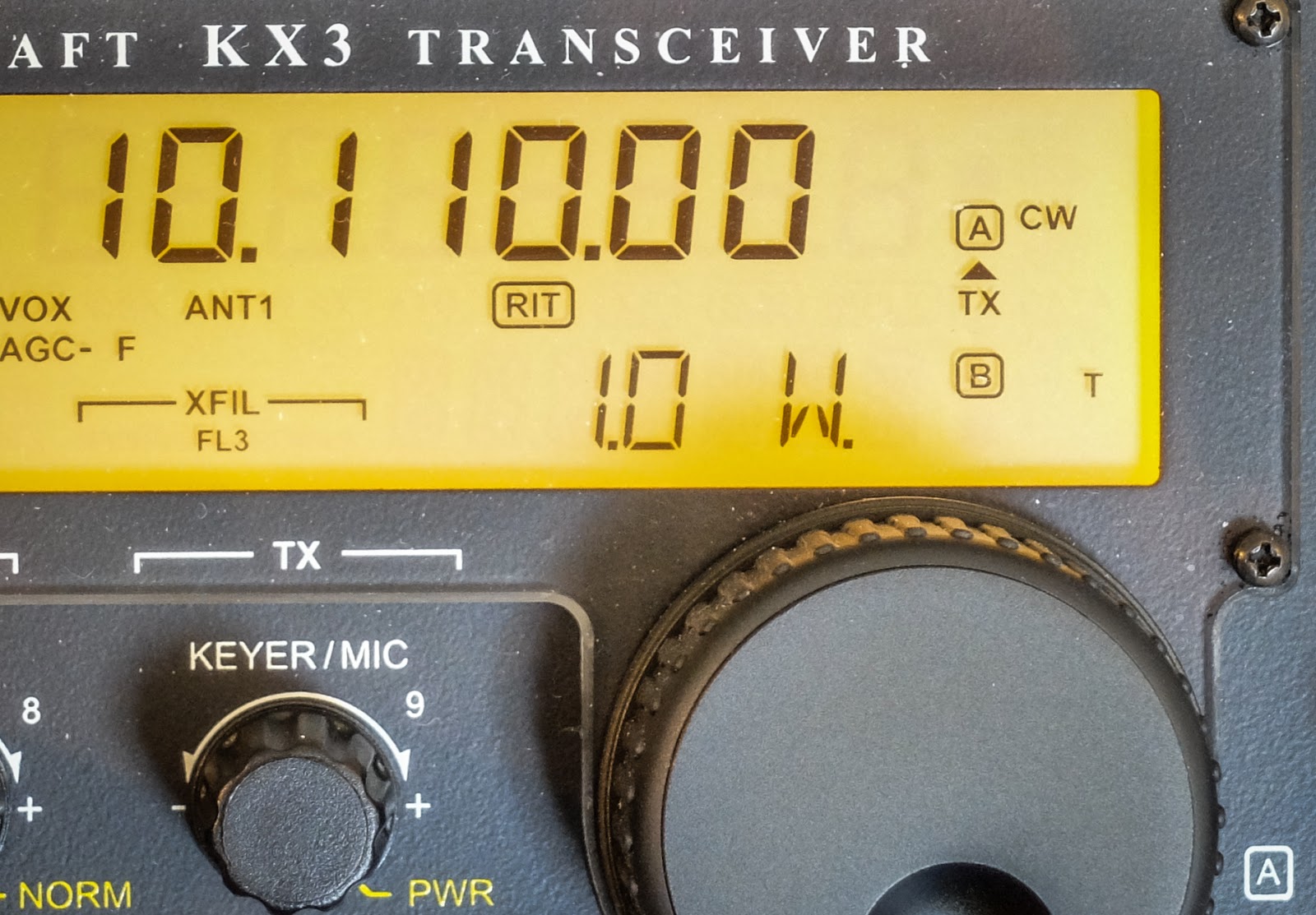 |
| 1 mighty watt |
My assumptions are often incorrect
I made QSOs on 30m, 20m, 17m and 10m this morning all at 1 watt. The solar conditions report was not really fantastic, especially for 10m. Yet 1 watt through the attic antenna bagged the only DX I heard on 10m. I had a couple of other multiple exchange contacts on 20m, 17m and one good old fashioned 25 minute long ragchew on 30m where I received a 599 report for my one watt from Bob (NR8M) in Ohio. Admittedly, Bob was booming in and we had good propagation to each other.
 |
| http://www.hamqsl.com/solar.html |
Video
The recording below was number 4 or 5 this morning. I wanted to post this one because I was working another QRP station in Arkansas (K5EDM) and we did NOT have great propagation to each other. He was running 5w while I was running 1w so it was QRP to QRPp. In the video you can see that I'm using some of the KX3's tricks to pull the signal up because there was a lot of QSB and noise (note the GEOMAGNETIC FIELD UNSETTLED in the solar report).
I had the volume maxed and was using the RF gain control mostly. I eventually had to turn on the preamp which really washed me in noise but I dropped the RF gain more and eventually switched in the APF (audio peaking filter) which performed magic on this contact. Often I find that APF doesn't help but this time it made a big difference.
That's all for now
So lower your power and raise your expectations
72/73
Richard N4PBQ
Doctor and patient are doing fine
A few days ago, I went out to the car as I usually do, for some lunchtime QRP. In my haste to get everything put away after I was done, I inadvertently knocked the external battery off the car seat onto the floor. The KX3 started to move, as it was still attached, but a quick hand stopped it, and all was well. Or so I thought.
Yesterday, I went out again, and this time the KX3 wouldn't turn on. No problem, I thought to myself, the battery was probably on its way out, as it has been a while since I have given it its last drink. So last evening, while I was attending a CERT class on animal handling during declared emergencies, I had the battery plugged in at home, charging.
When I got home, around 10:00 PM, I tried reconnecting the battery to the KX3 to see if everything was OK. Still no sign of life - my KX3 was still flat lining.. Hmmmmmm ........ could the battery have gone totally bad?
I carried the radio down to the shack 13.8V power supply. Viola! It turned on!
And then immediately turned off.

My brain went into over drive. What the %(#@*#$ was going on ?!?
I dread sending stuff out for repair. Don't know why, I just do. I was in the professional photographic electronics repair biz for over 20 years. I have fixed studio strobes costing well over $12,000.00. I have taken apart digital camera backs that cost more than a Mercedes Benz. I have stared down banks of charged capacitors storing up enough electrons to supply 6,400 Joules of energy in one pop - certainly I should be able to figure out a relatively minor KX3 repair? Right?
I rolled up my sleeves and got down to it. Obviously, this was a power problem. But why was the rig shutting down so quickly? Internal short? Bad connection somewhere? Then I noticed that if I wiggled the power plug a certain way, the radio would stay on. My mind immediately flashed back to the battery falling incident from the other day. I must have done something to the power socket.
The advantage of building the KX3 (if that's what you want to call it) is that you know how it goes together, so you're not frightened at the prospect of taking it apart. You've seen it in all its naked glory and you lovingly put it together at least once, right? So what's the big deal in taking it apart?
Well, when you built it roughly five years ago, some of the finer details of how it went together get muddled up in the old memory banks. That's why it's good to never toss the build manual! Within about 5 -7 minutes I had it apart and had the display circuit in my hand. A little extra light and a lot of extra magnification from a magnifying glass confirmed my suspicion.
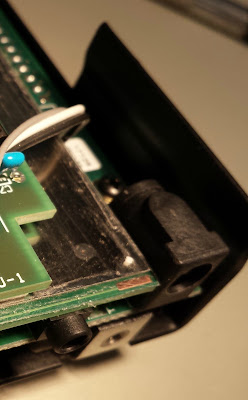
The power socket is a surface mount device, just about like everything else on that display/control circuit board. The weight of the battery tugged the socket enough to unmoor it from its assigned, tinned pads. When I would wiggle the connector "down" towards the circuit board, everything worked. As soon as I let downward pressure go, the connector would break contact from the circuit board again and the radio would appear dead.
I ran upstairs for a pair of scrubs and to wash my hands to prep for surgery. NO! Just kidding!

I changed my soldering station tip to the skinniest one that I have for when I work on SMD devices and I re-soldered that connector onto its pads. I took great care to add just a little "extra" solder just to make sure the connection is good, solid and won't come apart so easily in the future.
I hastily (I'll get back to that in a minute) put everything together and fired the radio up. Fixed! Problem solved! High fives and happy dances all around!
I will have to go back sometime over the weekend to remove the front plexiglass display window, though. In my haste, I wasn't so careful about finger prints. I'll have to go back and clean that up. Yes, I know ...... call me anal. I can't help it!
But as this blog post says - the patient (and more importantly, the doctor) are doing just fine! And even more importantly - no return trip to Aptos!
PROGNOSIS: Excellent! Today's lunchtime QRP session netted the following:
N0TA - SOTA peak W0C/PR-082 (Squaw Mountain) in CO on 20 Meters.
VP5/AC0W - Turks and Caicos Islands on 20 Meters
CT9/OM3RM - Madeira Island on 20 Meters.
PJ2/NF9V - Curacao on 15 Meters.
I chased KH7Y in Hawaii who was absolutely booming into NJ on 15 Meters, but could not make myself heard. Just goes to show, you can't win them all!
72 de Larry W2LJ
QRP - When you care to send the very least!

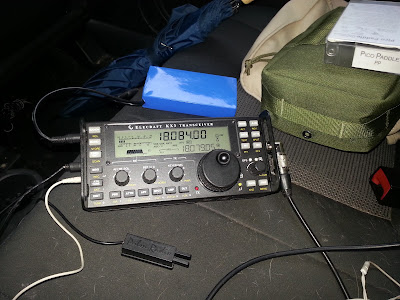
Gear on the backseat of the Jeep.
Yesterday, I went out again, and this time the KX3 wouldn't turn on. No problem, I thought to myself, the battery was probably on its way out, as it has been a while since I have given it its last drink. So last evening, while I was attending a CERT class on animal handling during declared emergencies, I had the battery plugged in at home, charging.
When I got home, around 10:00 PM, I tried reconnecting the battery to the KX3 to see if everything was OK. Still no sign of life - my KX3 was still flat lining.. Hmmmmmm ........ could the battery have gone totally bad?
I carried the radio down to the shack 13.8V power supply. Viola! It turned on!
And then immediately turned off.

My brain went into over drive. What the %(#@*#$ was going on ?!?
I dread sending stuff out for repair. Don't know why, I just do. I was in the professional photographic electronics repair biz for over 20 years. I have fixed studio strobes costing well over $12,000.00. I have taken apart digital camera backs that cost more than a Mercedes Benz. I have stared down banks of charged capacitors storing up enough electrons to supply 6,400 Joules of energy in one pop - certainly I should be able to figure out a relatively minor KX3 repair? Right?
I rolled up my sleeves and got down to it. Obviously, this was a power problem. But why was the rig shutting down so quickly? Internal short? Bad connection somewhere? Then I noticed that if I wiggled the power plug a certain way, the radio would stay on. My mind immediately flashed back to the battery falling incident from the other day. I must have done something to the power socket.

The power socket is the black, boxy thing to the right.
The advantage of building the KX3 (if that's what you want to call it) is that you know how it goes together, so you're not frightened at the prospect of taking it apart. You've seen it in all its naked glory and you lovingly put it together at least once, right? So what's the big deal in taking it apart?
Well, when you built it roughly five years ago, some of the finer details of how it went together get muddled up in the old memory banks. That's why it's good to never toss the build manual! Within about 5 -7 minutes I had it apart and had the display circuit in my hand. A little extra light and a lot of extra magnification from a magnifying glass confirmed my suspicion.
The power socket is a surface mount device, just about like everything else on that display/control circuit board. The weight of the battery tugged the socket enough to unmoor it from its assigned, tinned pads. When I would wiggle the connector "down" towards the circuit board, everything worked. As soon as I let downward pressure go, the connector would break contact from the circuit board again and the radio would appear dead.
I ran upstairs for a pair of scrubs and to wash my hands to prep for surgery. NO! Just kidding!

I changed my soldering station tip to the skinniest one that I have for when I work on SMD devices and I re-soldered that connector onto its pads. I took great care to add just a little "extra" solder just to make sure the connection is good, solid and won't come apart so easily in the future.
I hastily (I'll get back to that in a minute) put everything together and fired the radio up. Fixed! Problem solved! High fives and happy dances all around!
I will have to go back sometime over the weekend to remove the front plexiglass display window, though. In my haste, I wasn't so careful about finger prints. I'll have to go back and clean that up. Yes, I know ...... call me anal. I can't help it!
But as this blog post says - the patient (and more importantly, the doctor) are doing just fine! And even more importantly - no return trip to Aptos!
PROGNOSIS: Excellent! Today's lunchtime QRP session netted the following:
N0TA - SOTA peak W0C/PR-082 (Squaw Mountain) in CO on 20 Meters.
VP5/AC0W - Turks and Caicos Islands on 20 Meters
CT9/OM3RM - Madeira Island on 20 Meters.
PJ2/NF9V - Curacao on 15 Meters.
I chased KH7Y in Hawaii who was absolutely booming into NJ on 15 Meters, but could not make myself heard. Just goes to show, you can't win them all!
72 de Larry W2LJ
QRP - When you care to send the very least!
Doctor and patient are doing fine
A few days ago, I went out to the car as I usually do, for some lunchtime QRP. In my haste to get everything put away after I was done, I inadvertently knocked the external battery off the car seat onto the floor. The KX3 started to move, as it was still attached, but a quick hand stopped it, and all was well. Or so I thought.
Yesterday, I went out again, and this time the KX3 wouldn't turn on. No problem, I thought to myself, the battery was probably on its way out, as it has been a while since I have given it its last drink. So last evening, while I was attending a CERT class on animal handling during declared emergencies, I had the battery plugged in at home, charging.
When I got home, around 10:00 PM, I tried reconnecting the battery to the KX3 to see if everything was OK. Still no sign of life - my KX3 was still flat lining.. Hmmmmmm ........ could the battery have gone totally bad?
I carried the radio down to the shack 13.8V power supply. Viola! It turned on!
And then immediately turned off.
My brain went into over drive. What the %(#@*#$ was going on ?!?
I dread sending stuff out for repair. Don't know why, I just do. I was in the professional photographic electronics repair biz for over 20 years. I have fixed studio strobes costing well over $12,000.00. I have taken apart digital camera backs that cost more than a Mercedes Benz. I have stared down banks of charged capacitors storing up enough electrons to supply 6,400 Joules of energy in one pop - certainly I should be able to figure out a relatively minor KX3 repair? Right?
I rolled up my sleeves and got down to it. Obviously, this was a power problem. But why was the rig shutting down so quickly? Internal short? Bad connection somewhere? Then I noticed that if I wiggled the power plug a certain way, the radio would stay on. My mind immediately flashed back to the battery falling incident from the other day. I must have done something to the power socket.
The advantage of building the KX3 (if that's what you want to call it) is that you know how it goes together, so you're not frightened at the prospect of taking it apart. You've seen it in all its naked glory and you lovingly put it together at least once, right? So what's the big deal in taking it apart?
Well, when you built it roughly five years ago, some of the finer details of how it went together get muddled up in the old memory banks. That's why it's good to never toss the build manual! Within about 5 -7 minutes I had it apart and had the display circuit in my hand. A little extra light and a lot of extra magnification from a magnifying glass confirmed my suspicion.
The power socket is a surface mount device, just about like everything else on that display/control circuit board. The weight of the battery tugged the socket enough to unmoor it from its assigned, tinned pads. When I would wiggle the connector "down" towards the circuit board, everything worked. As soon as I let downward pressure go, the connector would break contact from the circuit board again and the radio would appear dead.
I ran upstairs for a pair of scrubs and to wash my hands to prep for surgery. NO! Just kidding!
I changed my soldering station tip to the skinniest one that I have for when I work on SMD devices and I re-soldered that connector onto its pads. I took great care to add just a little "extra" solder just to make sure the connection is good, solid and won't come apart so easily in the future.
I hastily (I'll get back to that in a minute) put everything together and fired the radio up. Fixed! Problem solved! High fives and happy dances all around!
I will have to go back sometime over the weekend to remove the front plexiglass display window, though. In my haste, I wasn't so careful about finger prints. I'll have to go back and clean that up. Yes, I know ...... call me anal. I can't help it!
But as this blog post says - the patient (and more importantly, the doctor) are doing just fine! And even more importantly - no return trip to Aptos!
PROGNOSIS: Excellent! Today's lunchtime QRP session netted the following:
N0TA - SOTA peak W0C/PR-082 (Squaw Mountain) in CO on 20 Meters.
VP5/AC0W - Turks and Caicos Islands on 20 Meters
CT9/OM3RM - Madeira Island on 20 Meters.
PJ2/NF9V - Curacao on 15 Meters.
I chased KH7Y in Hawaii who was absolutely booming into NJ on 15 Meters, but could not make myself heard. Just goes to show, you can't win them all!
72 de Larry W2LJ
QRP - When you care to send the very least!
Gear on the backseat of the Jeep.
Yesterday, I went out again, and this time the KX3 wouldn't turn on. No problem, I thought to myself, the battery was probably on its way out, as it has been a while since I have given it its last drink. So last evening, while I was attending a CERT class on animal handling during declared emergencies, I had the battery plugged in at home, charging.
When I got home, around 10:00 PM, I tried reconnecting the battery to the KX3 to see if everything was OK. Still no sign of life - my KX3 was still flat lining.. Hmmmmmm ........ could the battery have gone totally bad?
I carried the radio down to the shack 13.8V power supply. Viola! It turned on!
And then immediately turned off.
My brain went into over drive. What the %(#@*#$ was going on ?!?
I dread sending stuff out for repair. Don't know why, I just do. I was in the professional photographic electronics repair biz for over 20 years. I have fixed studio strobes costing well over $12,000.00. I have taken apart digital camera backs that cost more than a Mercedes Benz. I have stared down banks of charged capacitors storing up enough electrons to supply 6,400 Joules of energy in one pop - certainly I should be able to figure out a relatively minor KX3 repair? Right?
I rolled up my sleeves and got down to it. Obviously, this was a power problem. But why was the rig shutting down so quickly? Internal short? Bad connection somewhere? Then I noticed that if I wiggled the power plug a certain way, the radio would stay on. My mind immediately flashed back to the battery falling incident from the other day. I must have done something to the power socket.
The power socket is the black, boxy thing to the right.
The advantage of building the KX3 (if that's what you want to call it) is that you know how it goes together, so you're not frightened at the prospect of taking it apart. You've seen it in all its naked glory and you lovingly put it together at least once, right? So what's the big deal in taking it apart?
Well, when you built it roughly five years ago, some of the finer details of how it went together get muddled up in the old memory banks. That's why it's good to never toss the build manual! Within about 5 -7 minutes I had it apart and had the display circuit in my hand. A little extra light and a lot of extra magnification from a magnifying glass confirmed my suspicion.
The power socket is a surface mount device, just about like everything else on that display/control circuit board. The weight of the battery tugged the socket enough to unmoor it from its assigned, tinned pads. When I would wiggle the connector "down" towards the circuit board, everything worked. As soon as I let downward pressure go, the connector would break contact from the circuit board again and the radio would appear dead.
I ran upstairs for a pair of scrubs and to wash my hands to prep for surgery. NO! Just kidding!
I changed my soldering station tip to the skinniest one that I have for when I work on SMD devices and I re-soldered that connector onto its pads. I took great care to add just a little "extra" solder just to make sure the connection is good, solid and won't come apart so easily in the future.
I hastily (I'll get back to that in a minute) put everything together and fired the radio up. Fixed! Problem solved! High fives and happy dances all around!
I will have to go back sometime over the weekend to remove the front plexiglass display window, though. In my haste, I wasn't so careful about finger prints. I'll have to go back and clean that up. Yes, I know ...... call me anal. I can't help it!
But as this blog post says - the patient (and more importantly, the doctor) are doing just fine! And even more importantly - no return trip to Aptos!
PROGNOSIS: Excellent! Today's lunchtime QRP session netted the following:
N0TA - SOTA peak W0C/PR-082 (Squaw Mountain) in CO on 20 Meters.
VP5/AC0W - Turks and Caicos Islands on 20 Meters
CT9/OM3RM - Madeira Island on 20 Meters.
PJ2/NF9V - Curacao on 15 Meters.
I chased KH7Y in Hawaii who was absolutely booming into NJ on 15 Meters, but could not make myself heard. Just goes to show, you can't win them all!
72 de Larry W2LJ
QRP - When you care to send the very least!
The need for speed in CW
CW QSO speed statistics...
As I continue on my Morse Code Journey I have been using a desktop application called Morse News to work on my code comprehension of natural language sentences for ragchew training. I set the program to send at speeds higher than I can copy to stretch me. Presently I have it set at 26wpm character speed and 23wpm Code speed. I can usually figure out what the news story is talking about but I miss a lot of the specifics.
 |
| I was a kid in the 1970s when Speed Racer was a popular cartoon |
The need for speed
Currently I'm OK working up to 20wpm qsos as long as the other station has good spacing. Sometimes I lose the thread or the specifics in a ragchew at 20wpm and I just ask them PSE AGN?
In sprints I can copy a callsign sent at 25wpm to 30wpm if I hear it a few times but that's no good for real contests where you need to catch that call sent at 30-40wpm sent the first time. My friend AA4XX has asked me to help him in multi-op contests but I know he is sending around 30wpm and I just can't hang there at this stage in my Morse Code journey.
Statistics show 25wpm is the magic number
So it got me to wondering what was the actual "average" qso speed. I downloaded days of raw data from Reverse Beacon Network. RBN collects the call sign, the SNR and the SPEED. The raw files contained between 40 to 50 thousand CW CQ calls logged each day after I filtered out other modes.
The average speed from RBN CW logs worked out to exactly 25wpm. The standard deviation was 5.34wpm which would mean most of the time you would expect to work stations between 20wpm and 30wpm. That seems reasonable and matches what I seem to hear on air. These numbers are from the CQ calls themselves and are only measuring character spacing speed so the code spacing is likely a bit lower in most cases and for ragchews is likely averaging 2 to 5 wpm lower than the actual sent character speed. Since I am not much interested in serious contesting at this stage in my hobby going over 30wpm isn't on my radar.
So based on those calculated CW speed statistics from RBN data if I can reach the point where I am comfortable in a 25wpm ragchew I should be content (for a while)
That's all for now.
So lower your power and raise your speed.... err expectations
72/73
Richard, N4PBQ













