Posts Tagged ‘amateur radio’
 A Dozen Radios in One Car. [VIDEO]
 July 26th, 2011 |
  Author:
 So I guess this video is as viral as you can get in the Ham Radio Community. But the name of the video lives up to what you see in it. I guess you could almost say it’s something you would see on HamSexy. But everyone has their own way. So here it is. The video that has been making it’s way around Twitter. Some questions I have about this video is, how does he know which mic to use, and how does he keep track of conversations? And what’s up with the business cards on the dash? And with all those speakers, does he get surround sound now if he tunes all the radios to the same frequency? Just askin’.
73.
Rich also writes a Tech blog and posts stories every Tuesday and Thursday on Q103, The Rock of Albany’s website, as well as Amateur Radio stories every Monday thru Friday here on AmiZed Studios.
Handiham World for 20 July 2011
Welcome to Handiham World!

It looks like we will meet our goals for Radio Camp this summer. We have a healthy level of participants, and most have completed their paperwork and made their travel plans. Quite a bit remains to be done in preparation, though. We have an excellent tower and beam antenna on a hill behind the camp’s “Rotary Building”, where we plan to set up an HF station using a Kenwood TS-570SAT and a TS-2000. Having these rigs to choose from should help make more operators comfortable. Since the beam has not been used this past year and things have been moved around, I will need to locate the rotor control box and dress the wiring back into the shack for a test run. One thing I have learned about antenna systems over the years is that unexpected problems can show up at the most awkward times. It pays to do a little footwork in advance. In this case, I will need to do real footwork, too. The main Handiham Headquarters building rests in a storybook-like clearing surrounded by forest at the base of a hill. Built on and into the side of the hill is the Rotary Building, named for its benefactors, the Rotary Clubs. Long ago, when the Handiham System was very young, there was a ham radio station in the Rotary Building, which was used during the shorter “May Convocations” that would ultimately evolve into the full-fledged Radio Camps.
So you can imagine that there would need to be an antenna system near the Rotary building, and sure enough, there was. A 50 foot self-supporting tower and beam antenna were installed up at the top of the hill behind the building. The entire system fell into disrepair when the Radio Camps moved to Courage North, and it wasn’t until recent years that the antenna and wiring were refurbished as part of an Eagle Scout project by Peter Widin, KC0ENI. This excellent resource will once again be used at Radio Camp, and should provide us with the opportunity to work some real DX! What is different this year is that we plan to install a permanent station in the library of the Rotary building, an excellent gathering space with plenty of room for operating skills participants. In preparation for the use of this area, I have completed the installation of wireless Internet and done some preliminary planning of the station setup. Although we could set up temporarily as in the past, this year we will have one of the familiar equipment desks that we have used at Courage North. This cabinet will provide a place to lock up the stored equipment when non-ham radio users are in the space.
Meanwhile, back on the Woodland side of camp, which is where we will enjoy living in the modern cabins during the week, I have checked the Internet and done my walk through of the buildings. I am thinking that we may have only one HF station, if that, set up at the Woodland cabins. After all, we will have stations on the pontoon boat, at the Rotary Building, and at the Headquarters. We do plan to have a JAWS computer with Echolink and the Remote Base software available as a training tool. Since there are wireless Internet hotspots available in Woodland, the Rotary, Lakeside dining hall, the Lakeside Gazebo, and Handiham HQ, there should be no shortage of places for us to use the Internet-enabled stations. Furthermore, the camp repeater will be on the air and it is Echolink-enabled. One of our goals is to teach the use of these new tools to as many of our campers as possible. If we are successful in getting our new IRLP node that has been configured by Lyle, K0LR, set up on our Woodland Internet connection, we will be able to use that to connect to IRLP node 9008, the Vancouver BC system.
By the way, this month marks 60 years since the FCC created the Novice class license. I was reminded of this by Ron, K3PID, my co-editor of our local radio club newsletter, who was asking club members to send in stories about their Novice days. I thought that was such a good idea that I would like to steal it, so how about some of those Novice stories? I will tell you one of my own next week.
Patrick Tice
[email protected]
Handiham Manager
Thanks for your support!
The Owatonna Steele County (Minnesota) Amateur Radio club recently sent in a gift of $50 in support of the Dr. Dave Challenge Grant. Dr. Dave Justis, KN0S, has challenged us to raise at least $5,000, which he will match.
Help us win the Dr. Dave Challenge!
Money is tight these days and we desperately need your support. Now, thanks to a generous challenge grant by Dr. Dave Justis, KN0S, we have a chance to help fill the budget gap. Dr. Dave will donate $5,000 to the Handiham System if we can raise a matching amount. That means we need to really put the fund-raising into high gear! If you can help, designate a donation to Handihams, stating that it is for the “Dr. Dave Challenge”. We will keep you posted in our weekly e-letter as to the progress of the fund.
Nancy can take credit card donations via the toll-free number, 1-866-426-3442, or accept checks sent to our Courage Center Handiham address:
Courage Handiham System
3915 Golden Valley Road
Golden Valley, MN 55422
Be sure to put a note saying “Dr. Dave Challenge” somewhere in the envelope or on the note line of the check.
Thank you so much for your support!

Handiham World for 13 July 2011
Welcome to Handiham World!

Photo: Pat, WA0TDA, holds up the the new ARRL 2010 Periodicals on CD-ROM and TravelPlus® for Repeaters CD. Both will be available for our Handiham members to try out at the Radio Camp in August.
Have you ever wondered where you saw that article about the antenna that you could build yourself and that would actually fit into your real estate? What month’s QST was it that had the review of the rig you’re thinking about buying? What’s in QEX, the “Forum for Communications Experimenters”? What about the National Contest Journal?
If you’re anything like me, you probably subscribe to several magazines and don’t really have the time to read every article. I always go through the contents and page through to see what jumps out at me, and in the process I find plenty of interesting articles that I am going to read later or save for reference. Before I know it, the next month’s magazines arrive and I am falling behind in my reading. I’ll have much more time in the winter, so the magazines go on the shelf in my ham shack, ordered by month. Sometimes the articles I wanted to read just never get read, and the reason is that they are too hard to find. It may be that I don’t even recall the title of the article or the author’s name, just the general topic. True, the periodicals search tool on the ARRL website will be helpful, but sometimes I can’t locate the article I want because my shelves are not organized as well as I would like.
I can see to read the print articles. Doing this kind of a search when you are blind can be a much more daunting task. That’s one of the reasons we will be installing the 2010 ARRL Periodicals CD-ROM on a Windows computer equipped with JAWS®, a popular screenreading software program by Freedom Scientific. The upcoming Handiham Radio Camp provides exactly the right opportunity for us to test the accessibility of the Periodicals CD using a screenreading computer operated by experienced blind amateur radio operators. The idea of having an entire year’s worth of QST, National Contest Journal, and QEX, the Forum for Communications Experimenters, available on a single CD with search capability seems a lot better than saving print publications on a shelf – or shoeboxes full of audio tapes or even the new flash memory digital NLS “books”. Most of us just don’t have the space to save more than a couple of year’s worth of old print magazines, and even if we do manage to keep them all in order, finding a particular article can be a chore, so we are looking forward to exploring this ARRL CD during Radio Camp.
One book we have never put onto tape for our blind Handiham members is the ARRL Repeater Directory. Think about it for awhile, and you’ll realize why. Not only would it be like reading the phone book, but it would also be impossibly difficult to use because you could never find anything in it, especially in audio cassette format. Imagine back in the days of books on tape what such a book would be like for a blind user. It would be a box full of cassettes, and one would have to keep them organized carefully. Even then, who wants to listen for hours to find the right spot on a tape that has just the repeater information you need? The lack of an accessible repeater directory for blind hams has been a problem, and even those of us who can see to read a print version can find the lookups of repeaters while traveling a hassle. That’s where the ARRL TravelPlus Repeater Directory on CD comes in handy. While I seldom plan to tote along a notebook computer just for repeater lookups while driving cross country, I do appreciate the pre-trip planning capabilities of the ARRL software. Once can print out a list of repeaters within a user-defined distance along a planned route. That saves the hassle of paging through a print repeater directory during your trip. I find it much more intuitive and easier to use, but what about our blind Handiham members? Would there be some features of the ARRL TravelPlus CD that could prove useful? That is what we are going to find out at Radio Camp in August when we install the software on our JAWS computer and see what we can do with it.
Handiham Radio Camp is August 8 through 13, 2011 at Camp Courage near Maple Lake, Minnesota. The camp repeater, W0EQO-R, is connected to the HANDIHAM Echolink conference and the Vancouver, BC IRLP node 9008. We also plan to have our own experimental low power IRLP node 7051 on the air. The camp station is W0ZSW, and will be operating on the HF bands.
Patrick Tice
[email protected]
Handiham Manager

News of Mumbai bombings arrives on Handiham net
I was surprised to hear about terrorist bombings in Mumbai, India from Vispi, VU2WLL, on today’s Handiham Echolink net. He says that he and his sister are both all right. The news media have conflicting numbers of casualties. There will no doubt be much more information later on today as this story unfolds. In the meantime, our thoughts are with the people of India as they cope with this senseless violence.

Handiham World for 06 July 2011
Welcome to Handiham World!
…And welcome to a new era of challenges for radio clubs.
What do I mean by that?
Well, if you have to ask, you might not be that tuned in to your local club’s activities. Radio clubs provide a means for you and I to get together with like-minded folks who appreciate amateur radio and who enjoy learning new things through club programs, keeping up their operating skills through club nets and activities, socializing with other radio amateurs, or being part of public service activities – to name just a few of the more obvious ones. I know that I have learned a lot about useful things that have helped me out in ham radio, thanks to the presentations at my local radio club.
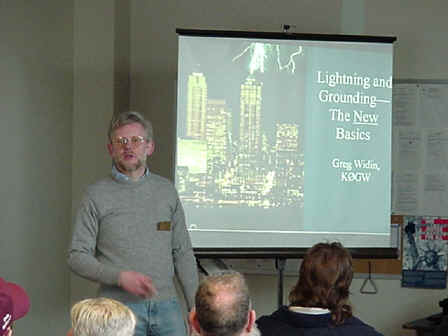
Pictured: Greg Widin, K0GW, ARRL Dakota Division Director, gives a club program presentation on lightning and grounding.
“A club is an association of two or more people united by a common interest or goal.” Thanks, Wikipedia! Of course we seldom think of clubs in terms of only two people. Usually a radio club is larger – sometimes much larger – and there may be several distinct interest groups within the club. The club may own some equipment, such as special tools for antenna work, a repeater system, a club station, training materials and equipment, and more.
The challenges:
Meeting space. If you have a club of only a few members, this isn’t a big deal. Clubs of a dozen or fewer members have lots of choices, up to and including private homes. Typically, a radio club will have a membership that is too large to be accommodated anywhere but a more formal meeting space, and that means casting about for a venue. With a demographic that includes aging baby boomers, a club definitely wants to have a meeting space that is accessible to those who might use wheelchairs or who are unable to climb stairs. You also want electricity, good lighting, and quiet space. Internet is a bonus, but if it is not available, it isn’t exactly a deal-killer. The challenge is finding the space at an affordable price! Back in the day, meeting spaces were plentiful and free for the asking, especially to small public service or special interest clubs like ham radio groups. Venues might include the local school, church halls, service organization halls, and municipal or county buildings. It is not so easy today. The economy is down. Every venue is looking to raise extra cash, so the days of free meeting space might just be in the rear view mirror! And permanent space with room for a club station – wow, that is REALLY hard to find these days. I know that several clubs have either lost or given up their space for club meetings and stations due to the press for more revenue or other activities related to the needs of the landlord or host organization.
Apathy. This one drives club officials nuts. And it’s nothing new, of course. There have always been club members who would rather jump out a window than put together a club program or write an article for the newsletter. But it’s worse now than ever before, and it’s related to number three on my list, which I’ll tell you about shortly. Suffice it to say that there are all too many hams out there who think it is a major hassle to even join a club, much less actively participate.
Overworked club members. Yes, this one has always been around because some club members take on way more than their share of club duties. But the reason it is worse than ever before goes back to the world economic downturn that started in 2007. As the economic woes gathered, companies and organizations began trimming their workforces. Everyone seemed to be affected, no matter what the industry, and those who were still working felt lucky to have jobs. Those who lost their jobs, ham radio operators among them, tightened their belts and didn’t spend anything extra on their radio hobby. Back at the workplace, those who still had jobs were doing the work of their old job plus that of a co-worker or two, since there were now not enough people on staff to get everything done. That meant longer, harder hours at work, and less time for amateur radio club activities. I have been a ham since 1967, and this is the first time I have been hearing about this phenomenon from other hams who feel too pressed to participate in club activities as they once did.
Recruiting. A club will fade away if it does not attract new members to replace those who die, lose interest, or move out of the area. Yet this aspect of club life is often left on the sidelines, going unnoticed until all of a sudden it seems as if there is no longer a reason to have regular club meetings. Recruiting is challenging in a world of worldwide internet connectivity with VoIP and other activities that mimic worldwide radio communication.
What can be done?
Remember that whatever needs doing, you do not have to do it all yourself. Leverage the manpower you do have by using the resources available at ARRL, which has lots of advice and ideas about clubs, club organization, and recruiting. Let’s take a closer look at each challenge:
A strategy to make meeting space more available is to make your club stand out above and beyond the others who might be competing for the same space. For example, if you are meeting in the county law enforcement center, you can make a better case for meeting space because your club supports emergency communications, Skywarn training and weather spotting, and public service communications. You are making sure that your club’s mission is aligned with that of the meeting space owner! No matter who hosts your meeting space, remember that it is wise to give back to your host in some way. If you are using a church hall for your meetings, perhaps the church needs volunteers for a clean up day or help at the church picnic. If you are lucky enough to get a special meeting room at a restaurant, everyone should buy a meal or at least spend a reasonable few bucks to make sure the restaurant owner turns a profit. The key? Be the best meeting space user you can be, and you will have more choices!
Apathy is hard to cure. In fact, I don’t even care anymore.
Ha, ha, I am just kidding about that not caring part, of course! I look at the programs and activities as the “good stuff” associated with a radio club. The other more pedestrian activities like the business meeting don’t really interest many of us. It’s the program on the DXpedition or the special event station that draws club members to the meetings. If your club has apathy oozing out of every nook and cranny, I’m willing to bet that your club doesn’t host good programs. Finding good presenters isn’t a given; the really good ones make the rounds but have limited time and resources. Most of your club’s programs and activities will ultimately come from within the club itself, and that means finding the right club member – one who is a really enthusiastic and positive go-getter – to do the going and getting. By that I mean they need to observe the membership, noting what areas of interest and expertise there are within the club. Then they have to recruit the guy who knows about antennas to give a talk. Apathy is something you chip away at by slowly building your circle of presenters. The more varied the topics, the better. Like the offerings on a menu at an excellent restaurant, there will soon be something for everyone at the club meetings.
The problem of club members who are stressed out by their work schedules will not be solved at the radio club, but I think it is reasonable for those members who are retired or who have a bit more time to step up to the plate and take on some of those extra club duties. We need to appreciate that those in their working years are trying to stuff 10 pounds of potatoes into a 5 pound bag these days, and are often also raising families with all of the obligations and demands on their time that those things require. Yes, those people are sometimes willing to take on club duties, but they are subject to “burn out” if they don’t get a little help. Next time you are at your radio club meeting and something needs doing, raise your hand. Lead by example.
Recruiting is vital, but how does a club go about it? I have seen several once active and vital radio clubs fade into obscurity and finally disband. Others have been successful in maintaining and growing their membership numbers. What is the secret?
Well, there are several, really. You have to understand the world around you – no small feat, that. What it means is knowing that amateur radio has a lot of competition for hobbyists who want to experiment with electronics. It means understanding that on line video gaming, so-called massively multiplayer online role-playing games (MMORPG), include elements of world-wide communication, cooperation, competition, scoring points, and community-building that are found in traditional amateur radio. There is, in other words, a lot of competition out there. Knowing what you are up against makes it easier to figure out how to package amateur radio and your radio club to better draw people in. If you want to make ham radio attractive to anyone under 100, you’d better start thinking of some interesting activities, outreach to school science teachers, high-profile cooperative ventures with other groups… I think you get the idea. My own local club drew some university students in by participating in tracking high-altitude balloon flights via APRS.
Another recruiting strategy is to offer Technician courses to the general public. We schedule ours right after a Skywarn course in the Spring, just before severe weather season kicks in. The classes are free, but the participants buy their own books. Graduates are invited to join our club. Education is one of the most important indicators of a club’s health. Show me a club without an education program, and I’ll show you a meeting room that will soon be available for a group of rock hounds or stamp collectors. Seriously, you have to offer classes or your club is toast. Again, check out the excellent resources on the ARRL website for tips on teaching and for resources like math help. Most importantly, say “YES!” when asked if you will be part of your club’s education and training team.
Your job? Make getting on the air with amateur radio sound like it’s at least as much fun as World of Warcraft®.
Go get ’em, tiger!

Handiham World for 29 June 2011
Welcome to Handiham World!
Before I mention anything else, I want to thank all of you who expressed sympathy or had suggestions for me and my broken computer. Things are looking up this week, and most everything is back to normal. I did have everything properly backed up. In our radio club, this is called the “belt & suspenders theory”. You wear both to make sure that if one fails, the other will still hold your pants up! It does pay to back up your data, since you just never know when something will quit working, whether hardware or software, in a system as complex as a computer. The idea of having backups extends to other parts of your ham shack, too. Having more than one radio can be a real relief when another has to be repaired at a factory service center a thousand miles away. Having a spare HT battery during a public service event is just plain smart. Engineers call this concept “redundancy”, and there is certainly good reason for it when you need to protect a high-stakes system like the communications system in an airliner or the brakes in a car. Since you have a lot at stake with your personal computer’s many files, you have an interest in protecting it with regular backups.

Turning to Field Day, we have an email from Ken, W6KHS, who came up with the idea of holding our own version of Field Day on the HANDIHAM Echolink conference:
You probably know by now that Field Day operations using the Handiham conference server was a total success. As this entity becomes more and more popular, repeaters and radio links using it will be more likely to receive emergency or life or death messages from situations when cell service is not available. I recommend that there be a twenty second break between transmissions so that there is room for emergency traffic to enter. If this information comes from you, it will be carved in stone, rather than from me. Thanks again for just being there.
73, Ken Schwartz W6KHS
Yes, Ken, you are right about that! Occasional longer pauses are in order considering that we are using a worldwide resource. Susi, WA0DKS, who worked behind the scenes to manage the Field Day event on the HANDIHAM conference and put in considerable time as net control station during the overnight hours, commented on the event, calling it a “rousing success”. Podcast listeners will hear Susi tell them about it herself! Our thanks to Jim, WB4LBM and the other net control stations and participants who made this first-time event possible. In talking with Susi after the event, we concluded that the HANDIHAM conference really gained a lot of exposure worldwide. I just happened to tune in later in the day on Saturday and heard a YL who had been at a local Field Day station here in the eastern Twin Cities Metro area. She was driving back home and heard our net on the N0BVE repeater system. (Thanks, Don!) As I have said many times before, having Echolink or IRLP on a repeater really enhances its value to the community, and will make the difference between a dead, unused system and a vital, much-appreciated community resource.
Even though the contacts made on our system don’t count for points, the whole idea of building our operating skills, making friends, showcasing amateur radio and technology, and building a stronger community while HAVING FUN just somehow seemed more important to me. I’ll bet it did to you, too.

Ambassador Program
Linux in the Ham Shack would like to be involved in more community events and we need your help to do it. Please check out our new Ambassador Program and let us know if you’re willing to participate. Help us make the world a better place for free software and amateur radio.
73 de The LHS Guys
Handiham World for 22 June 2011
Welcome to Handiham World!

One of the movies I remember enjoying was “The Perfect Storm”. A huge storm barreled up the Eastern United States seaboard and all the conditions aligned to turn it into a real disaster. Everything that could go wrong did go wrong.
This week seems a lot like that here in the ham shack. My main Windows computer suffered a failure and the Windows installation could not be repaired without a complete reinstallation. Although I regularly back everything up, reinstalling an operating system is still a huge and very disruptive process. Although you may have documents and the files you have created preserved, you have to reinstall all of your applications. That means all saved settings, passwords, usernames, the lot of it. So I am operating here on an old computer with limited resources. I cannot retrieve all of my old email and many contacts have disappeared. It is a huge mess and it will take a long time to get back to anything like an efficient office day.
But is it a perfect storm? Well, consider that yesterday I had to attend some staff training at our main office at Camp Courage. A thunderstorm had passed through several days before, knocking the W0ZSW remote base offline. That problem was fixed easily enough by restarting the rig control computer and setting the BIOS to always turn the machine on following a power failure. Turning to my main office computer, I found that it had been fried. So now my main office computer and my main home computer on which I produce all audio podcasts, do all audio editing, all my home email, the web publishing, and nearly everything else having to do with my computing life, all both down for the count.
Add to that the fact that we are into the busy season at camp and Courage Center, like other healthcare providers, is worried about an impending State government shutdown, and you can see that this is quite some storm!
So today’s e-letter will have to be shorter. I will do my best to catch up, but ask that emails and phone calls be kept to a minimum.
I know this is disappointing, so to cheer you up, we will hear a special presentation by Matt Arthur, KA0PQW, later on in the audio podcast version of this week’s e-letter. Matt sent me an audio lecture on sporadic-e propagation, and this is a perfect time of year to learn more about it and then look for some sporadic-e yourself!
Patrick Tice
[email protected]
Handiham Manager

Letters

Anne, K1STM, wrote to let us know that TIPSnet is in summer shut down mode and will return on September 13. The final TIPSnet for this past season was yesterday, June 21.
Editor’s note: I have lost a considerable amount of email. I am not sure when it will be recovered. If you have sent me something and it does not get acted upon, that is the reason. Please send only urgent email to [email protected] until further notice.
Troubleshooting 101: No column this week
Maybe if I ever figure out my computer problems, I’ll write about that, HI!
Send your ideas about troubleshooting for possible inclusion in this column to:














