Posts Tagged ‘6m’
 Sporadic on Six
 June 12th, 2013 |
  Author:
 Today there has been a really big Sporadic-E opening on 6m which lasted for several hours. In fact it is still going on as I type this.
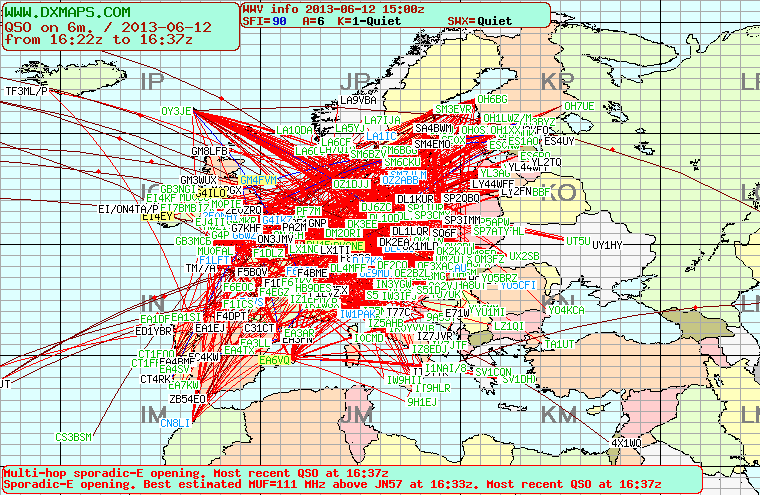
This snapshot of activity from DXMaps gives an idea of what the opening was like at its peak. The whole of western Europe must have been covered by a reflective Sporadic-E cloud!
From DXMaps I could see that the opening extended up to 2m for a time, though I didn’t hear anything myself. Unfortunately my QTH is poor for VHF so conditions have to be exceptionally good for me to hear any 2m DX let alone work it. So 6 remains my favourite VHF band.
I made several 6m contacts on SSB and several on PSK31. The most interesting call was LY44WFF, a DXpedition to Klaipeda, Lithuania KO05oi which is quite a rare square so I’m told. Best DX on PSK31 was probably David, 5B4AHY.
I never quite know how to answer calls on 6m PSK31. Some operators seem to use quick, contest style operating while others reel out their name, QTH, EPC number and so on. I prefer the quick format myself, with the aim of getting the contact completed before the conditions fade out. But if someone wants to exchange a bit more information I try to do that too.
A station operating RTTY was an unwelcome presence among the PSK just above 50.250. One RTTY station came up right smack on top of someone operating PSK63. Surprisingly I got perfect copy of the PSK63 station which was straddled by the RTTY signal! Surely it is time to abandon this old, wide, slow outmoded mode?
Show Notes #104
Episode #104 Audio (Listen Now):
Introduction:
- Pete is back on the show along with Russ
Announcements:
- Hamvention 2013 is happening May 17-19, 2013 in Dayton, Ohio. LHS reached the donation goal and thus will be in the Hara Arena. Thanks to Sierra Radio Systems for their incredibly generous donation that put us over the top. We will be talking with George from Sierra and Nick from Pignology in Episode #105. It’s a show you DO NOT want to miss.
- Bill, KA9WKA, has announced that he is also going to be on hiatus for a while. Therefore, we now have an opening for a show notes taker and keeper of all knowledge! If you’d like to be that person, please send us an e-mail or get in touch with Pete or I in the IRC channel.
- Website that lists known Linux Events.
- http://answers.oreilly.com/topic/3507-list-of-known-linuxfest-events/
Topics:
- We have a pre-recorded interview with Steve Nichols, G0KYA (also AB8ZV) the Author of STEALTH ANTENNAS an RSGB publication.
- http://g0kya.blogspot.com
- http://www.infotechcomms.co.uk
- HF Propagation Report Podcast
- Factors in HF Propagation
- Sunspots
- Flares
- CMEs
- Propagations changes over daily and monthly bases
- Solar Cycle 24 and its progress
- HF Propagation programs
- HamCap (Windows 32-bit)http://www.dxatlas.com/hamcap
- VOACAP (Linux, MacOS X, Windows)http://www.voacap.com
Feedback:
- Topic for short discussion: How is Ham Radio Free and Open Source?
- http://www.linuxjournal.com/ham (2010)
- http://www.linuxjournal.com/content/open-source-ham-%E2%80%93-free-range-chicken (2009)
- Both articles are more of a teaser for Linux Journal’s HAM section.
- Pro arguments:
- Home-brew your own
- Communications open worldwide
- No need for outside infrastructure
- Con arguments:
- Need a license from “The Man” to operate
- Many restrictions (band plan, op procedures, etc)
- Not Free, as in beer (license, equip, etc)
- Therefore, is it the ‘YANG’ to Linux’s ‘YING’?
- Due to the length of the interview with Steve Nichols, feedback will be moved to after the interview in Episode #105.
Contact Info:
- Contact Russ at [email protected] or [email protected].
- Listen to the live stream every other Tuesday at 8:00pm Central time. Check the LHS web site for dates.
- Leave us a voice mail at 1-909-LHS-SHOW (1-909-547-7469), or record an introduction to the podcast.
- Sign up for the LHS mailing list.
- LHS merchandise is available at the Merch link on Web site. Check out the Badgerwear or buy one of the other LHS-branded items at PrintFection.com/lhs or Cafe Press. Thanks!
- Thanks to Dave from Gamma Leonis for the theme music.
Music:
- “Alive” by Bright September
- “So Called a Hero” by Bright September
- http://www.brightseptember.com
6m 18 May 2013
This Saturday morning there was a big Sporadic-E opening on 6m. There were some pretty big signals, though once again I seemed to be on the edge of the opening. The Sporadic-E seemed centered over northern Europe and you can see from the map that it was pretty intense!.
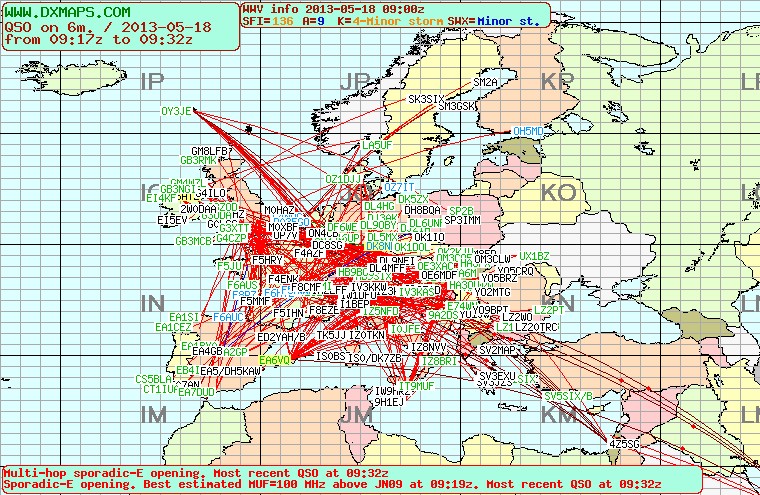 |
| 6m on 18 May 2013 at 0930z. Map from DXMaps.com |
I had KComm’s DX Cluster window open. I don’t use the cluster on HF and dislike it intensely, but spotting stations on the cluster (in a specific format with locators for both endpoints) is how VHF contact information gets to DXMaps.com.
I saw a couple of contacts from Ireland spotted on 2m so I switched bands.
 |
| 2m on 18 May 2013 at 0940z. Map from DXMaps.com |
As you can see, two lucky EI stations managed to work into northern Italy, one of them using a vertical antenna! Signals must have been strong but when I QSYed to 2m I didn’t hear anything. The Es must have been over the northern French coast and you can see that the same Es cloud must have permitted F6HTJ to spot the GB3ANG beacon and enabled DG7IG to work EA1CCM as the paths intersect at the exact same point..
I wasn’t lucky on 2m but I was a bit more successful on data and tuned to the PSK part of the 6m band just in time to catch a French station signing off with Tim, G4VXE. I managed QSOs with Gerard F4LKG and George EA4GB but I don’t think many stations were listening because my CQs went unanswered.
It seems as if the 2013 Sporadic-E season is off to a good start!
Spring is here!
Testing a new build of WSJTX for K1JT I hopped on to 10m and was surprised to see a strong signal. It soon revealed itself to be SM6NZV who gave me a +8dB report on my 5 watts.
This reminded me that it is May 1 today, the start of Spring and usually also the start of the Sporadic-E season. I tuned around on 6m and heard a couple of weak stations on my dipole, also a couple of stronger GMs working stations I could not hear.
I thought about installing the SDR-4+ as a panadapter for the K3 which had been one of the things I had intended to use it for. But something was amiss and I didn’t have control of the receiver’s frequency. I think the settings had got hosed, probably when I was playing around with using a USB DVB dongle as an SDR. I have no idea how to get it working again and I started getting stressed about it so I decided to abandon the idea.
SDRs are not for me, or at least not those that use a PC for a user interface. Windows is just too fragile, though if Linux is any better it’s only because there are fewer things to install on it in the first place!
Instead I will set up scanning on the K3 to scan a section of the 6m band. I always forget how to do this so I had to dig out the manual. Load the start frequency into VFO A and the end frequency in VFOB, make sure the mode and frequency are what you want and store it in a memory. I used memory 6 for 6m scanning.
To start a scan you just recall memory 6 (M>V, 6) and press and hold SCAN. I’ll probably forget that sequence of button presses as well so I looked up the CAT commands in the K3 Programmers Reference (SWT23;SWT29;SWH41;) and stored it in a KComm shortcut. I’ll probably make one for 2m as well though the chances of hearing any 2m Es up here are slim indeed. Last year I don’t think here was a single opening that extended this far north on 2m.
LHS Episode #104: Propagation 101 with G0KYA
 We sometimes on this show attempt to bring you interesting interviews with people who are both computer literate and ham radio literate at the same time. In this case, we bring a scholar, physics buff, aerospace engineer and brilliant guy, Steve Nichols (G0KYA), to discuss the science of radio wave propagation. No need to turn the show off before it even begins. Steve makes understanding the Earth’s atmosphere, its magnetic field, and a ton of stuff about the sun simple and approachable. No mind-bending equations, no physics lectures, just some great information for anyone interested in learning how a radio signal gets from here to there. A bunch of follow-up information in the form of books and Web sites are provided as well, links to which will be in the show notes, for anyone who wants to further their education. Thank you as always to our loyal listeners. Make sure to tell a friend next time you’re out for a cold one. The more the merrier.
73 de The LHS Guys
VHF white noise listening club
I’ve resumed my role in the vhf white noise listening club with this evenings UKAC 50Mhz contest. Its a bit early in the season to expect any results with 6m from here but nice to get a full 3 qso’s with my new (and more xyl friendly) 4 ele yagi, from Powabeam.
I opted for the smallest one they did as the previous long boom 5 ele was just too big and basically got in the way for much of the year. This one is shorter by quite a margin and performance isn’t far off what I would have expected from the previous one. Oddly enough it was a gift from my mother in law through the DX shop. Well done her, and by far better service than I received through other well known and innovative antenna manufacturers. The specs are largely what you would expect from a small beam but the quality of manufacture is superb. There is no need to trim or tune anything. Just bolt up and away you go. All in all less than 10 mins from start to up on the portable mast. Highly recommended.
Operating at home certainly beats sitting in a car, freezing yourself half to death, on the side of a fell road but there is not much in the way of chance that I’ll get good results from here without the aid of Es. When I could no longer hear the beacons in Northern Ireland it was time to turn the rig off though.
Ping!
WSPRing on 6m this afternoon and I captured this trace:
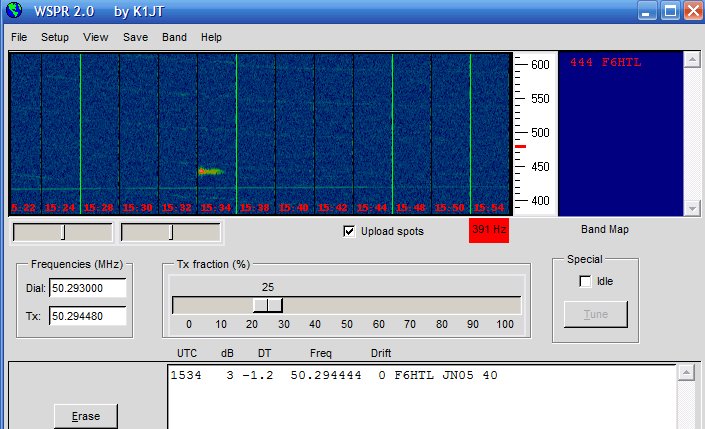
I’m not seeing anything else, though F6HTL spotted my transmission 2 minutes later. I wonder what type of propagation that was?
(Interesting that WSPR decoded the transmission even though the signal was only present for half a cycle.)














