 |
 An Aaargh! moment
 24 June 2013 | by
 Some of you may have received an invitation to join my LinkedIn network from me today. To those who accepted, thank you. To those who found the invitation unwelcome, I apologize.
It was not my intention to spam you in any way. Unfortunately I didn’t look carefully enough at what was displayed so that instead of emailing just those whom I had painstakingly selected from the list, the invitations went to all of the hundreds of addresses in my Gmail contacts list.
It was a real Aargh! moment, but by the time I had uttered the exclamation it was too late! Judging by all the invitations I have received in the past from people I don’t remember, I don’t think I am the first person to have done this.
Julian Moss, G4ILO, is a regular contributor to AmateurRadio.com and writes from Cumbria, England. Contact him at [email protected].
QRP Key?
So, that brings me to the term "QRP Key". We've all seen it, an advertisment or solicitation for a small morse key or paddle. Phrases like, "a nice compact morse key suitable for QRP operation" or the key is "QRP" sized. Now this brings a few questions to my mind. QRP in the technical sense means low power, so can you only sent 5 watts with this key? I suppose QRP operators are not suppose to use full sized keys or bugs as obviously you wouldn't be QRP any longer. Does using a full size key boost your signal? Does this mean that this small key cannot be used for QRO operation, will this "QRP key" degrade my high power signal? What are the specifications for a "QRP" key?
What about the QRPp operator? What are they to do for an appropriate key? Surely if you have QRP keys, QRPp keys must be even smaller and only those with very small hands can be successful, QRPp operators.
All of this is very confusing from a literal sense. If I am new to QRP must I get a new key? Dare I mix my QRO and QRP paddles or will I have problems if I do? I have this nice desk paddle that I love, but surely I couldn't use it with my KX3, or could I? Since the KX3 is larger than my KX1 maybe I could use my big paddle with it, but definitely not with the KX1. Surely you understand the dilemmas here. What to do?
Now, a few more descriptive terms for these small keys is the term "portable", "small "or the phrase "for field use". These terms, from a literal pespective, seem to make more sense. Certainly these "QRP keys" make sense for the QRO operator on an expediton who doesn't want to carry around a heavy key. Begali uses the term "adventure key", which seems to be self explanatory and doesn't invoke a QRP only use.
So, be careful and use your own judgement on when and where to use your QRP key, someone may be watching.
Mike Crownover, AD5A, is a regular contributor to AmateurRadio.com and writes from Texas, USA. Contact him at [email protected].
Any Guesses?
Guess the rude noise on 6m I recorded a little while ago but forgot all about
Alex Hill, G7KSE, is a regular contributor to AmateurRadio.com and writes from Cumbria, UK. Contact him at [email protected].
My first ever field day is over…………
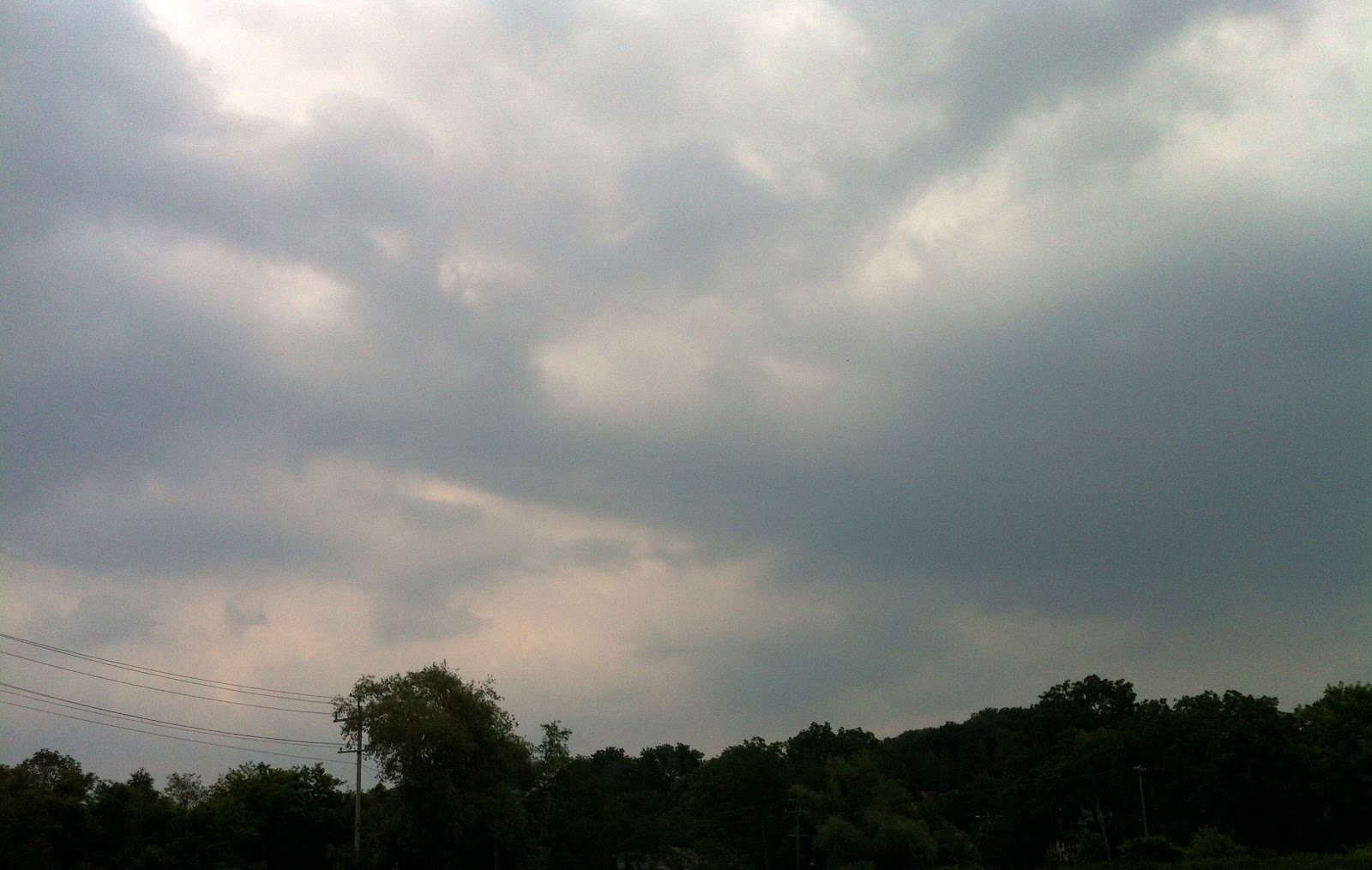 |
| The Saturday afternoon sky |
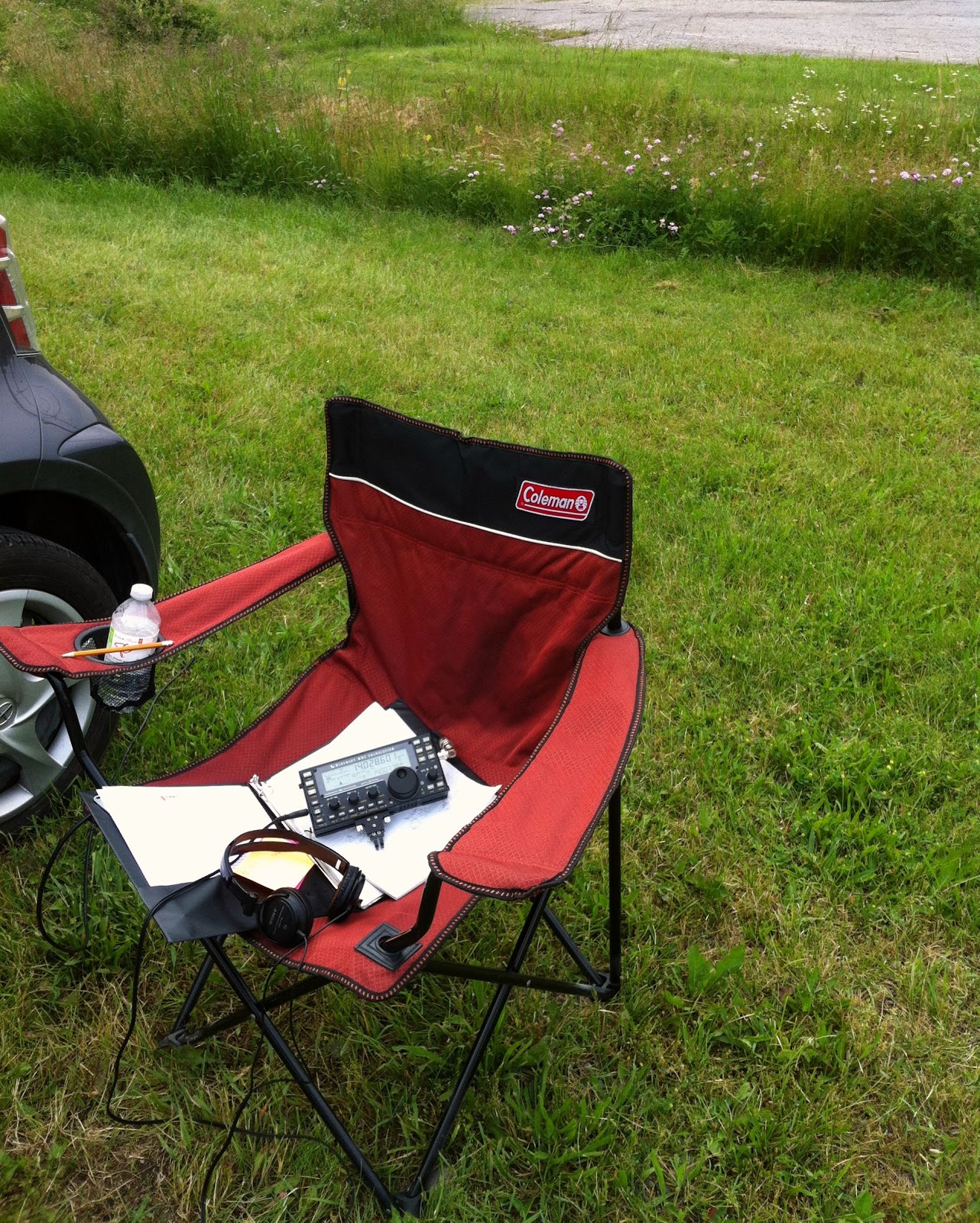 |
| Saturdays operating position |
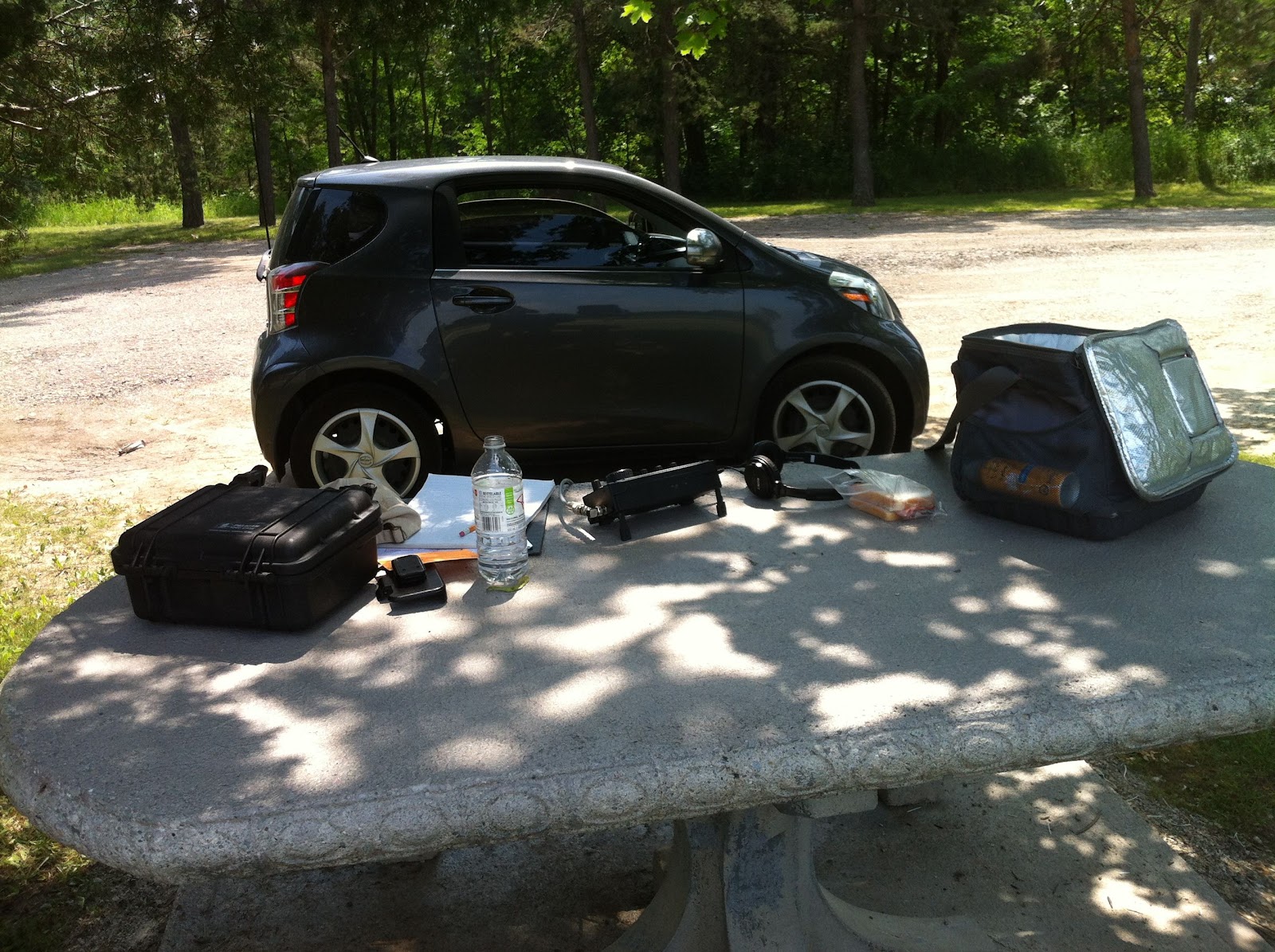 |
| Sundays spot...lunch time |
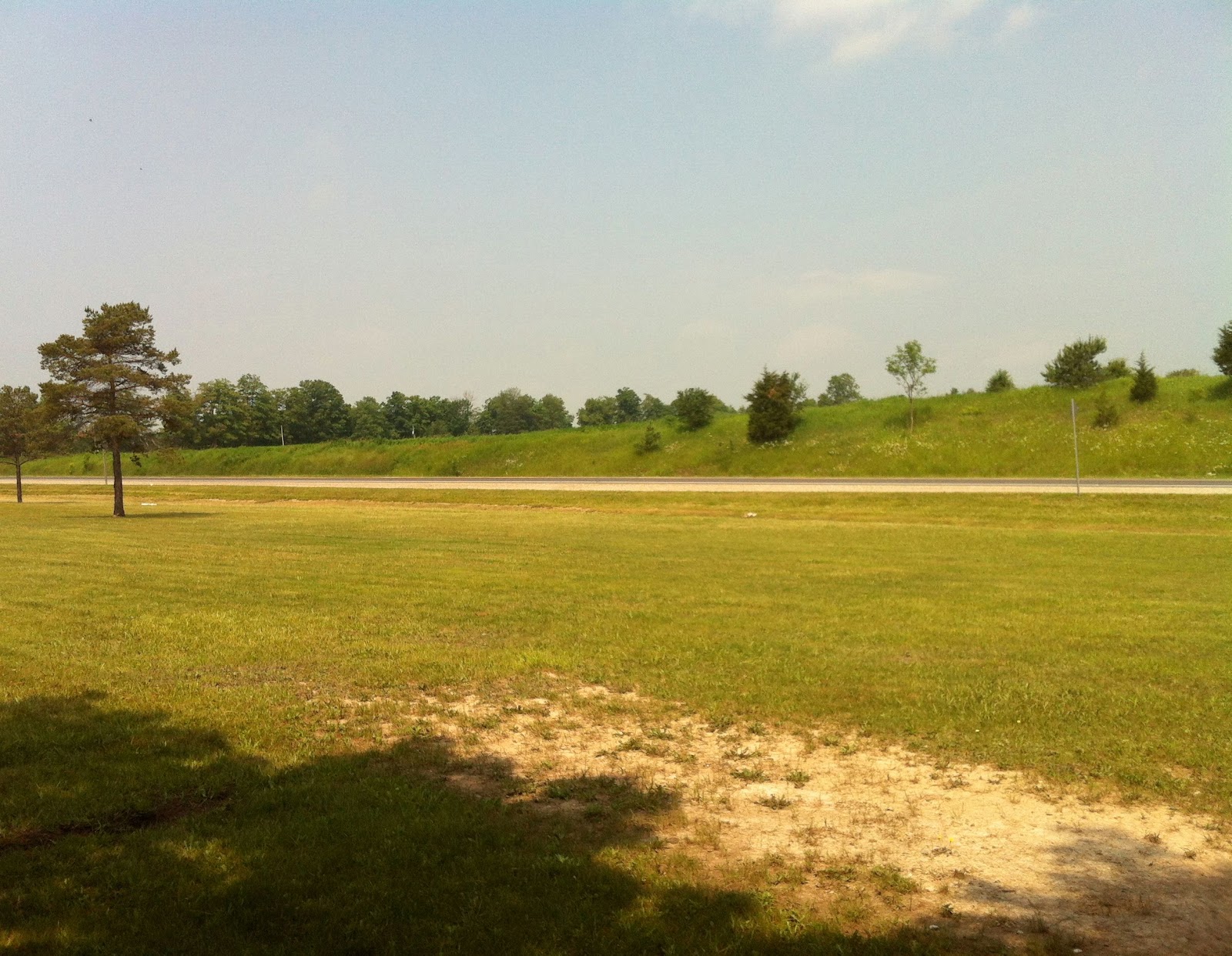 |
| Sundays weather |
Mike Weir, VE9KK, is a regular contributor to AmateurRadio.com and writes from New Brunswick, Canada. Contact him at [email protected].
Updated RTL1090 – more planes on your SDR based virtual radar
A few days ago, I noticed some mention about a new version of the RTL1090 program. This is Windows software which you can run on your PC in conjunction with the RTL-SDR dongles and plot ADS-B transmissions from aircraft. For a bit more detail, please see my earlier blog post
Yesterday evening I downloaded the program and installed it, which was straightforward. My first impression was that I was seeing more aircraft than I had before. With the small antenna provided with the dongle on the desk in front of me, I was seeing aircraft further out than I had done before with the RTL1090 software. Testing again this morning, the same seems true.
As well as seemingly being a bit more sensitive, the new version of the RTL1090 software provides a bit more information in the List view abut messages which have been decoded, which might be useful or interesting (or encouraging) if you have not yet got the link to a plotting program working yet.


Download the new version of RTL1090 here
The other thing that looks quite interesting is that the team have produced a program to interface with RTL1090 and plot aircraft on a map. It’s called Globe-S and can be found here – I haven’t yet installed it, but it looks a nice interface.
Tim Kirby, G4VXE, is a regular contributor to AmateurRadio.com and writes from Oxfordshire, England. Contact him at [email protected].
Where did the Stations Go ?

The DX seems to have disappeared here in the valley; it left just a mysteriously as it came. There didn’t appear to be any reason why I captured it, in the first place, around the first of the year, and there doesn’t seem to be any reason it left; but I’m hearing very little here in the valley.
Just as a precaution, I’ve submitted a work order (I’m not holding my breath) for a “new” Gold coating of on the West Virginia State Capitol Dome, which is just up the street. It seems only logical that the recent thunderstorms and a tremendous lightening strike (point blank) last week, on the dome, has reduced my DX to a trickle. I’m just not getting the usual radio signal “bounce” off all that gold.
All kidding aside; the weather has been terrible for the last few weeks. I think the same can be said about most of the European stations which I usually work. They seem to be underwater for the most part. I saw on the news this morning where Calgary Canada has been flooded. The mid west here in the US is still experiencing severe thunderstorms on a daily basis. I think we’re all in trouble with these shifting, and unusual weather patterns in the world.
Perhaps, in some unusual way, I’ll experience these unusual DX band conditions again next year at the same time? It’s beginning to sound like my DX contacts are somewhat of a fluke now, which is difficult to explain. I’ll be looking forward to the beginning of next year, to see if these conditions repeat themselves.
John Smithson, Jr., N8ZYA, is a regular contributor to AmateurRadio.com and writes from West Virginia, USA. Contact him at [email protected].
FUNcube Dongle
I’ve been spending a few hours playing around with a FUNcube Dongle Pro. There was a lot of excitement about this project a couple of years ago when it started. In order to get one you had to be quick off the mark on Ebay. I never succeeded, then I got ill and then I forgot about it. This one was passed on to me by a friend who successfully purchased one but never used it.

I started off by following the instructions in the user manual. I followed this by installing and setting up a complicated-looking SDR program called Spectravue. I was baffled by most of this program’s settings and I wasn’t sure if it worked.
What I should have done was try some of the SDR programs I installed when I was playing about with USB TV dongles at the beginning of the year. I started SDR#, selected the FUNcube Dongle from a pull-down list, clicked Start and it just worked!

Simon Brown’s SDR-Radio worked as well, and with equal ease, though as luck would have it I tried it on the very day that the (free) licence key for the program expired. This appeared to come as much of a surprise to Simon as everyone else. As I type, Simon has just uploaded a fix which I have yet to install.
I thought I would try using the FCD as an ADS-B receiver which I did with the TV dongles but I soon discovered that I can’t. The FCD looks like a budget USB sound card to the SDR software, so its bandwidth is restricted to 2 x 48kHz. The digital TV dongles can transfer a much wider bandwidth. This is noticeable if you try to receive Band 2 FM radio – through the FCD the signal sounds distorted on peaks because the bandwidth isn’t quite wide enough for FM stereo which needs a full 100kHz..
It will be interesting to use the dongle with the FUNcube 1 satellite when it gets off the ground later this year (we hope!) In the meantime I’ll use it to watch for Sporadic-E in the VHF band.
Julian Moss, G4ILO, is a regular contributor to AmateurRadio.com and writes from Cumbria, England. Contact him at [email protected].
 Ham Radio Deluxe |
 W5SWL Electronics |
 Ham Radio Prep |
 KB3IFH QSL Cards  Hip Ham Shirts  HamRadioAuctions HamRadioAuctions Reliance Antennas Reliance Antennas Enigma Shop Enigma Shop |  morseDX  Ni4L Antennas  R&L Electronics R&L Electronics antennas.us antennas.us QRV QRV |
- Matt W1MST, Managing Editor
