 |
 New Colorado 14er Event Shirt
 30 June 2013 | by
  Thanks to Steve WG0AT, we now have a new design for the Colorado 14er Event Shirt. Steve gen’d up a new logo that has the Colorado 14er Event blended with Summits On The Air (SOTA), that is available on a variety of t-shirts, a coffee mug and maybe a few other items. The logo, shown to the left, is a fantastic graphic featuring Ham Radio at Altitude.
Go to Cafepress to view and purchase the items that are available.
73, Bob K0NR
Bob Witte, KØNR, is a regular contributor to AmateurRadio.com and writes from Colorado, USA. Contact him at [email protected].
Beware a lion on a parachute: My first attempt at tracking High Altitude Balloons on 434MHz
A few weeks ago, I enjoyed tracking two high altitude balloons launched from near Cambridge, across the channel across Belgium, Germany and then finally into Austria. On that occasion, I didn’t have the time to set up the software to attempt to receive the data from the balloons and upload them.
Earlier in the week, I noticed Dave Akerman M6RPI mention that there would be two balloon launches this Saturday. Both quite interesting – one was a fund raising venture for Purley Infants’ School and the second one was even more fun – an attempt to release Kingsley, the Reading FC mascot from a balloon at exactly 18.71 miles above the earth and have him drift down to earth on a parachute.
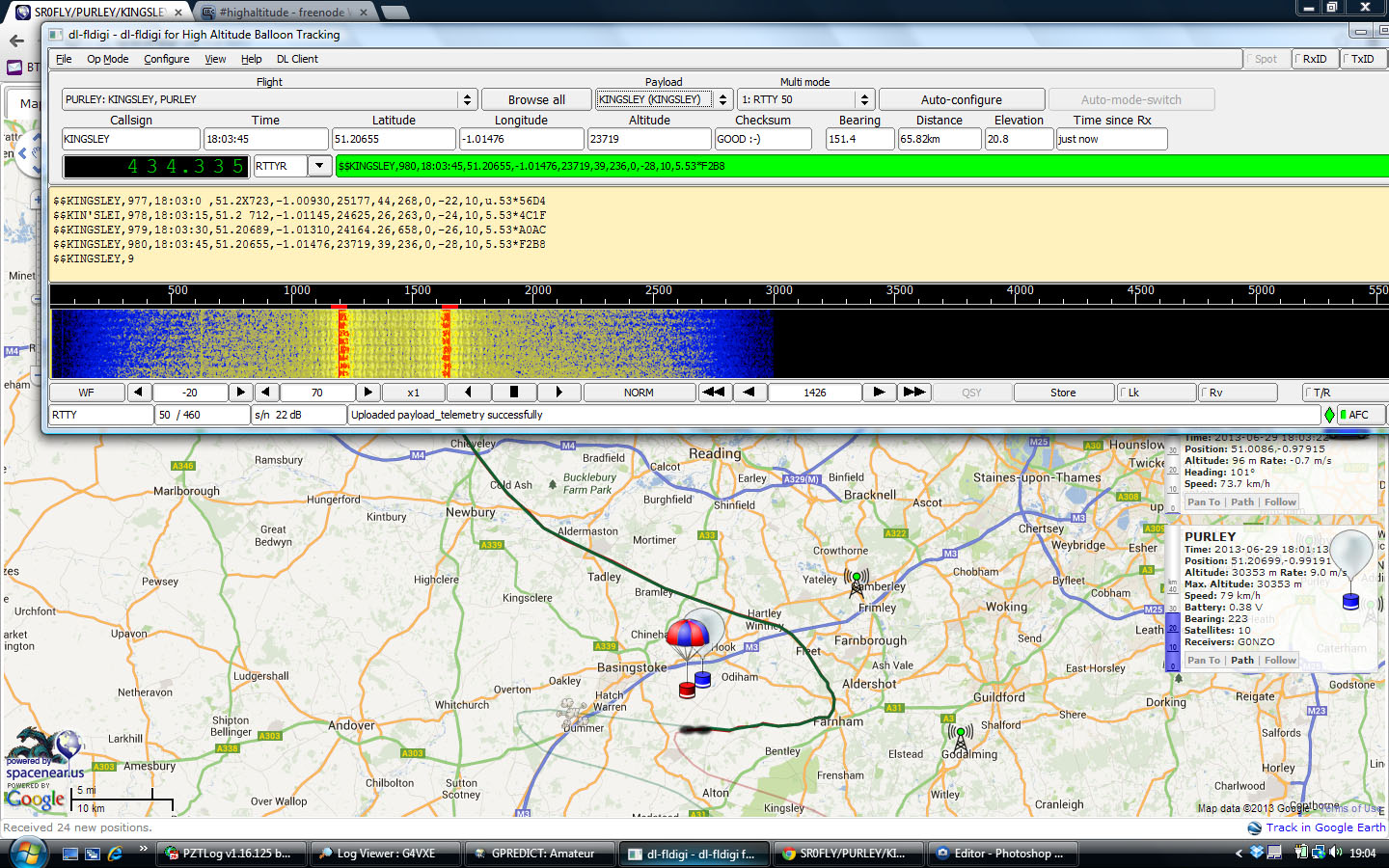
As ever, I didn’t really plan it, but at least I was downloading the DL-FLDIGI software as the balloons were being launched! Data about launches together with a plot about where the balloons currently launched are, is shown on the SpaceNear website
As the balloons were being launched from about 20 miles from me, I was reasonably confident I would hear them. I turned the 432MHz yagi (10 ele) towards the launch site. I picked the Purley balloon and tuned the FT847 to the appropriate frequency on 434MHz SSB. The balloons transmit a RTTY signal. Very soon, I could hear a weak signal.
I fired up DL-FLDIGI and filled in the station configuration details. After a bit of fiddling, I settled on setting the mode to RTTYR (the FT847 was on USB) and I was able to decode some data. Although I was receiving data and could see that it was being uploaded to the Spacenear site, I was getting a lot of bad checksums. Initially, I thought this was something I was doing wrong. However, I think it was because the Purley balloon must have been running quite low power. I will ask Dave about this.
However, when I tuned to the KINGSLEY balloon, signals were very much stronger and I was able to track it well as it rose to the target height, burst and then gently descended to a landing spot not too far from Basingstoke. It was fun tracking it very close to the horizon. Actually during part of the descent, the balloon’s transmit frequency was drifting fast – almost too fast for DL-FLDIGI’s AFC! However, I was able to persuade it to play after a bit more fiddling and a restart of the software!
Now, has anyone in Basingstoke seen a toy lion on a parachute? (actually, the good news is that Dave, M6RPI has recovered both payloads successfully, so Kingsley hasn’t had to sleep out rough..)
Tim Kirby, G4VXE, is a regular contributor to AmateurRadio.com and writes from Oxfordshire, England. Contact him at [email protected].
ICQ Podcast S06 E13 – Radio Safety (30 June 2013)
Series Six Episode Thirteen of the ICQ Podcast has been released. News Stories include :-
- RSGB Centenary
- New GB3WGI 144MHz transatlantic beacon goes live with G2FKZ legacy funding
- Dot, dash, full stop: Telegram service ends
- Moon bounce from Antarctica
- Duhallow Repeater Group
- 70MHz DXpedition to EU-013 Jersey
- 3rd UK High Altitude Society Conference
- California Radio Hams claim 77 GHz world record
- Band allocation at 5 MHz for Samoa
- 5 GHz Vehicle-to-Vehicle Communications
- Google Project Loon using 2400 and 5800 MHz
Your feedback and Martin Butler (M1MRB & W9ICQ) discusses Radio Safety.
Colin Butler, M6BOY, is the host of the ICQ Podcast, a weekly radio show about Amateur Radio. Contact him at [email protected].
ICQ Podcast S06 E13 – Radio Safety (30 June 2013)
Series Six Episode Thirteen of the ICQ Podcast has been released. News Stories include :-
- RSGB Centenary
- New GB3WGI 144MHz transatlantic beacon goes live with G2FKZ legacy funding
- Dot, dash, full stop: Telegram service ends
- Moon bounce from Antarctica
- Duhallow Repeater Group
- 70MHz DXpedition to EU-013 Jersey
- 3rd UK High Altitude Society Conference
- California Radio Hams claim 77 GHz world record
- Band allocation at 5 MHz for Samoa
- 5 GHz Vehicle-to-Vehicle Communications
- Google Project Loon using 2400 and 5800 MHz
Your feedback and Martin Butler (M1MRB & W9ICQ) discusses Radio Safety.
Colin Butler, M6BOY, is the host of the ICQ Podcast, a weekly radio show about Amateur Radio. Contact him at [email protected].
Still going QRP
Even with SSB there is a possibility to make DX QSO's. This video is a nice example. Today I worked IW2NOH and SQ9JXB with 1 watt JT9-1 on 20 meter this morning. I was calling LA3LJA but he did not come back for me, so I walked away from the rig to get a cup of coffee, and then I saw he was returning for me. So I missed the QSO here. Sorry.
Paul Stam, PC4T, is a regular contributor to AmateurRadio.com and writes from the Netherlands. Contact him at [email protected].
Series Six Episode Thirteen – Radio Safety
Series Six Episode Thirteen of the ICQ Amateur / Ham Radio Podcast has
been
released. The latest news, your feedback and Martin Butler (M1MRB & W9ICQ) discusses Radio Safety.

- RSGB Centenary
- New GB3WGI 144MHz transatlantic beacon goes live with G2FKZ legacy funding
- Dot, dash, full stop: Telegram service ends
- Moon bounce from Antarctica
- Duhallow Repeater Group
- 70MHz DXpedition to EU-013 Jersey
- 3rd UK High Altitude Society Conference
- California Radio Hams claim 77 GHz world record
- Band allocation at 5 MHz for Samoa
- 5 GHz Vehicle-to-Vehicle Communications
- Google Project Loon using 2400 and 5800 MHz

Colin Butler, M6BOY, is the host of the ICQ Podcast, a weekly radio show about Amateur Radio. Contact him at [email protected].
Radials done!
For now at least! 😉
After mowing the lawn early this afternoon, I finished the job that I had started the other evening. I finished getting my new set of radial wires down for my Butternut vertical.
My first set, put down so many years ago, consisted of a set of 25 foot (8 Meter) long wires, fanned out from the base of the Butternut. If memory serves me correctly, I originally put 25 radials down. They have long since disappeared under the lawn, but I know for a fact that two were damaged over the course of the years. One by me, and one by our dog.
Today, I put another dozen wires down, but these were not 25 footers. Today, I laid down wires as long as I could to the opposite end of the back lawn. In all, I put down approximately 650 feet (198 Meters) worth of wire. I used up what I had leftover from last time and entirely used up a brand new 500 foot spool of 14 gauge wire.
I still need to buy another bag of landscaping pins, so that I can secure the wires to the ground s little more securely in several areas. There are a few spots where I believe the lawn mower wheels might push the wire around, unless it’s secured a little better.
So that makes a total of 37 radials down around my Butternut. Someday, I’d like to get that total closer to 60. I have read in several articles that 60 is the magic number, where adding more than that causes no significant increase in benefit.
73 de Larry W2LJ
QRP – When you care to send the very least!
Larry Makoski, W2LJ, is a regular contributor to AmateurRadio.com and writes from New Jersey, USA. Contact him at [email protected].
 Ham Radio Deluxe |
 W5SWL Electronics |
 Ham Radio Prep |
 KB3IFH QSL Cards  Hip Ham Shirts  HamRadioAuctions HamRadioAuctions Reliance Antennas Reliance Antennas Enigma Shop Enigma Shop |  morseDX  Ni4L Antennas  R&L Electronics R&L Electronics antennas.us antennas.us QRV QRV |
- Matt W1MST, Managing Editor
