 |
 Hat trick
 29 August 2013 | by
 Today I pulled off a hat trick during my lunchtime QRP session. A triple play, a trifecta, a triple crown ….. three QSOs, one each on three different bands, in about 15 minutes. One on 20 Meters, one on 17 Meters, one on 15 Meters. A lot of band hopping!
The first QSO was a domestic one, but was perhaps the contact that intrigued me the most of the three. On 20 Meters, I worked Mike AI8Z/8, who was on SOTA Summit W8M/UP-057. This is better known as Feldtmann Ridge on Isle Royale National Park. The park is technically part of Michigan’s Upper Peninsula, but is actually an island in Lake Superior, very close to the Canadian shore. I did a Google search for images and have come away seeing that this is one very beautiful location.
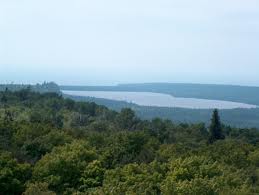
Looks like a perfect place for a QRP vacation. This is exactly the kind of QRP adventure that I dream of and salivate over. Some day, I’m going to go on one of these! I wonder if Ken WA8REI has ever been there?
The next QSO happened on 15 Meters, which seemed to be open with a few signals today. I answered HC2SL, Alfredo’s CQ from down in Guayaquil, Ecuador and received the standard DX “TU 599” exchange. He did get me first time, no fills; but I’m pretty darn sure I wasn’t really 599. Alfredo really was 599 up here in New Jersey, however. His signal was really booming in.
From there, it was a jump on over to 17 Meters, where I answered another CQ. This one was coming from Andy DM5MU, from Leipzig, Germany. Andy came back to me on my first call, also. Andy rewarded me with a 539 report, while I was able to send a 579 his way. The DX does not have to be 599+ in order to get a QSO. If you hear a DX station calling CQ, and they’re not making your eardrums bleed, don’t be afraid to throw your call sign out there, anyway. They might not hear you; but then again, they might. You’re never going to get a feel of who you can work and who you can’t if you only answer the loudest of the loud. Push the envelope – you will be rewarded many times over.
I would have liked to have stayed on longer, but after working Andy, I felt a buzz from my cell phone. A text message indicating that I had to cut lunch short and go back inside to handle a mini-crisis. Oh well ….. how do these crises seem to know when the bands are hopping?
On a “blog housecleaning” note, I have added one blog to the blogroll and have eliminated another. First off, welcome to Jim Smallwood N7RCS and his blog, “Low-power, low-profile QRP from the Pacific Northwest!” Looks like it’s going to be a good one.
Secondly, at the request of the blog owner, I have deleted the link to Smoke Curls by Jeff Davis KE9V. Jeff wrote me to let me know that he sold all his Amateur Radio gear and has retired from the hobby. ‘Tis a pity, I will miss his word smithing – he is one very talented person.
72 de Larry W2LJ
QRP – When you care to send the very least!
Larry Makoski, W2LJ, is a regular contributor to AmateurRadio.com and writes from New Jersey, USA. Contact him at [email protected].
Amateur Radio Newsline Report 1881 August 30 2013
- NTIA to lead a two year pilot study of all spectrum in the United States
- Hams respond to Colorado Flooding and the western states wildfires
- Ridgecrest California to consider higher ham tower height limit
- WRTC 2014 Team Leader applications due no later than September 13
- VA radio club begins a computer loan out program to needy high schoolers
G11 SDR
One thing I’ve never done is build my own complete rig. There are a lot of choices to be made when considering this, including budget and complexity. I’ve always liked SDR as a way to go but building my own Hermes HPSDR is probably a little bit beyond me soldering skills. So next on the list is the Genesis G11 from down under. I think I’ll do a bit more investigation and then plump for a suitable design. The club has some good test gear if its required so that shouldn’t be limiting.
I’d love to hear your advice or comments
Alex Hill, G7KSE, is a regular contributor to AmateurRadio.com and writes from Cumbria, UK. Contact him at [email protected].
4 SOTA Activators and a Regular
The bands seemed very dead today at lunch. I looked at SOTA Goat and saw that there were some guys spotted in New Mexico on some 10 point peaks. I listened first for WS0TA (club call) and could not immediately here him – he was there, but not strong enough to copy.
So I put out a CQ about 14.059 and checked for reports on the Reverse Beacon Network. I was spotted on both coasts by about 11 stations with many reporting 15-20+ DB – so I knew I was getting out. Do you ever wonder if the bands are dead, or just nobody is calling CQ??
Contacts for today:
WS0TA – I was finally able to pull him out of the mud with 339 reports both ways on 20 meters. This is a club call, so I am not sure who the OP was today. He was on W5N/SE-001. (Updated: Fred, KT5X was the Op today, and also the trustee, for WS0TA. Looking at his QRZ page he is also into trail running, and running on mountains! Very cool!)
K7SO – I saw him spotted on 10.110 and was able to work him easily thru the little pileup. He was 599 and he gave me a 579. He was on W5N/SE-003.
K1JD – He was 559 and he gave me 579, he was also on W5N/SE-003. Worked him on 10.110 also.
NM5S – also on W5N/SE-003 but on 40 meters about 7.031 – very weak but I called him when he peaked a bit. He gave me 449 and he was 339.
Fun to work 3 guys on the same peak – I bet they were having fun! Unfortunately for me, the chaser, I only got 10 points for the 3 contacts since you only get points for a peak once per day.
Right now I am sitting at 88 points.
N7BBH – Right as I was ready to pull the plug and head back to the office I heard Steve calling CQ and he was nice and strong. We have worked each other twice before. I had to keep it short since I was almost late, but he got stronger during his second exchange, and he reported I did as well.
Fun day once again!
Burke Jones, NØHYD, is a regular contributor to AmateurRadio.com and writes from Kansas, USA. Contact him at [email protected].
Pondering Antennas for the HOA Restricted Home
.JPG) |
| 30″ Magnetic Loop Under Construction |
As the list of major projects at our new home is starting to get shorter, I have been pondering an antenna installation that is more permanent than my Portable QRP Antenna that I strap to the deck railing when I want to operate.
The portable vertical I use, which is nice and quiet at the park, is VERY noisy at the home QTH which is full of all sorts of man made electrical noise.
First thought was to put a 66′ doublet in the attic and feed it with ladder line. I have no doubt this would work, but I have to invest in ladder line to make it happen.
I have a 30″ square magnetic loop that I have built from 1″ copper pipe before we found out we were moving. It is all soldered up, just sitting in my garage waiting for a tuning capacitor and feed loop to be installed. I am leaning towards this being my first antenna install here at the QTH.
Why a magnetic loop?
You can read all about the good and bad of loops online, but one of the biggest drivers is that they are supposed to be very quiet. Many hams that report S5+ noise on their dipoles are reporting S1-S2 noise on the loop.
The other reason is that it is almost done – probably a couple hours of work max and I could have it on the air. Additionally I can hang this in my garage, or put it in the attic, so that I can keep in good graces with the ever watchful HOA observers!
So that is what I am going to do. At first the tuning capacitor will be done with a coax stub tuned to a fixed frequency. I will do this centered around 14.060. This will give me a narrow little spot to play.
Then I am going to build a home brew butterfly capacitor – which I will document here.
Burke Jones, NØHYD, is a regular contributor to AmateurRadio.com and writes from Kansas, USA. Contact him at [email protected].
Another good lunchtime QRP session
Propagation numbers baffle me sometimes. Yesterday, when the numbers looked so good, I thought I was going to end up getting skunked. I did end up working Oleg UR3IFD, in the Ukraine, and I also had a very brief, QSB busted QSO with Paul WA9PWP. But other than those two very brief contacts, it was pretty grim. There wasn’t else much to be heard and my CQs on several bands went unanswered. Advance the clock 24 hours, to find the SSN is down to 35 and the SFI is only at 110. Not great numbers. But despite the numbers, I had a great outing.
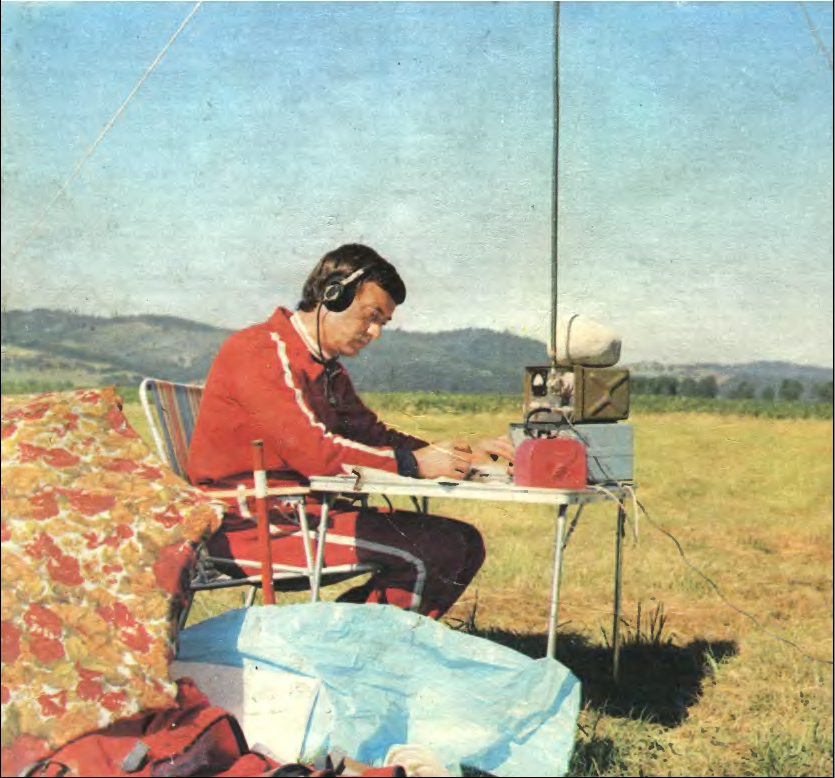
I started out on 17 Meters with a brief QSO with Ted LZ1ND, who was calling CQ. Ted was a good 599+ here in New Jersey, and I got a 549 in return. Not a bad report, and Ted got all my basic information, so I was definitely copy-able in Bulgaria. And it looks like Ted is quite comfortable behind the dial of a QRP rig himself. Here’s an old photo I dug up of him on the Web, taken while he was participating in Bulgaria’s HF QRP Field Day.
After Ted, I switched on over to 20 Meters and called CQ. I was answered by Ron W5VYN, from Whitesboro, TX. Ron had a magnificent signal into New Jersey. The fact that he was using home brewed gear made it all the sweeter. Ron had asked me if he was generating any key clicks, and I was happy to be able to tell him that he had a perfect, solid and stable 9 in the “T” portion of RST. His home brew rig sounded just as good as any commercial rig out there. That was a nice QSO.
That was followed up by a “quickie” QSO with Greg N4KGL. Greg, who’s down in Florida, was using one of those new PAR ENDFEDZ Trail Friendly antennas, which was generating a nice 579 signal for him. It’s always nice chatting with Greg, and I wish I could have stayed on longer. But as always, time flies when you’re having fun, and it was time to break down and head on back to work.
So it just goes to show …. you can have a great QRP day, even when the solar conditions say, “Maybe not”.
Even so, I had to laugh on the way home from work. As I was driving, I was listening to two Hams on a local 2 Meter repeater bemoan the current sunspot cycle. One was complaining about “How you just can’t work any decent DX without at least a 500 Watt amplifier!”. I almost lost it right there, I started chuckling so hard.
Lots of QRPers, including N8ZYA, K3WWP, W2LJ and many, many others have log books that attest to the direct opposite!
72 de Larry W2LJ
QRP – When you care to send the very least!
Larry Makoski, W2LJ, is a regular contributor to AmateurRadio.com and writes from New Jersey, USA. Contact him at [email protected].
Evening DX from Knox Mountain
What an evening! Nearly 80 degrees and humid. Judy and I walked to Knox Mountain. I worked Spain, California, Cuba, Morocco, and Texas.
The hike in was fast in order to keep ahead of the mosquitoes. It was well rewarded by the view of the pond after the 1.5 mile hike.

As I approached the pond, a large gray heron swooped up in front of me and headed east to the other end of the pond. It was stunning. We walked around to the front of the cabin. Beautiful!

I tossed a line nearly 50 feet into the cherry tree at the edge of the pond and pulled up a 33 foot wire. I set up the KX3 and used the earchi.org 9 to 1 unun. At first I operated on 20 meters. I worked two Spanish stations in a row and lost them both at the very end to QSB.

After that things picked up a bit. California and Cuba on 20 meters, then I switched to 17 and worked Morocco and Texas. Here’s the log:
27 Aug-13 2134 14.008 EA5HFW CW 559 599 Spain
27 Aug-13 2140 14.013 EA8AGF CW 449 579 Spain
27 Aug-13 2145 14.022 N6QQ CW 559 599 CA
27 Aug-13 2146 14.011 CO6RD CW 599 599 Cuba
27 Aug-13 2155 18.086 CN8KD CW 599 599 Morocco
27 Aug-13 2156 18.075 WF5W CW 579 599 TX
Mid-way during the operating a hoot owl in the woods not far away let forth with several calls. It was remarkable. Down by the pond Judy was knitting some baby booties in the sunlight.

As I packed up the gear, a bunch of jays started squabbling down by the pond… a chorus of “Dee Dee… Dee Dee. As we headed down the path, I turned back for one more snapshot of the pond.

Jim Cluett, W1PID, is a regular contributor to AmateurRadio.com and writes from New Hampshire, USA. Contact him at [email protected].
 Ham Radio Deluxe |
 W5SWL Electronics |
 Ham Radio Prep |
 KB3IFH QSL Cards  Hip Ham Shirts  HamRadioAuctions HamRadioAuctions Reliance Antennas Reliance Antennas Enigma Shop Enigma Shop |  morseDX  Ni4L Antennas  R&L Electronics R&L Electronics antennas.us antennas.us QRV QRV |
- Matt W1MST, Managing Editor
