 |
 Norway, Bulgaria and Philly – QRP!
 21 March 2014 | by
 Had a brief time to head to the park at lunch today – and once again had a blast!
Here is the low down….
LA5UF – Joe was calling CQ on 21.040. It took him a bit to dig me out and get my call right. He gave me a 449 and he was a solid 559 here in Kansas. Joe hails from Norway.
LZ2HR – I heard him calling CQ on 28.0299 with no takers. I threw my call out and he came right back to me. He gave me a 589 and he was a solid 599 here. Fun!
I called CQ for some time on 10 meters, and even though I was spotted all over on the RBN – no dice.
Then I heard….
K3DY calling CQ on 21.0469. We had a nice QSO with more than just a contest exchange. The band was a bit up and down, but solid copy both ways. Tony said he was reading my page as we talked. Thanks for the nice QSO Tony! Tony is outside Philadelphia, PA.
Any lunch time with a little CW is always fun!
I hope to get a version of my Portable QRP Antenna installed in the attic this weekend. We will see how that goes. I would really like to get a station setup at home, and eventually try some of the digital modes.
Burke Jones, NØHYD, is a regular contributor to AmateurRadio.com and writes from Kansas, USA. Contact him at [email protected].
0,5 W on 20 meter WSPR
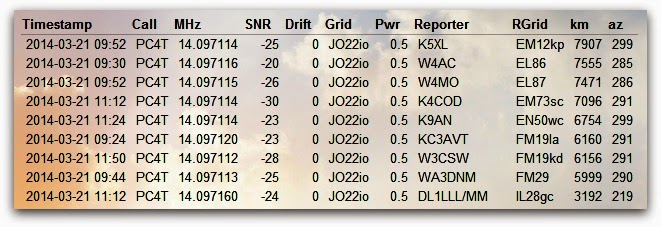
It seems to be that propagation is fair. So I tried 0,5 Watts on 20 meter today with WSPR. I show only reports above 2000 km.
Paul Stam, PC4T, is a regular contributor to AmateurRadio.com and writes from the Netherlands. Contact him at [email protected].
Amateur Radio Newsline Report 1910 March 21 2014
- Hams asked to assist in the hunt for Malaysian Airlines Flight MH 370
- Ukraine and Russia bring intruding signals to some HF ham radio bands
- Hams in France get new band allocations and more bands may come
- FCC invites public comment on proposal to restructure the 10 GHz band
- Ohio radio club to celebrate Earth Day on the air
- Surrey Space Center in UK developing virtual ride to space
Rumours of my demise…….
Are of course untrue 
Quite a bit has happened over the last few weeks. Primarily domestic and work duties have kept me away from the rig other than the occasional VHF contest appearance.
At home I have spent a considerable amount of time replacing cables and renewing bits and pieces that have succumbed to the Cumbrian winters and salt spray. The salty, windy air has corroded connectors, got into the coax outer (my poor connectors to blame) and generally caused some ‘issues’
So cabling all done
New telescopic mast purchased
New antenna purchased
So to the purchases. I bought a simple, manual 12.5m mast from Spiderbeam that is pretty substantial. Why no fixed mast? because radio is a hobby that I do and not the rest of the family and we enjoy the sea view more on that in another post. The antenna is a lightweight hexbeam from folding antennas. Again more info on that in a more detailed post. But suffice to say its all going down the same path. Simple radio. Nothing complicated. Nothing that can’t be easily moved or changed and no chasing the next rig / antenna / thing. Just turn on what I have and enjoy the simplicity.
Hold on a minute. I haven’t done the remainder of the decking….well at least I got to think about radio
Alex Hill, G7KSE, is a regular contributor to AmateurRadio.com and writes from Cumbria, UK. Contact him at [email protected].
Another good day!
Two for two Thursday, let’s call it!
Second day back to lunchtime QRP operating, and another good day. The higher bands were alive again. This time I worked Russia R2014ME (I had worked R2014E yesterday), Belarus EW8O and Mexico XE2I. And …. for the heck of it, I wanted to see if I could break the monstrous pileup that was foisting itself upon W1AW/5 in New Mexico. 15 Meters was hot and the band was long. The amount of European stations calling W1AW/5 was huge and LOUD! Would it be possible for a QRP station, powered at 5 Watts to break that melee?
Not only was is possible, but it happened. I made it into the log. But it took some listening and some figuring. The W1AW/5 station set up a pattern. He was working split, and was announcing “U”, which of course meant that he was listening up. But he was listening “in an race track pattern” as it were. By carefully listening for a while, I was able to determine a pattern:
1) W1AW/5 works a station
2) W1AW/5 moves the listening frequency up a few Hertz
3) W1AW/5 works the next station
4) W1AW/5 moves the listening frequency up a few Hertz
5) W1AW/5 works the next station
But he did this only to a point. Once he reached a point known only to him, he reversed the procedure. He would work a station and then listen a few Hertz DOWN from the last station he worked. He kept doing this until he reached a “lower UP frequency” that he determined and then started the whole business over again.
If I didn’t make myself clear (sometimes I have a problem doing that), what he was doing was changing his listening frequency in a circular pattern, even though he was always listening “UP”. For example – W1AW/5 was on, let’s say 21.030 MHZ – he was working stations between 21.031 and 21.034 MHz. And he was ping-ponging between the two. He would start listening up at 21.031 Hz and would keep moving his listening frequency until he hit 21.034 and then work back down to 21.031 and then back up to 21.034 and so on and so on and so on.
After determining what he was doing, I adjusted my transmit frequency to “get in his way”. After about three or four minutes of trying, I was able to make myself heard. Now I suppose that if I didn’t listen as much as I did, I might have made it into the log anyway, just by sheer dumb luck. But by determining what he was doing, I shortened the time (considerably, I think) that it took to get into his log. And during these lunchtime QRP sessions, time is a precious commodity, so saving time is a very good thing.
As I’ve stated before, I’m not going out of my way to take the pains to work all 50 W1AW stations. However, today I sensed a challenge that I felt like taking on. It’s good practice for the Fox hunts and those pesky DXpedition pileups.
Speaking of the QRP Fox hunts, I am one of the two 80 Meter Foxes tonight. This is my last stint of the 2013/2014 season. It’s been fun and I hope to hand out a lot of pelts tonight. As a Hound, this has been a particularly exhilarating season! According to the last tally – I have worked 25 out of 32 Foxes on 40 Meters (78%). On 80 Meters, I have worked 24 out of 30 Foxes (80%). This has been my best season – ever! The season ends in just a few weeks, and I hope to continue with a strong finish. Wait a second, I probably just went and jinxed myself! Then again, I guess I can’t really jinx myself as I owe all my success to the extraordinary ears and antennas of the Foxes.
One last note. If you get a chance, take a gander at the February 2014 edition of CQ magazine, if you can get your hands on one. There’s an article on my lunchtime QRP sessions that was written and submitted by yours truly. Rich W2VU felt it was worth including – hopefully by accepting my article, he’s not scraping the bottom of the barrel too hard!
72 de Larry W2LJ
QRP – When you care to send the very least!
Larry Makoski, W2LJ, is a regular contributor to AmateurRadio.com and writes from New Jersey, USA. Contact him at [email protected].
From Russia with Love…
Its been to many months since my last lunch time QRP session! Finally had a warm day with no work activities over lunch so I headed out to my favorite park and had a blast!!
As soon as I turned the KX3 on I heard…
KC2EE calling CQ on 14.060 – we exchanged 559 reports – he was in Houston, TX. Working Sid brought back the great feeling of sending some CW – although I was rusty!
Then I went on to work…
NA6MG was spotted on SOTA GOAT, so I tuned to 18.090 and there he was coming in at 599. Dan was on W6/CT-231.
OH4MDY was calling CQ on 18.075 and was a solid 599 here. I had to call a couple times, but finally made it. Retu was in Finland!
Next up was my best DX yet!
R7LA – Vasily was calling CQ on 24.893 with no takers. He really had to work to pull my callsign out, but then it seemed to get better. He copied my well after getting my call, so the conditions must have improved. He gave me a 559 and he was 599 here. He must have pulled up my QRZ page while on air because he told me that my QRP signal was FB! What a hoot! Thanks Vasily for pulling my 5 watts out of the mud, you made my day!
Not that spring is here, I will be operating much more at lunch time. I am still working on getting my home station set up. Antenna is ready, I just need to get it in the attic! I really want to start working some digital modes from home. I think they might work best because of the loud interference I experience there. We will see.
Burke Jones, NØHYD, is a regular contributor to AmateurRadio.com and writes from Kansas, USA. Contact him at [email protected].
0,5 W on 10 meter


I was happy that WA6JRW from California spotted me with 0,5 watt. That's 8875 km.
Paul Stam, PC4T, is a regular contributor to AmateurRadio.com and writes from the Netherlands. Contact him at [email protected].
 Ham Radio Deluxe |
 W5SWL Electronics |
 Ham Radio Prep |
 KB3IFH QSL Cards  Hip Ham Shirts  HamRadioAuctions HamRadioAuctions Reliance Antennas Reliance Antennas Enigma Shop Enigma Shop |  morseDX  Ni4L Antennas  R&L Electronics R&L Electronics antennas.us antennas.us QRV QRV |
- Matt W1MST, Managing Editor
