 |
 Grinding quartz and holding a frequency during World War II
 2 April 2015 | by
 I’m a great fan of the Prelinger Archives which is home to so many items like this video I’ve heard about recently from various ham radio email lists.
I like how the components of the earliest electronics and wireless were so basic and ‘natural’. Think of hand made capacitors and resistors using traces of graphite on paper. Valves (or tubes) of course were another story but still capable of being ‘homemade‘.
I love the idea that an accurate, literally rock solid frequency could be achieved using a piece of a very common rock – admittedly a pure piece of quartz cut just so.
This video details the elaborate and meticulous manufacture of quartz crystals during World War 2 by Reeves Sound Laboratories in 1943.
The 41’24” video can also be viewed and downloaded via the Prelinger Archives.
Most of the ‘radio quality’ quartz was mined in Brazil which ceased its neutrality in 1942 and joined the Allies.
The story of quartz crystals during WWII is told in ‘Crystal Clear‘ by Richard J. Thompson Jr. (Wiley) 2011.

“In Crystal Clear, Richard Thompson relates the story of the quartz crystal in World War II, from its early days as a curiosity for amateur radio enthusiasts, to its use by the United States Armed Forces. It follows the intrepid group of scientists and engineers from the Office of the Chief Signal Officer of the U.S. Army as they raced to create an effective quartz crystal unit. They had to find a reliable supply of radio-quality quartz; devise methods to reach, mine, and transport the quartz; find a way to manufacture quartz crystal oscillators rapidly; and then solve the puzzling “ageing problem” that plagued the early units. Ultimately, the development of quartz oscillators became the second largest scientific undertaking in World War II after the Manhattan Project.” (from the book’s blurb)

Reading in your head – the long path to morse code bliss
I’m one of those people who learnt morse code completely the wrong way. Starting off in the seventies with no guide I simply tuned into nightly morse transmissions sent by local hams at a very slow rate. I think they started at 5 words a minute. The main risk there was nodding off between words or impatiently guessing the wrong word.
Contemporary wisdom is that you should start listening at a much faster rate, say 15 or 20 words per minute. This is to prevent you counting dots and dashes in your head, and to make it easier for you to recognise the letters, numbers and even words by their sound.
Learning 15 wpm after mastering say 8 wpm is almost like learning a new language. Students of morse talk of ‘a plateau’ at 10 which is a mighty barrier to progressing up to a more useful conversational speed.
My personal goal is to be able to copy and send at 25 wpm and be able to sustain it over a couple of hours, and to be able to read mostly ‘in my head’, only using pencil and paper for details like names and callsigns.
Now that morse code is no longer compulsory for any ham licenses, surprisingly it seems to be more popular than ever! Especially with those hams who like to use low power to make contacts, or to take the lightest possible transceiver to a remote mountain top as part of the global ‘Summits on the Air‘ activity. Morse gets more mileage than voice per watt, and often these tiny transmitters are only putting out a couple of watts power.
And there’s something delightful in having the skill to read the beeps.
But for me it’s a skill I have to keep working on. I think in my twenties I was quite at ease chattering away at about 12 wpm seemingly for hours on end. Four decades on with a large slab of radio silence in between, I’m quite rusty, even though I know the basics are still there like riding a bike.
I’m a bit wobbly at the paddles, having grown up with the old fashioned straight key (the type you’re likely to have seen in old westerns). But you can feel slow but definite progress from every bit of practice you put in.
A Versatile 630m Antenna

Mark, VA7MM, had come up with a nicely-designed antenna that will serve as his main 630m radiator. Not only that but it can be used on 10m, 15m and 30m and 160m as well!
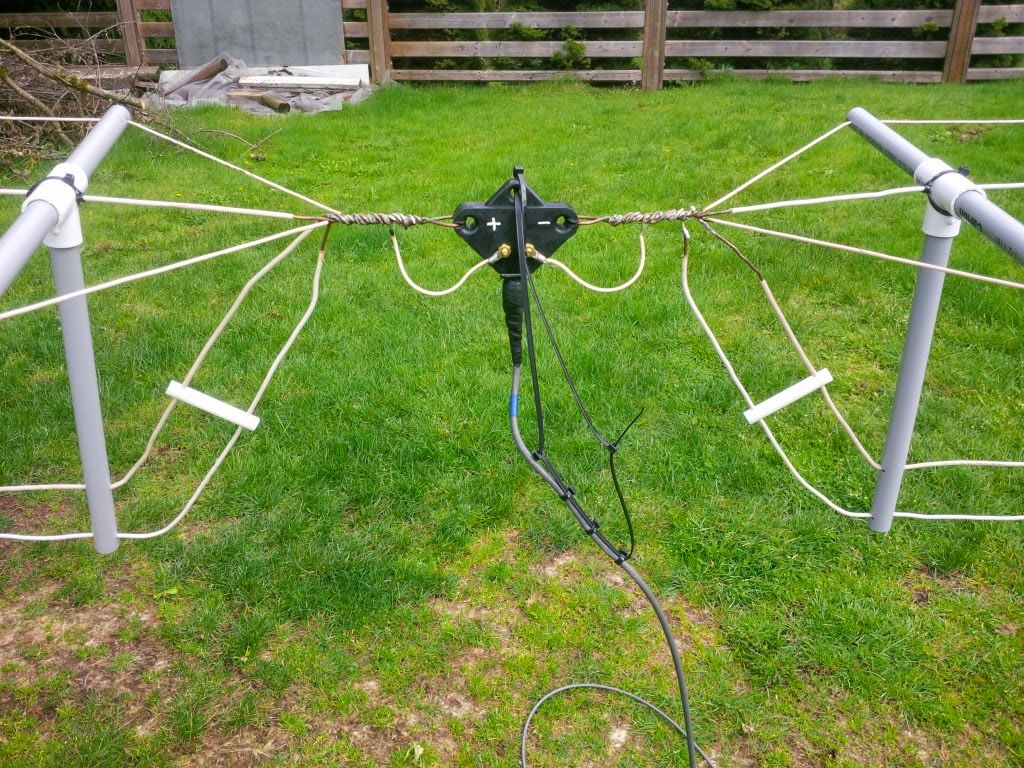
The antenna consists of a mini-flat top dipole, with three resonant dipole legs all terminating at a common feedpoint.

This can be used directly on any of the three high bands. Shorting the end of the coaxial cable, dropping vertically down from the feeedpoint, the dipole feedline becomes the vertical element of a top-loaded 630m 'T' antenna, 100' in the air.
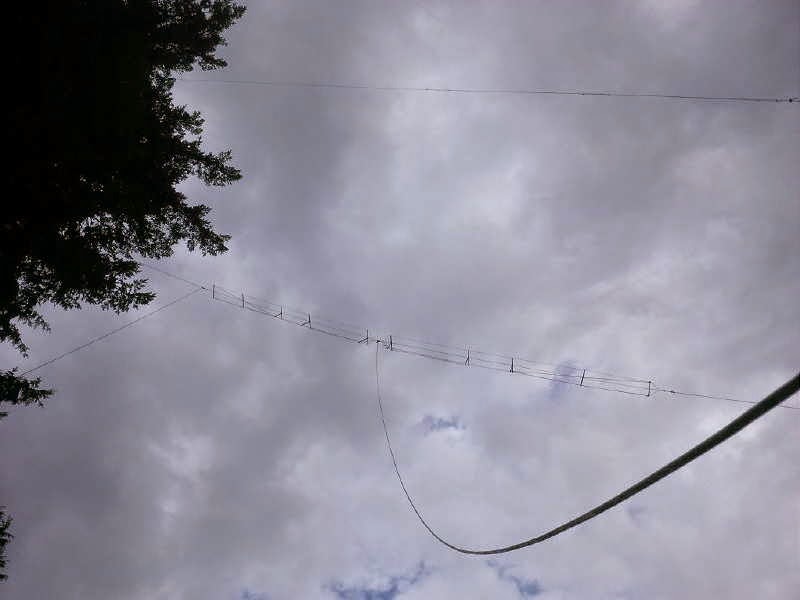
With suitable loading coils and appropriate switching, the 'T' will also be used on 160m, making the versatile antenna work on five different bands ... a nice demonstration of basic antenna principles put into real practice!
Steve McDonald, VE7SL, is a regular contributor to AmateurRadio.com and writes from British Columbia, Canada. Contact him at [email protected].
Inverted High Frequency Loss with LMR-450G
By John ‘Miklor’ K3NXU
PERFORMANCE TESTS – LMR-450G
The recently announced LMR-450G cable has aroused much curiosity since its characteristics have not been collectively available by any one source. By multiple inquiries to several manufactures (only three at this time) and numerous lab tests, we hope to put many of the existing questions to rest.
DESCRIPTION
The physical make up of this cable varies slightly from most conventional RF cables. The center conductor is a semi-stranded copper alloy surrounded by Telfon, which will absorb and distribute cable ‘hot spots’ caused by excessive standing wave. The double silver braid and foil outer coating which provides a 98.6% shield is what the inverted high frequency loss characteristics are attributed. The loss is substantially less as the frequency increases, making this cable especially attractive for UHF, cellular, PCS and microwave applications.

Measuring cable loss under lab conditions
LOSS PER 100′
30 MHz 2.4 db
50 MHz 2.1 db
150 MHz 1.6 db
450 MHz 1.1 db
800 MHz .51 db
1200 MHz .37 db
1950 MHz .31 db
The cable’s most unique property is attributed to the outer jacket material Neo-glow, an RF sensitive composite plastic which will visibly indicate RF ‘hot spots’ in the cable. Adjusting the cable length to the antenna system for the ‘perfect’ impedance match is crucial at high frequency, thus the importance of a low SWR for peak performance.

From 100 Watts and up this cable will brighten up your world.
PROPER INSTALLATION
The low level emission of light from LMR-450G cable can be enhanced by wearing lightly tinted sunglasses with UV protection, which enhances the light radiation from the cable. Select an approximate length of cable needed for the installation which must be multiples of a 1/4 wavelength for the desired frequency. The exact length can be determined by using the formula 467 / Freq (MHz) plus approximately 18 inches.
The initial tests should be run with a 50 ohm dummy load at one end of the cable. With a minimum of 7 watts from the transmitter, you will see a faint glow from the cable indicating the ‘hot spots’ to be eliminated. These are the points along the cable where the RF is at its maximum. It is at these points where the RF connectors should be mounted. Trimming the excess cable may be required at both ends of the cable to produce the most effective match. Use caution not to trim too much cable as the loss characteristics improve with longer cable lengths.
SUMMARY
This could be the beginning of the long awaited high frequency “SUPER” cables. Only available in limited quantities at this time; contact your local cable supplier for more details.


Hans, PD0AC, is a regular contributor to AmateurRadio.com and writes from Almere, The Netherlands. Contact him at [email protected].
Inverted High Frequency Loss with LMR-450G
By John ‘Miklor’ K3NXU
PERFORMANCE TESTS – LMR-450G
The recently announced LMR-450G cable has aroused much curiosity since its characteristics have not been collectively available by any one source. By multiple inquiries to several manufactures (only three at this time) and numerous lab tests, we hope to put many of the existing questions to rest.
DESCRIPTION
The physical make up of this cable varies slightly from most conventional RF cables. The center conductor is a semi-stranded copper alloy surrounded by Telfon, which will absorb and distribute cable ‘hot spots’ caused by excessive standing wave. The double silver braid and foil outer coating which provides a 98.6% shield is what the inverted high frequency loss characteristics are attributed. The loss is substantially less as the frequency increases, making this cable especially attractive for UHF, cellular, PCS and microwave applications.
Measuring cable loss under lab conditions
LOSS PER 100′
30 MHz 2.4 db
50 MHz 2.1 db
150 MHz 1.6 db
450 MHz 1.1 db
800 MHz .51 db
1200 MHz .37 db
1950 MHz .31 db
The cable’s most unique property is attributed to the outer jacket material Neo-glow, an RF sensitive composite plastic which will visibly indicate RF ‘hot spots’ in the cable. Adjusting the cable length to the antenna system for the ‘perfect’ impedance match is crucial at high frequency, thus the importance of a low SWR for peak performance.
From 100 Watts and up this cable will brighten up your world.
PROPER INSTALLATION
The low level emission of light from LMR-450G cable can be enhanced by wearing lightly tinted sunglasses with UV protection, which enhances the light radiation from the cable. Select an approximate length of cable needed for the installation which must be multiples of a 1/4 wavelength for the desired frequency. The exact length can be determined by using the formula 467 / Freq (MHz) plus approximately 18 inches.
The initial tests should be run with a 50 ohm dummy load at one end of the cable. With a minimum of 7 watts from the transmitter, you will see a faint glow from the cable indicating the ‘hot spots’ to be eliminated. These are the points along the cable where the RF is at its maximum. It is at these points where the RF connectors should be mounted. Trimming the excess cable may be required at both ends of the cable to produce the most effective match. Use caution not to trim too much cable as the loss characteristics improve with longer cable lengths.
SUMMARY
This could be the beginning of the long awaited high frequency “SUPER” cables. Only available in limited quantities at this time; contact your local cable supplier for more details.
Hans, PD0AC, is a regular contributor to AmateurRadio.com and writes from Almere, The Netherlands. Contact him at [email protected].
Heathkit Announces Acquisition of Radio Shack
Heathkit announced today they have reached an agreement to acquire the assets of Radio Shack for $300M, blocking efforts from mobile wireless carrier Sprint to acquire a large portion of the struggling and now bankrupt North American consumer electronics retailer. No further details were mentioned by Heathkit other than they “had big plans” and “everyone should stay tuned to the website for details.”
Radio Shack CEO Joseph Magnacca was quoted in a press release as saying “We are very happy and excited about the pending transaction with Heathkit. The Heathkit team has shown us they have a more viable business plan than Sprint, and our creditors agree that the Heathkit team brings a higher level of management, leadership, and strategy to Radio Shack, more than the company has ever had.”
Immediately after the announcement amateur radio online forums were alive with discussions and speculation on when closed stores would reopen. Several commenters reminisced about the days when Radio Shack offered amateur radios and components. One person noted how difficult it is to get good 68k ohm resistors and Radio Shack could chart a course to profitability if they just stocked these resistors. Others bemoaned Radio Shack’s practice of asking for customer addresses, claiming it was a front for NSA information-gathering efforts. Several commenters agreed that Radio Shack should offer a vacuum tube code practice oscillator kit.

Anthony, K3NG, is a regular contributor to AmateurRadio.com.
Today’s Space Weather Forecast Discussion (2015 Mar 31 1230 UTC)
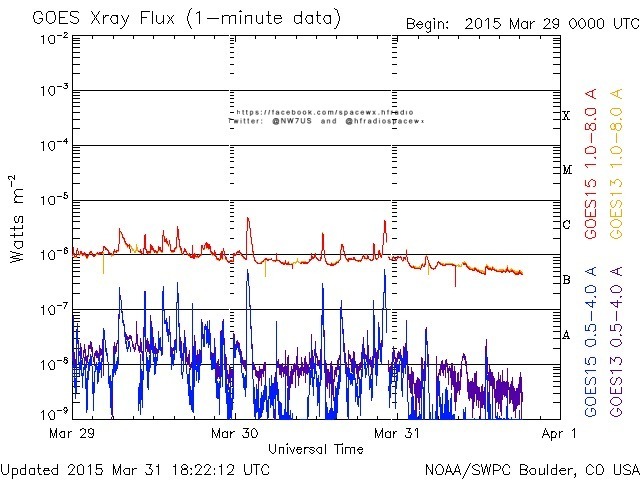
Here is the current forecast discussion on space weather and geophysical activity, issued 2015 Mar 31 1230 UTC.
Solar Activity
24 hr Summary: Solar activity was at low levels with C-flare activity from both Regions 2303 (N18, L=065) and 2305 (S10W58, Dho/beta). The largest flare of the period was a C4 at 30/2205 from Region 2303 just beyond the NW limb. Slight decay was observed in the leading spots of Region 2315 (S20W36, Dro/beta) and the trailing spots in Region 2305. No Earth-directed coronal mass ejections were observed.
Forecast: Solar activity is likely to be at low levels with a slight chance for an isolated M-class (R1-R2, Minor-Moderate) flare for day one (31 Mar). An increased chance for M-class activity is expected by days two and three (01-02 Apr) as old Regions 2302 (N12, L=189) and 2297 (S17, L=196) are expected to return.
Energetic Particle
24 hr Summary: The greater than 2 MeV electron flux at geosynchronous orbit was at normal levels. The greater than 10 MeV proton flux at geosynchronous orbit remained at background levels.
Forecast: The greater than 2 MeV electron flux at geosynchronous orbit is forecast to be at normal to moderate levels all three days (31 Mar -02 Apr) The greater than 10 MeV proton flux at geosynchronous orbit is expected to be at or near background conditions (Below S1-Minor) for the forecast period.
Solar Wind
24 hr Summary: Solar wind speed at the ACE spacecraft for the majority of the period was in the mid-300 km/s range but increased to near 400 km/s after 0730 UTC. Phi was negative. Bz was at or above -4 nT and Bt was less than 7 nT through 0730 UTC when it increased to near 16 nT. The increase in activity is likely due to the onset of a coronal hole high speed stream (CH HSS).
Forecast: Continued enhancement of solar wind parameters is anticipated on day one (31 Mar) and remain enhanced through day three (02 Apr) as the CH HSS becomes geoeffective.
Geospace
24 hr Summary: The geomagnetic field was at quiet levels.
Forecast: Unsettled to active conditions are expected to dominate through day three (02 Apr) due to CH HSS effects. trans-equatorial high speed stream becomes geoeffective.
Don’t forget to visit our live space weather and radio propagation web site, at: http://SunSpotWatch.com/
Live Aurora mapping is at http://aurora.sunspotwatch.com/
If you are on Twitter, please follow these two users:
+ https://Twitter.com/NW7US
+ https://Twitter.com/hfradiospacewx
Get the space weather and radio propagation self-study course, today. Visit http://nw7us.us/swc for the latest sale and for more information!
We’re on Facebook: http://NW7US.us/swhfr
Visit, subscribe: NW7US Radio Communications and Propagation YouTube Channel
 Ham Radio Deluxe |
 W5SWL Electronics |
 Ham Radio Prep |
 KB3IFH QSL Cards  Hip Ham Shirts  HamRadioAuctions HamRadioAuctions Reliance Antennas Reliance Antennas Enigma Shop Enigma Shop |  morseDX  Ni4L Antennas  R&L Electronics R&L Electronics antennas.us antennas.us QRV QRV |
- Matt W1MST, Managing Editor
