 |
 I fancy some 472kHz WSPR!
 26 June 2015 | by
 It is ages since I was active on 472kHz, so I might fire up the FT817 and transverter to see if anyone can spot my 5mW ERP or I can spot others. I shall use the earth-electrode “antenna” and go QRT on 6m to free up the FT817.
It is summertime, so noise levels will be higher, making my weak signal harder to copy than in the winter. It will take me about 5 minutes to swap bands and reset everything. The FT817 has to be set to 500mW and split mode so I receive directly on the 472kHz band but TX on the 80m band into the transverter.
If you copy me on 472kHz WSPR please report it.
UPDATE 2009z: Well, that was a good start! I just switched to MF and received 2 spots by G8HUH in IO81mg (250km) in daylight. I shall now leave 474.2kHz WSPR running overnight to see what else happens. With 5mW (maybe less) ERP I am quite happy with his -26/-27dB S/N reports.
UPDATE 2126z: So far G8HUH (250km) has spotted me 10 times this evening. I have spotted no-one and no-one else has spotted me, as yet.

Roger Lapthorn, G3XBM, is a regular contributor to AmateurRadio.com and writes from Cambridge, England.
Mr. Carlson’s Lab – A YouTube Treasure
As you have probably noticed, most modern fixed capacitors no longer indicate the 'grounded' end or the lead going to the internal shielding. At one time, the capacitor's polarity was commonly marked with a band on one end but this is no longer the case ... even though one side is indeed still the shielded side. Depending on exactly what part of the circuit your fixed capacitor is being used in, connecting it in the reverse direction (shield going to signal side), can introduce hum, RF pickup, instability and generally result in poorer capacitor / circuit performance ... and all it takes to determine which lead is which is an oscilloscope!
The second video I viewed shows the process used to resurrect a Yaesu FT-1000MP in truly terrible condition. In a very professional step-by-step process the video shows the logical and systematic approach at making the radio better than new.
Both videos are done by a truly gifted engineer, Paul Carlson, VE7ZWZ, and are exceptionally well done ... the quality one would expect to have to pay for rather than freely view on YouTube.
If you visit Paul's YouTube channel, you'll find a host of other radio and audio-related videos and I guarantee that you will learn something of value ... and probably hang around to watch several more. They are really well done.
Steve McDonald, VE7SL, is a regular contributor to AmateurRadio.com and writes from British Columbia, Canada. Contact him at [email protected].
Pofung UV-6R Dual Band Handheld
Pofung UV-6R 136-174MHz & UHF:400-470MHz Dual Band Handheld FM Professional Two-way Radio

Lots of radio in a small package. Built well and performs well.
http://www.radioddity.com/skin/frontend/default/lanting/download/UV-6R%20User%20Manual
Brilliant Easy to read display
The first thing that impressed me aside from the size and quality was the brilliant and easy to read display of this radio. The two line display and the choice of display color make this radio easy to use and navigate through the menu system. The various option for screen color lighting also make the radio easy to read. The fact that the display lighting can be changed to suit the operator is a nice feature.
Superb audio quality
I have to say that after owning a few of the big 3 brand of radios I was thrown back by the outstanding and loud audio this radio has. I was not sure what to expect at first with such a small radio but the audio is outstanding, sounds great and no distortion even at full volume.
Features and Specifications:
- Dual Band Transceiver
- Brilliant L.C.D. Display
- D.C.S. and C.T.C.S.S. encoding
- VOX function
- Flashlight/Alarm feature
- FM radio band receive
- 128 memory channels
- Dual watch
- Menu driven programming
- Software available for programming (cable sold separately)
- Drop in Li-On charger
- 7.4v 1800mah Li-On battery
- High (5w) and Low (1w) power settings
- Accessory ports for adding speaker microphone (sold separately)
- Belt clip ( Soft case also sold separately)
- Selectable frequency steps
- Selectable repeater offsets
- Adjustable squelch via menu
- Adjustable TOT (Transmission Timer)
- Cross band receive/transmit
- Dual VFO
- Narrow and Wide FM selectable
And much more to even include in features.
The radio itself is great little performer. Battery life on receive is fantastic, battery life on transmit has yet to be determined. Looks rugged and fits nicely in the hand.
For the price of this radio (under $50.00 with free shipping to Canada and U.S.A.) you cannot go wrong for a radio to throw in your shirt pocket or your backpack as a take along radio to listen to N.O.A.A. weather stations, FM stations and monitor local repeaters. Accessories are all about one third each of the cost of the radio, which makes the low price of this radio even more impressive. The small antenna with SMA connector though lacks in receive performance of course, but other antennas can be purchased and used with this radio to get out of those fringe areas.
The Pofung UV-6R is a great introduction to the increasing line of radios on the market. It makes it affordable for the first time user and easy to operate; it also performs well and gets great audio reports into the repeaters. It’s light weight and long battery life make a great emergency radio for that go-kit or to have on hand when needed for that last minute hike.
Fred Lesnick
VE3FAL
**** (4 out of 5)
Fred Lesnick, VE3FAL, is a regular contributor to AmateurRadio.com and writes from Thunder Bay Ontario, Canada. Contact him at [email protected].
Series Eight Episode Thirteen – Friedrichshafen Preview (24 June 2015)
In this episode, Martin M1MRB / W9ICQ, Ed Durrant DD5LP ,Martin Rothwell M0SGL and Colin Butler M6BOY discuss the upcoming Ham Radio Friedrichshafen Event.
Colin Butler, M6BOY, is the host of the ICQ Podcast, a weekly radio show about Amateur Radio. Contact him at [email protected].
Series Eight Episode Thirteen – Friedrichshafen Preview (24 June 2015)
In this episode, Martin M1MRB / W9ICQ, Ed Durrant DD5LP ,Martin Rothwell M0SGL and Colin Butler M6BOY discuss the upcoming Ham Radio Friedrichshafen Event.
Colin Butler, M6BOY, is the host of the ICQ Podcast, a weekly radio show about Amateur Radio. Contact him at [email protected].
Weekly Propagation Summary – 2015 Jun 22 16:10 UTC
Here is this week’s space weather and geophysical report, issued 2015 Jun 22 0548 UTC.
Highlights of Solar and Geomagnetic Activity 15 – 21 June 2015
Solar activity was at low to moderate levels. Weak to mid-level C-class flares were observed on 15-17 Jun from Regions 2360 (N15, L=129, class/area Eac/220 on 12 Jun), 2367 (S20, L=002, class/area Ekc/400 on 15 Jun), 2268 (S06, L=100, class/area Bxo/010 on 14 Jun) and 2371 (N13, L=302, class/area Fkc/1180 on 21 Jun). Activity increased to moderate levels (R1-minor) on 18 Jun. Old Region 2365 (S13, L=079) produced a long duration event (LDE) M1 flare at 18/0127 UTC. At 18/1736 UTC, Region 2371 produced an M3/1n LDE with associated Type IV and Tenflare (2200 sfu) radio emissions. Associated with this event was an asymmetric, full-halo CME first visible in LASCO C2 imagery at 18/1724 UTC.
19 Jun saw a return to low levels with weak to high-level C-class flares observed from Region 2371. At about 19/0500 UTC, a large filament eruption was observed in the SSE quadrant of the disk. Associated with this eruption was a partial-halo CME, first observed in LASCO C2 imagery at 19/0845 UTC. Moderate levels returned on 20 Jun with an M1/if flare observed at 20/0648 UTC. 21 Jun saw a total of 4 M-class class flares. Region 2371 produced an M2/1n flare at 21/0142 UTC with associated Type II (682 km/s) and Type IV radio emissions. Also associated with this event was a full-halo CME. Shortly afterward, this same region produced an M2.6 x-ray event. At 21/0944 UTC, Region 2367 produced an M3/2b flare followed by an M1 x-ray event at 21/1820 UTC.
A pair of 10 MeV at greater than or equal to 10 pfu proton events were observed at geosynchronous orbit. The first event began at 18/1135 UTC, reached a maximum of 16 pfu at 18/1445 UTC and ended at 19/0230 UTC. This event was associated with the M1 flare from old Region 2365 observed at 18/0127 UTC. The second event began at 21/2035 UTC and reached at peak of near 50 pfu at the end of the summary period and was still rising. This event was associated with the M1 flare from Region 2367 observed at 21/1820 UTC.
The greater than 2 MeV electron flux at geosynchronous orbit reached high levels through the entire summary period.
Geomagnetic field activity was at quiet to active levels through the period. Quiet to unsettled levels were observed on 15-17 Jun with isolated active periods observed on 15 and 17 Jun. This activity was due to positive polarity coronal hole high speed stream (CH HSS) effects. Solar wind parameters, measured at the ACE satellite, indicated wind speeds of near 600 km/s early on 15 Jun decreasing to about 450 km/s by the end of the 17th. Total field ranged between 4-8 nT while the Bz component varied between +/- 5 nT. Phi angle was in a predominately positive (away) orientation. Predominately quiet conditions were observed on 18 Jun through late on 21 June. Solar wind speeds decreased from about 450 km/s early on 18 June to near 275 km/s by 21/1540 UTC. During this same time frame, total field ranged between 1-6 nT, Bz varied between +4 nT to -3 nT and phi remained mostly positive. After 21/1540 UTC, wind speed increased to about 360 km/s, Bt increased to 12 nT, Bz varied between +8 nT to -7 nT and phi briefly rotated to a negative (towards) sector. This deviation indicated a possible co-rotating interaction region in advance of an anticipated positive polarity CH HSS.
Forecast of Solar and Geomagnetic Activity 22 June – 18 July 2015
Solar activity is expected to be at moderate to high levels (R1-R2, minor-moderate). Active Regions 2367 and 2371, and the return of old Region 2365 on 30 Jun, are expected to keep activity levels enhanced through the outlook period.
The 10 MeV at greater than or equal to 10 pfu proton flux at geosynchronous orbit is expected to remain at the S1 (minor) to S2 (moderate) levels through 24 Jun. Effects from the 21 Jun M1 flare, coupled with multiple shocks from the 18, 19 and 21 Jun CMEs, are expected to keep proton flux above event levels.
The greater than 2 MeV electron flux at geosynchronous orbit is expected to be at normal to moderate levels on 22 Jun through 06 Jul. Moderate to high levels are expected on 07-18 Jul due to CH HSS effects.
Geomagnetic field activity is expected to be at unsettled to severe storm levels (G1-G3, minor-strong) on 22-24 Jun. This activity is due to the expected arrival of the three CMEs from 18, 19 and 21 Jun. Unsettled to active periods are expected on 06-08 Jul, 12-13 Jul and 18 Jul, along with minor storm periods (G1-minor) on 05 and 11 Jul, due to CIR/CH HSS effects. Predominately quiet to unsettled levels are expected for the remainder of the outlook period.
Don’t forget to visit our live space weather and radio propagation web site, at: http://SunSpotWatch.com/
Live Aurora mapping is at http://aurora.sunspotwatch.com/
If you are on Twitter, please follow these two users: + https://Twitter.com/NW7US + https://Twitter.com/hfradiospacewx
Get the space weather and radio propagation self-study course, today. Visit http://nw7us.us/swc for the latest sale and for more information!
Check out the stunning view of our Sun in action, as seen during the last five years with the Solar Dynamics Observatory (SDO): https://www.youtube.com/watch?v=zXN-MdoGM9g
We’re on Facebook: http://NW7US.us/swhfr
Visit, subscribe: NW7US Radio Communications and Propagation YouTube Channel
Summer Solstice Magic

A loud NØLL in Kansas was the first station heard this morning at around 0600 local time but I suspect the band had been open even earlier, judging by the strength of the signals. It didn't take long for the band to stretch out further and not too much later, signals from the Caribbean were making it into southern British Columbia, as well as many parts of North America.
At times the band seemed as crowded as 20m CW during the Sweepstakes as so many of the CW stations congregate in the 20KHz slot just below 50.100MHz. Before breakfast, the following stations were in the log:
ZF1EJ Cayman Islands
9Y4D Trinidad
YV1KK Venezuela
6Y5WJ Jamaica
KP4EIT Puerto Rico
XE2MVY Mexico
XE2X Mexico
WP3C Puerto Rico
NP4BM Puerto Rico
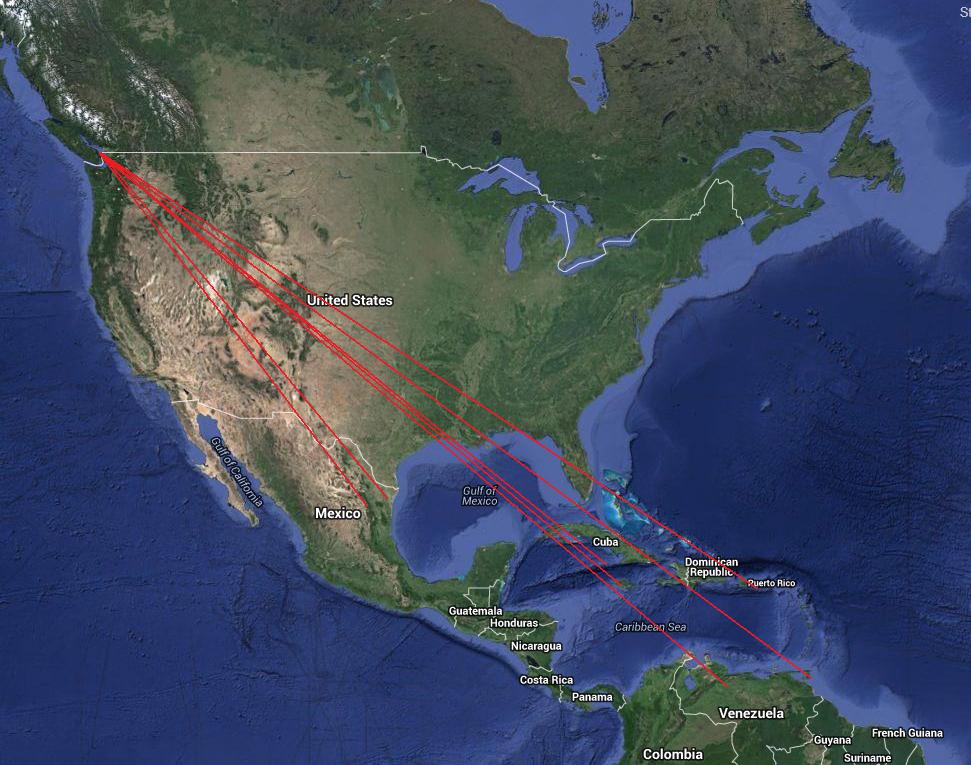 |
| courtesy: https://www.google.ca/maps |
At times, several in band 'growly' carriers with polar flutter were heard as well as weak signals from some of the 49MHz videos still operating in central Europe.
It will be interesting to see if we have a repeat of this prop tomorrow (Monday) but I rather suspect much of this was the result of two well-placed solar flares earlier in the morning and will not be repeated ... I hope I'm wrong!
Steve McDonald, VE7SL, is a regular contributor to AmateurRadio.com and writes from British Columbia, Canada. Contact him at [email protected].
 Ham Radio Deluxe |
 W5SWL Electronics |
 Ham Radio Prep |
 KB3IFH QSL Cards  Hip Ham Shirts  HamRadioAuctions HamRadioAuctions Reliance Antennas Reliance Antennas Enigma Shop Enigma Shop |  morseDX  Ni4L Antennas  R&L Electronics R&L Electronics antennas.us antennas.us QRV QRV |
- Matt W1MST, Managing Editor
