 |
 AmateurLogic 82: More to Come
 15 September 2015 | by
AmateurLogic.TV Episode 82 is now available for download.
More fun from the Huntsville Hamfest with the whole crew! Details about the 10th Anniversary Contest. And your viewer emails.
1:08:10
George Thomas, W5JDX, is co-host of AmateurLogic.TV, an original amateur radio video program hosted by George Thomas (W5JDX), Tommy Martin (N5ZNO), Peter Berrett (VK3PB), and Emile Diodene (KE5QKR). Contact him at [email protected].
Portable Lightwave Receiver Progress
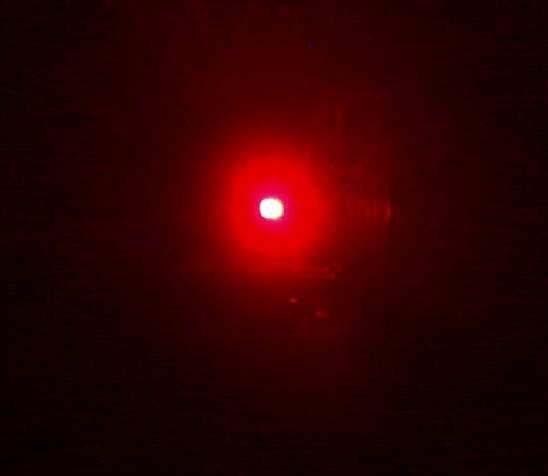
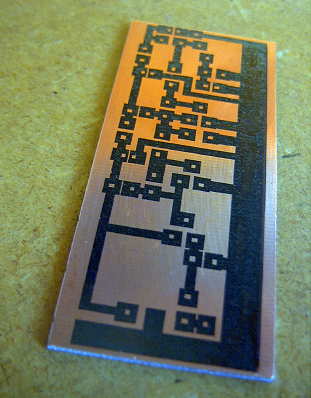
Yesterday, between dabbling in the Arkansas State QSO Party on CW, I manufactured and assembled the PCB for the new 'portable' lightwave receiver. When building PCBs, I use the printer-toner method, after drawing the design with MS Paint. Compared to some of the freeware PCB design software now available it is fairly crude, but it more than meets my needs and could even work for designing SMD boards if needed. I've also made the switch from using the messy and corrosive Ferric Chloride etchant to a weak solution of Hydrogen Peroxide and Muriatic acid. The latter seems so much cleaner, faster and overall produces a better-etched board. Boards can be completely etched in around three minutes, compared to the much longer Ferric Chloride.
I chose to use the same receiver circuit as the one in my main system, garnered from the design shown in Roger's, (G3XBM) blog. If you have an interest in getting started in lightwave experimenting, you will find Roger's blog of his lightwave adventures to be both informative and inspiring.
 |
| courtesy: http://g3xbm-qrp.blogspot.ca |
As before, I made a couple of minor changes to the receiver, substituting a BPW34 optical pin diode for the one shown as well as subbing a 2N5457 JFET for the MPF102. In addition, 2N5089s were substituted for the 2N3904s. The newer JFET is lower in noise as are the higher gain 5089s. In all likelihood, the differences are only minor but I like to think that every little bit helps when all system-losses are considered.
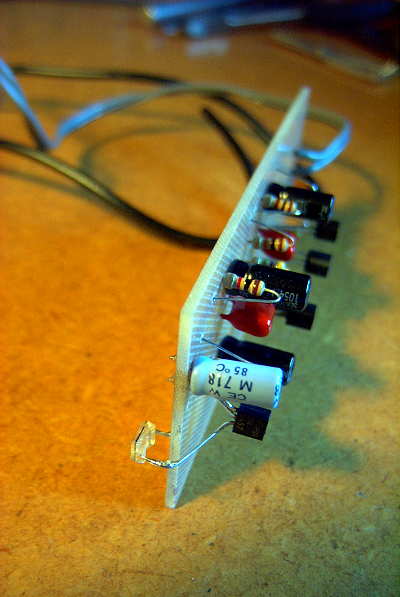
Note that it is important to make the connection between the diode and the JFET's gate lead 'floating' in the air as any contact with the PCB could introduce unwanted loses at this point.
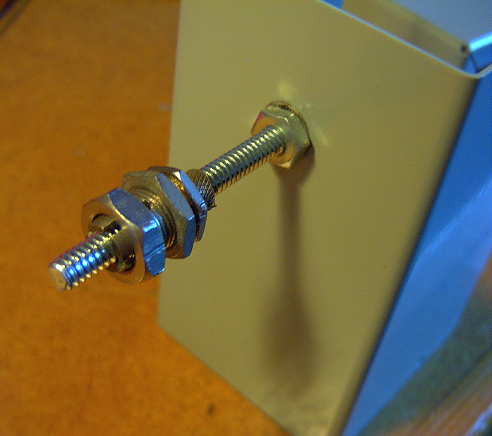
As in my original receiver, a locking split-shaft, removed from a junk box potentiometer, was mounted to the back side of receiver box. This will allow the receiver box and its pin-diode to be aligned forward and backward for focus and then locked. Once built, the focusing carriage will allow the receiver to move laterally, left to right as well as vertically, up and down. Positioning the optical diode at the exact focal point of the lens and maintaining this position is crucial. The finished carriage, will look similar to this one, used in my main system's receiver and transmitter box.
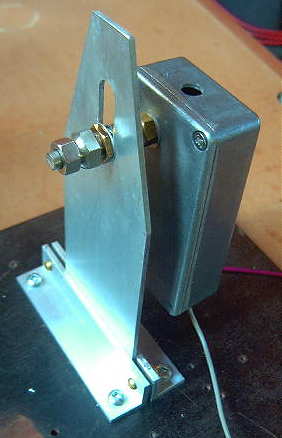
So it's on to the plywood receiver box and then the focusing carriage. It will be interesting to see how my $5 fresnel lens page-reader, purchased from Princess Auto, compares with the slightly larger (and probably better) lens in the main system's receiver.
Steve McDonald, VE7SL, is a regular contributor to AmateurRadio.com and writes from British Columbia, Canada. Contact him at [email protected].
Meet the Arc Fault Circuit Interrupter
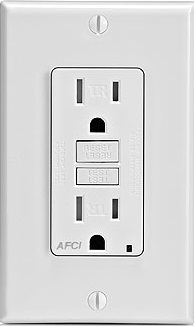 You are probably familiar with the Ground Fault Circuit Interrupter (GFCI), also called Ground Fault Interrupter (GFI), Residual-Current Device (RCD) and a few other names. While doing some electrical work for a family member, I discovered Arc Fault Circuit Interrupters (AFCIs) in the breaker box. Having a genuine Electrical Engineering degree (two, actually), I’d like to believe that I am reasonably up to date on basic house wiring. But somehow AFCIs had escaped my attention, even though they started appearing in the National Electric Code over 10 years ago.
A bit of searching on the internet revealed that these newfangled devices are intended to detect arc faults are below the trip level of a normal circuit breaker. Think in terms of a frayed extension cord that arcs over, creating a fire hazard, but not exceeding the 15 ampere rating of a typical house circuit. As usual, the Wikipedia entry is a good place to start. AFCIs detect arcs by monitoring the current behavior throughout the 60 Hz cycle. There are characteristics in the waveform that indicate an arc condition exists, causing the AFCI to disconnect the circuit. This article goes into more technical detail if you are interested:
New Technology for Preventing Residential Electrical Fires: Arc-Fault Circuit Interrupters (AFCIs)
Just like GFIs, AFCIs are available for installation in the main breaker panel and for installation at the electrical outlet. The diagram below shows the block diagram of a typical single-phase AFCI. This is not your old school circuit breaker but a complex system that performs both arc and ground fault detection. As already mentioned, the arc detection is performed by sensing the current behavior. The ground fault detection senses the difference between the current leaving and returning to the device. If there is a significant mismatch between the two currents, a ground fault has occurred.
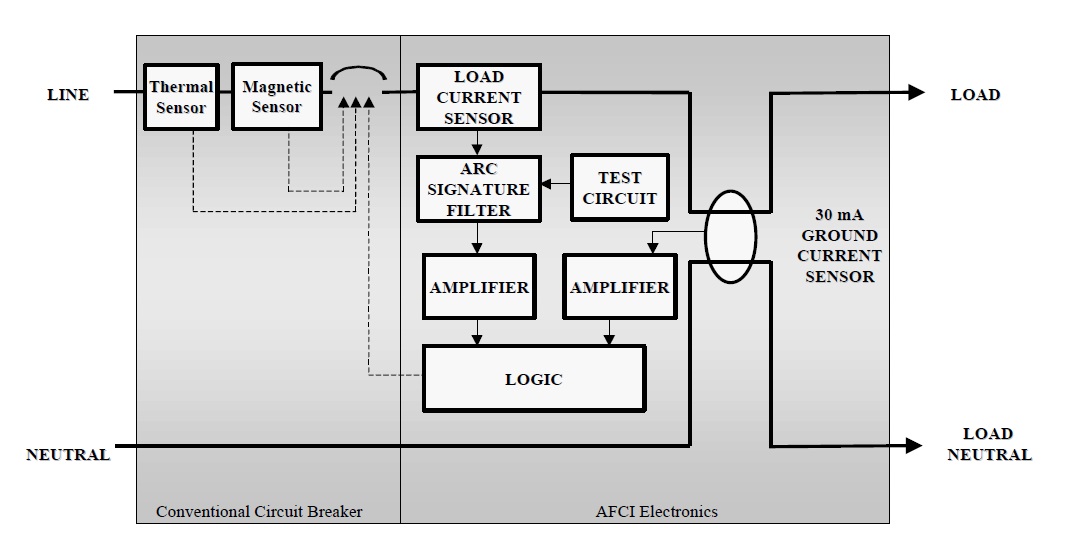
From “New Technology for Preventing Residential Electrical Fires: Arc-Fault Circuit Interrupters (AFCIs)”
This post is just a quick introduction to AFCIs, with a USA perspective. Your local building codes are now or will soon be requiring AFCIs on new construction, so you’ll probably encounter them sooner or later. The National Electrical Manufacturers Association has a website with additional information: www.afcisafety.org.
73, Bob K0NR
The post Meet the Arc Fault Circuit Interrupter appeared first on The KØNR Radio Site.
Bob Witte, KØNR, is a regular contributor to AmateurRadio.com and writes from Colorado, USA. Contact him at [email protected].
Solo mast erecting
I think the wind gods were against me on this day. I recently had a lovely evening with a few newly licensed amateurs, who asked a very simple question. How do you erect a radio mast for when you are on your own. Its something i never asked, and it was something i have perfected over a number of years.
So armed with the Go-Pro and log camera I visited my local park to try and demonstrate exactly how i erect the mast.
Of course, I never realised how windy it was, but i preserved and managed to record a quick video showing how i “get it up”
I hope the video is of use to you, and apologies about the audio.
Dan Trudgian, MØTGN, is a regular contributor to AmateurRadio.com and writes from Wiltshire, England. He's a radio nut, IT guru, general good guy and an all round good egg. Contact him him here.
Solo mast erecting
I think the wind gods were against me on this day. I recently had a lovely evening with a few newly licensed amateurs, who asked a very simple question. How do you erect a radio mast for when you are on your own. Its something i never asked, and it was something i have perfected over a number of years.
So armed with the Go-Pro and log camera I visited my local park to try and demonstrate exactly how i erect the mast.
Of course, I never realised how windy it was, but i preserved and managed to record a quick video showing how i “get it up”
I hope the video is of use to you, and apologies about the audio.
Dan Trudgian, MØTGN, is a regular contributor to AmateurRadio.com and writes from Wiltshire, England. He's a radio nut, IT guru, general good guy and an all round good egg. Contact him him here.
Amateur Radio Weekly – Issue 77

How can we get more women involved in ham radio?
We are currently dealing with a hobby that is only 15% women that keeps fretting about getting more people involved in it, so why do we allow things that would drive half the population away?
amateurradio.com
How Radio Mala laid the groundwork for lifesaving communication
This is a story about a tool — amateur radio — that has helped, and will continue to help save lives. We call ourselves Radio Mala.
Make:
Arkansas Ham tops his own satellite contact distance record
Operating from an old US Forest Service fire tower atop Rich Mountain in western Arkansas, Swanson worked Manuel “Dom” Ruiz in Valencia, Spain via AO-7.
ARRL
FreeDV champion partners with Outernet
The modem will use QPSK, a LDPC code, and deliver payload data at around 2400 bit/s in a 5kHz RF bandwidth.
Rowetel
Morse code used to cheat during chess match
The 37-year-old player was also “batting his eyelids in the most unnatural way”, Mr Coqueraut said.
Southgate
Experimenting with the Ham Radio Wilderness Protocol
Just as Morse code was fading in the mid-1990s, the American Radio Relay League proposed the Wilderness Protocol as a way for hikers and campers to call for help in remote areas before mobile cell phone coverage became ubiquitous.
KC4LMD
D-STAR QSO Party 2015 September 18th
The goal of the D‐STAR QSO PARTY is to communicate through as many D‐STAR repeaters as possible throughout the world.
Icom
Using HD radio signals for navigation
In this article, we present the results of a study using AM HD Radio, digital radio in the 540–1700 kHz band of the frequency spectrum, with known transmitter locations, to locate and track receiver locations that are otherwise unknown.
GPS World
The Cold War nuke that fried satellites
The explosion – the world’s most powerful high altitude nuclear test – created an electromagnetic pulse (EMP) strong enough to disrupt global radio communications.
BBC
VHF-UHF Hams asked to observe Radio Quiet Zones
The National Radio Astronomy Observatory (NRAO) at Green Bank, West, Virginia, has asked that hams notify the facility if they plan to operate within 10 miles of either the Green Bank Telescope or the Sugar Grove Research Station.
ARRL
QSO logger for Android
QSO Secretary is a special logging program, optimized for mobile, portable, and field operations. It has been designed to allow quick entry of important information regarding QSOs.
Google Play
How to
See actual microwaves
In this post I will show you how to actually see microwaves by modifying a coffee can radar which you can build at home.
Hack A Day
Amateur Radio Weekly is curated by Cale Mooth K4HCK. Sign up free to receive ham radio's most relevant news, projects, technology and events by e-mail each week at http://www.hamweekly.com.
Simple 28MHz WSPR (or PSK31) RX
Facebook is throwing up memories from 3 years ago and one of these was a schematic for my WSPR RX for 10m, using low cost 14.060MHz crystals with a Polyakov mixer (injection at half signal frequency) The circuit worked well and could also be used for PSK31. Essentially this is a direct conversion receiver, but it mattered not. Even if you bought all parts new it is very inexpensive. 3 years later I would replace the 2 diodes by Schottky ones as these are now low cost and need less injection than the silicon ones shown.
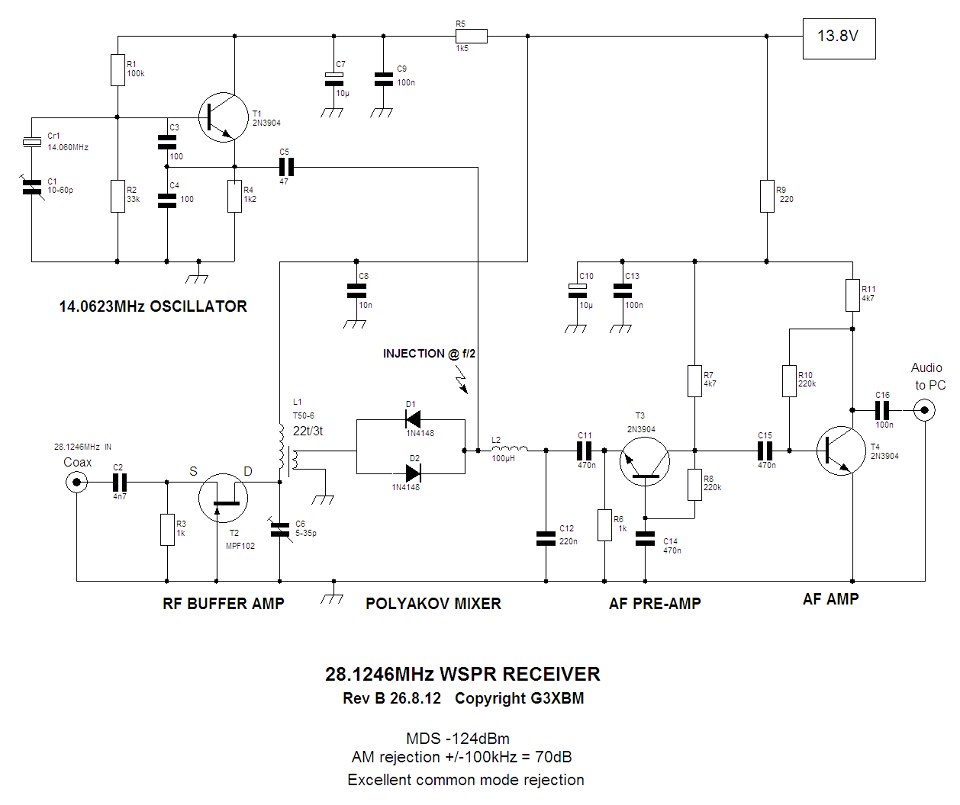

Roger Lapthorn, G3XBM, is a regular contributor to AmateurRadio.com and writes from Cambridge, England.
 Ham Radio Deluxe |
 W5SWL Electronics |
 Ham Radio Prep |
 KB3IFH QSL Cards  Hip Ham Shirts  HamRadioAuctions HamRadioAuctions Reliance Antennas Reliance Antennas Enigma Shop Enigma Shop |  morseDX  Ni4L Antennas  R&L Electronics R&L Electronics antennas.us antennas.us QRV QRV |
- Matt W1MST, Managing Editor
