 |
 A wonderful weekend of JOTA
 18 October 2015 | by
 But this week I had to get my head straight since the South Kesteven ARS (of which I am Chairman) were involved for the second year in the Scouting Jamboree on the Air (JOTA) weekend operating GB5FSG for the 1st Foston Scouts.
But before that we were also involved with another local scouting group, the 1st Barrowby where we assisted in a class of 12 Cubs with their communication badge.
Together with Stewart (M0SDM), Sean (2E0ENN) and Konrad (2E0KVF) we spent an evening giving them a introduction to amateur radio. Konrad who is an ex-scout leader explained the hobby, Stewart and Sean helped them pass messages via a radio. There was also a timely visible pass of the International Space Station during the evening and I hoped they might be able to see it while I demonstrated transmitting APRS messages via the onboard digipeater.
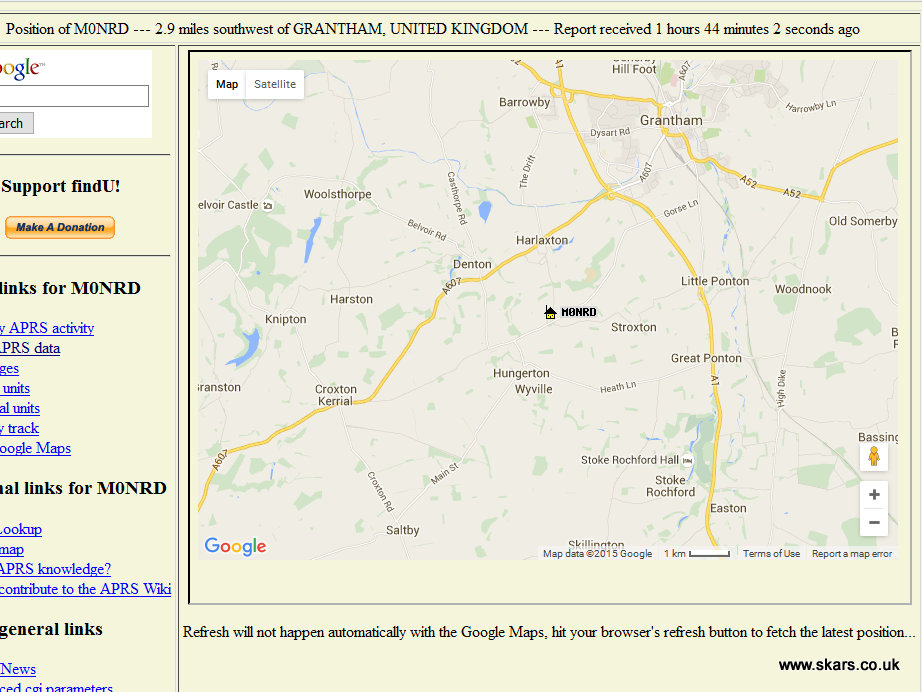
Using my new dual band Yagi, laptop and FT857D in the boot of my car I did successfully get messages digipeated and igated however the cloud and rain prevented the cubs seeing the ISS pass overhead (I put the coordinates in slightly wrong, so are shown slightly south of where we were)

The evening was a great success and the enthusiasm shown by the Scout leaders hopefully means SKARS will be involved in more activities for the Barrowby Scout group. Interestingly we were not the first local club they approached to assist but after they were given the cold shoulder by them we were happy to take up the challenge. The Barrowby group were also interested in being involved in the Jamboree on the Air (JOTA) next year.
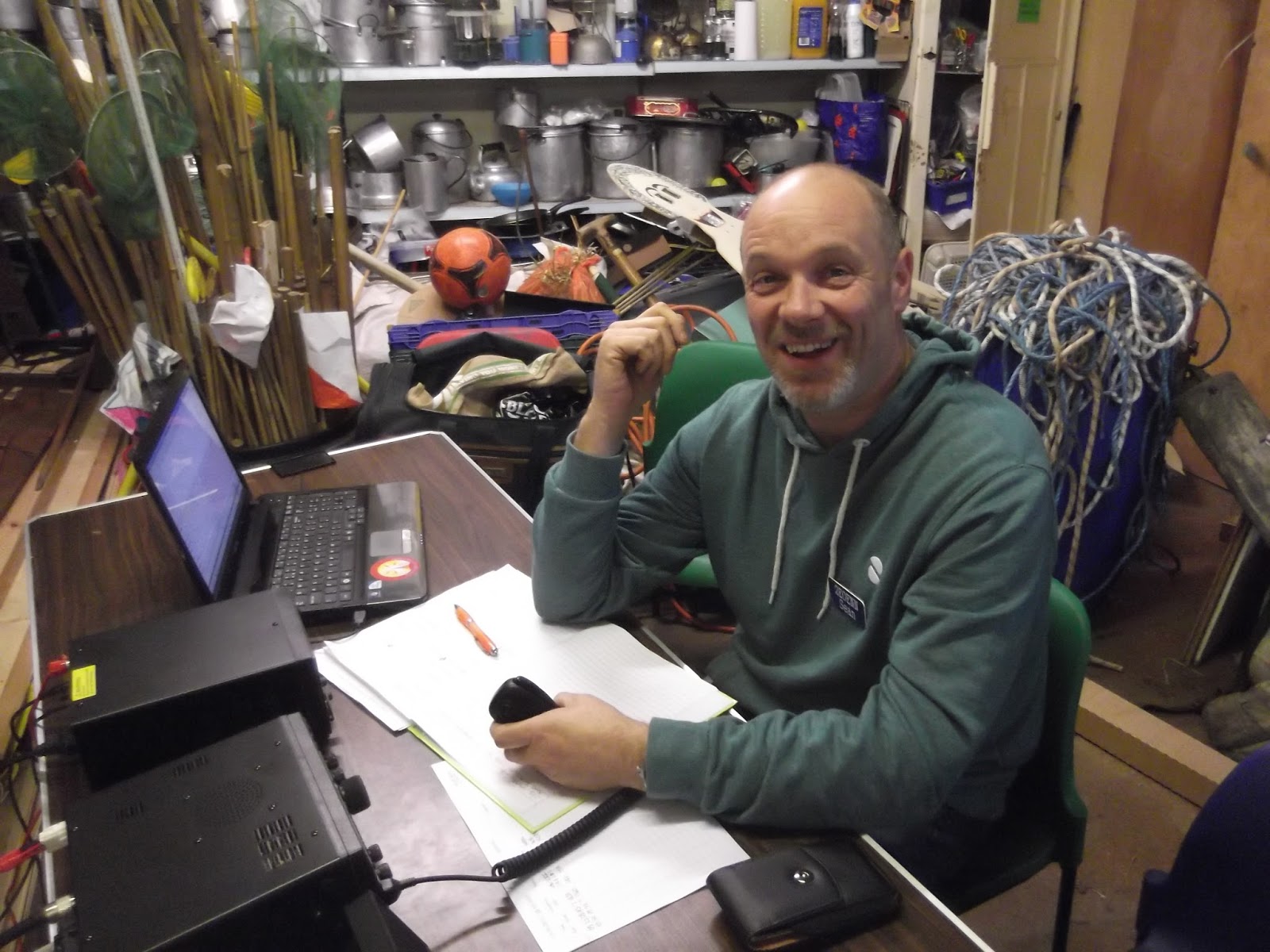
So on to the main event this week, the GB5FSG JOTA station, operated by Stewart, Sean and myself. It is exactly a year since I gained my full licence and this was my first Notice of Variation for a special event station, last year under the previous chairman we had run GB2FFC with some success but this year we hoped to improve the experience for the Cubs/Beavers and Scouts.
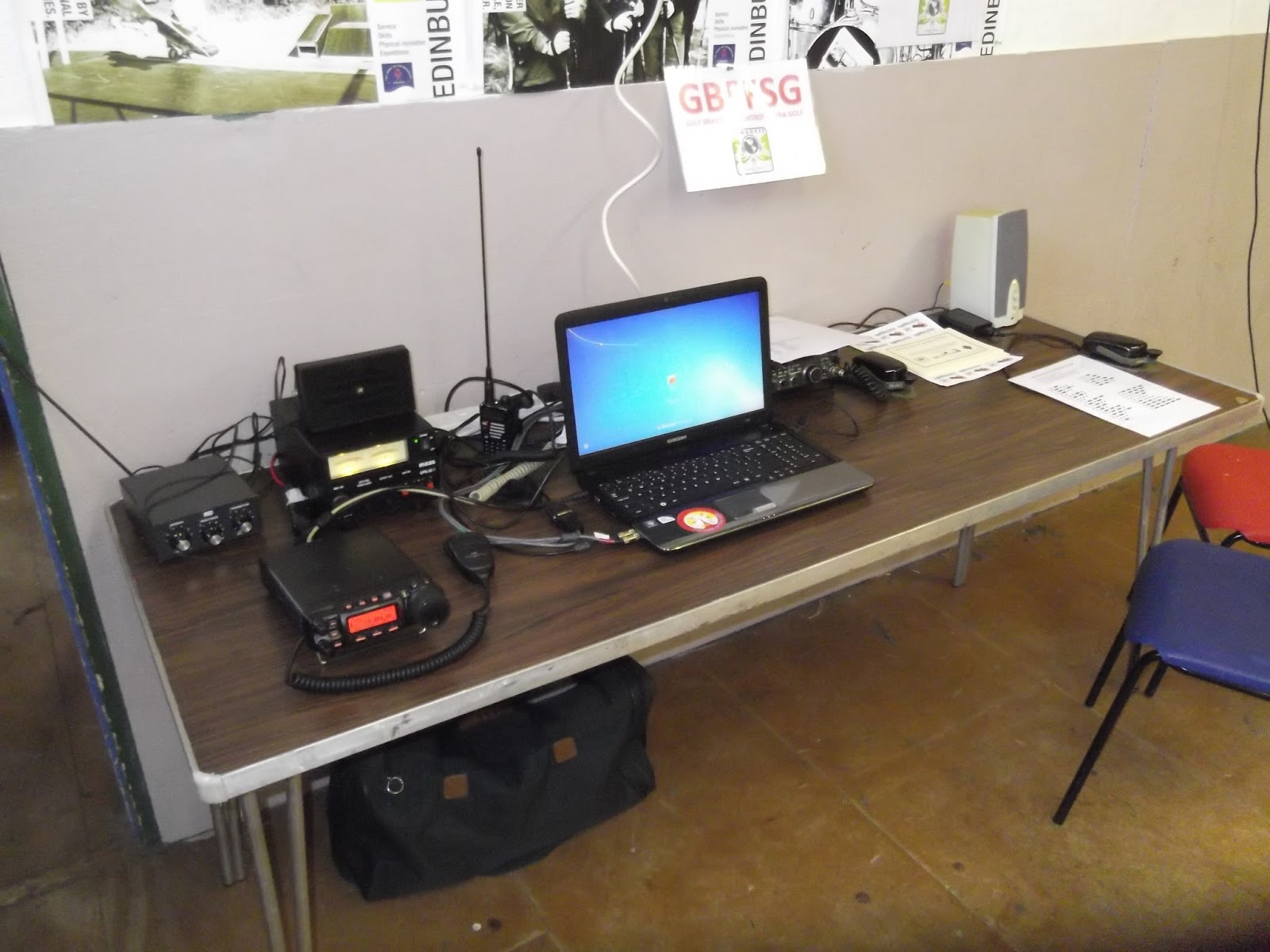
Firstly we had a much improved antenna installation, with Stewart's Land Rover and impressive pushup mast we had an excellent OCFD dipole, resonant on several bands including 40m along with another smaller pole holding up an end fed long wire for the datamode station. We also put up a collinear for a 2m VHF station.
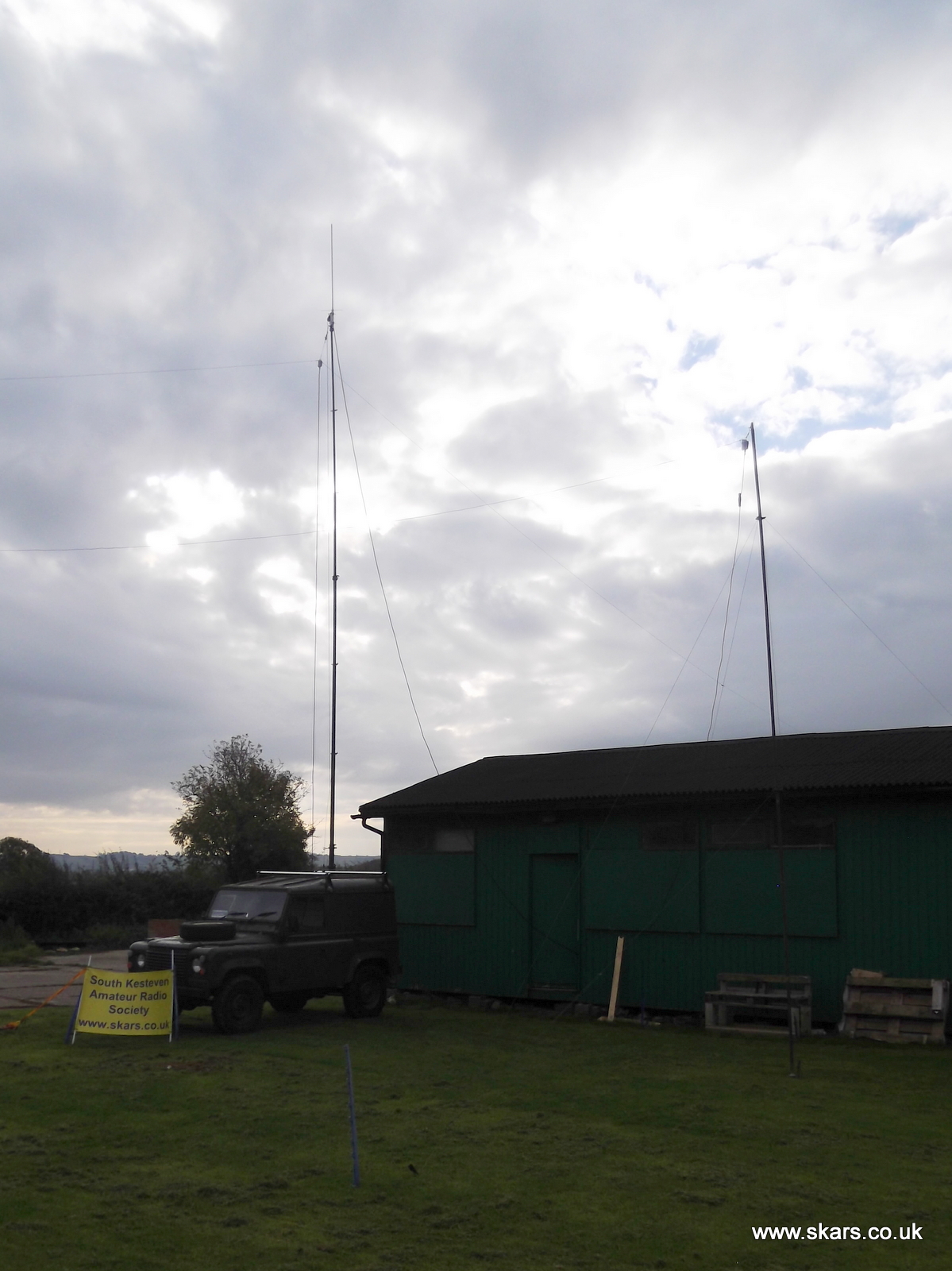
Last year we were hampered by the noise of excitable children in the main room of the scout hut which made operating and hearing contacts difficult. This year we asked for some separation from the hubbub and had planned to use a tent. Instead we setup in the storage area in the back of the hut which proved ideal as it allowed us to control the number of children and allowed easier working conditions - it was a little chilly but much warmer than a tent would have been.
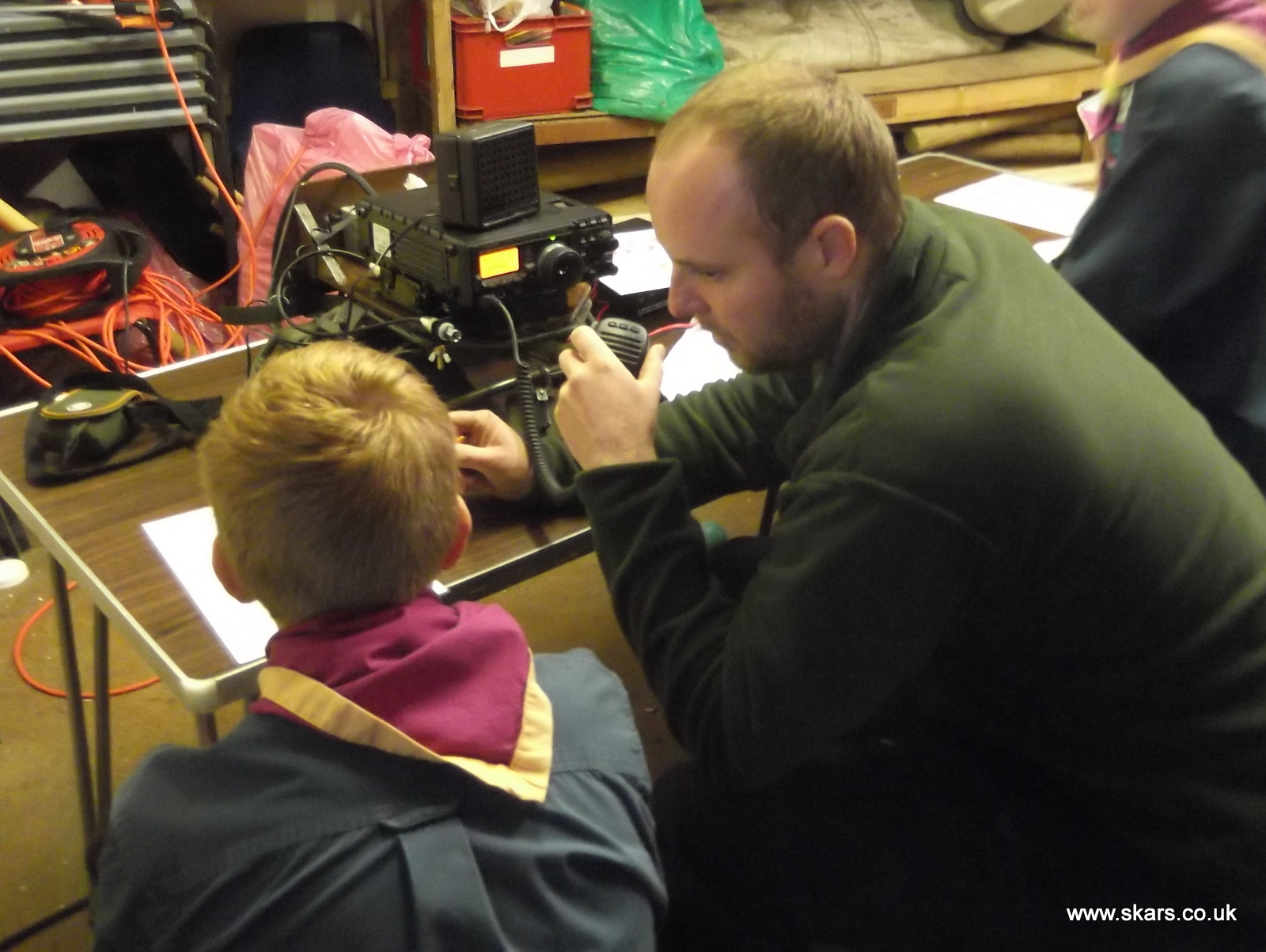
On Saturday we used Stewart's FT897 as the main HF rig, Sean operated a 2m meter station with a number of contacts. Like last year I had my FT857 operating a datamode (primarily PSK) but a damaged feeder issue curtailed this for most of the day and we soon concentrated on the HF SSB voice contact as conditions were good and the band was busy with other JOTA stations.
In keeping with the aims of JOTA we didn't chase numbers instead we had some lengthy quality contacts, including a marathon 30 minute plus contact with I believe was GB2WSG the 2nd Wellington Scout Group with lots of two-way greeting messages being sent to really give the children a full experience of using the radio.
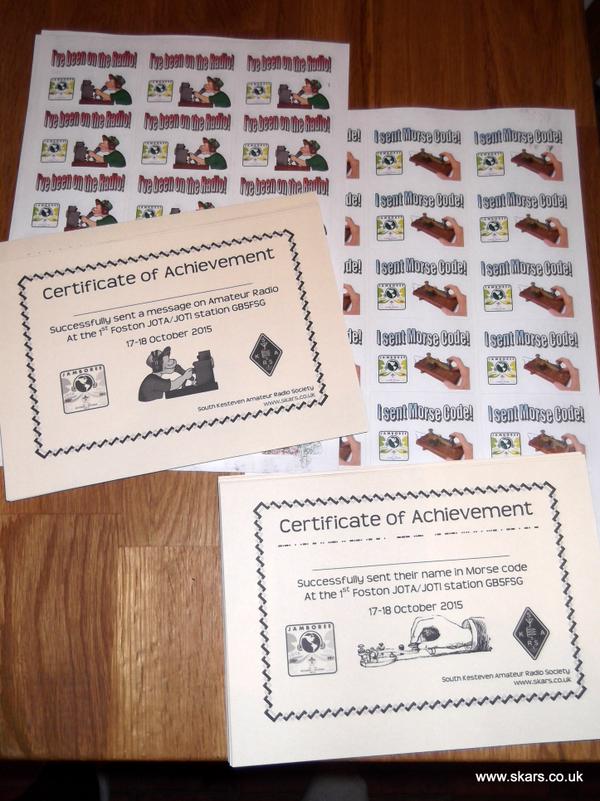
The day before I had quickly constructed a Morse code oscillator (since I didn't have one) using an arduino board and an old computer speaker for added volume and this proved popular as the children tapped out their own names, their friends names, call signs, their ages and various words.
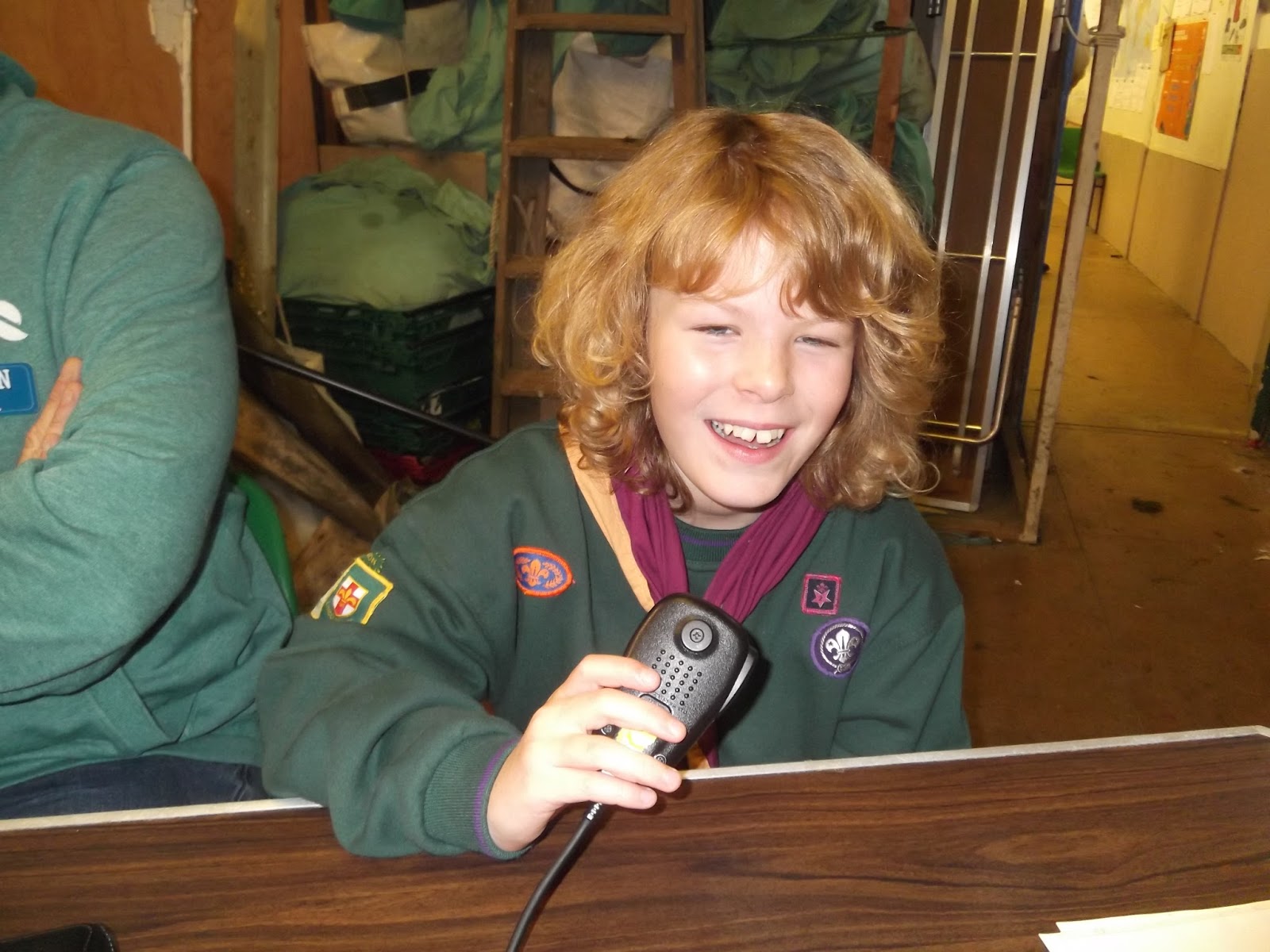
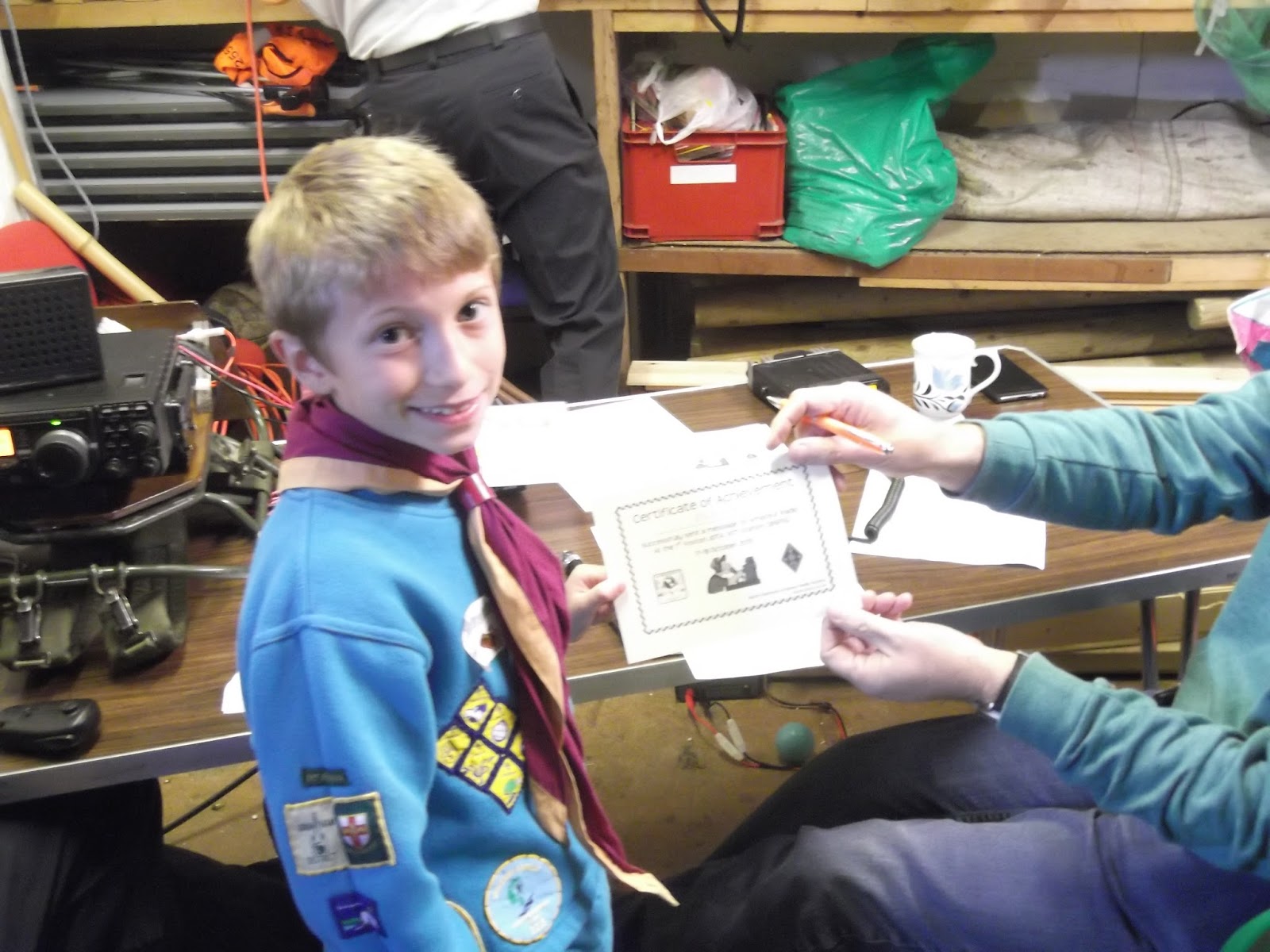
Working with the Scouts this week has really was a therapeutic exercise for my soul and made me glad I got licenced and was able to get involved with this. I am not naturally comfortable with children, since I am not a parent. But it was rewarding seeing the look of wonder on some of their faces as they passed messages.. like it was magic ;-)
Andrew Garratt, MØNRD, is a regular contributor to AmateurRadio.com and writes from East Midlands, England. Contact him at [email protected].
The ‘Stew’
 Last night saw the October 'pre-Stew' 160 m CW contest. Technically, it's supposed to be a bit of a warm-up for the real 'Stew Perry Contest' (SP) in late December but it 's really just an excuse for 160m diehards to get back on their favorite winter-time band a bit earlier than normal. After a noisy summer with few DX opportunities, most topbanders are chomping at the bit for any kind of 160m action!
The 'Stew' is my favorite contest of the year and is probably one of the fairest in terms of scoring ... unlike many contests that favor location and ham density, everyone is on a level playing field in the SP. The contest exchange consists of Grid Locators only, and the number of points collected for each QSO is based upon the calculated distance between the two respective grids ... nothing could be fairer and it would be wonderful to see other contests adopt this scoring format.
Stew Perry, W1BB, was a very early proponent of the 'gentleman's' band and was instrumental in popularizing its recognition as a challenging part of the spectrum ... a part very capable of DX opportunities for those that liked to work for their reward. He organized regular Trans-Atlantic DX tests back in the 30's when few saw any merit in the 'topband' other than as a local ragchew band for phone operators. He produced a regular 'DX Bulletin', mailed free-of-charge to interested 160m operators, providing news and information on 160m activities around the world. He had a wonderful QTH, with his 160m station set up at a local lighthouse on the edge of the Atlantic ocean. Those that knew W1BB described him as a true 'gentleman', always willing to help out newcomers and share his vast knowledge of topband quirks with others. In 1976, W1BB was awarded 160m DXCC #1 ... proof that 160m was more than just a band for late night ragchewers.
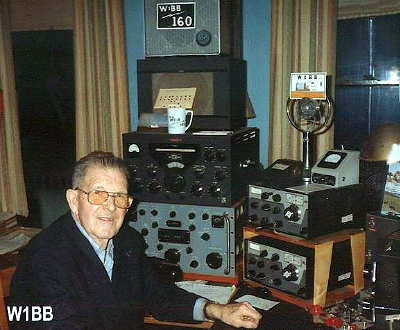 |
| courtesy: http://www.k1zm.com/w1bb |
If you've not tried 160m, the winter months offer several wonderful contesting opportunities ... the ARRL 160m CW test in December, followed by the real Stew Perry at the end of the month. To keep things rolling, January brings CQ's 160m CW weekend.
So there's still time to throw up an antenna and get your feet wet on the coming topband action. Perhaps a start on your 160m W.A.S. award ... a challenging place to begin and one that would likely bring a broad smile to 'Mr. 160' himself, Stew Perry.
Steve McDonald, VE7SL, is a regular contributor to AmateurRadio.com and writes from British Columbia, Canada. Contact him at [email protected].
Ionosondes, the “Fish Finders” of the Ionosphere, and How Ham Radio Can Help Advance Ionospheric Science
Part 1 of a 3 part Blog
Part 2 will cover the RBN – Reverse Beacon Network & DXMaps.com
Part 3 will describe the RBN Node @ WØLFA
An ionosonde is a portmanteau for “ionospheric sounder,” instruments managed by educational, government, military and scientific agencies around the world to monitor and measure the ionosphere. You can think of Ionosondes as “fish finders” that find, instead of schools of fish, regions of electrons and electrically charged atoms and molecules in the upper atmosphere.
The first ionosondes were invented in the 1920s, grew in sophistication during the 1930s, and were used by both sides during WWII to identify the best shortwave communication frequencies. A thorough history of ionosondes written in 1998 by Dr.Klaus Bibl is downloaded in PDF from the Annals of Geophysics Website here:
http://www.annalsofgeophysics.eu/index.php/annals/article/download/3810/3874
Ionosonde systems incorporate a transmitter tunable from as low as 500-kHz to as high at 40-MHz (1.6 to 12-MHz sweeps are a more typical range), antennas usually pointed straight up, and a receiver that tracks the transmitter listening for echoes reflected back to earth. It is, in other words, a radar system.
One of the four crossed-loop receive antennas used at the now-decommissioned ionosonde site in Lerwick, Shetland Islands (http://www.ukssdc.ac.uk/ionosondes/lersite.html)
Ionospheric weather, like tropospheric weather closer to earth, is in constant flux. The global ionosonde network is periodically mapping the ionosphere measuring the highest frequency reflected back to earth (this is Fc, the critical frequency) and at what height above earth that occurs (which reveals which ionospheric layer is in play). The critical frequency is proportional to charged particle density in each ionospheric layer. Signals at frequencies above Fc at the F2 layer (highest ionospheric layer) continue off into space instead of coming back to earth. Here is an example of an ionosonde ionogram (vertical axis is km above ground, horizontal axis is frequency in MHz):
Annotated ionogram from Wikipedia (en.wikipedia.org/wiki/Ionogram)
Knowing the critical frequency at various points around the world enables calculation of MUF (Maximum Usable Frequency) for shortwave radio broadcast and two-way radio communication in those regions. A useful rule of thumb is the MUF will be around three times the Fc. So, for a Fc of 6.2-MHz the MUF for signals transiting that region of the ionosphere would be around 18.7-MHz. In such conditions, the amateur 17-meter band, centered on 18.1-MHz, would be a great choice for long distance communication, as would the 20-meter band (14-MHz). The 15-meter band (21 MHz), on the other hand, would likely be ‘dead’ for paths across that region.
Q: why is the MUF so much higher than the Fc? A: radio waves propagated over long distances are refracted (bent) back to earth at acute angles, not ‘bounced’ back to earth like a handball off a wall. Less ionization is needed for refraction at low angles than for a return of a signal transmitted straight up.
(In addition to electron density profiles, ionosondes can measure Doppler shifts and polarization of ionospheric echoes. Why hams should care about ordinary and extraordinary waves and the polarization of ionospheric propagated signals will be the topic of a future WØLFA Blog post.)
How many ionosondes are in regular operation around the world and are reporting their data publicly? Best I can tell, it’s something around one hundred. The UK Solar System Data Centre has an interactive map (reproduced below) with data on each site, more info at www.ukssdc.ac.uk/wdcc1/ionosondes/world.html.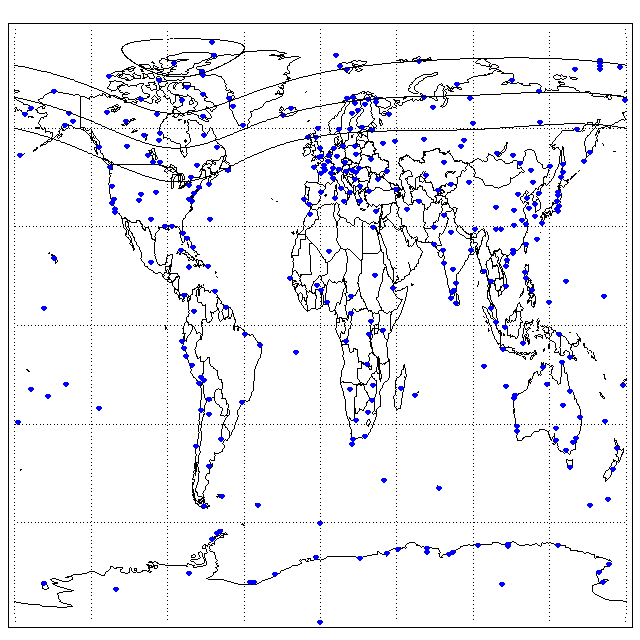
A hundred ionosondes (+/-) is ‘not nothing,’ however, the world’s a big place, and there are large ionospheric regions going unmapped by the ionosonde network. That’s where ham radio comes to the party.
The number of amateur radio operators communicating long distances over shortwave on any given day vastly outnumbers active ionosondes by orders of magnitude. Two of the most popular ham activities are contesting, making as many contacts with as many other hams in as many countries as possible in a given period, typically over a weekend, and DXing, contacting as many countries as possible in one’s lifetime during or outside of contests, the more obscure and hard-to-contact, the better.
“Contesters” and “DXers,” which are not mutually exclusive groups, tend to be very knowledgeable about radio propagation from their own extensive observations. Knowing what bands to operate on and at what times given the current state of the ionosphere can give a contester a winning edge or help a DXer snag an elusive country.
Hams have developed several innovative tools to collect, correlate and analyze the large number of ionospheric observations taking place on the ham bands every day. Every successful contact, a “QSO’ in ham-speak, is a data point. The American Radio Relay League’s Logbook of the World database is closing in on a billion QSO records from over 80,000 contributors! More data = better science.
Part 2 of this Blog will discuss two of the ways hams are collecting and analyzing ham radio-generated ionospheric propagation data in real-time: RBN, the Reverse Beacon Network, and DXmaps.com.
Part 3 will describe the RBN Node @ WØLFA.
Bill Hein, AA7XT, is a regular contributor to AmateurRadio.com and writes from Colorado, USA. He is co-owner of Force 12 and InnovAntennas. Contact him at [email protected].
Series Eight Episode Twenty-Two – Icom ID-51 Review (18 October 2015)
In this episode, Martin Butler (M1MRB / W9ICQ) is joined by Leslie Butterfield (G0CIB), Chris Howard (M0TCH) and Martin Rothwell (M0SGL) to discuss the latest Amateur / Ham Radio news. Colin (M6BOY) rounds up the news in brief, and this episodes feature is Icom ID-51 Review by Martin Rothwell (M0SGL).
- Fall in Australian Ham Radio Licences
- Electricity from Air
- Plans for PLT in The Netherlands
- New Radio Station for Sylvan Grove Hospital
- Amateur / Ham Radio Operators Behind Warning System
- dogparkSDR Version 1.0 Released
- RSGB Young Members Down by Nearly 50%
- ISS Danish CubeSats Deployed
Colin Butler, M6BOY, is the host of the ICQ Podcast, a weekly radio show about Amateur Radio. Contact him at [email protected].
Series Eight Episode Twenty-Two – Icom ID-51 Review (18 October 2015)
In this episode, Martin Butler (M1MRB / W9ICQ) is joined by Leslie Butterfield (G0CIB), Chris Howard (M0TCH) and Martin Rothwell (M0SGL) to discuss the latest Amateur / Ham Radio news. Colin (M6BOY) rounds up the news in brief, and this episodes feature is Icom ID-51 Review by Martin Rothwell (M0SGL).
- Fall in Australian Ham Radio Licences
- Electricity from Air
- Plans for PLT in The Netherlands
- New Radio Station for Sylvan Grove Hospital
- Amateur / Ham Radio Operators Behind Warning System
- dogparkSDR Version 1.0 Released
- RSGB Young Members Down by Nearly 50%
- ISS Danish CubeSats Deployed
Colin Butler, M6BOY, is the host of the ICQ Podcast, a weekly radio show about Amateur Radio. Contact him at [email protected].
RadCom and the IC7300
My RadCom arrived by post today. Unlike in the recent edition of PW, the advertisers were publishing details of the new ICOM radio and were keen to take deposits. Perhaps they have got later data? I quite like the look of the new IC7300 radio, but feel the price will soon fall to £799 or less. I can wait. I may wait to see what the FT817 replacement looks like. A 5W (or maybe 10W) radio would suit my needs better.
The latest RadCom has a review of ICOMs latest flagship radio, the IC7851, selling for around £9000. Does anyone really spend this sort of money on amateur radio gear? With PSU, tower, big beam and big rotator this implies over £10000 on amateur gear. I suppose some people must spend this sort of money. My FT817 has served me for over 14 years now. To me, this was an investment and I had to give it careful thought. I wonder how many XYLs are happy for their husbands to spend over £10000 on a hobby?
Each to their own. If you really have that kind of disposable income how you spend it is your decision.

Roger Lapthorn, G3XBM, is a regular contributor to AmateurRadio.com and writes from Cambridge, England.
Amateur Radio Weekly – Issue 81

DV4mini: All-in-one USB hotspot for D-STAR, DMR, Fusion
USB stick containing 70 cm data transceiver. Works with D-Star, DMR, Fusion, APCO25 and other digital modes which are based on GMSK, 2FSK or 4FSK.
YouTube
ARRL releases excellent Parity Act explanation video
ARRL President Kay Craigie, N3KN, said the video will be made available on Capitol Hill to make sure that Members of Congress have correct information, instead of misrepresentations.
ARRL
Kickstarter: Tiniest APRS tracking device
The Tracksoar APRS tracker is the smallest, lightest, ready to fly open source APRS tracker.
Kickstarter
Criticisms around ARES October SET
These groups rarely (if ever) properly train on the challenges of trying to use NVIS nets around the clock. Many don’t realize that 60 meters is not optional and they will likely need 160 meters in the mix too.
The Kentucky Packet Network
Field Day logging: A study in pain (PDF)
A local area network based logging system shared between stations, stored in a single database.
KK4SXX
AMSAT live OSCAR satellite status page
This page shows the most up-to-date status of all satellites reported in real time.
AMSAT
How a drug cartel took over Mexico with walkie-talkies
Inside the communications infrastructure of the ultra-violent syndicate.
Popular Science
OS X contest software overview 2015
Whether you are a serious contester, a casual contester, or someone who is just getting started, there is a contest logger that can meet your specific needs.
Mac Ham Radio
Curtain antenna for shortwave radio broadcasting
The curtain antenna is a dipole array, consisting of rows and columns of dipoles.
Broadcast Belgium
D Layer absorption
We learn in Technician Class and General Class studies that the ionosphere’s D layer is created in the daytime by ionizing solar rays and fades away completely at night, and we learn that the D layer absorbs HF frequencies below the 20-meter band.
Ham Radio School
How to
Dealing with urban radio interference on shortwave
The levels of urban radio frequency interference, or RFI, have increased dramatically in the last two decades and the proliferation of poorly engineered electronic gadgets is largely to blame.
The SWLing Post
Video
Amateur Radio: A 21st century hobby
Whether you enjoy writing software, getting hands-on with practical equipment, developing new technology or simply want to use what’s already there to communicate with others across the world, you’ll find all of this – and more – within amateur radio.
RSGB
Basic amplifiers: 1963 U.S. Army training film
An electronic amplifier is used for increasing the power of a signal.
U.S. Army
Amateur Radio Weekly is curated by Cale Mooth K4HCK. Sign up free to receive ham radio's most relevant news, projects, technology and events by e-mail each week at http://www.hamweekly.com.
 Ham Radio Deluxe |
 W5SWL Electronics |
 Ham Radio Prep |
 KB3IFH QSL Cards  Hip Ham Shirts  HamRadioAuctions HamRadioAuctions Reliance Antennas Reliance Antennas Enigma Shop Enigma Shop |  morseDX  Ni4L Antennas  R&L Electronics R&L Electronics antennas.us antennas.us QRV QRV |
- Matt W1MST, Managing Editor
