 |
 Amateur Radio Weekly – Issue 92
 2 January 2016 | by
FreeDV 2016 road map
Release VHF FreeDV modes, one mode that runs through $60 HTs, another that outperforms closed source DV by 10dB.
Rowetel
Danger in calm seas
These three things present a clear and present danger to our continued growth and enjoyment of the radio hobby.
KE9V
First Amateur Radio geosynchronous satellite to launch in 2017
“Seven days a week, 24 hours a day, 365 days a year, a new ham band will be available for the Americas.”
KB6NU
CQ World Wide favor limiting operating time to less than 48 hours
Contesters want to see a time-limited category for single operators.
ARRL
Bouncing radio off of airplanes
Amateur radio operators are always trying some new stunt or other. It’s like they’ve got something to prove. Take Aircraft scatter for instance: the idea is to extend your radio’s range by bouncing it directionally off of overhead airplanes.
Hack a Day
PWM and MPPT solar charge controller
The solar charge controller is arguably the most important component of a solar energy system.
Off Grid Ham
Signal direction finding with an RTL-SDR + Raspberry Pi
Direction finding system built out of a Raspberry Pi, an RTL-SDR and four antennas.
RTL-SDR.COM
Airplane on 60m!
I almost cannot believe it happened. And how unique this contact was.
PE4BAS
How to
How I learned Morse Code
They practiced the art of radiotelegraphy: where the contacts were easier to make, the operators were more skilled, and the signals were stronger. I wanted in.
Fine Business
Super simple APRS position reporter
My criteria has been a Raspberry Pi and an HT as the two major hardware components. No hardware TNCs and no custom cabling.
K4HCK
Video
Building a new Ham shack
We are living in a rental house and we plan to build a new house. So, I need to setup a ham shack.
K7AGE
11kV lightning arrestor and exploding disconnecter
This is a lightning arrester from an 11kV power distribution line with an interesting feature to clear itself electrically when sustained current flows through it.
YouTube
Amateur Radio Weekly is curated by Cale Mooth K4HCK. Sign up free to receive ham radio's most relevant news, projects, technology and events by e-mail each week at http://www.hamweekly.com.
Ham College 12
All about repeaters. More questions and answers from the Technician class question pool. Learn how you can win an Icom T-shirt and cap.
01:05:54
George Thomas, W5JDX, is co-host of AmateurLogic.TV, an original amateur radio video program hosted by George Thomas (W5JDX), Tommy Martin (N5ZNO), Peter Berrett (VK3PB), and Emile Diodene (KE5QKR). Contact him at [email protected].
New Year’s Day
I got on for a bit last night for SKN. I don't know if it was just bad band conditions with the remnants of that CME lingering; or perhaps it was my atrocious bug fist. I made no contacts last night.
During the day today, I did a bit better. I worked five different NPOTA activations (6 QSOs):
N8XX - TR04 - North County National Scenic Trail
W1BXY - NS76 - Weir Farm National Historic Sight
NC8IN - NS55 - Ninety Six National Historic Sight
NR3P - SS01 - Assateague Island National Seashore
KK4ZUU - BP02 - Mnasassas National Battlefield Park
K7UPJ - NS55- Ninety Six National Historic Sight
I just realized now that I worked NS55 twice. Basically, I was dial twiddling, working the ones I could hear decently. There were a few others, but QSB was so bad on 20 Meters at times that I bypassed a few, thinking conditions would get better. They didn't, and going back to try and work those again, I found them to be gone. Sometimes the Propagation Princess is a cruel mistress!
Only N8XX and NR3P were CW, though. I had to break out the microphone and resort to SSB for the others. As Yoda would say, "A disturbing trend in The Force, I sense".
As mentioned in an earlier post, the 2016 NJQRP Skeeter Hunt will be featuring NPOTA - but let that be just a foot note. I would hope that a lot of you who read this blog regularly will step up the plate and activate NPOTA entities using CW (and QRP).
Remember, it doesn't have to be an elaborate set up, with multi ops and crazy antenna installations that last all day. This NPOTA program was tailor made for portable QRP ops! Go to one of the entities, throw a wire into a tree, or perhaps break out the Buddistick, Buddipole, Alex Loop - what have you. Get on the air for a few hours and hand out some contacts!
Also, remember that this is a year long celebration. There were a bumper crop of NPOTA activations on the air today. It seems that everyone wanted to be active on "Day One", but there are 365 days left (this is a Leap Year, don't forget). So get out there and have some fun. That's what this is all about - going outdoors, setting up and having some fun.
This is OUR specialty, guys! Let's show them how it's done!
72 de Larry W2LJ
QRP - When you care to send the very least!
Larry Makoski, W2LJ, is a regular contributor to AmateurRadio.com and writes from New Jersey, USA. Contact him at [email protected].
PLT Devices – Have I welcomed the Devil in to the shack?
I need to set up the ability to remotely operate the station via the internet as well as experiment with internet linking systems but the wi-fi link to the shack isn't fast or reliable enough. Now if I do a scan looking for wi-fi networks I can see well over a dozen, some of them quite strong and more are popping up all the time and I suspect this congestion is part of my problem.
The Samsung Smart TV in the house was also wi-fi linked but we were having increasing issues with the BBC iPlayer and Netflix with buffering or poor quality images because of poor signal and data rates.
Ideally I would be like to fit proper ethernet cables but it is totally impractical without major upheaval or unsightly trunking a definite no-no. In the end the only workable and affordable solution seemed to be to get some of those evil Powerline Transmission (PLT) devices.
I have suffered strong sporadic QRM myself which I have assumed were neighbours PLT networking devices as I'd read the horror stories, seen the videos and anecdotal reports of mains borne noise caused by them. So I hadn't even considered it until I saw a post and video by Dan Trudgian (M0TGN) about his experiences of using some Netgear devices and the apparant lack of interference to his radio activities. Some members of South Kesteven ARS had also started using them, so I took the plunge and ordered some Netgear ones reduced on Amazon in the Boxing Day sales.

Setting them up was easy, but the acid test was how much noise did they generate? I set up one device in the shack at the far end of the mains cable run to maximise radiation. Streaming internet radio and a HD movie on Netflix I then used the FUNCube Dongle PRO+ SDR connected to the OCFD to see what noise they were generating.
Here are my observations going through the various HF bands. Where noise is present I first stopped the streaming and then powered off the devices to eliminate them as the cause, where they were the cause it seemed eliminating the network traffic was sufficient to greatly reduce the effect.
80 Meters


While the antenna isn't optimised for 80m, signals can be seen as well as noise. Before you get excited this noise has been present for quite a while and isn't being caused by the new Netgear devices. This noise is what I suspected was generated by PLT devices used by my neighbours.
60 Meters

Shocking noise but again this isn't caused by my new devices, the noise has the same characteristics as that seen on 80m.
40 Meters
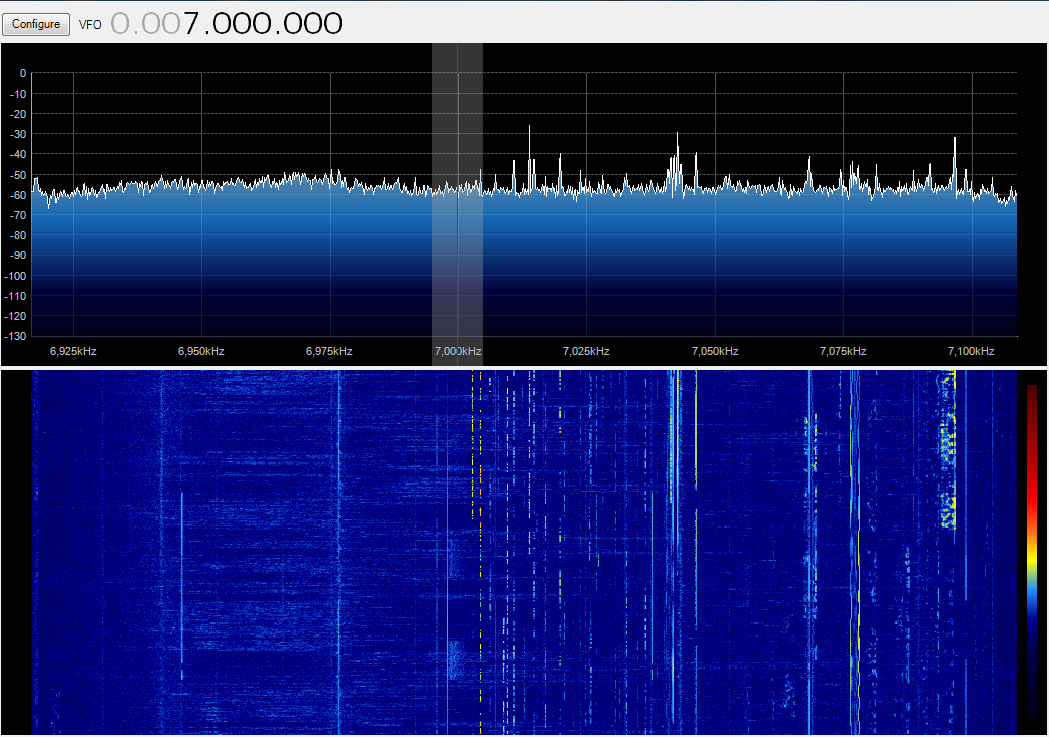

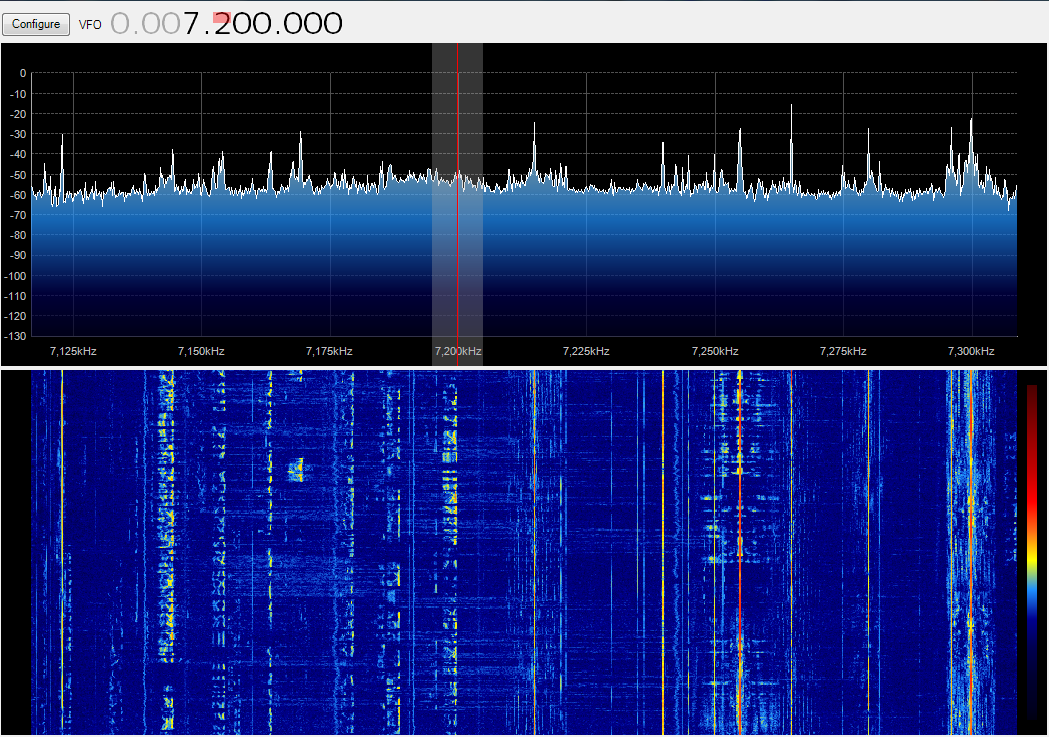

The band was busy, there is some noise again but not from the new devices, this was looking encouraging. I have also showed the adjacent broadcast band.
30 Meters

Again, largely noise free
20 Meters
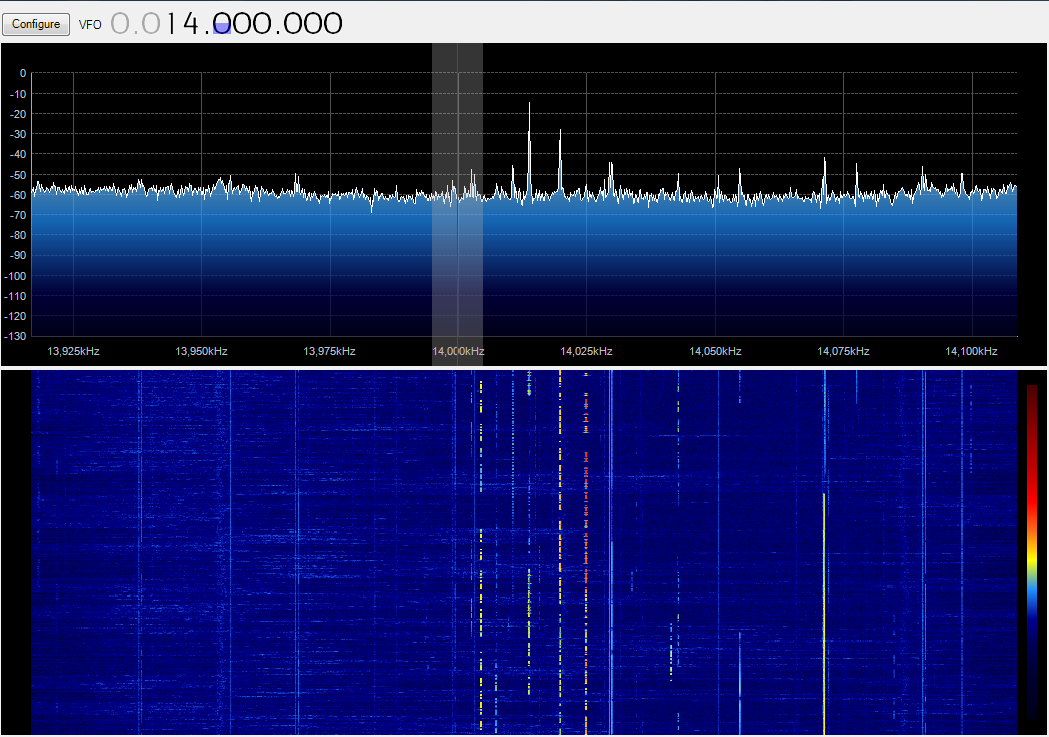


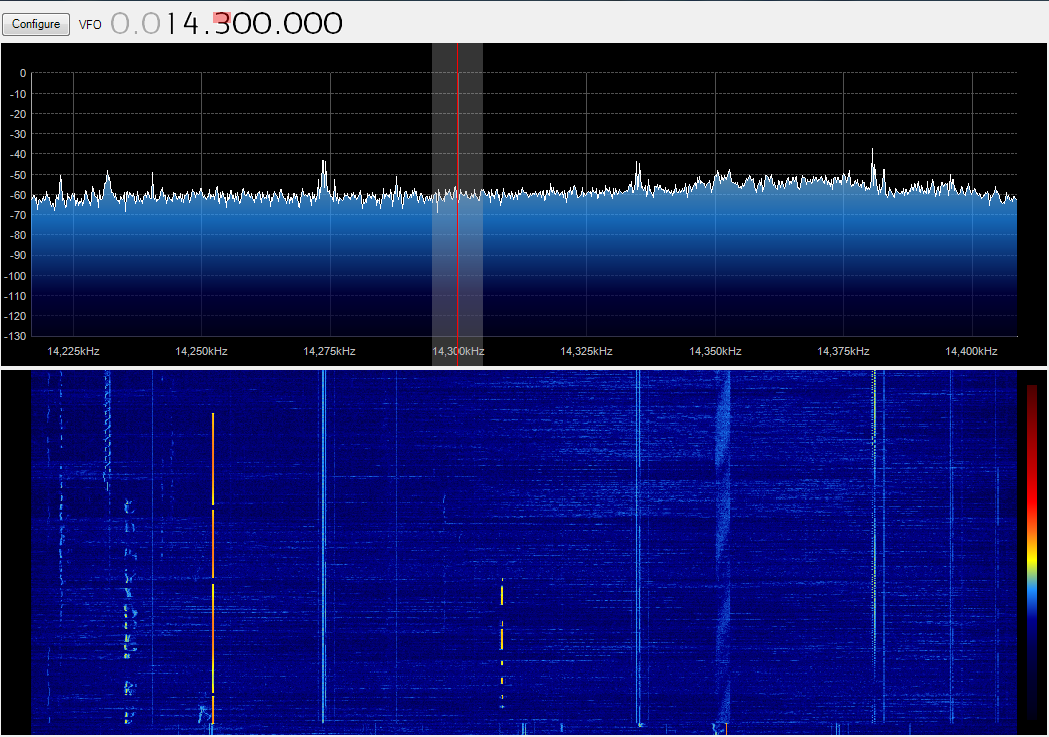
Still largely noise free, the QRM that is present still wasn't due to the new devices
17 Meters


This was the first indication of QRM from the new devices, however it appears effectively filtered to leave the amateur allocation clear. The faint noise in the middle picture is not from the new devices.
15 Meters


Again this band was clear of noise
12 Meters
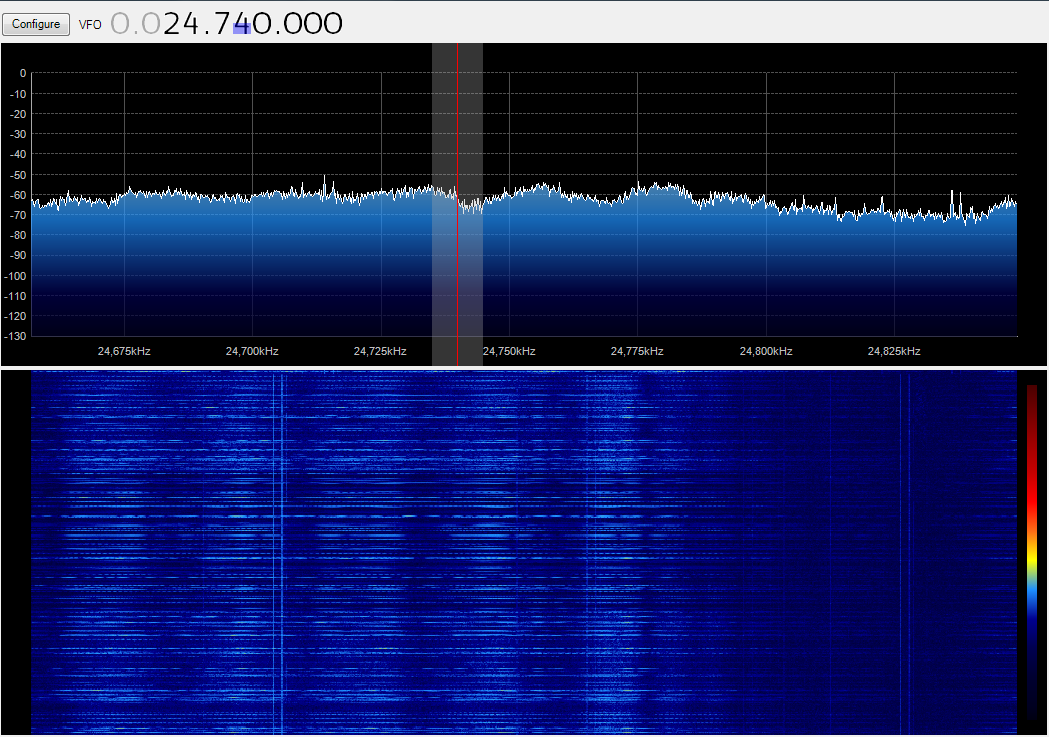

Showing the two ends of the band again the clear signal/noise from the devices again seems effectively filtered
10 Meter
I didn't observe any additional noise on this band, but unfortunately deleted the screen grabs ;-)So where was the QRM?


While the amateur bands appear to be filtered, the transmission can of course can clearly be seen on some non-amateur bands and apart from 16 meters seems to avoid the broadcast bands.
Conclusion
These Netgear XAVB5221 devices seem effective, indeed doing a speedtest in the shack was more than acceptable (the dire upload speed is a 'feature' of my cable ISP)
This fairly rudimentary testing has largely given me confidence that they won't be any issues. The band conditions weren't brilliant when I did test, but even with the absence of signals on the band any noise would be evident as seen. Yes they clearly do generate QRM but thankfully not it seems in the amateur bands. I haven't heard any extra noise on any of the radios over the last few days so all is looking promising. I will keep you posted if there is any change.
Andrew Garratt, MØNRD, is a regular contributor to AmateurRadio.com and writes from East Midlands, England. Contact him at [email protected].
PLT Devices – Have I welcomed the Devil in to the shack?
I need to set up the ability to remotely operate the station via the internet as well as experiment with internet linking systems but the wi-fi link to the shack isn't fast or reliable enough. Now if I do a scan looking for wi-fi networks I can see well over a dozen, some of them quite strong and more are popping up all the time and I suspect this congestion is part of my problem.
The Samsung Smart TV in the house was also wi-fi linked but we were having increasing issues with the BBC iPlayer and Netflix with buffering or poor quality images because of poor signal and data rates.
Ideally I would be like to fit proper ethernet cables but it is totally impractical without major upheaval or unsightly trunking a definite no-no. In the end the only workable and affordable solution seemed to be to get some of those evil Powerline Transmission (PLT) devices.
I have suffered strong sporadic QRM myself which I have assumed were neighbours PLT networking devices as I'd read the horror stories, seen the videos and anecdotal reports of mains borne noise caused by them. So I hadn't even considered it until I saw a post and video by Dan Trudgian (M0TGN) about his experiences of using some Netgear devices and the apparant lack of interference to his radio activities. Some members of South Kesteven ARS had also started using them, so I took the plunge and ordered some Netgear ones reduced on Amazon in the Boxing Day sales.
Setting them up was easy, but the acid test was how much noise did they generate? I set up one device in the shack at the far end of the mains cable run to maximise radiation. Streaming internet radio and a HD movie on Netflix I then used the FUNCube Dongle PRO+ SDR connected to the OCFD to see what noise they were generating.
Here are my observations going through the various HF bands. Where noise is present I first stopped the streaming and then powered off the devices to eliminate them as the cause, where they were the cause it seemed eliminating the network traffic was sufficient to greatly reduce the effect.
80 Meters
While the antenna isn't optimised for 80m, signals can be seen as well as noise. Before you get excited this noise has been present for quite a while and isn't being caused by the new Netgear devices. This noise is what I suspected was generated by PLT devices used by my neighbours.
60 Meters
Shocking noise but again this isn't caused by my new devices, the noise has the same characteristics as that seen on 80m.
40 Meters
The band was busy, there is some noise again but not from the new devices, this was looking encouraging. I have also showed the adjacent broadcast band.
30 Meters
Again, largely noise free
20 Meters
Still largely noise free, the QRM that is present still wasn't due to the new devices
17 Meters
This was the first indication of QRM from the new devices, however it appears effectively filtered to leave the amateur allocation clear. The faint noise in the middle picture is not from the new devices.
15 Meters
Again this band was clear of noise
12 Meters
Showing the two ends of the band again the clear signal/noise from the devices again seems effectively filtered
10 Meter
I didn't observe any additional noise on this band, but unfortunately deleted the screen grabs ;-)So where was the QRM?
While the amateur bands appear to be filtered, the transmission can of course can clearly be seen on some non-amateur bands and apart from 16 meters seems to avoid the broadcast bands.
Conclusion
These Netgear XAVB5221 devices seem effective, indeed doing a speedtest in the shack was more than acceptable (the dire upload speed is a 'feature' of my cable ISP)This fairly rudimentary testing has largely given me confidence that they won't be any issues. The band conditions weren't brilliant when I did test, but even with the absence of signals on the band any noise would be evident as seen. Yes they clearly do generate QRM but thankfully not it seems in the amateur bands. I haven't heard any extra noise on any of the radios over the last few days so all is looking promising. I will keep you posted if there is any change.
Andrew Garratt, MØNRD, is a regular contributor to AmateurRadio.com and writes from East Midlands, England. Contact him at [email protected].
The Spectrum Monitor — January, 2016
 Stories you’ll find in our January, 2016 issue:
Building Solar-Powered Amateur Radio Beacons for 630 and 10-Meters
By Geir Laastad LA6LU
In the August 2015 issue of TSM, Geir wrote about “Advanced Radio Noise Filtering Using DSP Technologies.” This time Geir puts his electronics know-how to work while he shows us how he built two amateur radio beacons for opposite ends of the amateur HF spectrum: the 630 and 10-meter bands. The site for his beacons is his remote cabin in the woods—far away from everything, which is why his beacons are also powered off the grid. Using QRP Labs Ultimate3 QRSS/WSPR kits, these beacons have to be very rugged to take the abuse Norway’s winters can dish out.
TSM Reviews: AOR DV-1 Wideband Receiver
By Chris Parris
AOR is a brand well known to monitoring enthusiasts. They have a long history of making high-end receivers featuring advanced technology capable of wideband reception from longwave to the high side of UHF. “Federal Wavelengths” columnist, Chris Parris, puts this pedigreed receiver through its paces and finds some welcome pluses and a few disappointing minuses. He especially liked this radio’s ability to seek out weaker digital signals that other radios missed and he found ways to overcome the radio’s anemic audio.
Retro Radio: Finding, Storing and Savoring Vintage Amateur Radio Gear
By Richard Fisher KI6SN
Knowledgeable radio amateurs describe “vintage” transmitters, receivers and transceivers as being somewhat relative—only you know it when you see it. That’s because each of us have our own radio experiences, some dating to decades ago and others more recent. Nostalgia is a many splendored thing. Last month he looked at broadcast-band and shortwave receivers of a rich, bygone era. In this second part, his focus is on collecting, restoring and enjoying commercially manufactured vintage amateur radio equipment. As Richard shows us, restoring these ham band workhorses requires more than just a fondness for days gone buy.
VHF and Above: Sporadic-E Propagation
By Joe Lynch N6CL
From late November to early January, and again in the middle of May through the end of July, sporadic-E propagation appears more often on VHF and above frequencies in the Northern Hemisphere. This type of propagation occurs when there is a sporadic ionization of the E-layer that appears in the late morning and late afternoon local time during those months. But, working meteor-scatter Sporadic-E is not for slow hands, Joe shows you how to work fast to successfully log QSOs using this ephemeral mode. And, for once, it’s not about expensive esoteric antennas!
ATSC Off-Air Local Television: The Programming
By Mike Kohl
The Golden Age of Television is really here. Never before has there been such an abundance of choices in TV entertainment for the home. Last month, Mike hinted at multiple delivery methods being used to deliver signals. This month he looks at the content provided by local television broadcasters to their local Over-the-Air (OTA) viewers in representative regions of North America. Mike continues to show us all how to “cut the cord,” this month looking at OTA programming rewards. You might be surprised at just how many OTA channels you can find where you live.
Scanning America
By Dan Veenaman
Pensacola’s APCO P-25 Phase 2 and Whistler’s New Scanners
Federal Wavelengths
By Chris Parris
DMR, APCO-25, MotoTRBO, and the IRS
Utility Planet
By Hugh Stegman NV6H
Mexican Military Returns to HF ALE
Digital HF: Intercept and Analyze
By Mike Chace-Ortiz AB1TZ/G6DHU
The US Navy HF Broadcast System Revisited
HF Utility Logs
By Mike Chace-Ortiz and Hugh Stegman
Digitally Speaking
By Cory Sickles WA3UVV
Digital Voice on the HF Bands
Amateur Radio Insights
By Kirk Kleinschmidt NT0Z
DVB Dongles: Beef Up your $20 SDR
Radio 101
By Ken Reitz KS4ZR
WorldSpace, WRN, WXFAX and More
Radio Propagation
By Tomas Hood NW7UST
Catching Those Winter Mediumwave DX Signals
The World of Shortwave Listening
By Jeff White
A South Pacific Radio Odyssey
The Shortwave Listener
By Fred Waterer
RNZI, BBC, RFI, WHRI and VOA
Maritime Monitoring
By Ron Walsh VE3GO
CMB: Continuous Marine Broadcasts
The Longwave Zone
By Kevin O’Hern Carey WB2QMY
SDR: I’m a Believer!
Adventures in Radio Restoration
By Rich Post KB8TAD
In Command Again Part 2: Experiments in Powering the Command Transmitters
Antenna Connections
By Dan Farber AC0LW
Stealthy Green Jolly Loop Revisited: On the Low Down
The Spectrum Monitor is available in PDF format which can be read on any desktop, laptop, iPad®, Kindle® Fire, or other device capable of opening a PDF file. Annual subscription is $24. Individual monthly issues are available for $3 each.
Ken Reitz, KS4ZR, is publisher and managing editor of The Spectrum Monitor. Contact him at [email protected].
Winter Assault on Mt Herman (W0C/FR-063)
On the last day of the year, it seemed like a good idea to get in one more SOTA activation. It turns out that I had not been up Mt Herman (W0C/FR-063) all year, even though it’s close by. See this page for the trail description. Joyce KØJJW and I decided to hike up in the morning, reaching the summit around 11 AM local time. This was my third SOTA activation of Mt Herman, but I’ve operated from there many more times in various VHF contests (back before SOTA was a thing in Colorado).
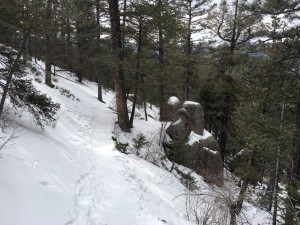
Winter conditions on Mount Herman trail.
The road to the trailhead was in good condition but snowpacked and icy. This road is not plowed during the winter but it is often passable with a decent 4WD vehicle. Today, you could make it to the trailhead with 2WD and some careful driving. The trail conditions were typical for winter time: almost completely covered in snow with a few bare spots showing here and there. The trail was packed powder and not particularly icy. Still, we appreciated having traction devices on our boots. This trail can be downright treacherous when it ices up, so traction devices (Yaktrax, Microspikes, etc.) are highly recommended. Trekking poles can be helpful, too.

Joyce K0JJW and Bob K0NR on the trail.
Once at the summit, I used my Yaesu FT-60 handheld radio and a half-wave vertical antenna to work people on 146.52 MHz. Having notified a number of people that I would be on the air, I actually had a bit of a pile up on 2m fm. In short order, I worked KE5QNG, WA6MM, KH7AL, WG0AT, W7AWH, K9MAP, K0JQZ, K9DBX, W0STU, KD0MFO, WB0ROK, KD0VHD and KL7IZW. Best DX was about 50 miles with W7AWH in Pueblo West. Thanks to everyone that got on the air to work me.
The weather was cold, about 15 deg F, so we didn’t stay too long on the summit and headed back down the trail. OK, maybe “winter assault” is a bit of an exaggeration. Let’s call it a fun hike in cold weather.
73, Bob K0NR
Other postings on SOTA activation of Mt Herman:
Soggy Mount Herman SOTA Activation (W0C/FR-063)
Mt Herman: SOTA plus VHF Contest
The post Winter Assault on Mt Herman (W0C/FR-063) appeared first on The KØNR Radio Site.
Bob Witte, KØNR, is a regular contributor to AmateurRadio.com and writes from Colorado, USA. Contact him at [email protected].
 Ham Radio Deluxe |
 W5SWL Electronics |
 Ham Radio Prep |
 KB3IFH QSL Cards  Hip Ham Shirts  HamRadioAuctions HamRadioAuctions Reliance Antennas Reliance Antennas Enigma Shop Enigma Shop |  morseDX  Ni4L Antennas  R&L Electronics R&L Electronics antennas.us antennas.us QRV QRV |
- Matt W1MST, Managing Editor
