 |
 Had a wonderful time today
 17 January 2016 | by
If you saw Dave's setup, you would swear that you died and went to Ham Radio heaven. Dave recently purchased a minivan, which has become a custom outfitted portable communications center. Dave has hand crafted a wooden bed frame, with storage underneath that allows him to cart along everything he needs for portable Amateur Radio operations. If the need arises, Dave can operate quite comfortably from either inside or outside the van. He is equipped for just about any eventuality that you can think of, and if need be, he can "camp out" in semi-luxury as needed. I should have taken pictures for this post, but I was so excited about helping to activate an entity for NPOTA that I plumb forgot! (See my update below)
I got to the park shortly after Noon. It's been years since I've been up to Jockey Hollow and I took a few wrong turns. I ended up driving through Harding, NJ. Wow! Talk about seeing where the "1%" lives. What estates! But I digress.
I got to the Jockey Hollow parking lot and Dave was already good to go. He had his hybrid homebrew/commercial Buddipole on a painters pole at about the 15 foot level. He had just finished conducting a run when I drove up, so he was ready to take a break and stretch his legs for a bit when I arrived. We chatted for a bit while I admired his set up. Dave was using a Yaesu at 100 Watts off a deep cycle marine battery, and it was doing him in good stead.
Shortly after, we got back down to business. Dave folded down the seat, so I could set next to him (very comfortably) on his padded bed frame/bench seat/storage cabinet. I offered to log for him while he took the microphone. Dave called "CQ NPOTA" for a bit and we had a few bites. Then I decided to whip out my cell phone, bring up DX Summit and spot him on the cluster.
Quite literally, all Hell broke loose! It was like standing next to a dam when it decided to burst. We were at the business end of a pileup and were having the time of our lives. A little over an hour later, Dave decided to take another break, so I operated station KD2FSI for a few more QSOs, while he stretched his legs. When things quieted down, we both took a break to discover that we had made over 100 QSOs in that short amount of time. We worked all up and down the East coast and as far West as Arizona and New Mexico.
While Dave was operating solo, he also worked into Canada, the Netherlands and Belgium, I believe. It was a great time and I'm very grateful to Dave that he let me be his wingman for the day. As far as Amateur Radio goes, Dave is still considered a "rookie" as he is licensed for less than three years. Let me tell you, Dave is no rookie! Dave has taken to HF operating like a bird to the air or a fish to the water. He is completely at home behind the microphone for phone operations and behind the keyboard for digital operations.
And, oh yeah, he's also learning to get comfortable behind the key for CW operations. I'm hoping that he'll really be comfortable by Field Day!
UPDATE:
Dave posted some photos to the SPARC Facebook page, so I am going to do a little cross posting here, so you can see his wonderful set up.
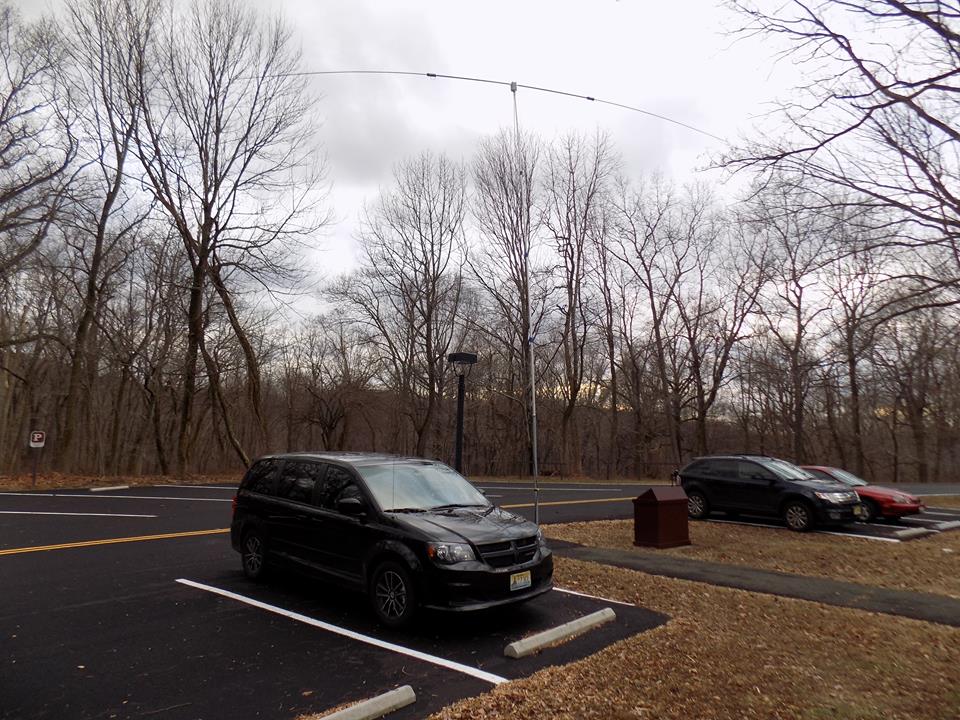
Dave's minivan parked on his homebrew mast holder. The mast is an extendable painter's pole. I'm guesstimating about 15 feet high. His Buddipole is a hybrid of homebrew and commercial W3FF parts. By his outing yesterday, it was obvious that Dave's concoction is a huge success!
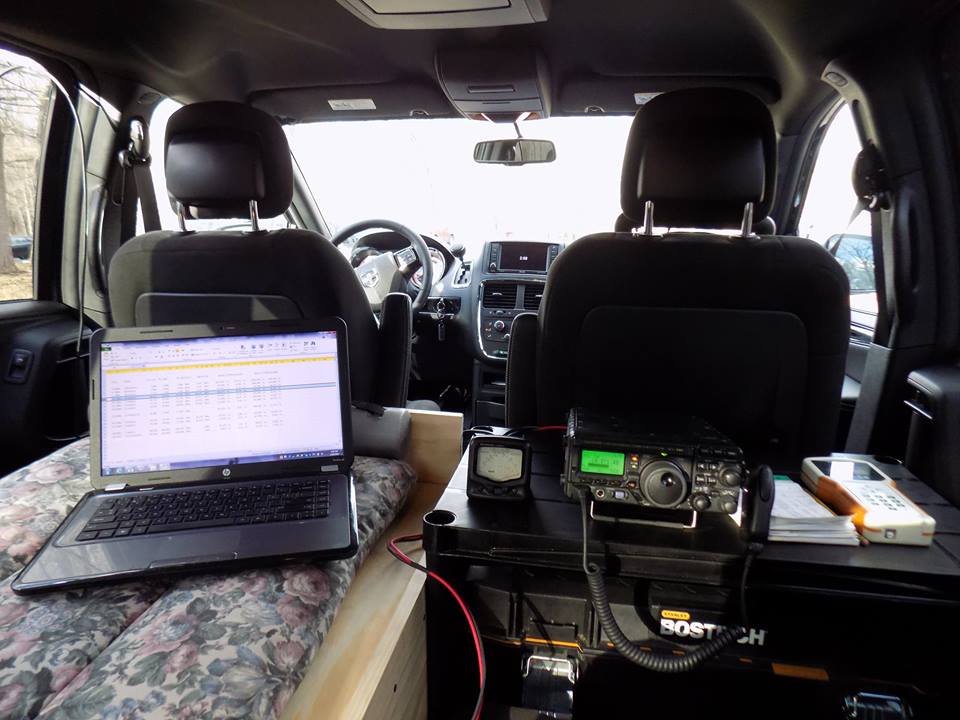
From the back of the minivan looking forward. Dave's laptop is sitting on his handcrafted bedframe/storage unit. As you can see, it also serves as a desk. He had only a thin cushion on it, as he was not spending an overnight at the park. For sleeping purposes, Dave has a much thicker and comfortable memory foam pad that his son gave him for Christmas. This thin pad was just the thing for using his bedframe as a bench when Dave was running stations while I logged for him.
72 de Larry W2LJ
QRP - When you care to send the very least!
Larry Makoski, W2LJ, is a regular contributor to AmateurRadio.com and writes from New Jersey, USA. Contact him at [email protected].
Amateur Radio Weekly – Issue 94

ISS SSTV activity today
The SSTV transmissions will be made from the amateur radio station located in the Russian Service Module of the ISS using the callsign RS0ISS.
AMSAT UK
Review: Heathkit Explorer Jr. GR-150 TRF AM radio receiver kit
The Explorer Jr. manual is very nicely done, spiral-bound, and very reminiscent of the old Heathkit manuals in terms of layout and detail.
The SWLing Post
Number of Ham Radio licenses to reach 750,000 by 2017
The number of unexpired amateur radio licenses in the United States was 733,594 in November 2015, an annual growth rate of 1.05% and five year growth rate of 4.52%.
KC4LMD
A stealthy HOA HamStick directional dipole
This is a sneak peek at the project and I will follow up with a very detailed build, tune and operation on 20 and 40 meters bands using both Phone and digital PSK31.
Prepared Ham
USB rechargeable AA batteries
Featuring the same lithium polymer chemistry of your smarthphone, these AA and AAA batteries can be plugged directly into USB for charging.
Macworld
Retirement and Ham Radio
What I have come to learn is that Monday is just as good a day as Saturday and weekend crowds are to be avoided. There are no crowds on Tuesdays.
amateurradio.com
MyAPRS: APRS app for iOS
A modern APRS app for iOS users with model detection, frequency detection, and C4FM highlights.
MyAPRS
Splat! scripts
Scripts to run the Splat! radio terrain mapping tool.
GitHub
Recent Ham attack
The weather station was taken down for test, and upon investigation, the source of the problem was quickly discovered to be a result of squirrel sabotage.
Essex Ham
Video
The Russian Woodpecker documentary now online
An enormous secret Soviet weapon that stands in the shadow of Chernobyl, and which Kremlinologists in the 1980s thought might be a giant mind-control device.
russianwoodpecker.com
Moonbounce/EME Project Diana 70th anniversary special event
This is a narrated compilation of videos taken on 10 January 2016 at a special event that commemorates the 70th Anniversary of the US Army Signal Corp’s Project Diana.
W2AEW
Amateur Radio Weekly is curated by Cale Mooth K4HCK. Sign up free to receive ham radio's most relevant news, projects, technology and events by e-mail each week at http://www.hamweekly.com.
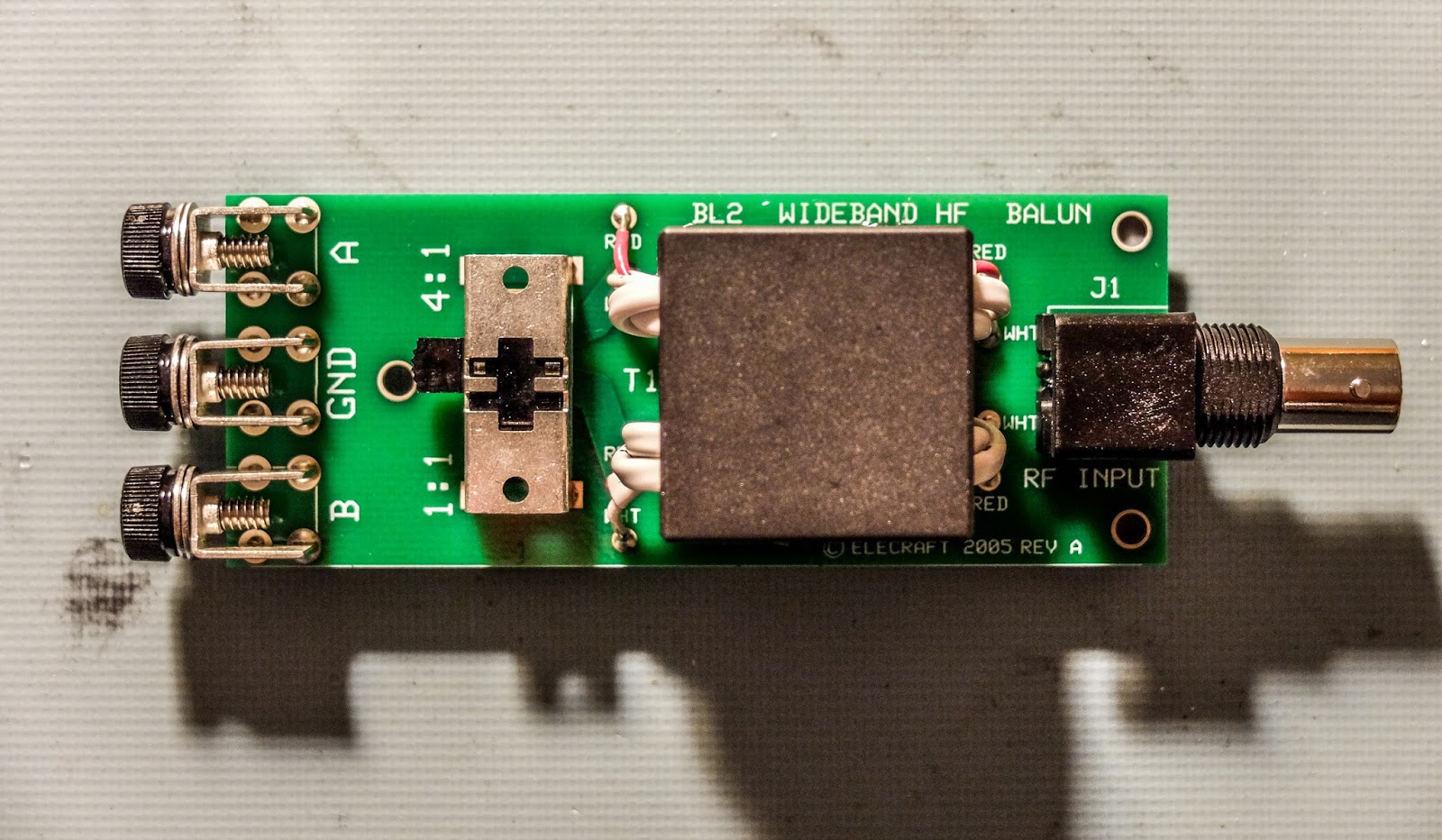
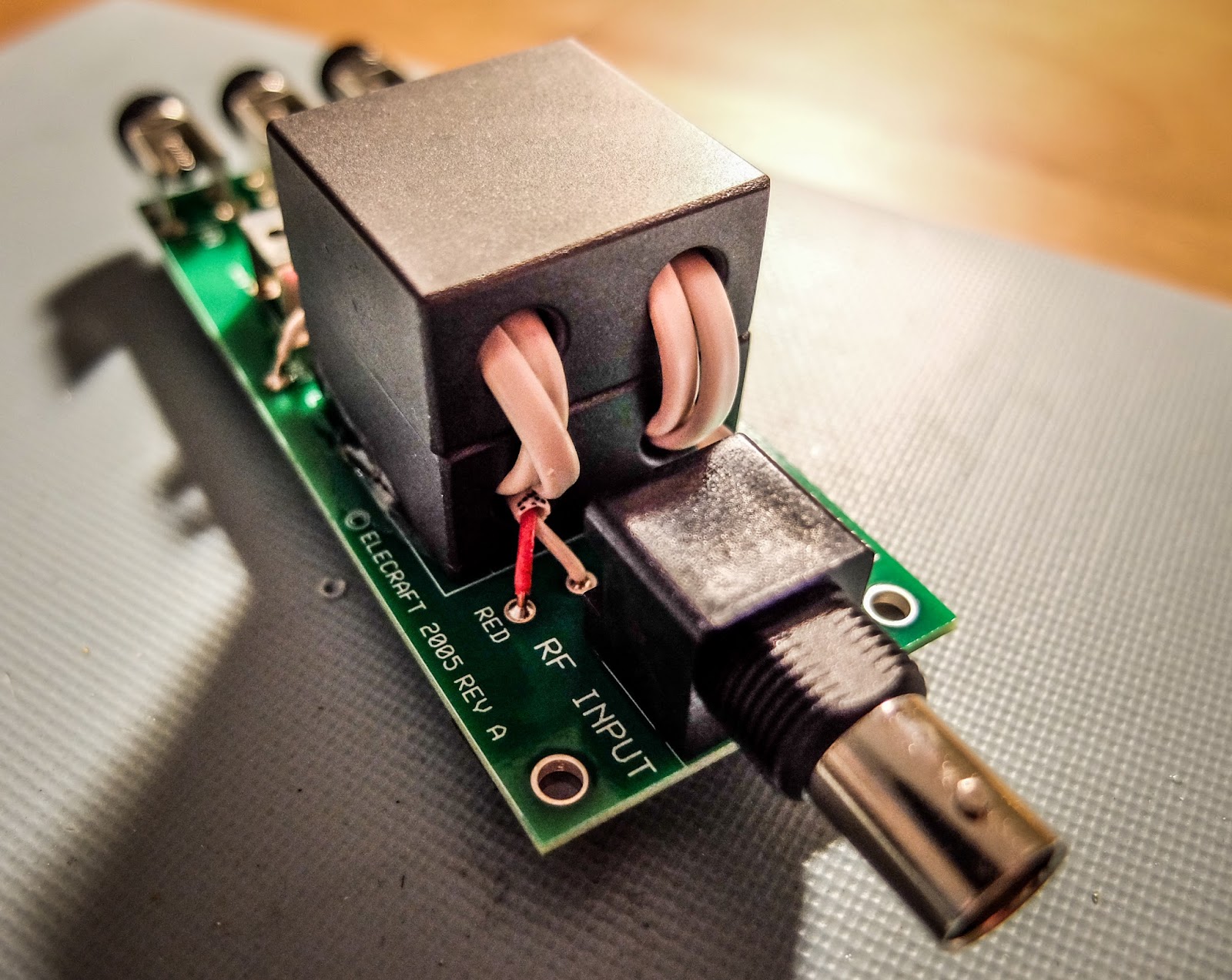
Elecraft BL2
Two Baluns in One
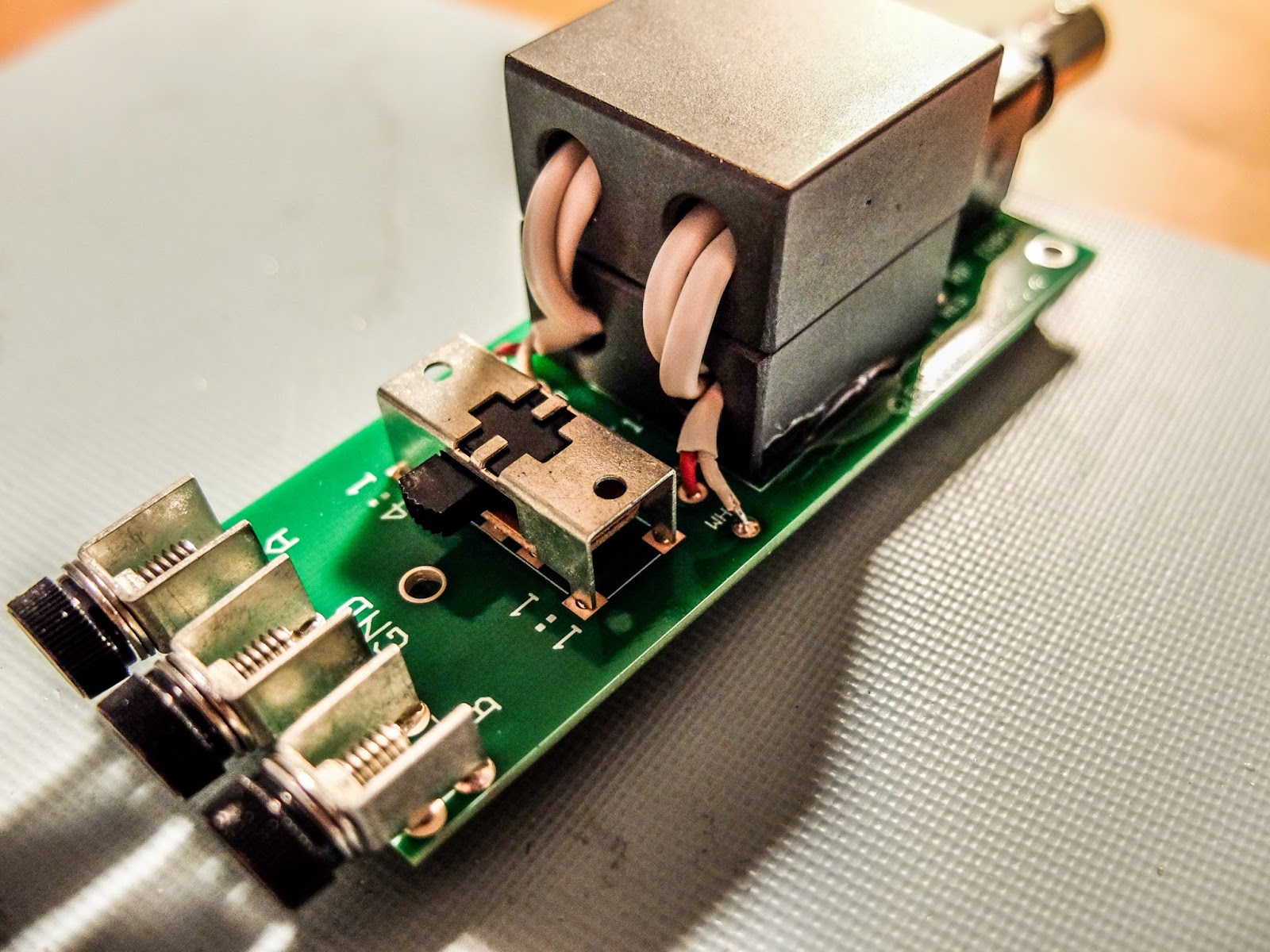 |
| Elecraft BL2 kit |
According to an email correspondence with Gary (AB7MY) at Elecraft...
- The ground lug is there to be used to bleed off static voltage on an antenna that is not DC or earth grounded.
- We don't recommend using the balun with an end fed wire. It will have too much loss. The balun is for use with a balanced antenna and a low impedance of 200-300 ohms or less.
Too Fragile?
Summary
Update 2-8-2016
Richard Carpenter, AA4OO, is a regular contributor to AmateurRadio.com and writes from North Carolina, USA. Contact him at [email protected].
2016 SOTA Activity Days
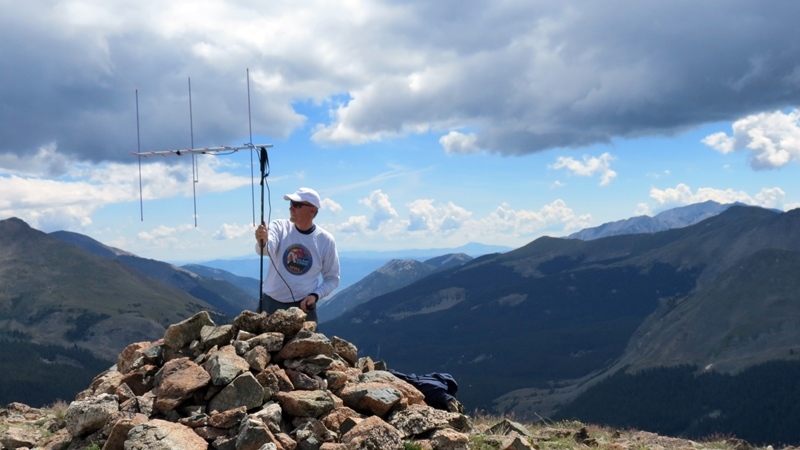 Summits On The Air (SOTA) operating events are a great way to promote activity and create opportunities for summit-to-summit radio contacts. Here’s the 2016 calendar, an update of the 2015 list suggested by Guy N7UN. Many of these dates are aligned with VHF events but there will be HF activity as well.
- Jan 30-Feb 1: ARRL Jan VHF Contest + NA SOTA Winter Activity Weekend
- Apr 16-17: North America SOTA Spring Activity Weekend
- Jun 11-13: ARRL June VHF Contest + NA SOTA Summer Activity Weekend
- Jul 16-17: CQ WW VHF Contest + optional for SOTA
- Aug 6-7: Colorado 14er Event + NA SOTA Rocky Mtn Rendezvous + W7 SOTA Activity Weekend + ARRL UHF Contest
- Sept 10-12: ARRL Sept VHF Contest + NA SOTA Fall Activity Weekend
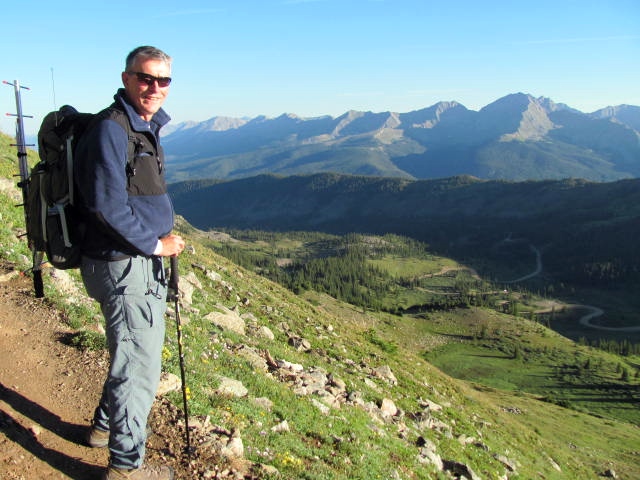 Of course, any day is a good day for SOTA activity. The August 6-7 weekend looks to be the alignment of the planets with four events happening around that weekend. Early August usually offers excellent conditions for hiking the highest peaks in Colorado, so come on out and play.
For more info on VHF SOTA, see How To Do a VHF SOTA Activation.
Get off the couch, put on your hiking boots, grab your backpack, grab your radio but most important: get on the air!
73, Bob K0NR
The post 2016 SOTA Activity Days appeared first on The KØNR Radio Site.
Bob Witte, KØNR, is a regular contributor to AmateurRadio.com and writes from Colorado, USA. Contact him at [email protected].
UTC time on the desktop
 |
| My new UTC clock on the PC desktop |
Mike Weir, VE9KK, is a regular contributor to AmateurRadio.com and writes from New Brunswick, Canada. Contact him at [email protected].
I Need You in My Log! SKCC K3Y/0 Special Event (January 2016)
I need your help!
Come meet me on the shortwave (HF) ham bands for the Morse code (CW mode) special event, the Straight Key Century Club (SKCC) celebration, with special callsign, K3Y. During the shifts (time slots) listed below, I am the control operator as K3Y/0.
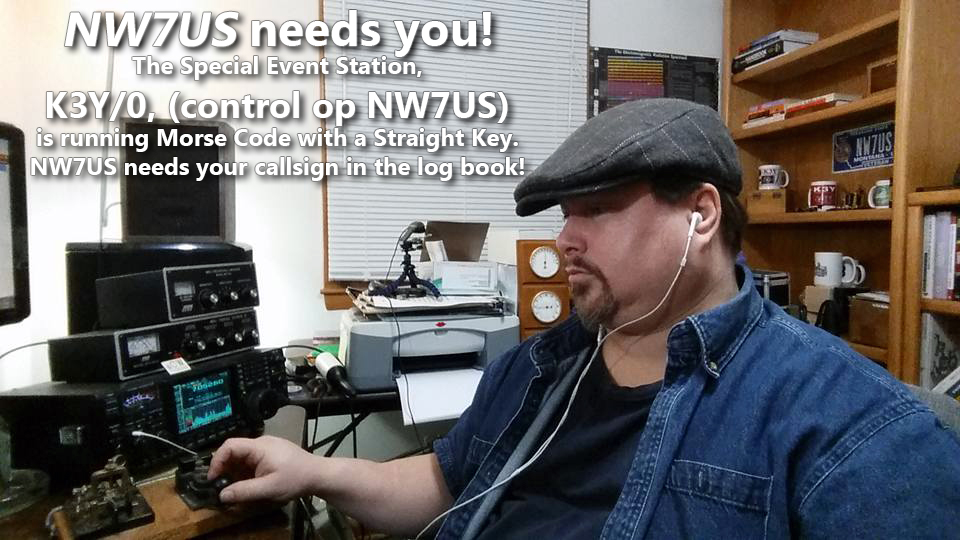 I need you to make a contact with me.
This special event takes place every year during January. We celebrate the legacy of Morse code, and promote Morse code and manual creation of the code by any non-electronic (digital) device and method. Which means that we love mechanical bugs, straight keys, two ends of a wire, or any other manual device, if Morse code is generated. The Straight Key Century Club is a free membership group. The link to their website is below.
I need you to make a contact with me, during my scheduled times, listed below.
NOTE: YOU DO NOT NEED TO BE A MEMBER OF THE (free) SKCC GROUP. To get into my logbook, you meet me on my frequency, and use Morse code to communicate with me. It is painless. If you must, you can use computer-generated Morse code. Or, you can tap it out on any Morse code signalling device, like a bug, a set of paddles, or a straight key; whatever you choose to make Morse code emanate from your HF transmitter.
HOWEVER: For those of you who want to get fully immersed in the spirit of this event, you are invited to use a straight key. And, as a bonus, you may and can join the SKCC group for FREE. Then, you would have your own SKCC number. That’d be cool; we SKCC members use that number in our exchange during our QSO information exchange. But, you don’t need that. Since it is free, why not?
What is needed is simply you, getting on the shortwave band, finding me, hearing me, and responding to me with Morse code. In other words, we need to have a QSO using Morse code. I am not a fast operator, so no problem if you are not very fast. I’ll meet your speed.
In any case, here are some of the times I will be on the air as K3Y/0… please dust off your straight key, bug, paddles, whatever, and make a QSO with me. Thanks!
My current schedule:
UTC Start/End (remember, these are NOT your local times, but are the UTC (GMT) times!)
(revised times, as of edit date)
 00:00 - 02:59 19-Jan-16
 00:00 - 02:59 20-Jan-16
 00:00 - 02:59 21-Jan-16
 00:00 - 02:59 22-Jan-16
 00:00 - 05:59 23-Jan-16
 14:00 - 18:59 23-Jan-16
 20:00 - 21:59 23-Jan-16
 00:00 - 02:59 24-Jan-16
 14:00 - 18:59 24-Jan-16
 21:00 - 21:59 24-Jan-16
 00:00 - 02:59 25-Jan-16
 00:00 - 02:59 26-Jan-16
 00:00 - 02:59 27-Jan-16
 00:00 - 02:59 28-Jan-16
 00:00 - 02:59 29-Jan-16
 00:00 - 05:59 30-Jan-16
 13:00 - 18:59 30-Jan-16
 20:00 - 21:59 30-Jan-16
 00:00 - 03:59 31-Jan-16
 13:00 - 23:59 31-Jan-16
Now, what frequency will I be on?
To find out what frequency I am on:
Visit http://g.nw7us.us/sched4SKCC and look on the right side for my callsign, NW7US. I usually post my frequency of operation right after my call sign.
Typically, evening operation is 30m, then 40m, and then possibly 80m.
If you are trying to alert me to your presence, you may message me on my personal Facebook profile, under my “Tomas David Hood” profile messages, but I may not see that right away.
Here is the detail covering the K3Y operation and the SKCC group: http://skccgroup.com/k3y
73 de NW7US
dit dit
This was last year:
https://www.youtube.com/watch?v=UfRvITFpTb4
..
..
Visit, subscribe: NW7US Radio Communications and Propagation YouTube Channel
Making Weak Signal QSO’s On 630m
As much as I love CW and try and promote its use on 630m, one cannot deny the growing interest and use of the WSPR mode on our newest ham band.
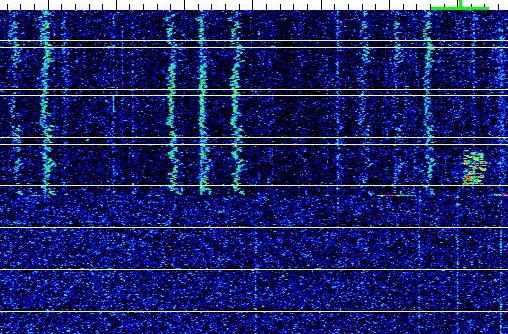
Its ability to dig deep into the noise and successfully decode signals as weak as -30db makes it an attractive method of watching the night-to-night and hour-to-hour propagation magic.
One only needs to check the number of stations logged into the WSPRnet Activity-page, uploading 630m spots each night ... a typical evening will see 60-80 calls listed.
The main problem with WSPR is that it's a one-way, beacon-only mode and it's not possible to utilize it for a valid two-way contact. It's nice to know that station 'A' is able to hear station 'B', and vice-versa, but the only way for both stations to know this is for them to both be monitoring the internet uploads ... if both stations were able to confirm their respective receptions all via radio, then a two-way contact could be claimed. Thankfully, there is another mode that solves this dilemma, without internet intervention and that's JT9.
JT9, developed by K1JT, is a spin off from his JT65 weak signal QSO-mode software developed for EME. JT9 has been tailored for the noisier HF and MF bands and is apparently, about 2db more sensitive than JT65. In the past, I have made several single-yagi EME contacts on 2m using JT65, with many of these QSO's being in the -27 to -29 db range. This would suggest that 630m JT9 contacts could be made at signal levels as weak as -30db!
A recent "630m Activity Weekend" in Europe turned out be a "630m JT9 QSO Party" with dozens of Europeans working each other throughout the event using this weak signal mode with great success. It looks very much as if JT9 may now be the go-to mode for two-way work on 630m when, as is often the case, signals can be easily seen on a visual waterfall display, but are too weak to be heard on CW.
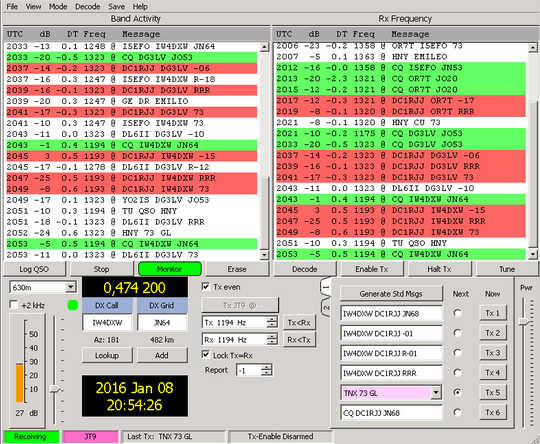 |
| DC1RJJ's 630m JT9 action courtesy: KB5NJD |
On this side of the Atlantic, recent JT9 contacts have been made between several of the U.S. experimental stations. WH2XCR in Hawaii (K9FD/KH6) and WG2XIQ in Texas (KB5NJD) worked on Dec 9th, while WH2XGP (W7IUV), WG2XSV (W0YSE/7) and others have been exploiting the power of JT9 to work around the country.
Such has been the case for me recently, with the arrival of VE3OT on 630m. Since beginning his nightly slow speed CW, QRSS6 beaconing, his signals have been easily visible here every night but only strong enough to hear aurally, on two occasions. It is likely that we could work each other fairly routinely on JT9 but will need to wait for very good conditions to work on CW.
The good thing about modes such as WSPR and JT9 is that they can be used without the need for linear amplifiers in the PA ... class D or E amplifiers, fairly universal in the LF/MF world, can be employed. The most popular route at present seems to be via a homebrew transverter that will allow the use of the station's main HF transceiver (using the tone-generating JT9 / WSPR software) to generate the required 630m RF.
I've been looking for a new radio workbench project to catch my interest and building a 630m transmitting converter is beginning to look more attractive, now that we have another DX target in VE3 land ... of course, if and when the U.S.A. gets the band, there will be an entire new crew of stations spread across the continent to keep the transverter busy!
Steve McDonald, VE7SL, is a regular contributor to AmateurRadio.com and writes from British Columbia, Canada. Contact him at [email protected].
 Ham Radio Deluxe |
 W5SWL Electronics |
 Ham Radio Prep |
 KB3IFH QSL Cards  Hip Ham Shirts  HamRadioAuctions HamRadioAuctions Reliance Antennas Reliance Antennas Enigma Shop Enigma Shop |  morseDX  Ni4L Antennas  R&L Electronics R&L Electronics antennas.us antennas.us QRV QRV |
- Matt W1MST, Managing Editor
