 |
 The big ‘secret’ to successful DXing
 11 March 2016 | by
  Jim Heath, W6LG, has launched a new video series about the art of DXing. He should know about the subject — he’s been working DX on 20-meters with great success for over 50 years.
“It doesn’t take a huge station to work DX, and it doesn’t take a lot of money,” Heath says. “You can have a lot of fun with a very modest station.”
He says that one key to success is not getting caught up following the crowd. “The skill is not getting onto a DX net and putting your call sign in and waiting for your turn to work a guy in Japan. That’s not working DX — that’s being spoon-fed DX,” he says. “If you’re new to DXing, go for the easy countries: the guys who are calling CQ.”
Most people who have real success working DX do a lot more listening than talking. “A DXer listens, listens, and listens some more and learns about propagation and knows when the band is going to open to certain parts of the world,” he says.

Hans, SM5BUS
“A good example of a guy who has a tremendous signal out of Scandinavia day after day is SM5BUS,” Heath says. “If you’ve tuned 20-meters, you’ve more than likely heard him. He knows propagation really well. He’s learned over the years when the band is open and he listens a lot.”
 “While you might think because this guy is the only thing you can hear out of Scandinavia, that he has an antenna at 100 feet and 1,500 watts behind it. It’s not true,” Heath says. “He’s got a two-element Yagi attached to his chimney 10 meters above ground, but he knows when propagation is good. He’s there to work the propagation, to work the band opening. He does it over and over again and that’s been true for decades.”
If you want to learn more secrets of DXing, watch Jim’s first video below and subscribe to his YouTube channel.
Matt Thomas, W1MST, is the managing editor of AmateurRadio.com. Contact him at [email protected].
Thinking
This time I have a hankering to go on up to HP28, Morristown National Historical Park, which actually consists of four different areas:
1) The Ford Mansion
2) Washington's Headquarters Museum
3) Jockey Hollow
4) Fort Nonsense
The best area for operating without causing too much undo commotion to anyone else, is from the parking lot at Jockey Hollow. Jockey Hollow is where the Continental Army wintered in 1779-1780 - a winter which turned out to be way more severe than the previous winter, which has become better known as "The Winter at Valley Forge".
That's where Dave KD2FSI activated HP28 back in January (and where I logged for him as he handled his really first big HF pileup). I noticed some pretty tall trees right next to the parking spots (the parking lot is big), so maybe I can quietly throw my PAR END-FEDZ 40/20/10 into one of them. Of course, the main bands for operating will be 40 and 20 Meters. As is always the case for W2LJ, operations will be primarily CW - but I am thinking of perhaps even doing a little QRP SSB if activity on the CW bands gets lax. I'm not sure if HP28 has been activated via CW. Maybe I can be the first.
This weekend, if I get the time, I would like to finally experiment with building a magnetic loop antenna for 40 - 10 Meters. I have some coax in the basement that's too short for anything else and would serve well, I think. I have a 365pF variable cap that I got from eBay. I have been reading some articles lately and it doesn't look like building a rudimentary loop would be all that difficult. If I have success with it, maybe I can eventually come up with a homebrewed version of the AlexLoop WalkHam model that I can use for portable ops. It might prove to be a viable option when I want to be away from the Jeep, and yet I can't hang an EFHW, or doublet.
72 de Larry W2LJ
QRP - When you care to send the very least!
Larry Makoski, W2LJ, is a regular contributor to AmateurRadio.com and writes from New Jersey, USA. Contact him at [email protected].
Thinking
This time I have a hankering to go on up to HP28, Morristown National Historical Park, which actually consists of four different areas:
1) The Ford Mansion
2) Washington's Headquarters Museum
3) Jockey Hollow
4) Fort Nonsense
The best area for operating without causing too much undo commotion to anyone else, is from the parking lot at Jockey Hollow. Jockey Hollow is where the Continental Army wintered in 1779-1780 - a winter which turned out to be way more severe than the previous winter, which has become better known as "The Winter at Valley Forge".
That's where Dave KD2FSI activated HP28 back in January (and where I logged for him as he handled his really first big HF pileup). I noticed some pretty tall trees right next to the parking spots (the parking lot is big), so maybe I can quietly throw my PAR END-FEDZ 40/20/10 into one of them. Of course, the main bands for operating will be 40 and 20 Meters. As is always the case for W2LJ, operations will be primarily CW - but I am thinking of perhaps even doing a little QRP SSB if activity on the CW bands gets lax. I'm not sure if HP28 has been activated via CW. Maybe I can be the first.
This weekend, if I get the time, I would like to finally experiment with building a magnetic loop antenna for 40 - 10 Meters. I have some coax in the basement that's too short for anything else and would serve well, I think. I have a 365pF variable cap that I got from eBay. I have been reading some articles lately and it doesn't look like building a rudimentary loop would be all that difficult. If I have success with it, maybe I can eventually come up with a homebrewed version of the AlexLoop WalkHam model that I can use for portable ops. It might prove to be a viable option when I want to be away from the Jeep, and yet I can't hang an EFHW, or doublet.
72 de Larry W2LJ
QRP - When you care to send the very least!
Larry Makoski, W2LJ, is a regular contributor to AmateurRadio.com and writes from New Jersey, USA. Contact him at [email protected].
Ham Talk LIVE! Episode 4: Tom Vinson, NY0V

It’s a call-in talk show about ham radio!
 Ham Talk LIVE! Episode 4
w/ Tom Vinson, NY0V
Myanmar trip – Boy Scout Merit Badge
Thursday, 10 March 2016
9:00 PM Eastern Time (02:00 UTC)
Listen to this episode LIVE (and to all previous episodes) in the player below:
[spreaker type=standard width=620px autoplay=false show_id=1607081]
Matt Thomas, W1MST, is the managing editor of AmateurRadio.com. Contact him at [email protected].
Just One More db …

How often have you struggled to pull a weak signal out of the noise? "Just give me one more db", you tell yourself.
A recent posting to the Topband reflector by Frank, W3LPL, sent me to the interesting webpage of Dave, AB7E. Dave had been pondering two antenna systems, one of which would provide a 2db improvement in forward gain but at a much higher cost ... he wondered if the extra expense would be worthwhile and could he even hear the difference that 2db would make? He created a series of CW files, incrementing the signal level in 1db steps to see for himself!
Now I've always been told that you need to increase signal strength by at least 3db before your ears can detect any difference ... but listen carefully and you may be in for a surprise, as AB7E discovered.
It's probably best to listen to this signal with headphones but, even on my I-Pad's tiny speaker, the demonstration is clear. The first recording starts at "zero db", which is sent twice while the next signal is "one db", sent twice. See if you can hear the difference between each 1 db increment as he steps up to "six db":

Lastly, AB7E demonstrates the problem with sending too fast when conditions are very marginal. Here, several signals are sent at 20, 25, 30 and 35 WPM. Sending calls at high speed can often seem effective, even under poor conditions but this seems to demonstrate that slowing down just a bit would make it somewhat easier:
One of the more interesting comments posted regarding these recordings was from Bob, N6RW who cited his work in satellite communications:
"I spent part of my engineering career designing satellite command FSK
demodulators - including the deep space Pioneer Venus orbiter. To test
the performance of them, we would mix the test signal with white noise.
When you look at the FSK Bit-Error-Rate (BER) curve (bit errors versus
signal to noise ratio in a bandwidth equal to the bit rate), you can see
the BER improves by a factor of 10 to 1 for every dB in S/N ratio. In
other words, for every dB improvement, you get one tenth the errors."
Now Dave never did tell us if he bought the bigger antenna or not but I'm betting that he did ... it looks like "just one more db" may really be just enough after all.
Steve McDonald, VE7SL, is a regular contributor to AmateurRadio.com and writes from British Columbia, Canada. Contact him at [email protected].
Two Portable Ops, NPOTA, and the Shack – Oh My!
Finally getting a chance to get caught up since my last posting! I have been having lots of fun with the radio lately so it’s time to check in.
Portable Op 1/45: On February 20 & 21 we visited my mother-in-law in the Kansas City area. I knew the girls would be busy shopping and doing some sewing, so I brought the KX3 and antenna along. I strapped the antenna to the deck railing and setup on the kitchen table. I had lots of fun, there was some contest going on, but I have not looked up which one, but there was lots of DX.
I worked about 18 stations into South America and west to Hawaii. Good times, but unfortunately none of them have confirmed via LOTW!
Portable Op 2/45: February 22nd I went to the local park over my lunch hour and had some radio fun. I worked CO8LY in Cuba and two stations in NM – WS0TA (on a summit) and KE5AKL.
NPOTA Portable Op 3/45: On February 25th I had to be in the Kansas City are on business. There are several of the parks in that area. One spot was actually a three-fer since there were 3 trails that crossed at that location. So I activated Lone Elm park which was a major camping location along the Oregon, Santa Fe and California Trails.
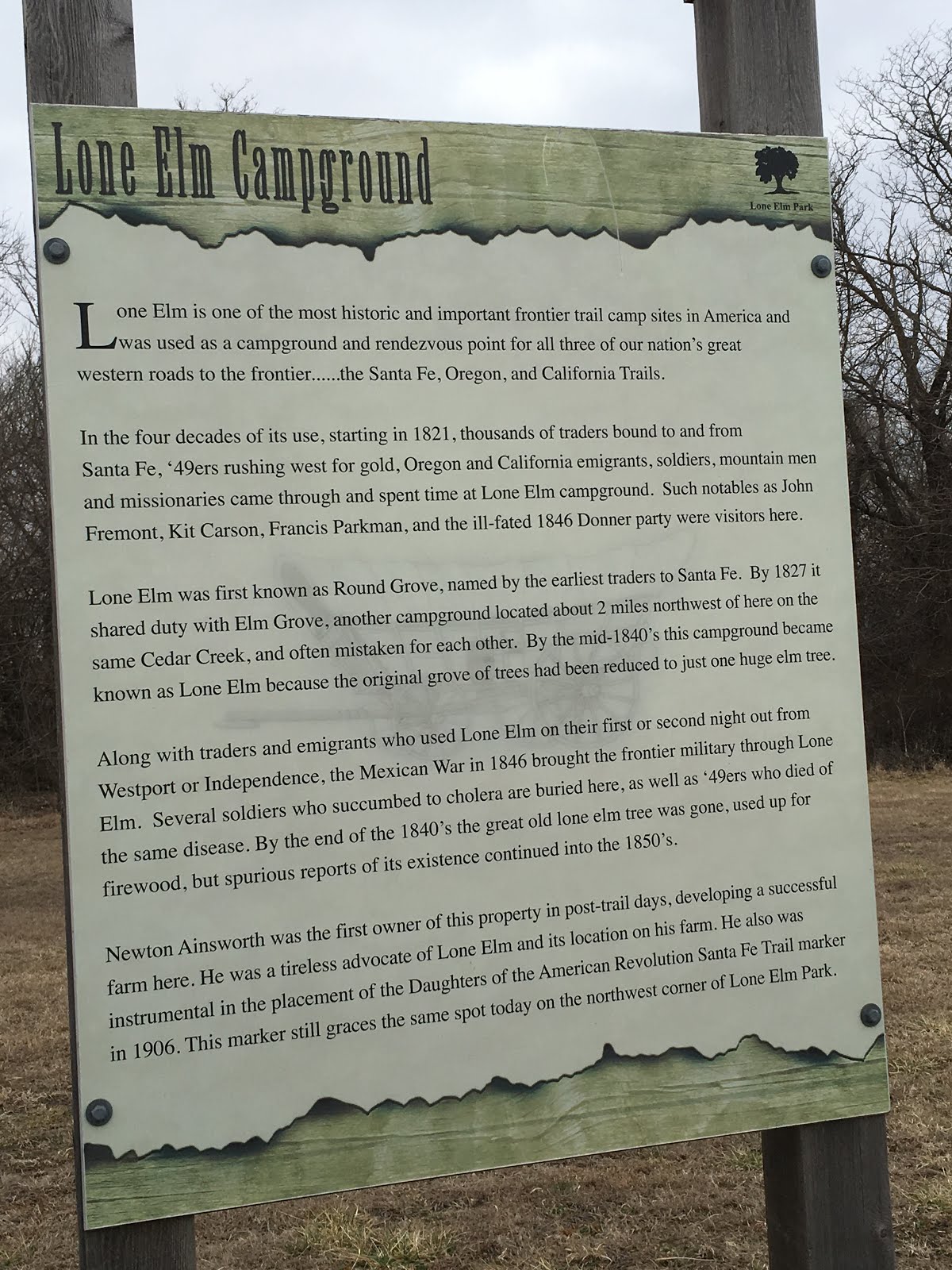
What a blast this was – in 2 hours I worked 55 stations all stateside except two DX from Canada and Belgium all on 20 meters. I started out calling CQ about 14.059 and started getting some calls. After about 20 minutes I spotted myself on DXSummit and it go crazy. Having never been at the receiving end of a pileup on CW it sounded like one sound – I could not make out hardly anything except a fragment of a call.
What a blast! If you have anyway to get out and activate one of the parks DO IT!.
Unfortunately on this outing right before I was ready to leave my Jakite pole collapsed into itself. The top sections fell into the bigger sections with the wire antenna tied to the top. I can’t seem to figure out how to get it back apart – it is stuck inside. So I need to get that figured out before I can do much more portable operating.
In the Shack: I have been having lots of fun running PSK31 from the shack. In the last week or so I have worked over 30 stations. This is a fun mode for quick contacts or a little rag chewing. Most of the time I connect to the computer in my shack with Teamviewer on my iPad while sitting in my easy chair in the living room with the family. This works really well and allows me to be around the family and still have some radio fun.
Burke Jones, NØHYD, is a regular contributor to AmateurRadio.com and writes from Kansas, USA. Contact him at [email protected].
Two Portable Ops, NPOTA, and the Shack – Oh My!
Finally getting a chance to get caught up since my last posting! I have been having lots of fun with the radio lately so it’s time to check in.
Portable Op 1/45: On February 20 & 21 we visited my mother-in-law in the Kansas City area. I knew the girls would be busy shopping and doing some sewing, so I brought the KX3 and antenna along. I strapped the antenna to the deck railing and setup on the kitchen table. I had lots of fun, there was some contest going on, but I have not looked up which one, but there was lots of DX.
I worked about 18 stations into South America and west to Hawaii. Good times, but unfortunately none of them have confirmed via LOTW!
Portable Op 2/45: February 22nd I went to the local park over my lunch hour and had some radio fun. I worked CO8LY in Cuba and two stations in NM – WS0TA (on a summit) and KE5AKL.
NPOTA Portable Op 3/45: On February 25th I had to be in the Kansas City are on business. There are several of the parks in that area. One spot was actually a three-fer since there were 3 trails that crossed at that location. So I activated Lone Elm park which was a major camping location along the Oregon, Santa Fe and California Trails.
What a blast this was – in 2 hours I worked 55 stations all stateside except two DX from Canada and Belgium all on 20 meters. I started out calling CQ about 14.059 and started getting some calls. After about 20 minutes I spotted myself on DXSummit and it go crazy. Having never been at the receiving end of a pileup on CW it sounded like one sound – I could not make out hardly anything except a fragment of a call.
What a blast! If you have anyway to get out and activate one of the parks DO IT!.
Unfortunately on this outing right before I was ready to leave my Jakite pole collapsed into itself. The top sections fell into the bigger sections with the wire antenna tied to the top. I can’t seem to figure out how to get it back apart – it is stuck inside. So I need to get that figured out before I can do much more portable operating.
In the Shack: I have been having lots of fun running PSK31 from the shack. In the last week or so I have worked over 30 stations. This is a fun mode for quick contacts or a little rag chewing. Most of the time I connect to the computer in my shack with Teamviewer on my iPad while sitting in my easy chair in the living room with the family. This works really well and allows me to be around the family and still have some radio fun.
Burke Jones, NØHYD, is a regular contributor to AmateurRadio.com and writes from Kansas, USA. Contact him at [email protected].
 Ham Radio Deluxe |
 W5SWL Electronics |
 Ham Radio Prep |
 KB3IFH QSL Cards  Hip Ham Shirts  HamRadioAuctions HamRadioAuctions Reliance Antennas Reliance Antennas Enigma Shop Enigma Shop |  morseDX  Ni4L Antennas  R&L Electronics R&L Electronics antennas.us antennas.us QRV QRV |
- Matt W1MST, Managing Editor
