 |
 Episode 207- Icom IC-2730 Review
 20 March 2016 | by
 In this episode, Martin M1MRB / W9ICQ is joined by Ed Durrant DD5LP and Andy Mace M0MUX to discuss the latest Amateur / Ham Radio news. Colin M6BOY rounds up the news in brief, and this episodes feature is a review of the Icom IC-2730 Review by Chris Howard M0TCH.
- Radio Ham Licensed for 75 years
- Remote Controlled Short-Wave Receiver
- Belgium gets WRC15 5 MHz allocation and 4m extension
- 434 MHz Balloon Flies over North Africa
- G0KSC Wins RSGB Award Again
- Millions of UK TVs to Become Obsolete
- School SSTV CubeSat to Deploy from ISS
- UK Space Spectrum Strategy Consultation
Colin Butler, M6BOY, is the host of the ICQ Podcast, a weekly radio show about Amateur Radio. Contact him at [email protected].
I had hoped for better results

I got to the park on time, right before Noon (1600 UTC). I allowed my TomTom GPS unit to bring me up to Jockey Hollow via a new route which I had never taken before. This brought me up through the Great Dismal Swamp, which is designated as a National Wildlife Refuge. It is truly a beautiful area and as I was driving through, I could see herons and egrets and all sorts of birds in the marshes. Seeing that the Great Dismal Swamp is designated as a National Wildlife Refuge, I was wondering why it's not listed as one of the NPOTA WR entities. A little Googling revealed that the Swamp is administered by the United States Fish and Wildlife Service and not the National Parks Service. That's a shame because that would be a really beautiful area to set up a portable operation from.
Anyway, I got to the Park and got set up, which by now, only takes me a few minutes. After so many lunch time QRP sessions, I could do this in my sleep, or with my eyes shut.
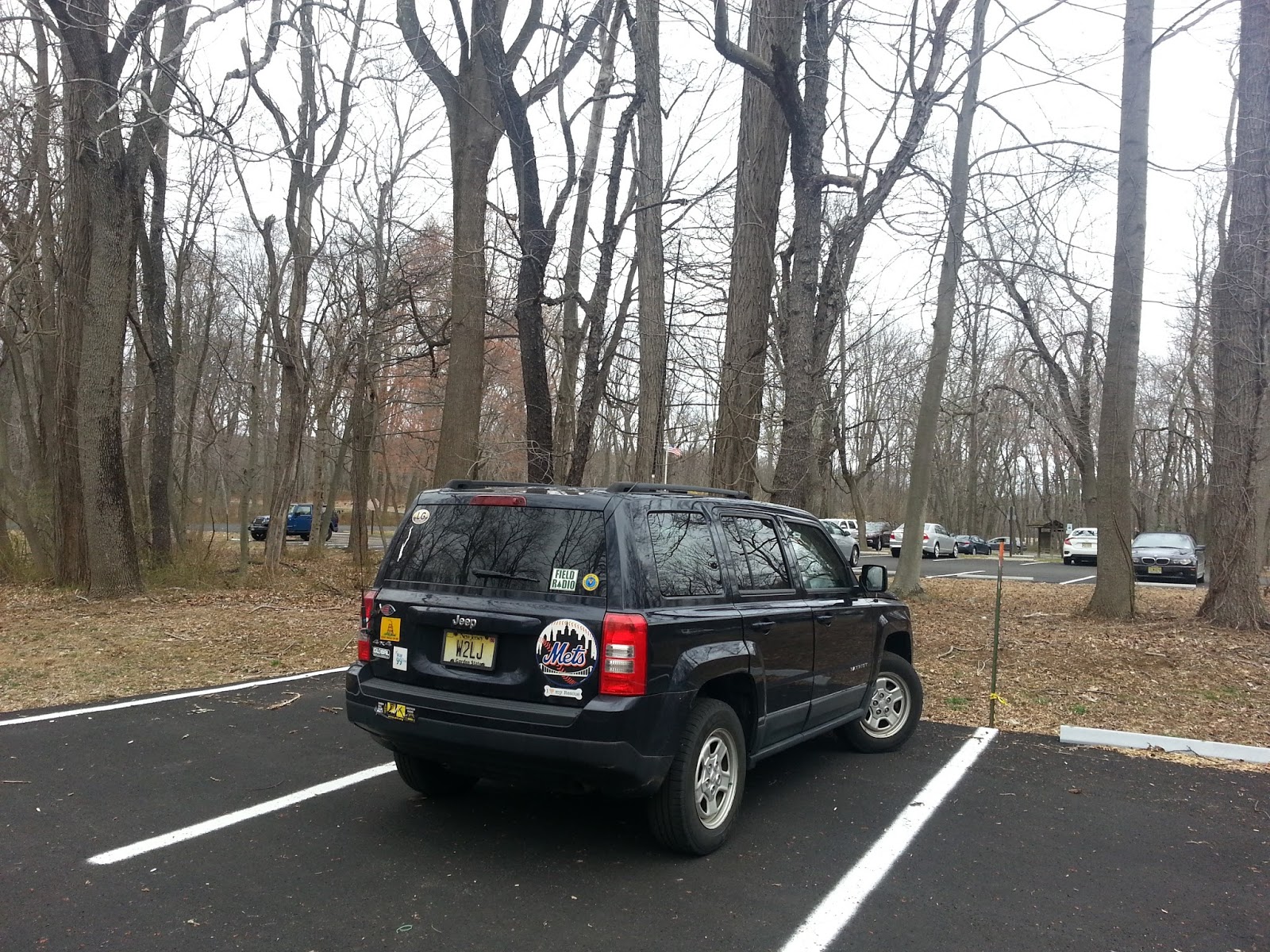
Since I was planning on operating some SSB in case there was a lack of activity, I brought along my big, heavy Werker deep cycle battery. I figured that this way, I could operate for an extended period of time at the 10 Watt SSB level if I needed to. And boy, did it turn out that I needed to!
The first thing I did after setting up was tune to around 14.061 MHz - the neighborhood of the QRP Watering Hole. I was shocked by what I heard - wall to wall CW signals! There was literally nowhere to sit where there wasn't a station calling "CQ TEST". I didn't realize that today was the RUDX, the Russian DX Contest - and boy, it filled the band!
I went on up to 17 Meters and heard some Europeans that were very loud. Knowing that meant the band was wide open, I easily found a clear spot at 18.082 MHz and proceeded to call "CQ NPOTA". The band was wide open, but as it turned out, there wasn't much if any activity. I worked K0IG right off the bat and then ...... nothing.
Not wanting to waste too much time, I got out of the Jeep and switched from the Buddistick to my 40 Meter Hamstick. I went down to 7.037 MHz, called CQ and was greeted by the normal NPOTA pileup. I was stoked and began to work station after station. The only bad thing was that the initial pileup lasted for only a few minutes, and then I began the monotonous routine of calling "CQ NPOTA" and waiting minutes in between answers.
Getting bored, I decided to give 20 Meters another try. Off came the Hamstick and up went the Buddistick. I called CQ for a bit and got a couple of QSO completed on 14.060 MHz, but it was tough. The stations calling me were loud, but their calls were being blanketed by even louder DX stations. Those guys had to be using mondo power. How much do they allow over in Europe, anyway?
Sitting there, disappointed as heck, I was ready to pack it in and head home a bit early. Then an inspiration occurred that maybe I should give 20 Meter SSB a whirl. Even though I'm not an avid fan of SSB, I decided to give it a shot. I was rewarded with a small run of about a dozen stations before that too, ended up petering out.
I had gone up to HP28 with a spiral notebook, thinking I would fill pages with call signs. After all, my outing to TR23 in January netted me over 80 QSOs. For some reason. I was thinking I would break that record easily. Just the opposite happened! I ended up with only 27 QSOs - but you know what? I discovered that a bad day of Amateur Radio is STILL better than a good day at work. So I'm a happy camper, anyway.
This only gives me more incentive to go back up to HP28 later this year, but this time throw a wire into a tree. I know that's kind of verboten, and on Facebook, someone actually related how they were asked to leave a park the other day for doing that. With that in mind, just before I left, I went to the visitor center and explained that I was an Amateur Radio operator and what NPOTA was (she knew what it was, by the way) and asked if there was any prohibition about wires in trees. She said as long as it was temporary, and would cause no damage and would not interfere with anyone else's visit, that they were OK with it.
So when I got back to the car, just for the heck of it, I attempted to launch a line over a limb just to see how it would go. 30 plus feet on the first try.
I'll be back, Jockey Hollow!
72 de Larry W2LJ
QRP - When you care to send the very least!
Larry Makoski, W2LJ, is a regular contributor to AmateurRadio.com and writes from New Jersey, USA. Contact him at [email protected].
I had hoped for better results
I got to the park on time, right before Noon (1600 UTC). I allowed my TomTom GPS unit to bring me up to Jockey Hollow via a new route which I had never taken before. This brought me up through the Great Dismal Swamp, which is designated as a National Wildlife Refuge. It is truly a beautiful area and as I was driving through, I could see herons and egrets and all sorts of birds in the marshes. Seeing that the Great Dismal Swamp is designated as a National Wildlife Refuge, I was wondering why it's not listed as one of the NPOTA WR entities. A little Googling revealed that the Swamp is administered by the United States Fish and Wildlife Service and not the National Parks Service. That's a shame because that would be a really beautiful area to set up a portable operation from.
Anyway, I got to the Park and got set up, which by now, only takes me a few minutes. After so many lunch time QRP sessions, I could do this in my sleep, or with my eyes shut.
Since I was planning on operating some SSB in case there was a lack of activity, I brought along my big, heavy Werker deep cycle battery. I figured that this way, I could operate for an extended period of time at the 10 Watt SSB level if I needed to. And boy, did it turn out that I needed to!
The first thing I did after setting up was tune to around 14.061 MHz - the neighborhood of the QRP Watering Hole. I was shocked by what I heard - wall to wall CW signals! There was literally nowhere to sit where there wasn't a station calling "CQ TEST". I didn't realize that today was the RUDX, the Russian DX Contest - and boy, it filled the band!
I went on up to 17 Meters and heard some Europeans that were very loud. Knowing that meant the band was wide open, I easily found a clear spot at 18.082 MHz and proceeded to call "CQ NPOTA". The band was wide open, but as it turned out, there wasn't much if any activity. I worked K0IG right off the bat and then ...... nothing.
Not wanting to waste too much time, I got out of the Jeep and switched from the Buddistick to my 40 Meter Hamstick. I went down to 7.037 MHz, called CQ and was greeted by the normal NPOTA pileup. I was stoked and began to work station after station. The only bad thing was that the initial pileup lasted for only a few minutes, and then I began the monotonous routine of calling "CQ NPOTA" and waiting minutes in between answers.
Getting bored, I decided to give 20 Meters another try. Off came the Hamstick and up went the Buddistick. I called CQ for a bit and got a couple of QSO completed on 14.060 MHz, but it was tough. The stations calling me were loud, but their calls were being blanketed by even louder DX stations. Those guys had to be using mondo power. How much do they allow over in Europe, anyway?
Sitting there, disappointed as heck, I was ready to pack it in and head home a bit early. Then an inspiration occurred that maybe I should give 20 Meter SSB a whirl. Even though I'm not an avid fan of SSB, I decided to give it a shot. I was rewarded with a small run of about a dozen stations before that too, ended up petering out.
I had gone up to HP28 with a spiral notebook, thinking I would fill pages with call signs. After all, my outing to TR23 in January netted me over 80 QSOs. For some reason. I was thinking I would break that record easily. Just the opposite happened! I ended up with only 27 QSOs - but you know what? I discovered that a bad day of Amateur Radio is STILL better than a good day at work. So I'm a happy camper, anyway.
This only gives me more incentive to go back up to HP28 later this year, but this time throw a wire into a tree. I know that's kind of verboten, and on Facebook, someone actually related how they were asked to leave a park the other day for doing that. With that in mind, just before I left, I went to the visitor center and explained that I was an Amateur Radio operator and what NPOTA was (she knew what it was, by the way) and asked if there was any prohibition about wires in trees. She said as long as it was temporary, and would cause no damage and would not interfere with anyone else's visit, that they were OK with it.
So when I got back to the car, just for the heck of it, I attempted to launch a line over a limb just to see how it would go. 30 plus feet on the first try.
I'll be back, Jockey Hollow!
72 de Larry W2LJ
QRP - When you care to send the very least!
Larry Makoski, W2LJ, is a regular contributor to AmateurRadio.com and writes from New Jersey, USA. Contact him at [email protected].
Saturday Morning On Radio Row
 |
| New York City |
As a young shortwave-crazed kid in the 50's, there was nothing that I looked forward to more than the weekend and being able to stay up as late as I wanted, tuning the bands on my big old GE cathedral ... high up in my third-floor attic bedroom shack. But number two on the list was my weekly Saturday morning trip, by bus, to Vancouver's north Granville Street and then on to the library. There I could read the latest radio magazines as well as look at their huge archived collection of earlier issues.
In the 50's, there was a three block strip of radio shops on the north end of Granville street, just after the bridge into downtown Vancouver.
 |
| Granville Street |
During this same time span, once or twice per year, the family would pile into Dad's old Chevrolet and we would make a road-trip to Seattle. Unlike the present, our Canadian dollar was worth more than the American dollar back then, so there were always some great shopping bargains to be found. I recall there being a number of old radio shops as well as several surplus stores just south of Pike Street, on 1st Avenue as well as a few more, one or two blocks down the hill toward the docks. Maybe these were the last vestiges of Seattle's version of 'Radio Row'.
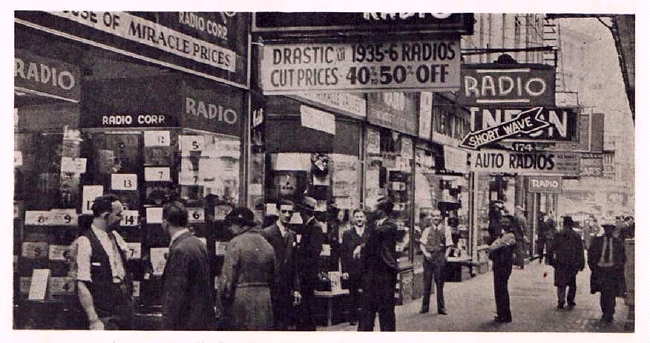
Of course nothing compares with the original 'Radio Row', located in the lower Manhattan district of New York City. It was born along with radio itself and by the early 30's the Cortlandt Street neighbourhood was blanketed with shops selling radios to consumers and components to builders. A Saturday morning trip to the Cortlandt Street paradise was a ritual for hundreds of radio fanatics for more than four decades, as seen in this timely old film taken one typical (Saturday?) morning on New York's 'Radio Row' ... what an amazing time it must have been!
From "The Death of New York's Radio Row", by Syd Steinhardt :
"Radio Row's popularity peaked in the 1950s. Its proximity to the New Jersey ferry docks and the financial district, combined with the advent of new consumer electronics goods and postwar demand, attracted floods of shoppers to the area every day except Sunday. To service their customers, stores opened at 7:00 a.m. on weekdays and closed late on Saturdays.
Radio Row was not a neat and pretty sight. Block upon block over 300 street level stores, with over three times as many enterprises in the floors above them were jammed into 20 to 25-foot storefronts, up and down streets such as Albany, Carlisle, Greenwich and Liberty. Their shelves and floor spaces were packed with vacuum tubes, condensers, transistors and other high-tech bric-a-brac for ham radio enthusiasts and do-it-yourselfers. It was, as the New York Times called it in 1950, "a paradise for electronic tinkerers." "
By the mid sixties, only a few radio shops remained and after some very bitter court battles, the remaining merchants were 'bought out' and the Cortlandt Street area was cleared so that construction could begin on the World Trade Center's twin towers. Today, the area is now home to One World Trade Center, the tallest building in the U.S.A. and to the 9/11 Memorial ... now all sacred ground.
 |
| courtesy: New York Port Authority |
I was in New York City, three years after 9/11 and recall looking with much sadness into the multi-block deep hole in the ground ... how much happier it must have been there, back on those wonderful Saturday mornings, on 'Radio Row'.
Steve McDonald, VE7SL, is a regular contributor to AmateurRadio.com and writes from British Columbia, Canada. Contact him at [email protected].
Amateur Radio Weekly – Issue 103

Tytera MD-9600 DMR Digital Mobile Radio
Tytera has introduced a new mobile two way radio capable of operation in both digital and analog modes.
Cricket Ventures
In depth: Icom IC-7300 review
Icom IC-7300 is the first direct sampling SDR (software defined radio) available from one of the “big three” Japanese manufacturers.
YO9IRF
FreeDV 2400A
Two new FreeDV modes for VHF/UHF.
Rowetel
SM2000 update (turning your $35 HT into a digital radio)
KA8BMA has been working steadily on the CAD work for the SM2000 VHF Radio.
Rowetel
The Amateur Radio Operators Preparing for the Worst
In natural or man-made disasters, ham-radio enthusiasts put their hobby to work.
The Atlantic
The first transatlantic communication cables
The TAT-1 system would have two cables, one for east-west traffic, the other for west-east calls. The core of each cable was a single coaxial cable with a solid copper center conductor
Hack A Day
Over the horizon radars becoming routine on Amateur HF bands
A 50 kHz wide Russian OTH radar has been heard in the evening on 80 meters, often in the CW part of the band.
ARRL
Raspberry Pi QRP TX Shield for WSPR
The QRPi board is an inexpensive way of turning a Raspberry Pi single-board computer into a QRP transmitter.
Tucson Amateur Packet Radio Corp
IC-7300 — A Game Changer
While traditional receiver designs utilize Local Oscillators, LO, these Analog to Digital converter, ADC, devices have become the heart of the IC-7300 receiver design.
Icom
Listen for ISS with Raspberry Pi 3 and SoDeRa
Receive amateur radio transmissions from the International Space Station.
AMSAT UK
Carrington Probabilities
His estimate of the probability of another Carrington event is surprisingly high.
VE7SL
Our hobby in 30 years?
An aging population will not buy so many rigs, will not support magazines. Numbers will fall. Activity will fall.
amateurradio.com
ARRL on Instagram
The official Instagram account for ARRL, the National Association for Amateur Radio in the US.
Instagram
Stuart Sizer: Heathkit designer
Stu Sizer––”stylist, artist, maker of models, bon vivant”––was tasked with crafting Heathkit’s user-friendly and attractive exterior designs.
The SWLing Post
Amateur Radio Weekly is curated by Cale Mooth K4HCK. Sign up free to receive ham radio's most relevant news, projects, technology and events by e-mail each week at http://www.hamweekly.com.
Will the Kids of Today Ever Experience That?
 As a young man, I was a CW Radio Operator aboard a U.S. Coast Guard Cutter (CastleRock/NBZF), I was thrilled everyday to go on watch. It led to me getting a ham ticket in 1955 and thereafter, enjoying the hobby. I always stayed a “CW” operator and never enjoyed the 2-meter FM “thing” as it seemed more like CB to me!
Later in life I got the opportunity to work on Merchant Marine vessels, and after some 30 years, with the exception of Telex, not much had changed.. CW was still alive and well, though many of the shore stations began closing down (i.e. WCC, WSL, KPH, etc.).
The writing was in the wall when more and more ships traffic went Telex.. Frankly, because of the length of a majority of these messages, including ship food stores and engine room parts, my keyer would have blown up!
Then not long after, they brought cell phones aboard — the beginning of the end for the ship’s Radio Officers. In 1999, most of the remaining Coast Guard and commercial Maritime stations went silent.
All I can tell you is that while it lasted , it was a great job. But it’s hard to call something a job when you have loved it all your life.
I am very concerned about our hobby these days: no CW requirement. Why would today’s generation want to study for a test when all they have to do is get online and they can communicate all over the world with no QRM, QRN, QSB etc.?
I can see the increase in FM 2-meter and 450 MHz FM for emergency help and that is great, but on the other hand is it actually “hamming” or “quasi police work?”
This is the trouble we older hams have, we live in the past trying to eek out a weak CW signal from some far off country.
With my 100 watts and dipole antenna, I had nightly CW QSO’S with ZL2LI from Christchurch, NZ while I was in Cleveland, Ohio. We could barely hear each other on some nights pushing the “cans” closer to my ears. But it was a thrill each and every time. Will the kids of today ever experience that?
On 7035 kHz., every night we had high speed CW ops from the “CFO” required minimum speeds of 45 WPM and nomination came from at least 2 CFO operators. This club was started by Jim Ricks. W9TO who had invented the famous Hallicrafters “TO” keyer. There are over 1,500 members.
But most of the ops like me are aging.. We need new young blood to keep the organization going.
The fact of the matter is we need new young ops in our most wonderful hobby to learn and use CW So that this art is NEVER lost.
David Eisenberger, K8KEM, is a special contributor to AmateurRadio.com and writes from Ohio, USA.
Portable Ops 6/45: “Are you a weather reporter?”
I got out a bit today to the local park for some more QRP fun chasing SKCC contacts. I have been using the paddles on the KX3 set to hand mode – but this needs to change. These seem to work great when using the keyer, but for hand keying it seems like they cut out from time to time while forming the dits and dahs. A decent hand key is next on the agenda for me!
While I was taking down the antenna and loading up at the end of my session an older gentleman that had been fishing and was parked near me asked if I was some type of weather reporter. I told him that I was an amateur radio operator and I was using morse code to talk to other stations across the country. We had a nice chat – I always wonder what people think of me sitting in my car with a 31′ pole and wire strapped to the bollard!
Today I had 4 nice contacts on 20 meters, 3 of them with SKCC members….
NV4U (9744T) – I answered Rons CQ, band was up and down a bit, but he was a nice easy copy from Georgia.
AH6AX (11165S) – Larry was from Maryland and was an easy 599 on my end and he gave me a 539 on his. Larry answered my CQ.
K2PAY (4304S) – Jerry answered my CQ and gave me a 559. I had to engage the narrow filter on the KX3 because someone else came on right next to us calling CQ – worked like a champ! Jerry was in New York and during our first exchange had to take a quick break to help his wife with something – I completely understand this!
KK6GLP – I heard Mike calling CQ around 14.060, and I had time to squeeze in one more before my time was up. He gave me a 599 and he was also 599 here in Kansas. Mike was in Roseville, CA and was running 50 watts. He said he had some bad QRM on his end, so we said 73 and ended our nice contact. Reading on Mikes QRZ page he can’t have a permanent antenna so he has a “rig in a box” and sets up in his backyard when he wants to operate.
It still amazes me that from a park, with a little antenna and just 5 watts I worked coast to coast today using CW and keying by hand. I would love to hear a recording of my sending, it sounds good on my end, but I often wonder how the spacing and timing sounds to someone else. I might have to find a WebSDR and see if I can hear myself sometime.
The strangest thing about today was that I called CQ many times, but I never saw a spot on RBN – this is pretty unusual.
Burke Jones, NØHYD, is a regular contributor to AmateurRadio.com and writes from Kansas, USA. Contact him at [email protected].
 Ham Radio Deluxe |
 W5SWL Electronics |
 Ham Radio Prep |
 KB3IFH QSL Cards  Hip Ham Shirts  HamRadioAuctions HamRadioAuctions Reliance Antennas Reliance Antennas Enigma Shop Enigma Shop |  morseDX  Ni4L Antennas  R&L Electronics R&L Electronics antennas.us antennas.us QRV QRV |
- Matt W1MST, Managing Editor
