 |
 Ham Talk LIVE! Episode 4: Tom Vinson, NY0V
 10 March 2016 | by
It’s a call-in talk show about ham radio!
 Ham Talk LIVE! Episode 4
w/ Tom Vinson, NY0V
Myanmar trip – Boy Scout Merit Badge
Thursday, 10 March 2016
9:00 PM Eastern Time (02:00 UTC)
Listen to this episode LIVE (and to all previous episodes) in the player below:
[spreaker type=standard width=620px autoplay=false show_id=1607081]
Matt Thomas, W1MST, is the managing editor of AmateurRadio.com. Contact him at [email protected].
Just One More db …

How often have you struggled to pull a weak signal out of the noise? "Just give me one more db", you tell yourself.
A recent posting to the Topband reflector by Frank, W3LPL, sent me to the interesting webpage of Dave, AB7E. Dave had been pondering two antenna systems, one of which would provide a 2db improvement in forward gain but at a much higher cost ... he wondered if the extra expense would be worthwhile and could he even hear the difference that 2db would make? He created a series of CW files, incrementing the signal level in 1db steps to see for himself!
Now I've always been told that you need to increase signal strength by at least 3db before your ears can detect any difference ... but listen carefully and you may be in for a surprise, as AB7E discovered.
It's probably best to listen to this signal with headphones but, even on my I-Pad's tiny speaker, the demonstration is clear. The first recording starts at "zero db", which is sent twice while the next signal is "one db", sent twice. See if you can hear the difference between each 1 db increment as he steps up to "six db":

Lastly, AB7E demonstrates the problem with sending too fast when conditions are very marginal. Here, several signals are sent at 20, 25, 30 and 35 WPM. Sending calls at high speed can often seem effective, even under poor conditions but this seems to demonstrate that slowing down just a bit would make it somewhat easier:
One of the more interesting comments posted regarding these recordings was from Bob, N6RW who cited his work in satellite communications:
"I spent part of my engineering career designing satellite command FSK
demodulators - including the deep space Pioneer Venus orbiter. To test
the performance of them, we would mix the test signal with white noise.
When you look at the FSK Bit-Error-Rate (BER) curve (bit errors versus
signal to noise ratio in a bandwidth equal to the bit rate), you can see
the BER improves by a factor of 10 to 1 for every dB in S/N ratio. In
other words, for every dB improvement, you get one tenth the errors."
Now Dave never did tell us if he bought the bigger antenna or not but I'm betting that he did ... it looks like "just one more db" may really be just enough after all.
Steve McDonald, VE7SL, is a regular contributor to AmateurRadio.com and writes from British Columbia, Canada. Contact him at [email protected].
Two Portable Ops, NPOTA, and the Shack – Oh My!
Finally getting a chance to get caught up since my last posting! I have been having lots of fun with the radio lately so it’s time to check in.
Portable Op 1/45: On February 20 & 21 we visited my mother-in-law in the Kansas City area. I knew the girls would be busy shopping and doing some sewing, so I brought the KX3 and antenna along. I strapped the antenna to the deck railing and setup on the kitchen table. I had lots of fun, there was some contest going on, but I have not looked up which one, but there was lots of DX.
I worked about 18 stations into South America and west to Hawaii. Good times, but unfortunately none of them have confirmed via LOTW!
Portable Op 2/45: February 22nd I went to the local park over my lunch hour and had some radio fun. I worked CO8LY in Cuba and two stations in NM – WS0TA (on a summit) and KE5AKL.
NPOTA Portable Op 3/45: On February 25th I had to be in the Kansas City are on business. There are several of the parks in that area. One spot was actually a three-fer since there were 3 trails that crossed at that location. So I activated Lone Elm park which was a major camping location along the Oregon, Santa Fe and California Trails.
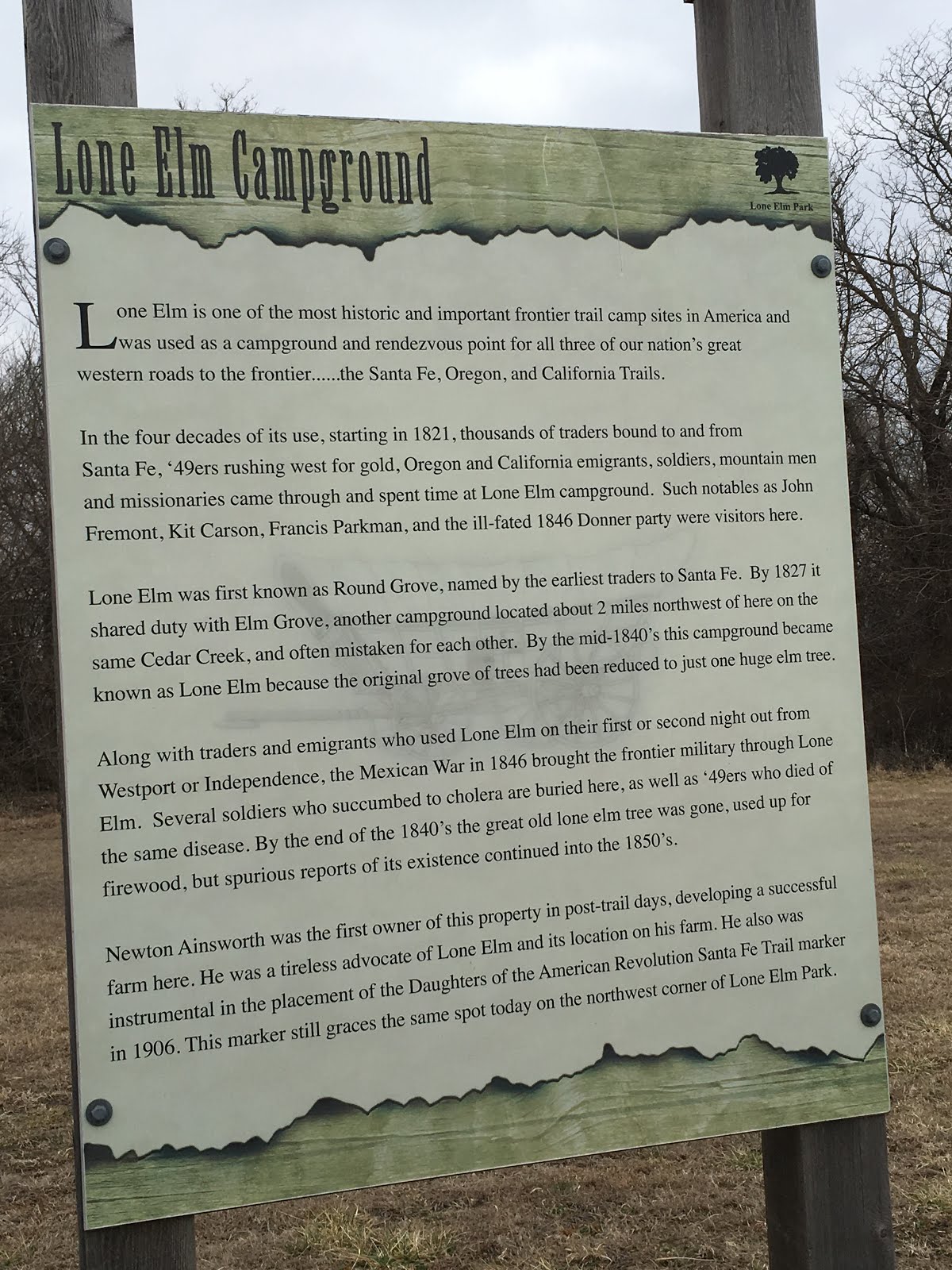
What a blast this was – in 2 hours I worked 55 stations all stateside except two DX from Canada and Belgium all on 20 meters. I started out calling CQ about 14.059 and started getting some calls. After about 20 minutes I spotted myself on DXSummit and it go crazy. Having never been at the receiving end of a pileup on CW it sounded like one sound – I could not make out hardly anything except a fragment of a call.
What a blast! If you have anyway to get out and activate one of the parks DO IT!.
Unfortunately on this outing right before I was ready to leave my Jakite pole collapsed into itself. The top sections fell into the bigger sections with the wire antenna tied to the top. I can’t seem to figure out how to get it back apart – it is stuck inside. So I need to get that figured out before I can do much more portable operating.
In the Shack: I have been having lots of fun running PSK31 from the shack. In the last week or so I have worked over 30 stations. This is a fun mode for quick contacts or a little rag chewing. Most of the time I connect to the computer in my shack with Teamviewer on my iPad while sitting in my easy chair in the living room with the family. This works really well and allows me to be around the family and still have some radio fun.
Burke Jones, NØHYD, is a regular contributor to AmateurRadio.com and writes from Kansas, USA. Contact him at [email protected].
Two Portable Ops, NPOTA, and the Shack – Oh My!
Finally getting a chance to get caught up since my last posting! I have been having lots of fun with the radio lately so it’s time to check in.
Portable Op 1/45: On February 20 & 21 we visited my mother-in-law in the Kansas City area. I knew the girls would be busy shopping and doing some sewing, so I brought the KX3 and antenna along. I strapped the antenna to the deck railing and setup on the kitchen table. I had lots of fun, there was some contest going on, but I have not looked up which one, but there was lots of DX.
I worked about 18 stations into South America and west to Hawaii. Good times, but unfortunately none of them have confirmed via LOTW!
Portable Op 2/45: February 22nd I went to the local park over my lunch hour and had some radio fun. I worked CO8LY in Cuba and two stations in NM – WS0TA (on a summit) and KE5AKL.
NPOTA Portable Op 3/45: On February 25th I had to be in the Kansas City are on business. There are several of the parks in that area. One spot was actually a three-fer since there were 3 trails that crossed at that location. So I activated Lone Elm park which was a major camping location along the Oregon, Santa Fe and California Trails.
What a blast this was – in 2 hours I worked 55 stations all stateside except two DX from Canada and Belgium all on 20 meters. I started out calling CQ about 14.059 and started getting some calls. After about 20 minutes I spotted myself on DXSummit and it go crazy. Having never been at the receiving end of a pileup on CW it sounded like one sound – I could not make out hardly anything except a fragment of a call.
What a blast! If you have anyway to get out and activate one of the parks DO IT!.
Unfortunately on this outing right before I was ready to leave my Jakite pole collapsed into itself. The top sections fell into the bigger sections with the wire antenna tied to the top. I can’t seem to figure out how to get it back apart – it is stuck inside. So I need to get that figured out before I can do much more portable operating.
In the Shack: I have been having lots of fun running PSK31 from the shack. In the last week or so I have worked over 30 stations. This is a fun mode for quick contacts or a little rag chewing. Most of the time I connect to the computer in my shack with Teamviewer on my iPad while sitting in my easy chair in the living room with the family. This works really well and allows me to be around the family and still have some radio fun.
Burke Jones, NØHYD, is a regular contributor to AmateurRadio.com and writes from Kansas, USA. Contact him at [email protected].
Amateur Radio Newsline Headlines – March 9, 2016

From this week’s Amateur Radio Newsline Headlines:
- Hams in Ohio have been preparing for an April 23 event called Near Vertical Incidence Skywave Antenna Day.
- In the Charleston, West Virginia area, hams are preparing for that area’s big Hamfest. In its 32nd year, it has a whole lot of new offerings.
- FCC records show that growth in amateur licenses continued through 2015, with a 735,405 licensees.
Don Wilbanks, AE5DW, is an anchor for Amateur Radio Newsline and co-host of TWiT's Ham Nation.
Chinese Kit Invasion
A few days later I stumbled upon an entry on the SOTA reflector entitled "QRPp Activation with a $3.56 Chinese Pixie..." by Manuel HB9DQM. Manuel had seen the radio on EBAy and couldn't pass up the opportunity to give it a shot. He not only built the radio, which takes the better part of an hour, but he decided to put it to the test in the field.
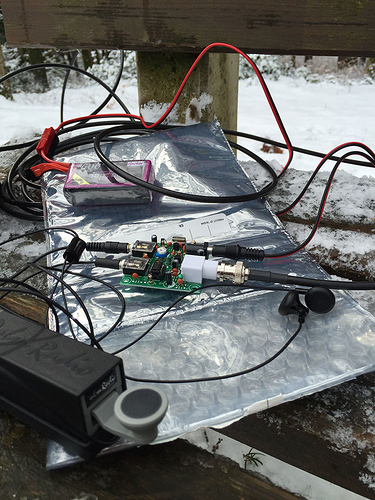 |
| HB9DQM Pixie Station |
Using the configuration above, running 300 milliwatts, he made 16 QSO's from a summit top bench. Pretty cool. 300 mw, wire antenna, battery power and a straight key, ah the magic of Ham Radio.
Of course the radio has limitations, it's crystal controlled, the radio comes with a 7.023 crystal (HB9DQM used a 7.030 crystal) and the bandwidth on receive is very wide, but as Manuel demonstrated, you can have some good, cheap fun with this little radio. He said he was listening to the world news, in English (courtesy of a BC station), while he worked the callers. An interesting diversion.
I did some further research on YouTube and found many happy campers who had purchased and assembled the kit. So I took the big plunge. I even went overboard and bought a couple of extra's as projects for my teenage grandsons who are hams.
There is one thing a little troublesome about this kit invasion however, at these prices, the other QRP kit providers can't compete. What will happen to them? Such is the world these days.
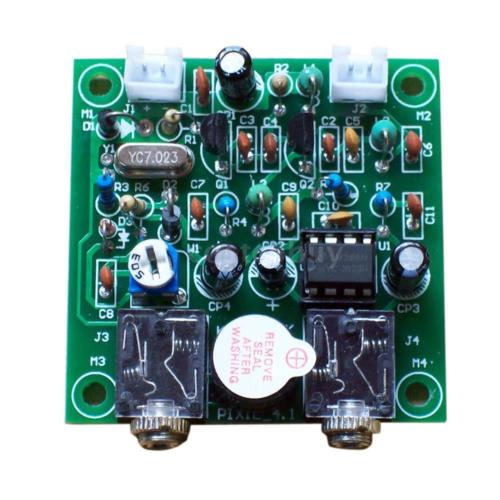 |
| Chinese version of the Pixie 2 |
Mike Crownover, AD5A, is a regular contributor to AmateurRadio.com and writes from Texas, USA. Contact him at [email protected].
Chinese Kit Invasion
A few days later I stumbled upon an entry on the SOTA reflector entitled "QRPp Activation with a $3.56 Chinese Pixie..." by Manuel HB9DQM. Manuel had seen the radio on EBAy and couldn't pass up the opportunity to give it a shot. He not only built the radio, which takes the better part of an hour, but he decided to put it to the test in the field.
|
| HB9DQM Pixie Station |
Using the configuration above, running 300 milliwatts, he made 16 QSO's from a summit top bench. Pretty cool. 300 mw, wire antenna, battery power and a straight key, ah the magic of Ham Radio.
Of course the radio has limitations, it's crystal controlled, the radio comes with a 7.023 crystal (HB9DQM used a 7.030 crystal) and the bandwidth on receive is very wide, but as Manuel demonstrated, you can have some good, cheap fun with this little radio. He said he was listening to the world news, in English (courtesy of a BC station), while he worked the callers. An interesting diversion.
I did some further research on YouTube and found many happy campers who had purchased and assembled the kit. So I took the big plunge. I even went overboard and bought a couple of extra's as projects for my teenage grandsons who are hams.
There is one thing a little troublesome about this kit invasion however, at these prices, the other QRP kit providers can't compete. What will happen to them? Such is the world these days.
|
| Chinese version of the Pixie 2 |
Mike Crownover, AD5A, is a regular contributor to AmateurRadio.com and writes from Texas, USA. Contact him at [email protected].
 Ham Radio Deluxe |
 W5SWL Electronics |
 Ham Radio Prep |
 KB3IFH QSL Cards  Hip Ham Shirts  HamRadioAuctions HamRadioAuctions Reliance Antennas Reliance Antennas Enigma Shop Enigma Shop |  morseDX  Ni4L Antennas  R&L Electronics R&L Electronics antennas.us antennas.us QRV QRV |
- Matt W1MST, Managing Editor
