 |
 Study Finds Anomaly with Amateur Radio Operators
 1 April 2017 | by
 Results from a study published by University of California Berkeley in The Journal of Psychology found that amateur radio operators are 45% more likely than the general public to believe fake news articles or material with misleading or outright wrong claims. Researchers weren’t specifically studying amateur radio operators, but discovered the correlation by accident. The report noted:
“We tested over 15,000 adult subjects and recorded profiles of each person… the common attributes like age, race, ethnicity, etc. and also their likes, dislikes, hobbies, diets, habits, etc. We discovered a strong and unexpected correlation with those claiming to be amateur or “ham” radio operators after running all of the data through an analysis using a recently developed Reverse Polish Bayesian algorithm. The unexpected data correlation continues to have the research team puzzled and further study is warranted.”
There is currently no proven explanation for the correlation, however one plausible hypothesis has emerged, that exposure to high levels of radio frequency energy combined with very fatty diets and long periods of television viewing, with political and news programming exposure, causing the frontal cortex of the brain to rapidly atrophy. Researchers are struggling to reproduce the characteristics as lab mice either die or become very disinterested when exposed to the combination of factors, especially when frequencies in the 3.5 Mhz range are used in experiments.
This article originally appeared in Radio Artisan.

Anthony, K3NG, is a regular contributor to AmateurRadio.com.
Amateur Radio Weekly – Issue 152

New Bands! FCC Issues Rules for 630 & 2,200 Meters
The FCC on March 28 adopted rules that will allow secondary Amateur Radio access to 472-479 kHz (630 meters) and to 135.7-137.8 kHz (2,200 meters).
ARRL
Three killed after storm chasers crash while pursuing tornado
A few miles west of Spur, Tex., three storm chasers died while tracking a tornado when their two vehicles collided at a rural intersection on Tuesday afternoon.
Washington Post
Global HF Pirate Weekend: March 30-April 2
The SWLing Post
Getting Started In Amateur Radio Data Modes
We will discuss the rationale for operating amateur radio data modes, the pros and cons as they apply to the off grid ham, and factors to consider before getting started.
Off Grid Ham
Review: Bioenno Power LiFePo4 Batteries
I’ve been using Bioenno’s 9aH LiFePO4 (Lithium Iron Phosphate) for over a year now with great success – even to power my 100 watt rig.
K5ACL
New power distribution kit build
I would highly recommend this power distribution center kit to anyone interested in learning what goes into making one and as a side benefit save a bit of money.
The Real Rich Hand
Make a 2.4 GHz Yagi with paper clips and popsicle sticks
It’s more like a 2.4 GHz field strength meter. The board on the antenna beam is a SparkFun ESP8266 Thing, which includes an Arduino-compatible microcontroller and a WiFi interface.
KB6NU
Video
Add an On The Air LED to Kenwood MC60 Desktop Mic
toddfun.com
Documentary: The DXer and the Technician
This true story is about two amateur radio operators who have been friends for over 35 years.
VA2PV
Essex 2 meter activity afternoon
Much of the activity is in FM and via the GB3DA repeater at Danbury. However there is also activity using CW, SSB, SSTV and other digital modes.
YouTube
CW (Morse Code) QSO on 30m
The key is an old Navy Flameproof straight key.
YouTube
Amateur Radio Weekly is curated by Cale Mooth K4HCK. Sign up free to receive ham radio's most relevant news, projects, technology and events by e-mail each week at http://www.hamweekly.com.
LF and MF Now Very Close For U.S. Amateurs!
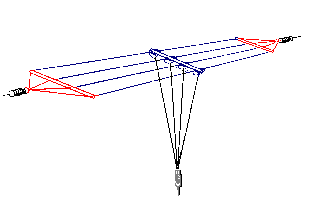
For U.S. amateurs anxiously awaiting implementation of the new 630m and 2200m bands, the wait seems to be almost over!
Good news came down late yesterday in the form of the FCC's "Report and Order" (ET Docket No. 15-99) which lays out the proposed rules and regulations that, barring any further changes, will likely become standard operating procedures once these two bands become finalized.
Highlights of the FCC's document are as follows:
1. Recognition that both Utilities (UTC) and amateurs can co-exist within these parts of the spectrum:
... co existence between PLC systems and amateur radio operations in these bands is possible, and the service rules we adopt in this Order will foster this co existence.
2. Amateurs operating within these bands must be no closer than 1 km from transmission lines that are actively carrying PLC (control) signals:
As proposed, we will permit amateur stations to operate in the 135.7-137.8 kHz and 472-479 kHz bands when separated by a specified distance from electric power transmission lines with PLC systems that use the same bands. To support the operations of both the amateur service and PLC systems in these bands, we adopt a minimum horizontal separation distance of one kilometer between the transmission line and the amateur station when operating in these bands.
We find that a one kilometer separation distance reasonably ensures that PLC systems and amateur radio stations are unlikely to experience interference. In addition, establishing a zone where amateur use is not authorized will simplify and streamline the process for determining whether an amateur station can transmit in these bands when in proximity to transmission lines upon which PLC systems operate.
3. Amateurs must "make notification" to local UTC authorities before commencing operation on either of these two bands:
We will require amateur operators to notify UTC of the location of their proposed station prior to commencing operations, to confirm that the station is not located within the one kilometer separation distance.
The notification requirement will entail notifying UTC of the operator’s call sign and coordinates of the proposed station’s location for confirmation that the location is outside the one kilometer separation distance, or the relevant PLC system is not transmitting on the requested bands. UTC, which maintains a database of PLC systems must respond to the notification within 30 days if it objects. If UTC raises no objection, amateur radio operators may commence operations on the band identified in their notification. The Wireless Telecommunications Bureau will issue a public notice providing the details for filing notifications with UTC.
A simple notification to UTC with a 30-day waiting period does not appear to be burdensome. Amateur operations can commence as soon as that period expires. ARRL claims that UTC should provide access to the PLC database to them or directly to amateurs to assist them in determining whether their notified operations are within the one-kilometer separation distance from transmission lines with PLC systems operating on these bands. ARRL fails to make a persuasive case why it would be a better organization to make those determinations rather than UTC. Further, since UTC has control of the PLC database which can be updated, we find no reason to mandate its release to another party especially considering the sensitive nature of information it contains.
4. Power limits will be expressed in EIRP as well as maximum PEP:
Amateur stations may operate in the 135.7-137.8 kHz band with a maximum radiated power of one watt EIRP ... that amateur stations operating in the 135.7-137.8 kHz band should be subject only to the general Part 97 limit of 1.5 kW peak envelope power (PEP).
We also adopt the power limits proposed in the WRC-12 NPRM for amateur stations operating in the 472-479 kHz band. For such stations, the maximum radiated power will be five watts EIRP, except for stations located in the portion of Alaska that is within 800 kilometers of the Russian Federation, where the EIRP will be limited to one watt. We also limit the transmitter power for amateur radio operations in the 472 479 kHz band to 500 watts PEP; provided, however, that the resulting radiated power does not exceed five watts EIRP. In other words, it may be necessary to reduce transmitter power below 500 watts PEP to avoid exceeding the five watts EIRP limit.
5. Antenna height will be limited:
... we will require that the antennas used to transmit in these bands not exceed 60 meters in height above ground level (AGL), as ARRL proposed.
6. Regarding transmission modes, no bandwidths have been specified in order to encourage experimentation:
Consistent with our proposal in the WRC-12 NPRM, and with the existing rules in Section 97.305 for the frequency bands below 30 MHz, we authorize amateur stations to transmit the following emission types throughout the new amateur bands: CW (international Morse code telegraphy), RTTY (narrow-band direct-printing telegraphy), data, phone, and image emissions. These emission types provide amateur operators with maximum flexibility, and we find that additional restrictions would needlessly hinder experimentation.
7. Experimental stations appear to 'still be in business' but are encouraged to transition to the 'amateur' service:
Finally, we decline to permit previously licensed experimental stations – some of which have been authorized with significantly more radiated power than the adopted EIRP limits for these new amateur service bands – to communicate with amateur stations operating in these bands. Amateur operations in these bands currently authorized under experimental licenses should transition their operations in accordance with the adopted rules and not circumvent such rules by use of experimental licenses.
My understanding of the R&O document is that participating parties may still file a 'Petition For Reconsideration' notification within 30 days of the R&O's publication in the Federal Register. Once these (if any) are dealt with, there are no other roadblocks preventing immediate implementation.
The document contains additional details not discussed here and makes fascinating reading for amateurs that might be looking forward to the new allocations.
This is the news that many U.S. amateurs have been waiting many years to hear! It is also good news for Canadian's operating on these bands to know that they may soon see a large increase in activity south of the border. Let's hope things continue to transpire favorably and that we will finally see the new bands become a reality.
Get those soldering irons out guys and gals!
Steve McDonald, VE7SL, is a regular contributor to AmateurRadio.com and writes from British Columbia, Canada. Contact him at [email protected].
LF and MF Now Very Close For U.S. Amateurs!
For U.S. amateurs anxiously awaiting implementation of the new 630m and 2200m bands, the wait seems to be almost over!
Good news came down late yesterday in the form of the FCC's "Report and Order" (ET Docket No. 15-99) which lays out the proposed rules and regulations that, barring any further changes, will likely become standard operating procedures once these two bands become finalized.
Highlights of the FCC's document are as follows:
1. Recognition that both Utilities (UTC) and amateurs can co-exist within these parts of the spectrum:
... co existence between PLC systems and amateur radio operations in these bands is possible, and the service rules we adopt in this Order will foster this co existence.
2. Amateurs operating within these bands must be no closer than 1 km from transmission lines that are actively carrying PLC (control) signals:
As proposed, we will permit amateur stations to operate in the 135.7-137.8 kHz and 472-479 kHz bands when separated by a specified distance from electric power transmission lines with PLC systems that use the same bands. To support the operations of both the amateur service and PLC systems in these bands, we adopt a minimum horizontal separation distance of one kilometer between the transmission line and the amateur station when operating in these bands.
We find that a one kilometer separation distance reasonably ensures that PLC systems and amateur radio stations are unlikely to experience interference. In addition, establishing a zone where amateur use is not authorized will simplify and streamline the process for determining whether an amateur station can transmit in these bands when in proximity to transmission lines upon which PLC systems operate.
3. Amateurs must "make notification" to local UTC authorities before commencing operation on either of these two bands:
We will require amateur operators to notify UTC of the location of their proposed station prior to commencing operations, to confirm that the station is not located within the one kilometer separation distance.
The notification requirement will entail notifying UTC of the operator’s call sign and coordinates of the proposed station’s location for confirmation that the location is outside the one kilometer separation distance, or the relevant PLC system is not transmitting on the requested bands. UTC, which maintains a database of PLC systems must respond to the notification within 30 days if it objects. If UTC raises no objection, amateur radio operators may commence operations on the band identified in their notification. The Wireless Telecommunications Bureau will issue a public notice providing the details for filing notifications with UTC.
A simple notification to UTC with a 30-day waiting period does not appear to be burdensome. Amateur operations can commence as soon as that period expires. ARRL claims that UTC should provide access to the PLC database to them or directly to amateurs to assist them in determining whether their notified operations are within the one-kilometer separation distance from transmission lines with PLC systems operating on these bands. ARRL fails to make a persuasive case why it would be a better organization to make those determinations rather than UTC. Further, since UTC has control of the PLC database which can be updated, we find no reason to mandate its release to another party especially considering the sensitive nature of information it contains.
4. Power limits will be expressed in EIRP as well as maximum PEP:
Amateur stations may operate in the 135.7-137.8 kHz band with a maximum radiated power of one watt EIRP ... that amateur stations operating in the 135.7-137.8 kHz band should be subject only to the general Part 97 limit of 1.5 kW peak envelope power (PEP).
We also adopt the power limits proposed in the WRC-12 NPRM for amateur stations operating in the 472-479 kHz band. For such stations, the maximum radiated power will be five watts EIRP, except for stations located in the portion of Alaska that is within 800 kilometers of the Russian Federation, where the EIRP will be limited to one watt. We also limit the transmitter power for amateur radio operations in the 472 479 kHz band to 500 watts PEP; provided, however, that the resulting radiated power does not exceed five watts EIRP. In other words, it may be necessary to reduce transmitter power below 500 watts PEP to avoid exceeding the five watts EIRP limit.
5. Antenna height will be limited:
... we will require that the antennas used to transmit in these bands not exceed 60 meters in height above ground level (AGL), as ARRL proposed.
6. Regarding transmission modes, no bandwidths have been specified in order to encourage experimentation:
Consistent with our proposal in the WRC-12 NPRM, and with the existing rules in Section 97.305 for the frequency bands below 30 MHz, we authorize amateur stations to transmit the following emission types throughout the new amateur bands: CW (international Morse code telegraphy), RTTY (narrow-band direct-printing telegraphy), data, phone, and image emissions. These emission types provide amateur operators with maximum flexibility, and we find that additional restrictions would needlessly hinder experimentation.
7. Experimental stations appear to 'still be in business' but are encouraged to transition to the 'amateur' service:
Finally, we decline to permit previously licensed experimental stations – some of which have been authorized with significantly more radiated power than the adopted EIRP limits for these new amateur service bands – to communicate with amateur stations operating in these bands. Amateur operations in these bands currently authorized under experimental licenses should transition their operations in accordance with the adopted rules and not circumvent such rules by use of experimental licenses.
My understanding of the R&O document is that participating parties may still file a 'Petition For Reconsideration' notification within 30 days of the R&O's publication in the Federal Register. Once these (if any) are dealt with, there are no other roadblocks preventing immediate implementation.
The document contains additional details not discussed here and makes fascinating reading for amateurs that might be looking forward to the new allocations.
This is the news that many U.S. amateurs have been waiting many years to hear! It is also good news for Canadian's operating on these bands to know that they may soon see a large increase in activity south of the border. Let's hope things continue to transpire favorably and that we will finally see the new bands become a reality.
Get those soldering irons out guys and gals!
Steve McDonald, VE7SL, is a regular contributor to AmateurRadio.com and writes from British Columbia, Canada. Contact him at [email protected].
SDR receivers and transceivers
There is a real gap in my knowledge as I have never once tried an SDR based receiver or transceiver. SDR dongles are very low cost, so I really have no excuse.
On the Southgate site I read news of a new SDR 5W transceiver.
See https://sunsdr.eu/product/sunsdr2-qrp/

Roger Lapthorn, G3XBM, is a regular contributor to AmateurRadio.com and writes from Cambridge, England.
CW Academy Intermediate
A little while ago I decided it was time to get a little help with my CW. Whilst I can have a reasonable QSO whilst I’m sat in the shack I tend to make a complete hash of it when /p. The bottom line is that my head copying skills just aren’t there. To try and fix this I enrolled on the CW Academy course for the slightly less than novices (Intermediate). I had expected that I was slated for October but it seems that we’re starting on April 1st! Hope there’s no significance in that.
Alex Hill, G7KSE, is a regular contributor to AmateurRadio.com and writes from Cumbria, UK. Contact him at [email protected].
LHS Episode #186: A Bad Case of CIFS
 This is Episode #186 of Linux in the Ham Shack. In this episode, topics include driving while using your amateur radio in Canada, UHF regulations in The Netherlands, amateur radio testing, Samba, tickr, Arch Linux, GeckoLinux and a whole lot more. Thank you so much for listening. We appreciate each and every one of you.
73 de The LHS Crew
Russ Woodman, K5TUX, co-hosts the Linux in the Ham Shack podcast which is available for download in both MP3 and OGG audio format. Contact him at [email protected].
 Ham Radio Deluxe |
 W5SWL Electronics |
 Ham Radio Prep |
 KB3IFH QSL Cards  Hip Ham Shirts  HamRadioAuctions HamRadioAuctions Reliance Antennas Reliance Antennas Enigma Shop Enigma Shop |  morseDX  Ni4L Antennas  R&L Electronics R&L Electronics antennas.us antennas.us QRV QRV |
- Matt W1MST, Managing Editor
