 |
 ICQ Podcast Episode 244 – Friedrichshafen Ham Radio 2017 Round-Up
 6 August 2017 | by
 In this episode, Martin M1MRB/W9ICQ is joined by Chris Howard M0TCH, Dan Romanchik KB6NU and Ed Durrant DD5LP to discuss the latest Amateur / Ham Radio news. Colin M6BOY rounds up the news in brief, and this episode’s feature is Friedrichshafen Ham Radio 2017 Round-Up
We would like to thank Philip Heckingbottom (VK6ADF) and our monthly and annual donors for keeping the podcast advert free. To donate, please visit - http://www.icqpodcast.com/donate
- YOTA 2017 Summer Event
- Lauren Richardson - 12 Completes Wainwright Challenge
- Differences in Amateur Radio CEPT Class 1 Licence Exam
- Ofcom Permitting 5.8 GHz Wi-Fi
- Youngsters Unimpressed with Traditional Ham Radio
- NCDXC to Start HF Elmering Program
- Fox-1 Satellite Operating Guide updates for 2017
- US Radio Ham Receives Lifetime Recognition
- FT8 Amateur/Ham Radio Mode Software Support
- Pictures Received from ISS
- UK Amateur Radio Licence Guidance
- PyQSO Amateur Radio Logging Software
Colin Butler, M6BOY, is the host of the ICQ Podcast, a weekly radio show about Amateur Radio. Contact him at [email protected].
ICQ Podcast Episode 244 – Friedrichshafen Ham Radio 2017 Round-Up
In this episode, Martin M1MRB/W9ICQ is joined by Chris Howard M0TCH, Dan Romanchik KB6NU and Ed Durrant DD5LP to discuss the latest Amateur / Ham Radio news. Colin M6BOY rounds up the news in brief, and this episode’s feature is Friedrichshafen Ham Radio 2017 Round-Up
We would like to thank Philip Heckingbottom (VK6ADF) and our monthly and annual donors for keeping the podcast advert free. To donate, please visit - http://www.icqpodcast.com/donate
- YOTA 2017 Summer Event
- Lauren Richardson - 12 Completes Wainwright Challenge
- Differences in Amateur Radio CEPT Class 1 Licence Exam
- Ofcom Permitting 5.8 GHz Wi-Fi
- Youngsters Unimpressed with Traditional Ham Radio
- NCDXC to Start HF Elmering Program
- Fox-1 Satellite Operating Guide updates for 2017
- US Radio Ham Receives Lifetime Recognition
- FT8 Amateur/Ham Radio Mode Software Support
- Pictures Received from ISS
- UK Amateur Radio Licence Guidance
- PyQSO Amateur Radio Logging Software
Colin Butler, M6BOY, is the host of the ICQ Podcast, a weekly radio show about Amateur Radio. Contact him at [email protected].
Hallicrafters Shortwave Radio; Winning WWII With Technology (1944)
Great film about a great radio manufacturer and radio set.
In 1944, this short subject film was produced by the Jam Handy Organization and sponsored by the Hallicrafters Company. It shows the construction of the SCR-299 and dramatizes its use during World War II. This is a B&W documentary presenting a look at the manufacturing and use of the (now defunct) Hallicrafters Company’s SCR-299 “mobile communications unit.” This 1944 film, produced with help from the US Army Signal Corps, and by the Hallicrafters Company, explains how, using radio gear such as this Hallicrafters shortwave radio transmitter and receiver technology, the US Forces and Allies were better equipped to win World War II.
The SCR-299 “mobile communications unit” was developed to provide long-range communications during World War II. The US Military sought improvements of range, flexibility and durability over its existing SCR-197 and SCR-597 transmitters. In 1942, Hallicrafters Standard HT-4 was selected as the SCR-299’s transmitter, known subsequently by its military designation as the BC-610. The SCR-299 was first used on November 8, 1942, during Operation TORCH involving companies of the 829th Signal Service Battalion establishing a radio net that could exchange messages between beach-landed forces and bases in Gibraltar. Despite initial problems unloading the sets from convoy ships, the SCR-299s served until the installation of permanent Army Command and Administrative Network stations. According to US Army military historians, “General Dwight Eisenhower credited the SCR-299 in his successful reorganization of the American forces and final defeat of the Nazis at Kasserine Pass.”
The SCR-299 was a “self-contained” receiving and transmitting mobile high-frequency (HF; or, shortwave) station capable of operating from 2 MHz to 8 MHz. Using conversion kits, it could operate from 1 MHz to 18 MHz. The transmitter output reached 350 watts.
The entire unit came in a K-51 truck except for Power Unit PE-95 which was in a K-52 trailer. Power could either be supplied by the Power Unit and a 12-volt storage battery or 115-volt 60-cycle AC commercial power and two spare 6-volt storage batteries. The power requirement was 2000 watts, plus 1500 watts for heater and lights.
The system could be remotely controlled up to a distance of one mile (1.6 km) using two EE-8 field telephones and W-110-B Wire kit. Remote equipment was provided for remotely keying or voice modulating the transmitter, remotely listening to the receiver, and for communicating with the operator of the station.
Read more details here: http://en.wikipedia.org/wiki/SCR-299
Public domain film from the Library of Congress Prelinger Archive.
..
73 de NW7US
..
Visit, subscribe: NW7US Radio Communications and Propagation YouTube Channel
Amateur Radio Weekly – Issue 168

Hara Arena to be auctioned by IRS
The minimum bid is $850,000; proceeds will satisfy a tax lien.
ARRL
Amateur Radio and The Maker Community
Makers generally use radios as a means of achieving a larger goal whereas radio amateurs generally use radios as a means of communicating.
FaradayRF
A rediscovery of TV antennas
Almost a third of Americans (29%) are unaware television is available for free.
Southgate
The ghostly radio station that no one claims to run
MDZhB has been broadcasting since 1982. No one knows why.
BBC
Antenna Summer – part 2
I finally went further on my quest to erect a better antenna for 20 meters.
AmateurRadio.com
Ham pushes village to allow zoning exception for front-yard antenna
Should there be a way for government to give one person the right, just one time, to exceed the letter of the law, without changing that law for all time for everybody that comes after that person?
Chicago Tribune
Wolf River Coil Silver Bullet – the ultimate portable vertical antenna
Once I threw a few radials underneath the antenna, I was hearing like I had never heard before.
K5ACL
Deployable VHF crossed Yagi antenna for CubeSats
Sean Hum VA3SHV and Jeff Nicholls VA3NGJ worked on the design for a deployable VHF crossed Yagi antenna on the recently launched NORsat-2.
AMSAT UK
WSPR comparison: vertical vs. dipole
My quick analysis indicates the vertical had the edge over the dipole in distance and total spots.
N4KGL
Ham Radio promotional posters
The six posters are based around the theme, “Ham Radio Is…”
ARRL
Video
FT-8 HF/6m digital mode introduction for beginners
This is an introduction for someone who has never heard of FT-8, or has never used JT-65.
HamRadioConcepts
Antenna tram
2X Array installed @ 50′
YouTube
Solar power inverter interference 30mhz to 120mhz
This is what happens if you or your neighbors install a dodgy quality solar power system.
YouTube
Amateur Radio Weekly is curated by Cale Mooth K4HCK. Sign up free to receive ham radio's most relevant news, projects, technology and events by e-mail each week at http://www.hamweekly.com.
Another Black Mountain SOTA (W0C/FR-031)
There are (at least) 20 different summits named “Black Mountain” just in the state of Colorado. I’m sure there are many more nationwide. It seems to be a popular, if unimaginative, name. This is why we have a numbering system for Summits On The Air, else we would forever be talking about “which Black Mountain was that anyway?” Or Deer Peak or Sheep Mountain or …
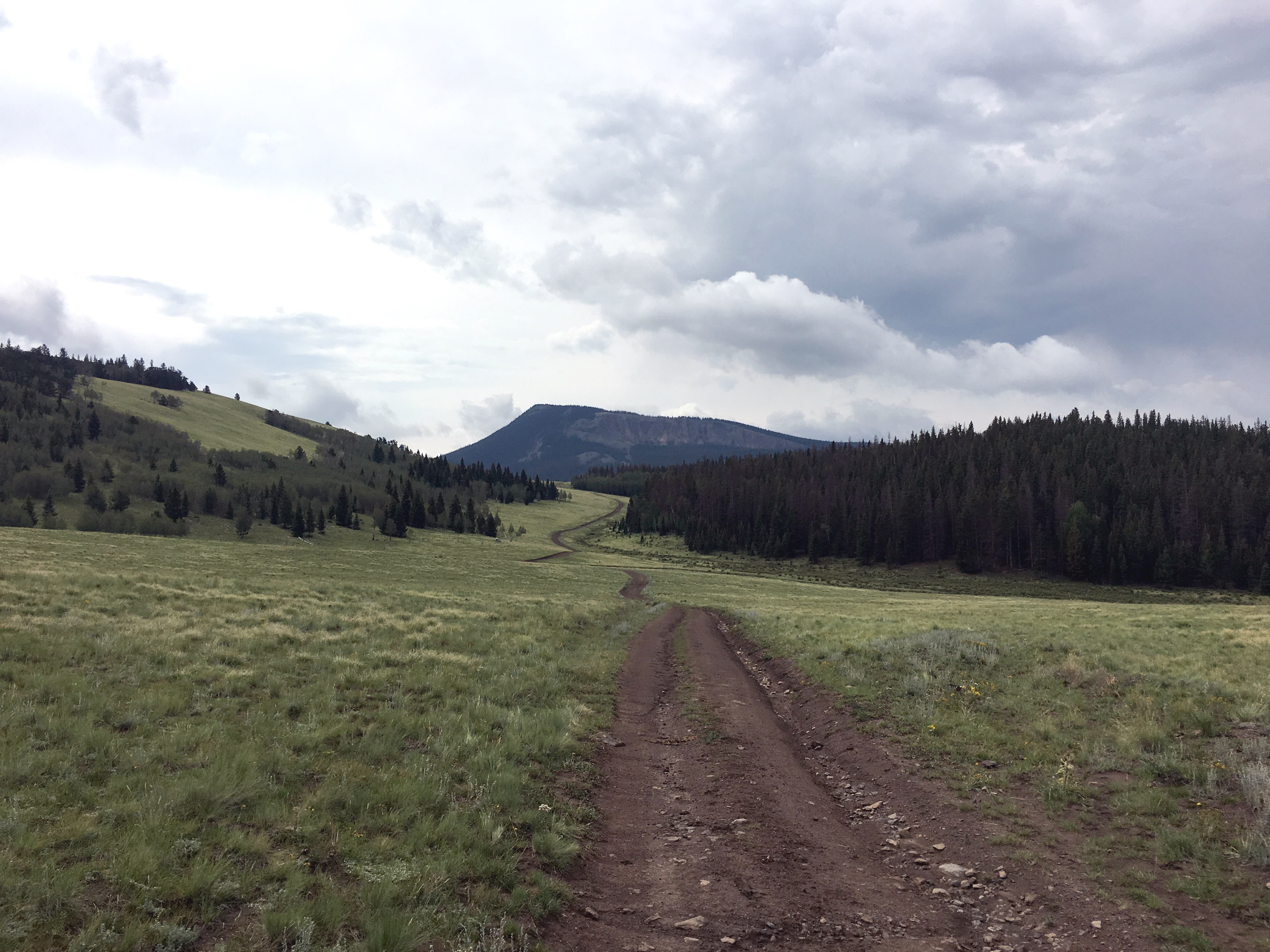
On Thursday, Joyce K0JJW and I activated another Black Mountain, this one with Summits On The Air (SOTA) designator: W0C/FR-031. I’m not sure why it has an FR or Front Range designation, as the summit is actually in the South Park region of the state. I can tell you that it is an awesome summit with great views.
To get to Black Mountain, take Highway 9 south out of Hartsel, CO (or come north on Highway 9 from the south). The Pike National Forest map is very helpful with getting into the vicinity of the mountain. Turn west on FS 108. (This is the same road that leads to Dicks Peak W0C/FR-041.) This road has a sign that indicated “Dicks Peak” and “Black Mountain”. Follow FS 108 S/SW and then take FS 107 to the south (right turn). Follow FS 107 to FS 268, then follow FS 268. About this time, you should have an excellent view of Black Mountain to the south. The roads were muddy and rutted, definitely 4WD. Our Jeep Wrangler had no problem but a AWD crossover/Subaru may be challenged to get through.
Black Mountain has a steep vertical rock face to the north, which is very visible. At this point, we wondered if we signed up for a difficult climb…but not so. FS 268 turns west, kind of parallel to Black Mountain, then heads away from it. At this point, we wondered if we were on the wrong road. Not so. At this point, the Pike National Forest map failed us…it seems to be incomplete in this area. Instead we used the gaiagps.com app on my smartphone which had a representation of the terrain and roads. As we headed west on FS 268 we saw a road heading off to the south. (I don’t recall if it is marked, but see map below.) Take this road south for about one and a half miles…looking for an unmarked road heading off to the east. The intersection with this road is easy to miss as it is not that distinct. But the road is very visible heading off to the east, so you’ll probably spot it later if you miss the turn and can circle back.
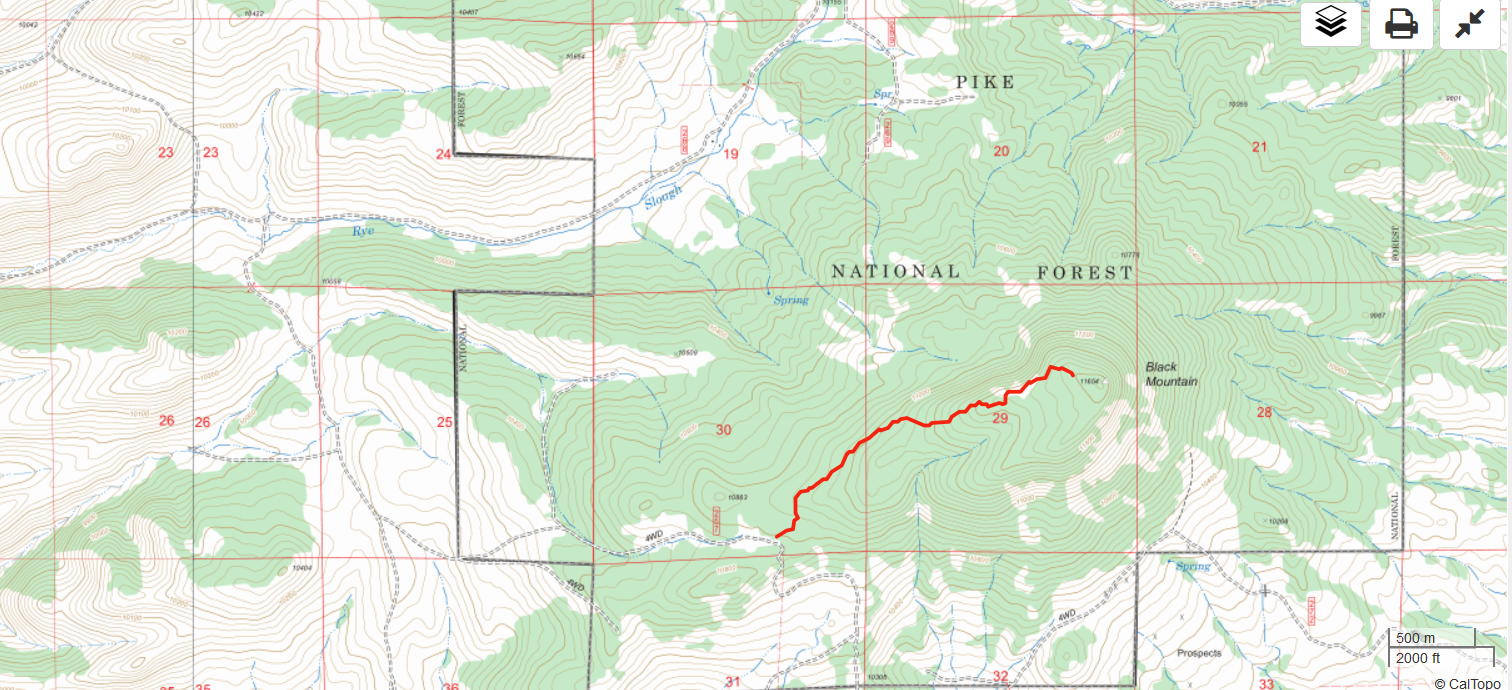
We took the unmarked road east until it deadended at a camping spot. We parked there and started the climb up to the summit. There are only random bits of a trail here and there, so we mostly just followed the GPS towards the summit. The route is forested with some downed timber but not difficult to navigate. The steep north side of Black Mountain provided some nice views. The hike is about 1.5 miles and 1000 feet vertical.
On top, we worked stations on 2m and 70cm fm without much trouble. It is an excellent VHF/UHF site and we found a number of locals hanging out on 146.52 MHz. We reversed our route on the way down and drove the Jeep out.
W0C/FR-222
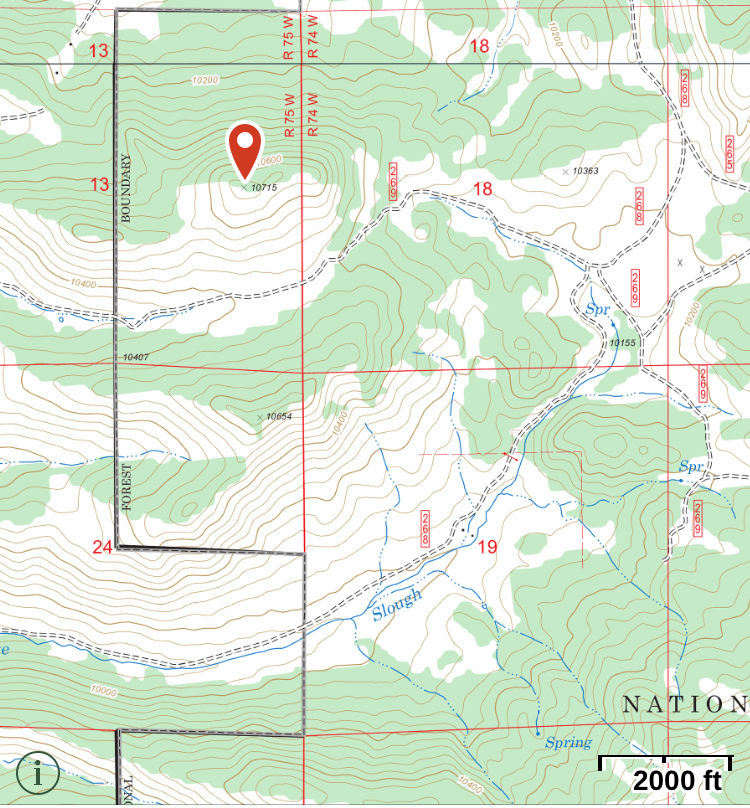
Steve WG0AT suggested that we could do an nearby unnamed peak (W0C/FR-222) on the same day. This is an excellent idea and we did just that. We headed back north and took FS 269 west, parking just south of FR-222. FR-222 is not shown on the Pike National Forest map but the Gaiagps.com app and other maps show it. The summit is easily seen from the road and a short hike gets you to the top (about 1/3 mile and 500 vertical feet).
73, Bob K0NR
The post Another Black Mountain SOTA (W0C/FR-031) appeared first on The KØNR Radio Site.
Bob Witte, KØNR, is a regular contributor to AmateurRadio.com and writes from Colorado, USA. Contact him at [email protected].
Amateur TV with Tom O’Hara, W6ORG – ETH080

Have you ever wanted to be in a movie? Or maybe on TV? Well while you can make your own movie and you could be on a TV, you probably won’t be on commercial TV. However you can be on Amateur TV.
In this episode I talk with Tom O’Hara, W6ORG. Tom has been a ham for a while and had a successful ATV business for over 50 years!! He retired and shut his business down at the end of 2014, but that hasn’t stopped him from working with Amateur TV!
Listen to this episode to find out more about Amateur TV and about Tom:
http://www.everythinghamradio.com/podcast/80
Curtis Mohr, K5CLM, is the author/owner of Everything Ham Radio Blog and Youtube channel. Contact him at [email protected].
Oh those Eqsl cards
Mike Weir, VE9KK, is a regular contributor to AmateurRadio.com and writes from New Brunswick, Canada. Contact him at [email protected].
 Ham Radio Deluxe |
 W5SWL Electronics |
 Ham Radio Prep |
 KB3IFH QSL Cards  Hip Ham Shirts  HamRadioAuctions HamRadioAuctions Reliance Antennas Reliance Antennas Enigma Shop Enigma Shop |  morseDX  Ni4L Antennas  R&L Electronics R&L Electronics antennas.us antennas.us QRV QRV |
- Matt W1MST, Managing Editor
