 |
 Canada Post / QSLs / Magicband Transformations
 21 July 2017 | by
Several weeks ago I mused about my interest in earth-mode VLF experiments, following the inspirational exploits of G3XBM in his earth-mode work a few years ago.
His low powered system utilizing a 5W audio IC and simple circuitry produced surprisingly interesting results over several kilometers.
With possible future experimenting in mind, I found a nice low-powered IC audio amplifier kit from China on e-Bay, capable of producing about 18W at 12V ... more with higher voltage and proper heat-sinking.


Whenever buying from China, I look for a dealer with the highest feedback rating and always compare their complaints versus the number of orders shipped. There always seems to be a few that are 99.9 - 100%, which, for me, has always assured that they are probably not selling junk. Anything lower than 98% can often be a red flag.
The kit was just $1.50 and with free-shipping, what's to lose?
A few weeks after I had placed my order, the nightly TV news had a spot regarding the problem that these "free shipping" packets were creating for Canada Post and their customers. It seems that in the past few months, as more and more "free" shipments were arriving from the far east, Canada Post had not been able to keep up with the processing. The news spot showed row upon row of shipping containers parked at the back of Vancouver International's (YVR) postal processing plant, with all of them filled with thousands of small "free" packets waiting to be processed!
It seems that each packet needs to be scanned by the border security folks (CBSA) for illegal material before it can be processed by Canada Post and the back-up was building at a tremendous rate. There appears to be little if any profit for Canada Post with these smaller untracked packages and they are given the lowest priority-rating possible.
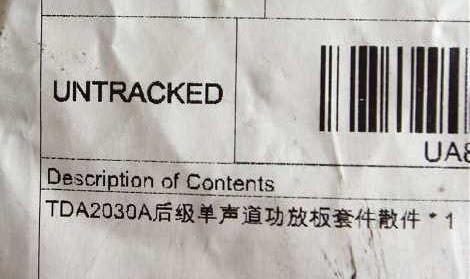
In order to speed up the process, both CBSA and Canada Post facilities would need to expand their operational capabilities at the airport and I suspect there is no serious will to do this until pressured politically by angry customers.
All parcels from China that are mailed to Canada stop at Vancouver's YVR before going further. The mammoth recent increase in online "free-shipping", in spite of the normally estimated 3-4 week delivery time, has proven too attractive for customers and our domestic system has failed to meet the new load demands.
With this new information in mind, my e-Bay purchase would prove to be an interesting test of the system and of the TV news spot's accuracy. Normally, I would have expected my tiny parcel to arrive in about 30 days, but mine would be one that eventually ended up in the airport parking lot.
The kit finally arrived this week, with a delivery time of 89 days! Many online sellers will offer an inexpensive option to pay for faster shipping, something that will still take a couple of weeks but much better than three months. If you are given this inexpensive shipping option I would highly recommend that you choose it, and if not, ask for an alternative to "free shipping". Unless something changes soon, delays will continue to increase.
I also wonder, and perhaps you can comment below, are U.S. customers seeing the same long delays as we here in Canada are experiencing when the "free shipping" option is chosen?

QSLs in my mailbox always excite me ... especially like yesterday's, arriving in a thin light-brown envelope decorated with colorful stamps.
I'm 100% certain this is because of receiving similar-appearing envelopes containing QSL cards during my formative years from age eleven onward and how much enjoyment the cards from shortwave stations all over the world brought me at this young age. For me, there is no replacement for a paper QSL, but sadly, this long-standing tradition is slowly slipping away due to the high cost of mailing even a normal-size envelope.
Earlier this summer I had a nice run of JA's on 6m Es but this time, instead of CW, they were on JT65A. Yesterday's card was for one of the digital contacts.

Signals were weak, at -23 db ... far too weak to be heard on CW but easily readable during the 60 second deep-listen period mandated by the JT65A mode. With so many stations now listening higher in the band for JT-mode signals, there has been very little activity on CW and now, with the introduction of yet another new digital mode, FT8, even the digital activity is split into sections, with neither mode being compatible.
I have held off installing the newer WSJT-X version containing the FT8 fifteen-second transmission mode until all of the bugs are ironed out ... the software will likely be tweaked a few more times yet before it reaches the polished final version we see for JT65 and others.
FT8 has been designed for weaker 6m Es openings that are often too short in duration for the longer time periods needed by JT65's sixty-second sequences. FT8 contacts can be completed quickly, before short-lived signals can drop out, but the shorter sequences come at the cost of reduced sensitivity ... probably a worthwhile tradeoff.
Conventional mode activity on 6m has suffered tremendously with the introduction of these new modes and it seems that if you want to work weak signal DX (and not all do), sadly it may be digital or nothing at all if the trends continue.
If all of the DX moves from CW to digital, for me, much of the magic will disappear as well. Letting the computer do all of the thinking is not nearly as satisfying or enjoyable as using my brain and CW skills to put a new rare one in the log. Six meters continues to evolve and I'm not overly excited by the direction it seems to be going.
Steve McDonald, VE7SL, is a regular contributor to AmateurRadio.com and writes from British Columbia, Canada. Contact him at [email protected].
Heathkit has a new product out.
 |
| The HM-1002 |
The spec's are below:
Power / SWR / Return Loss Accuracy:
- Meter: 2% nominal for Power, SWR, Return Loss.
- Sensors: Specs vary per sensor model. 5% or better when assembled as directed (no promises yet but we actually hope to beat 2%).
Frequency Accuracy & Precision: 6-digit precision, displaying 100Hz units with +/- 100Hz accuracy for MF, HF, 6 meters. Accuracy and precision always depend on sensor as well as meter. Frequency measurement requires a Heathkit® frequency-capable sensor; one is provided with each meter purchase.
Range: Frequency and power range depend on the sensor model(s) in use. With standard sensor, meter range is 50mW to 2kW power (17dBm to 63dBm) nominal, and 1.6MHz to 54MHz frequency nominal, when assembled as directed. (Subject to change) As with any power device, true SWR handling capability varies with sensor and depends on applied power level, and we will report lab results here as they are confirmed.
Front panel: Sensor/mode cluster, power cluster, SWR/return cluster, color graphic LCD display, calibrated DigilogTM bargraph, configurable visual alert.
Rear panel: Power jacks, sensor jacks, digital jack, audio annunciator.
Enclosure: Hardwood sides, plastic top/bottom, screwless top & front design with integral feet (patent pending).
Size: Approx. 2.2" high x 5.5" wide x 4.75" deep (6 x 14 x 12cm).
Weight: 1 lb (0.5 kg) nominal.
Included: All kit parts, any required assembly hex wrenches, one sensor, silver solder, one six-foot (2m) indoor sensor cable.
Compliance/legal: RoHS. Optional AC power adapter is UL approved. Patent pending.
AC power: Optional AC adapter accepts 90-130 VAC 60 Hz pure sine wave (North American standard), approx. 4 watts. 6ft (1.9m) power cord. (UK, Europe: 50 Hz compatible, but requires a different power adapter.*)
DC power: Accepts 12VDC nominal. Anderson PowerPole jack.
Tools required: Low-wattage soldering iron, wire cutters, needlenose pliers.
RFI/EMC & safety: No switching power supply brick. No mains line voltage (no 120VAC or 230VAC) in the box.
Accessories: (Coming soon) AC adapters, cables, more sensor models.
The cost for all this is 575.00 U.S.
Mike Weir, VE9KK, is a regular contributor to AmateurRadio.com and writes from New Brunswick, Canada. Contact him at [email protected].
Heathkit has a new product out.
|
| The HM-1002 |
The spec's are below:
Power / SWR / Return Loss Accuracy:
- Meter: 2% nominal for Power, SWR, Return Loss.
- Sensors: Specs vary per sensor model. 5% or better when assembled as directed (no promises yet but we actually hope to beat 2%).
Frequency Accuracy & Precision: 6-digit precision, displaying 100Hz units with +/- 100Hz accuracy for MF, HF, 6 meters. Accuracy and precision always depend on sensor as well as meter. Frequency measurement requires a Heathkit® frequency-capable sensor; one is provided with each meter purchase.
Range: Frequency and power range depend on the sensor model(s) in use. With standard sensor, meter range is 50mW to 2kW power (17dBm to 63dBm) nominal, and 1.6MHz to 54MHz frequency nominal, when assembled as directed. (Subject to change) As with any power device, true SWR handling capability varies with sensor and depends on applied power level, and we will report lab results here as they are confirmed.
Front panel: Sensor/mode cluster, power cluster, SWR/return cluster, color graphic LCD display, calibrated DigilogTM bargraph, configurable visual alert.
Rear panel: Power jacks, sensor jacks, digital jack, audio annunciator.
Enclosure: Hardwood sides, plastic top/bottom, screwless top & front design with integral feet (patent pending).
Size: Approx. 2.2" high x 5.5" wide x 4.75" deep (6 x 14 x 12cm).
Weight: 1 lb (0.5 kg) nominal.
Included: All kit parts, any required assembly hex wrenches, one sensor, silver solder, one six-foot (2m) indoor sensor cable.
Compliance/legal: RoHS. Optional AC power adapter is UL approved. Patent pending.
AC power: Optional AC adapter accepts 90-130 VAC 60 Hz pure sine wave (North American standard), approx. 4 watts. 6ft (1.9m) power cord. (UK, Europe: 50 Hz compatible, but requires a different power adapter.*)
DC power: Accepts 12VDC nominal. Anderson PowerPole jack.
Tools required: Low-wattage soldering iron, wire cutters, needlenose pliers.
RFI/EMC & safety: No switching power supply brick. No mains line voltage (no 120VAC or 230VAC) in the box.
Accessories: (Coming soon) AC adapters, cables, more sensor models.
The cost for all this is 575.00 U.S.
Mike Weir, VE9KK, is a regular contributor to AmateurRadio.com and writes from New Brunswick, Canada. Contact him at [email protected].
On this day, 48 years ago

Larry Makoski, W2LJ, is a regular contributor to AmateurRadio.com and writes from New Jersey, USA. Contact him at [email protected].
On this day, 48 years ago
Larry Makoski, W2LJ, is a regular contributor to AmateurRadio.com and writes from New Jersey, USA. Contact him at [email protected].
RepeaterBook – A FREE Online Repeater Directory – ETH078

In this episode of the Everything Ham Radio Podcast, we talk with Garrett Dow, KD6KPC, the creator of RepeaterBook.com. RepeaterBook is a free online repeater directory that covers all of the US and Canada as well as several other countries around the world.
You can use RepeaterBook directly from its website, or through its app. You can find the app on IOS, Android and Kindle. RepeaterBook has done a great job on getting and maintaining the information of about 35,000 repeaters thank in a large part to about 95 admins that maintain the records in their assigned areas and from the ham community at large.
Make sure you give the interview a listen and check out the show notes.
Curtis Mohr, K5CLM, is the author/owner of Everything Ham Radio Blog and Youtube channel. Contact him at [email protected].
QRP from the Seashore
Judy and I drove over to the beach today. It was glorious! We got lots of sun, had a fantastic walk, and I operated in the CWT sprint for a few minutes. The highlight of the operating was making a beach-to-beach QRP QSO with K4KRW in North Carolina.

We drove over to Rye Harbor in the morning and had a picnic lunch as soon as we arrived. Then we walked a couple of miles along the beach. After this Judy lay down on the shore to soak up some sun. I rode my bike about a half mile inland to play radio for a while. I’d brought a kite, but there wasn’t quite enough wind to lift an antenna… so I went in search of some trees. I found a wildlife area not too far from the road. A narrow path leads through the woods to a platform overlooking a beautiful inland marsh.

Except for the heat (high 80s in the shade), the spot was perfect. I had a 30 foot tree nearby and set up the wire as a sloper. The little deck even had a chair and a bench to operate on. I ran the KX3 on 20 meters and right away worked IK0YVV in Italy. Marco gave me a 559. Then I worked Gilly, WA5SNL in Texas. He also gave me a 559.

After signing I tuned up to the QRP frequency. K4KRW, Richard, was calling CQ. To my delight, he was operating from a beach in North Carolina with a KX3 and an end-fed wire. But… his wire was lifted by a kite! After arriving home, I found an email from Richard with a photo of his operating position.

We had a great QSO and exchanged 559 signal reports. What a thrill to work another KX3 operator on the beach!
Now the CWT sprint had started and I joined in. I only operated for 10 minutes, because by now my shirt was drenched and I’d had enough of this heat. Here’s my log. I’ve changed it to reflect the other station’s QTH instead of the CWOPS member number used in the real exchange:
19 Jul-17 1840 14.028 IK0YVV CW 559 579 Italy Marco
19 Jul-17 1848 14.029 WA5SNL CW 559 579 TX Gilly
19 Jul-17 1854 14.060 K4KRW CW 559 559 NC Richard
19 Jul-17 1902 14.036 AA3B CW 599 599 PA Bud
19 Jul-17 1903 14.035 K9CT CW 599 599 IL Craig
19 Jul-17 1903 14.034 AD8J CW 599 599 NC John
19 Jul-17 1905 14.032 K4RO CW 599 599 TN Kirk
19 Jul-17 1907 14.026 N4ZZ CW 599 599 TN Doc
19 Jul-17 1908 14.036 N2SR CW 599 599 NJ Tom
19 Jul-17 1909 14.034 NR4M CW 599 599 VA Steve
With this I packed up and headed back to Rye Harbor. This is really a beautiful spot. Wild rugosa roses form a hedge along the road and fill the air with fragrance. Next to the harbor is a little state park with facilities. It’s a perfect place to spend the day.

Jim Cluett, W1PID, is a regular contributor to AmateurRadio.com and writes from New Hampshire, USA. Contact him at [email protected].
 Ham Radio Deluxe |
 W5SWL Electronics |
 Ham Radio Prep |
 KB3IFH QSL Cards  Hip Ham Shirts  HamRadioAuctions HamRadioAuctions Reliance Antennas Reliance Antennas Enigma Shop Enigma Shop |  morseDX  Ni4L Antennas  R&L Electronics R&L Electronics antennas.us antennas.us QRV QRV |
- Matt W1MST, Managing Editor
