 |
 Hunting For NDBs In CLE 225
 23 November 2017 | by
 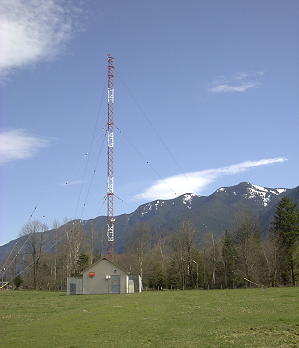 |
| LU - 214 KHz |
This coming weekend will see another monthly CLE challenge. This time the hunting grounds will be: 190 - 239.9 kHz PLUS normal NDBs on 'half-way' frequencies nnn.5 kHz (from 190.5 - 999.5 kHz).
For those unfamiliar with this monthly activity, a 'CLE' is a 'Co-ordinated Listening Event', as NDB DXers around the world focus their listening time on one small slice of the NDB spectrum.
A nice challenge in this one is to hear the Abbotsford (BC) NDB, 'LU', on 214 kHz. This is the beacon associated with Abbotsford Int'l Airport, Vancouver International's alternate for foggy conditions. It is located in a breathtaking mountain meadow location at the foot of the North Cascade Mountains. It's 500W Nautel drives a 100' vertical and with all of that space, I suspect a very robust ground system.
'LU' gets out very well and has been heard from Hawaii to New England and should be a good propagation indicator for many North American participants. Look for 'LU's upper-sideband CW identifier, repeated every 10.4 seconds, on 214.404 kHz with your receiver in the CW mode.
Usually November provides some excellent propagation as the summer thunderstorms have pretty much run their course but the recent warning of upcoming geomagnetic activity may, once again, mean something else in store for us. Often these 'warnings' are not as dire as they might appear and MF propagation remains robust or even enhanced.
When tuning for NDBs, put your receiver in the CW mode and listen for the NDB's CW identifier, repeated every few seconds. Listen for U.S. NDB identifiers approximately 1 kHz higher or lower than the published transmitted frequency since these beacons are modulated with a 1020 Hz tone approximately.
For example, 'AA' in Fargo transmits on 365 kHz and its upper sideband CW identifier is tuned at 366.025 kHz while its lower sideband CW ident can be tuned at 363.946 kHz. Its USB tone is actually 1025 Hz while its LSB tone is 1054 Hz.
Often, one sideband will be much stronger than the other so if you don't hear the first one, try listening on the other sideband.
Canadian NDBs normally have an USB tone only, usually very close to 400 Hz. They also have a long dash (keydown) following the CW identifier.
All NDBs heard in North America will be listed in the RNA database (updated daily) while those heard in Europe may be found in the REU database. Beacons heard outside of these regions will be found in the RWW database.
From CLE organizer Brian Keyte, G3SIA, comes the usual 'heads-up':
Hello all,
Do try not to miss our 225th co-ordinated listening event - it starts this
Friday at midday. We can hope for good conditions, some comfortable
listening and opportunities to catch some good DX.
This should be ideal to try out a CLE for the first time.
Days: Fri. 24 - Mon. 27 November, Midday-Midday, your local time
Frequencies: 1) NDBs from 190 - 239.9 kHz
PLUS: 2) Normal NDBs on 'half-way' frequencies nnn.5 kHz
(from 190.5 - 999.5 kHz)
So for all of us it is a CLE in two parts - the first part is hunting for
the NDBs whose published frequencies are lower than 240 kHz.
The second part is hunting for the NDBs whose carrier frequencies
are 'half-way'. E.g. 284.5 DY, 333.5 VOG, 370.5 LB, 381.5 SJX (in MI),
390.5 ITR, 433.5 HEN ( Not nnn.6, etc. )
'Normal' NDBs - no DGPS, please.
(Most Europe listeners will hear few or none from part 1, while
listeners away from Europe will hear few or none from part 2)
The Seeklists from REU/RNA/RWW will help you – you will find them
from the link on the CLE page http://www.ndblist.info/cle.htm
Please send your CLE log to the List, if possible as a plain text email and
not in an attachment, showing 'CLE225' at the start of its title. (Loggings
from both parts can be shown together in the same list if you wish)
Please include on EVERY line of your log:
# The date (or just the day 'dd') and UTC (days change at 00:00 UTC).
# kHz - the beacon's nominal frequency.
# The Call Ident.
It is important to show those main items FIRST - any other optional
details such as Location, Distance, etc. go LATER in the same line.
Don't forget to give your OWN location and details of your receiver and
aerial(s), etc. Others will be interested to know, especially new members
- and old ones with memories like mine!
Also, please ALWAYS send your last log with ‘FINAL’ in the subject.
## That is important even if you send no interim logs ##
Listening on the 'half-way' frequencies means we might also catch some
interesting non-CLE beacons - please tell us about those too, but in a
separate list. If any of them are UNIDs whose carriers seem to be on
'half-way' frequencies include them in your main list of course.
Joachim and I will be processing the incoming logs – please look out for
our 'Any More Logs?' email at about 18:00 UTC on Tuesday evening,
with a list to let you check that your log has been found OK.
Joachim will again be making the combined results for us.
Do make sure that your log has arrived on the NDB List at the very latest
by 09:00 UTC on Wednesday 29 November.
Good listening
Brian
----------------------------------------------------------
From: Brian Keyte G3SIA ndbcle'at'gmail.com
Location: Surrey, SE England (CLE Coordinator)
----------------------------------------------------------
(If you wish you could use any one remote receiver for your loggings,
stating the location and owner – and with their permission if required.
A remote listener may NOT also use another receiver, local or remote,
to make further loggings for the same CLE.
These listening events serve several purposes. They:
- determine, worldwide, which beacons are actually in service and on-the-air so the online database can be kept up-to-date
- determine, worldwide, which beacons are out-of-service or have gone silent since the last CLE covering this range
- will indicate the state of propagation conditions at the various participant locations
- will give you an indication of how well your LF/MF receiving system is working
- give participants a fun yet challenging activity to keep their listening skills honed
Final details can be found at the NDB List website, and worldwide results, for every participant, will be posted there a few days after the event. If you are a member of the ndblist Group, results will also be e-mailed and posted there.
The very active Yahoo ndblist Group is a great place to learn more about the 'Art of NDB DXing' or to meet other listeners in your region. There is a lot of good information available there and new members are always very welcome. As well, you can follow the results of other CLE participants from night to night as propagation is always an active topic of discussion.
You need not be an ndblist member to participate in the CLEs and all reports, no matter how small, are of much value to the organizers.
'First-time' logs are always VERY welcome!
Reports may be sent to the ndblist or e-mailed to either myself or CLE co-ordinator, Brian Keyte (G3SIA), whose address appears above.
Please ... give the CLE a try ... then let us know what NDB's can be heard from your location! Your report can then be added to the worldwide database to help keep it up-to-date.
Have fun and good hunting!
Steve McDonald, VE7SL, is a regular contributor to AmateurRadio.com and writes from British Columbia, Canada. Contact him at [email protected].
Come Join the Fun With Olivia on HF (Shortwave Digital Mode Olivia)
For those of you who have dived into the crowded but fun pool of FT8 operation or one of the other Joe Taylor modes (such as JT65 or JT9) and are excited now about digital modes, here’s something you might enjoy, too. Unlike those modes that allow you to make quick work of getting DX stations into your logbook, simply by exchanging callsigns, a signal report, and a grid square, there are other modes that offer keyboard-to-keyboard conversational QSO opportunities.
One such mode is known as Olivia and this mode offers keyboard-to-keyboard chatting for when you want to relax, and maybe make a friend. Ham radio is the oldest electronic social networking infrastructure.
In 2005, SP9VRC, Pawel Jalocha, released to the world a mode that he developed starting in 2003 to overcome difficult radio signal propagation conditions on the shortwave (high-frequency, or HF) bands. By difficult, we are talking significant phase distortions and low signal-to-noise ratios (SNR) plus multipath propagation effects. The Olivia-modulated radio signals are decoded even when it is ten to fourteen dB below the noise floor. That means that Olivia is decoded when the amplitude of the noise is slightly over three times that of the digital signal!
Olivia decodes well under other conditions that are a complex mix of atmospheric noise, signal fading (QSB), interference (QRM), polar flutter caused by a radio signal traversing a polar path. Olivia is even capable when the signal is affected by auroral conditions (including the Sporadic-E Auroral Mode, where signals are refracted off of the highly-energized E-region in which the Aurora is active).
Currently, the only other digital modes that match or exceed Olivia in their sensitivity are some of the modes designed by Joe Taylor as implemented in the WSJT programs, including FT8, JT65A, and JT65-HF–each of which are certainly limited in usage and definitely not able to provide true conversation capabilities. Olivia is useful for emergency communications, unlike JT65A or the newly popular FT8.
Here is a demonstration of a two-way transmission using the Olivia digital mode on shortwave. I am in QSO (conversation) with KA5TPJ. There are two other Olivia QSOs just below our frequency. Just above us is a lot of FT8 activity. Below the two other Olivia QSOs are PSK31 QSOs. The band is active. Olivia is not dead!
The standard Olivia formats (shown as the number of tones/bandwidth in Hz) are 8/250, 8/500, 16/500, 8/1000, 16/1000, and 32/1000. Some even use 16/2000 for series emergency communication. The most commonly-used formats are 16/500, 8/500, and 8/250. However, the 32/1000 and 16/1000 are popular in some areas of the world and on certain bands.
This can cause some confusion and problems with so many formats and so many other digital modes. After getting used to the sound and look of Olivia in the waterfall, though, it becomes easier to identify the format when you encounter it. To aid in your detection of what mode is being used, there is a feature of many digital-mode software implementation suites: the RSID. The video, below, is a demonstration on how to set the Reed-Solomon Identification (RSID) feature in Ham Radio Deluxe’s Digital Master 780 module (HRD DM780).
I encourage ALL operators in any digital mode such as Olivia, set the RSID feature on as shown in this example. In Fldigi, the RSID is the TXID and RXID (I believe).
Please make sure you are using the RSID (Reed Solomon Identification – RSID or TXID, RXID) option in your software. RSID transmits a short burst at the start of your transmission which identifies the mode you are using. When it does that, those amateur radio operators also using RSID while listening will be alerted by their software that you are transmitting in the specific mode (Olivia, hopefully), the settings (like 8/250), and where on the waterfall your transmission is located. This might be a popup window and/or text on the receive text panel. When the operator clicks on that, the software moves the waterfall cursor right on top of the signal and changes the mode in the software. This will help you make more contacts!
+ NOTE 1: MixW doesn’t have RSID features. Request it!
+ NOTE 2: A problem exists in the current paid version of HRD’s DM780: the DM780 RSID popup box to click does not work. HRD support is aware of the problem. You can still use the textual version that you can select in the settings so that it appears in the receive text areas. If you click the RSID link that comes across the text area, DM780 will tune to the reported signal, and change to the correct settings.
+ NOTE 3: some websites publish frequencies that are right on top of weak-signal FT8, JT65 and JT9 segments. Even if that is a matter of contention, follow the regulations and be kind: DO NOT QRM weak-signal QSOs! AGAIN: make sure that your signal does not cross into other sub-bands where weak-signal modes are active. For instance, do not have any part of your signal at x.074 or higher, as this is the sub-band for FT8, JT65A, and JT9.
Quick Reference: we in the active Olivia group suggest 8/250 as the starting settings when calling CQ on the USB dial frequency of 14.072 MHz with an offset of 700 Hz, on 20m–that translates to a CENTER frequency of 14.0729 MHz. On 40m, 7.072 MHz on the dial with an offset of 700 Hz (and again 8/250) which translates to a center frequency of 7.0729 MHz.

An example of the calling frequency on 20 meters with a center frequency of 14.0729 MHz, 8 tones, and a bandwidth of 250 Hz.
Also, do not quickly switch to other modes without calling CQ for at least a five-minute window. It is really horrid when people call CQ and change settings, modes, bandwidths, tones, every time they call CQ during the same session!
There are several key resources that we in the Olivia community are developing, to make it easier for you to enter into the great world of Olivia. One is an active support e-mail group to which you can subscribe at https://groups.io/g/Olivia — a group containing topical areas of interest which can be filtered so that you are not flooded by email containing topics of which you are not interested. It has a files section, as well, in which we will add helpful how-to instructions and so on.
Another resource is our Facebook group, at https://www.Facebook.com/groups/olivia.hf — also with a files area containing help files. This group is a great resource for getting help from like-minded Olivia digital mode enthusiasts.
Some more eavesdropping on an Olivia QSO:
And, two more:
One last note: Olivia is NOT a weak-signal mode. There are no points won by barely making a contact. In the USA FCC regulations, you are directed to use only the power necessary to make the QSO. Typically, with poor propagation, using Olivia with an output power of 100w is the minimum to establish a reliable circuit. You just cannot go beyond your rig’s duty cycle (don’t burn out the finals in your radio!). You also must be sure that you do not overdrive the audio chain into your radio. Be sure that you do not have RF coming back into your audio chain. Yes, 100 watts is acceptable. Don’t let anyone convince you otherwise. After all, think about RTTY.
Welcome to Olivia! See you on the waterfall.
73 de NW7US
Visit, subscribe: NW7US Radio Communications and Propagation YouTube Channel
The Spectrum Monitor — November, 2017
 Stories you’ll find in our November, 2017 issue:
TSM Reviews: Yaesu FT-891 All-Mode HF+6 100-Watt Transceiver
By Mark Haverstock K8MSH
This month Mark takes a look at the Yaesu FT-891, one of the least expensive 100-watt, all-mode HF+6-meter radios on the market today. Mark finds that, “Its small size and remote head make it perfect for mobile/portable use, and its small footprint fits even on crowded desktops. The larger display is a welcome change, considerably more readable than the tiny ones on the FT-857D and FT-897D.” Mark also notes, “Those who own or have owned Yaesu radios will be used to the menu system, and will appreciate the attempts to provide easier access to some functions.” But that’s not all the 891 has going for it, as you’ll learn when Mark puts his 891on the air.
TSM Reviews: SpyVerter V2
By Bob Grove W8JHD
The earlier version of SpyVerter got a nod of approval from Bob Grove two years ago. But what would he say about this latest version? Spoiler alert! Bob says, “I’ve never changed my mind about the superiority of the Airspy spectrum-displaying receiver to its competitors. Now, with the addition of the previously-missing lower spectrum—virtually down to zero—this is a current leader in computer accessories for radio hobbyists.” In this month’s review he even tells how to use this device to monitor birds, animals and insects in the audio spectrum as well as the sounds of fish in the sea!
TSM’s Annual Scanner Buyer’s Guide
By Larry Van Horn N5FPW
The radio scanner world has been in flux since it began decades ago. And, while the number of manufacturers has shrunk over the years, the capabilities of these electronic marvels have kept pace with the changes. In this survey of all available scanners, Larry writes that, “bare bones, conventional analog-only scanners will run from just under $100. A good analog-only trunk-tracking scanner can be purchased for less than $200 (street price); however, if you need to monitor an APCO P25 Phase I digital trunked radio system, that price quickly jumps to around $400. Add in additional digital modes such as DMR and/or NXDN and APCO P25 Phase II systems and now you are looking at a sticker price north of $500 in most cases.” But, you may not need the latest technology where you live. Find out which scanner is best for your particular location.
Entry Level HF Transceiver Comparison
By Cory GB Sickles WA3UVV
Are you a Technician class amateur radio licensee, looking to explore what is available in HF transceivers in a price range that won’t break the bank? HF operation requires a little more commitment than VHF/UHF FM gear and, while you can easily pick up a high-quality monoband mobile for under $200 or a dual-band portable in the same price range, HF gear is going to run you a bit more. Considering all that you get in the deal though, it’s still reasonably priced. Cory takes a comparative look at what Alinco, Icom, Kenwood, and Yaesu have in the way of 100-watt, entry-level offerings, with a street price of less than $800. With the need for a 20A power supply and simple antenna, a “Kilobuck” budget should certainly get you on the air or perhaps even less.
Scanning America
By Dan Veeneman
Scanning Midwest Utilities’ DMR Services
Federal Wavelengths
By Chris Parris
New Kennedy Space Center Trunked System
Milcom
By Larry Van Horn N5FPW
Who’s Who in the Milcom Radio Spectrum: Monitoring the HF OR Frequencies
Utility Planet
By Hugh Stegman NV6H
Rethinking HF Emergency Communications
Shortwave Utility Logs
Compiled by Hugh Stegman and Mike Chace-Ortiz
VHF and Above
By Joe Lynch N6CL
The Leonids Meteor Shower
Amateur Radio Insights
By Kirk Kleinschmidt NT0Z
Antenna Tuner Secrets
Radio 101
By Ken Reitz KS4ZR
Cruising the FM Band with a Little Help from the Web
Radio Propagation
By Tomas Hood NW7US
The Sun Blasts a Hole in Earth’s Magnetic Shield
World of Shortwave Listening
By Keith Perron
Rich O’Shea: An American DJ in Asia
The Shortwave Listener
By Fred Waterer
BBC Broadcasts to North Korea; Reach Beyond Australia and Religion on Shortwave
Amateur Radio Astronomy
By Stan Nelson KB5VL
Solar Eclipse VLF Effects
The Longwave Zone
By Kevin O’Hern Cary WB2QMY
2200m/630m: Are You Registered Yet?
Adventures is Radio Restoration
By Rich Post KB8TAD
Putting the Spark back into a Sparks-Withington (Sparton 141X)
Antenna Connections
By Dan Farber AC0LW
Transformations: Getting From X to 50
The Spectrum Monitor is available in PDF format which can be read on any desktop, laptop, iPad®, Kindle® Fire, or other device capable of opening a PDF file. Annual subscription is $24. Individual monthly issues are available for $3 each.
Ken Reitz, KS4ZR, is publisher and managing editor of The Spectrum Monitor. Contact him at [email protected].
Best Digital Mode? … Not Really
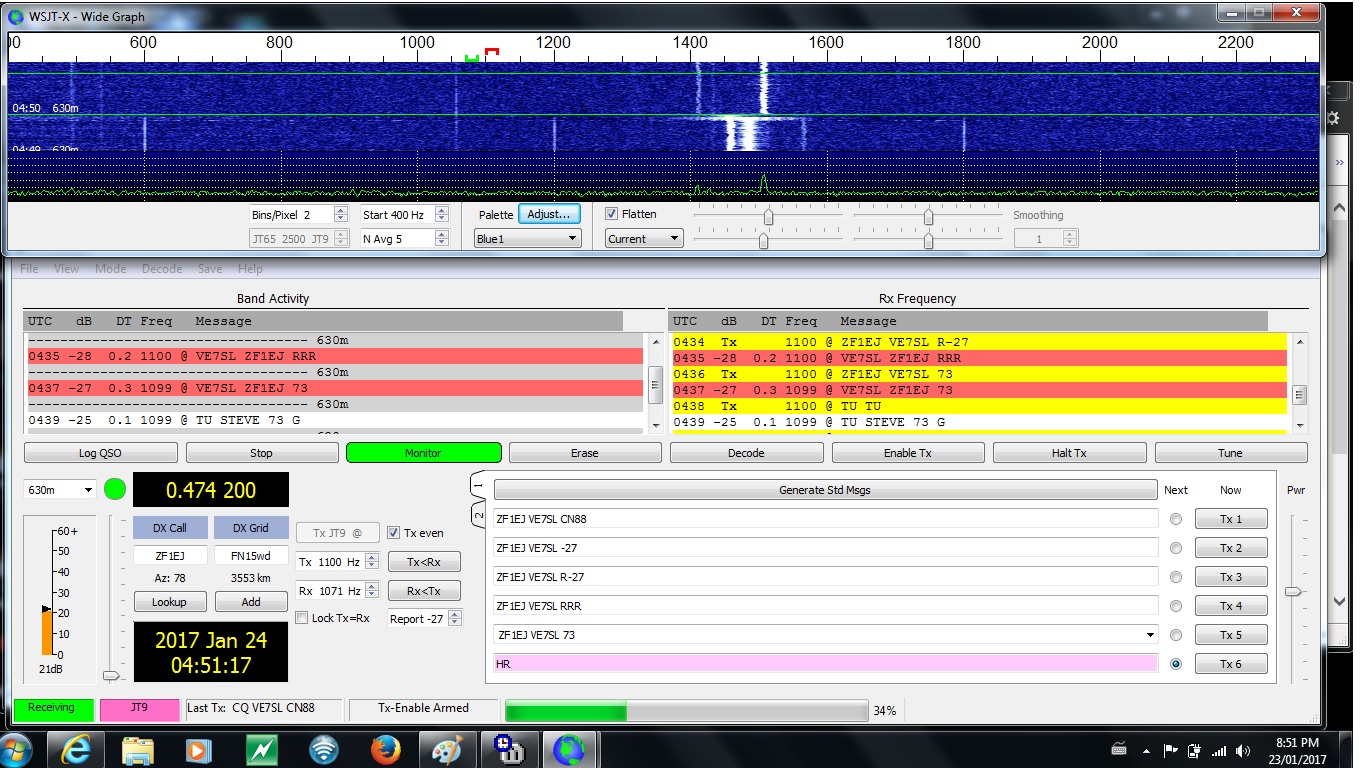 For the past year, as interest in the digital modes began to skyrocket, I have been reading the topical discussions and questions posted in the WSJT Yahoo Group.
Since the introduction of FT8, the group's daily traffic has soared and easily occupies the vast majority of inquiry.
Far and away, most questions either involve software / computer configuration problems or inquiries involving the operational use of the software itself. I am often surprised at the range of inquiry and in almost all questions involving the software itself, it just comes down to 'reading the manual' ... it seems that hams, like so many others, just don't like to read manuals and for a technically-oriented hobby, I find this peculiar. Perhaps it's because I'm just the opposite, and will usually go over instructional material, more than once, before plugging something in or installing any new software.
Not all digital modes are 'created equal' nor with the same purpose in mind and for those new to these modes or making the transition from traditional mode operations, sorting them out can often be a source of confusion. One such user broached this very topic with his recent inquiry:
Bill, G4WJS, has been handling most of the technical inquiries and I thought his reply might help others that could be wondering the same thing:
... simple answer, neither wins in all situations. Each mode in WSJT-X is designed for a certain set of requirements and given those the protocol and the decoders try to optimize sensitivity and robustness.
FT8 is not as sensitive, a few dB behind JT65A but as you point out it is particularly suitable for multi-hop 6m Es propagation where openings can be very short. This is no surprise as it was crafted for exactly that. OTOH FT8 has become *very* popular on HF, probably because most HF QSOs do not need ultimate sensitivity and the 15s T/R period makes QSOs four times as fast compared with JT65. This last attribute is surely what is driving the massive uptake on HF on the current "easy DX" propagation bands like 20m for daylight paths and 40m for darkness paths.
JT9 was designed for HF and uses about 1/10 of the bandwidth of JT65A along with even better sensitivity. Unfortunately many users use ancient software with no JT9 support or are working through JT65 goals like WAS mode specific endorsements so JT9 does not get the attention it deserves. Although JT9 works for many on 6m, the tighter frequency tolerance required is a limitation for many with older rigs.
Both FT8 and JT65A have two pass decoders that can dig out multiple overlapping signals (similar techniques could be developed for JT9 but the need has not been seen yet).
FT8 has the AP decoder which gets a couple of dB extra sensitivity for critical decodes and also helps with truncated or interrupted messages in some cases.
WSPR is a pseudo beacon mode that uses a short message and two minute T/R period that has greater sensitivity than even JT9 despite the signal being only 6Hz wide. WSPR like JT65A and FT8 uses a two pass decoder capable of decoding overlapping signals.
There is also MSK144, QRA64, JT4, the fast versions of JT9, ISCAT, FreqCal and Echo mode. Each with a specific purpose and maybe for other opportunities they were not initially designed for.
For myself, I have yet to download the latest WSJT-X release, as I presently have no need, nor see the need to use FT8. To utilize the new release, I think I'll need to delete my older (pre-FT8) version, in order to avoid file confliction problems. My older version works very well for what I do need, and that is JT9. There are a few features on the software that I also find handy, which have been removed in the newer versions ... I think.
Of course there is always the possibility that the trend will reverse as many eventually find that FT8 contacts are not all that interesting. The inability to exchange anything other than minimal required QSO information is the price paid for that extra sensitivity ... fine for that once in awhile new one in the log but not very satisfying for everyday communications.
The 'reversing trend' was also addressed in a recent posting to the WSJT Yahoo Group:
In my opinion it is nice to see a steady return to JT65 & JT9.
An all round better mode.
Still a bit short on the DX stations but I am sure they will follow soon.
I have also seen some confusion when some are describing WSPR 'QSOs'. This is disturbing since there can never be a two-way exchange of information, all via radio (a QSO) using the one-way WSPR beacon-mode. Some may be confusing 'WSPR QSO's' for the actual Weak-Signal two-way 'WSPR QSO' modes such as JT65, JT9, FT8 etc.
Since WSPR relies on an internet back-channel exchange of information (to see where you've been heard), there is no actual on-air exchange of the data needed to claim a legitimate contact. To make such a claim would be no different than two stations, each running a beacon and calling each other up on the telephone to say that they can hear each other and calling it a two-way 'QSO'!
I have been using, and will continue to use JT9 on the new 630m band where signal levels are often too marginal for CW work but easily handled with this digital QSO mode ... otherwise I'll keep pounding brass whenever I can!
Steve McDonald, VE7SL, is a regular contributor to AmateurRadio.com and writes from British Columbia, Canada. Contact him at [email protected].
Is the Internet Destroying Amateur Radio?
 How many times do you hear the comment “ham radio…do people still do that?” followed by the statement that “surely the internet has made ham radio obsolete.” For the most part, that misses the point about the use and attractiveness of amateur radio. And yes, that is a clickbait headline.
I’ve written before that Amateur Radio Is Not for Talking and that the Universal Purpose of Ham Radio is to have fun messing around with radios. One significant statistic is that the number of FCC amateur radio licensees remain at an all time high. Eventually, the demographics will likely catch up with us and this number will start to decline, but it hasn’t happened yet.
The internet has become a tool that is used to complement amateur radio, often in ways that we may not have predicted. Although there are plenty of “keep the internet out of amateur radio” folks in the hobby, there are many more that have found clever ways to make use of the internet. I view emerging technologies and technological innovation as unstoppable forces that will impact us whether we try to ignore them or not. Using that lens, let’s examine the impact of the internet on amateur radio.
Here are a few broad categories of impact:
1. Communication Pipe
The internet is often used to provide an additional mechanism for transporting ham radio communications. Obvious examples are VoIP systems such as EchoLink and IRLP. Also included in this category are digital voice systems that use the internet to connect radios together: D-STAR, Yaesu System Fusion, Brandmeister Network, DMR-MARC Network. WinLink is a global email system using ham radio. The core transport technology is the Internet Protocol Suite (TCP/IP) which is not limited to the public internet. Some ham radio organizations are implementing IP links using microwave gear on the amateur radio bands so they are independent of the internet.
Another application in this category is remote operation of ham stations. That is, use an internet connection to control a ham station at another location. Sometimes people refer to this as the Long Microphone Cord Model (or maybe I just made that us). Hams do this with their own private stations but there are also shared stations established by radio clubs and commercial vendors (see Remote Ham Radio). With community restrictions on external antennas being very common, having a remote station available is very attractive.
This has turned out to be quite disruptive because so much of ham radio operating depends on your location, which is generally determined by the location of the transmitter. But now you can have a person sitting in downtown Denver operating a transmitter that is in Fiji. Kind of confuses things a bit. Regulatory issues also come into play: that transmitter in Fiji is going to fall under Fiji regulation which usually means needing an amateur radio license issued by the local government. The day is coming when a DXpedition to a remote island will consist of a helicopter delivery of a remote radio box (with satellite link and self-deploying HF antenna) that is operated by someone sitting at home using their smartphone.
2. Reporting and Coordination
Ham radio operators also use the internet for spotting and reporting purposes. Spotting has been around for a long time, which basically means letting other hams know that a particular station is on the air and can be worked from a particular location. Hams have done this without the internet but the internet certainly allows for more efficiency. Or at least a lot more spots. DX Maps is a good example of a spotting web site that supports lists and mapping of spots.
Radio hams also use the internet for coordinating radio contacts. One of the most extreme examples is the use of pingjockey for arranging meteor scatter communications. Typically, two hams will connect on pingjockey and agree to try a meteor contact on a specific frequency, with specific timing, etc. This technique is easy to abuse, either intentionally or via sloppy operating habits, because you can inadvertently share the radio contact information via the internet. However, properly used, pingjockey is a wonderful tool that promotes meteor scatter operating. ON4KST operates an amateur radio chat website that enables a wide variety of online communication and coordination between hams.
The Reverse Beacon Network (RBN) is a network of radio receivers listening to the amateur bands and reporting what stations they hear. These stations are often referred to as CW Skimmers because they skim the CW information from the received signals. RBN began with decoding CW but now also supports RTTY. There’s no fundamental reason it couldn’t be extended to other modes, even voice modes, with sufficient computing power.
PSK Reporter is a similar reporting system which accumulates signal reports from HF digital stations. As the name implies, it was first focused on PSK31 but has expanded to include other digital modes.
3. Logging and Confirmations
For decades, hams have been keeping their radio logs using a wide range of software that is available. This is a handy way of keeping track of radio contacts and tracking progress towards operating awards. More recently, online systems have been developed to allow radio contacts to be confirmed electronically. That is, instead of exchanging QSL cards as confirmation of a radio contact, both hams submit their log information to a central server that records the radio contact. The ARRL offers the Logbook of The World (LoTW) which supports these awards: DXCC, WAS, VUCC and CQ WPX. The eQSL web site was the first online QSL site, offering electronic QSL card delivery and its own set of operating awards. Club Log is another online electronic logging system. The popular qrz.com web site has added a logbook feature to its set of features.
Electronic confirmation of radio contacts is a huge improvement for ham radio. While many of us still enjoy getting a paper QSL card, collecting QSLs for awards is a royal pain. Mailing QSL cards is expensive, takes time and often involves long delays.
Impact on Amateur Radio
Here’s my analysis of the situation: Categories 2 and 3 mostly represent a net positive influence on amateur radio. These are straight up information age applications that provide useful and quick updates about radio propagation and radio contacts. Yes, there is some downside in that many hams become dependent on them instead of doing it the old fashioned way: turn the big knob on the radio and listen. Not a big deal given the benefits.
Category 1 is more of an issue for me. The major effect is that it enables worldwide communication a lot easier while using ham radio. This is what causes many hams to say That’s Not Real Ham Radio when the internet is used to do so much of the work. Focusing on the actual radio wave propagation, there is really no comparison between working DX on the 15m band and making the same QSO with a UHF DMR handheld piped through the internet. At this point, I try not to overthink the issue, dropping back to The Universal Purpose of Amateur Radio is to Have Fun Messing Around with Radios. So if chasing DX on 15m floats your boat, keep on doing it. If the DMR handheld provides enjoyment for you, I’m OK with that, too.
Perhaps more importantly, we can’t really stop the impact of new technology. Oh, I suppose the amateur radio community could petition the FCC to restrict Category 1 use of ham radio. There could be regulations that limit the use of the internet being interconnected with Part 97 radio operation. However, that would have an even bigger negative impact on the hobby by arbitrarily restricting innovation. Imagine if we had to tell technically-minded newbies in the hobby that “well, we have this rule that says you can’t actually use the biggest technology shift in the 21st century” while using ham radio. We do have some rules concerning awards and contests such as you can’t use a VoIP network to quality for DXCC. There will probably be more of that kind of restriction occurring as technology moves forward, which is fine by me.
What’s Next?
When it comes to technological change, its often difficult to predict the future. Some of it is easy: we’ll see higher bandwidths and more wireless coverage on the planet as 5G and other future technologies roll out. Figuring out how this affects ham radio is a bit more difficult. Right now, there are still remote locations that aren’t on the network but that will change. I expect even remote DXpeditions to eventually have excellent connectivity which could lead to instant check QSLs. (That’s kind of happening already but it could become more of a realtime event.) As systems become smarter (e.g., machine learning, artificial intelligence), distributed systems will become more automated. We can expect more automation of ham radio activity which will certainly be controversial. Did you really work that other station if the software in your home ham station did it while you were away at work?
To wrap up, I don’t think the internet is ruining amateur radio but it is certainly changing it. The key is to keep having fun and enjoying the hobby. If you aren’t having fun, you probably aren’t doing it right.
What do you think?
73, Bob K0NR
The post Is the Internet Destroying Amateur Radio? appeared first on The KØNR Radio Site.
Bob Witte, KØNR, is a regular contributor to AmateurRadio.com and writes from Colorado, USA. Contact him at [email protected].
Amateur Radio Weekly – Issue 181

The antenna on Rocky Top
The University of Tennessee Amateur Radio club has a set of antennas nestled between the lights at the top of Neyland Stadium in Knoxville. The tower is so high, most of the 102,000+ fans wouldn’t ever notice it. With the lights on, it’s impossible to catch a glimpse.
K4HCK
Portable AllStarLink node
Raspberry Pi 3 + Baofeng BF-888s connecting to a 4G LTE hotspot.
KP4IP
Ham Radio network keeps Capital commuters rolling along
The Capital District Commuter Assistance Network is a group of operators who provide information about travel hazards.
The Record
Thank you for my signal report
Maybe this is a radical idea but for my own operation I will strive to start sending more accurate reports and help the other station truly know how they are being copied.
AA4OO
Building a feedline HF choke
The choke has a resistance of over 1000 ohms on most of the Amateur HF bands, and up to 5000 ohms in the middle bands.
Daniel Estévez
Build an end fed match box
Connected to my end fed inverted L it shows decent SWR on 40 and 20m. My transceiver’s built-in ATU easily matched on both those bands.
marxy’s musing on technology
Video
NVIS event with a fence antenna
I connected to the fence using two alligator clips from the coax, one clipping to the fence and the other clipping to two 33ft radials which ran perpendicular to the fence.
VA3OSO
Antenna made from exterior Christmas lights
W6LG shows the dipole antenna and an instantaneous antenna tuner.
W6LG
USA-135M Cape San Blas lighthouse activation
The Panama City Amateur Radio Club activated USA-135M, the Cape San Blas Lighthouse.
W4RYZ
Rowboat mobile
While on vacation in Maine, I borrow a friends rowboat and go mobile maritime off the coast of Maine. I work a nice pile up and finish the day off with fish and chips.
KB1HQS
Behind the scenes at the Arecibo Radio Telescope
Matt and Tom
Baofeng UV-5R stress test: Receiver and transmitter overload
Open circuit with 5 minutes of RF, short circuit with 5 minutes of RF high power directly on the front end of the receiver.
YouTube
Resin casting tips and tricks
I cover some of the techniques that I use to be efficient when I am resin casting.
resin-casting-tips
Amateur Radio Weekly is curated by Cale Mooth K4HCK. Sign up free to receive ham radio's most relevant news, projects, technology and events by e-mail each week at http://www.hamweekly.com.
Final TX Factor of 2017
Yes, TX Factor episode 19 is now on the air at www.txfactor.co.uk
In part one of our reports from the UK’s Hamfest 2017 we have a sneak preview of the Icom IC-7610 and IC-R8600 rigs.
We meet the new owners of PW Magazine, and Pete tries his hand at the RSGB on-line exam. There’s also an update on the Society’s EMC Committee’s findings.
Bob finds his way back to New Broadcasting House in London where the Director General discovers he has amateurs working for the Corporation. Nevertheless, Lord Hall broadcasts from the shack of the newly resurrected club station G8BBC. And, Laurie Margolis G3UML recounts an historic QSO he had from the early 1980s.
Plus, you can win a mobile linear-amp for your handie in our free-to-enter draw.
Thanks you for your continued support and we hope you continue to watch and enjoy the show in 2018.
TX Factor Team
Nick Bennett 2EØFGQ co-hosts TX Factor with Bob McCreadie GØFGX and Mike Marsh G1IAR. Contact the team at [email protected]
 Ham Radio Deluxe |
 W5SWL Electronics |
 Ham Radio Prep |
 KB3IFH QSL Cards  Hip Ham Shirts  HamRadioAuctions HamRadioAuctions Reliance Antennas Reliance Antennas Enigma Shop Enigma Shop |  morseDX  Ni4L Antennas  R&L Electronics R&L Electronics antennas.us antennas.us QRV QRV |
- Matt W1MST, Managing Editor
