 |
 Siglent Joins as Homebrew Heroes Award Corporate Sponsor
 27 July 2019 | by
 Siglent Technologies LTD in Solon Ohio joins the Homebrew Heroes Award list of corporate prize sponsors. Jason Chonko, Marketing Manager, Applications, announced their participation on Friday, July 16, 2019:
“The amateur radio and maker communities have embraced Siglent since our North American office opened over 5 years ago. Since then, we have been proud to work together with our customers to develop instrumentation that delivers high performance measurements at prices that are within reach for a broad group of people.
One of the highlights of our year is attending HAMVention and getting a chance to meet some of our best customers face-to-face and discuss some really challenging measurements. Siglent is proud to join the Homebrew Heroes award program and will be donating an SDS1202X-E oscilloscope, one of our most valuable products, to the annual recipient.”
The SDS1202X-E Series Super Phosphor Oscilloscope has a 200 mhz bandwidth, Intelligent triggers, 10 types of one-button shortcuts, History waveform record (History) function, 1 Mpts FFT, Large 7-inch TFT-LCD display with 800 * 480 resolution, Multiple interface types (USB Host, USB Device (USB-TMC), LAN (VXI-11), Pass / Fail, Trigger Out, and SCPI remote control commands), Bode plotting function controls external generator, and many other features. Details on the SDA1202X-E are at this link. For Siglent’s complete line of products, go to https://store.siglentamerica.com.
The Homebrew Heroes Award Program is delighted to have another corporate sponsor commit to honoring our recipients. We are sure that this prize will significantly enhance the Hero’s workbench in future work that will benefit the amateur radio community. For more details on the Homebrew Heroes Award program, go to HomebrewHeroes.org.


Frank Howell, K4FMH, is a regular contributor to AmateurRadio.com and writes from Mississippi, USA. Contact him at [email protected].
Hunting For NDBs In CLE246
 |
| ZSJ - 258 kHz Sandy Lake, ON : source |
This coming weekend will see another monthly CLE challenge. This time the hunting grounds will be split: 240.0 - 259.9 kHz and 420.0 - 439.9 kHz.
For those unfamiliar with this monthly activity, a 'CLE' is a 'Co-ordinated Listening Event', as NDB DXers around the world focus their listening time on one small slice of the NDB spectrum.
If you've been meaning to participate in CLE, then maybe this weekend is a fine time to try! Lately, we've had a lot of first time submissions so you won't be alone!
As well, if you're trying to learn CW, copying NDBs is perfect practice as the identifier speed is generally slow and the letters are repeated again every few seconds!
A nice challenge in this one is to hear ZSJ - 258 kHz. 'ZSJ' is located at Sandy Lake, in northwest Ontario.
'ZSJ' runs 500W into a 150' vertical and is well-heard throughout North America. It has been reported in Hawaii and in Europe. Listen for its upper-sideband CW identifier (with your receiver in the CW mode) on 258.404 kHz.
At this time of the season, summer lightning storms may provide additional listening challenges but maybe we will get lucky. Propagation can often be as good as mid-winter if the lightning cooperates.
When tuning for NDBs, put your receiver in the CW mode and listen for the NDB's CW identifier, repeated every few seconds. Listen for U.S. NDB identifiers approximately 1 kHz higher or lower than the published transmitted frequency since these beacons are modulated with a 1020 Hz tone approximately.
For example, 'AA' near Fargo, ND, transmits on 365 kHz and its upper sideband CW identifier is tuned at 366.025 kHz while its lower sideband CW ident can be tuned at 363.946 kHz. Its USB tone is actually 1025 Hz while its LSB tone is 1054 Hz.
Often, one sideband will be much stronger than the other so if you don't hear the first one, try listening on the other sideband.
Canadian NDBs normally have an USB tone only, usually very close to 400 Hz. They also have a long dash (keydown) following the CW identifier.
All NDBs heard in North America will be listed in the RNA database (updated daily) while those heard in Europe may be found in the REU database. Beacons heard outside of these regions will be found in the RWW database.
From CLE organizer Brian Keyte, G3SIA, comes the details:
Hello all,
These are the final details for our 246th co-ordinated listening event
this weekend. We'll be listening in two contrasting frequency ranges.
First timer logs too? Yes, please!
Days: Friday 26 July to Monday 29 July
Times: Start and end at midday, your LOCAL TIME
Range: 240.0 - 259.9 kHz plus 420.0 - 439.9 kHz
(BOTH ranges are for ALL listeners)
Please log NDBs that you can positively identify in the ranges, plus
any UNIDs that you come across there.
The lower frequency range will be really hard for most listeners in
Europe, the higher range not at all easy for most others.
Send your final CLE log to [email protected] if possible as a plain text
email and not in an attachment.
Show CLE246 and FINAL at the start of its title to help us find your log.
Show on EVERY LINE of your log:
# The Date (e.g. 2019-07-26, etc.) or day (e.g. 26)
# UTC (the day changes at 00:00 UTC).
# kHz - the beacon's nominal published frequency (if you know it).
# The Call Ident.
Please show those main items first on each line, BEFORE any optional
details (Location, Offsets, Cycle time, Distance, etc.)
If you send interim logs, do make sure that you also send a 'FINAL' log
containing all your loggings. As always, do make your log useful and
interesting to everyone by including your own location and brief details
of the receiver, aerial(s) and any recording equipment that you used.
We will send the usual 'Any More Logs?' email at about 19:00 UTC on
Tuesday so that you can check that your Final log has been found OK.
Do make sure that your log has arrived on the List at the very latest
by 08:00 UTC on Wednesday 31 July. Joachim and I hope to complete
making the combined results within a day or two.
To help you with your search you can find lists and maps showing the
target NDBs for your part of the World at http://www.ndblist.info/cle.htm
Select the CLE SEEKLIST link there.
Good listening
Brian
--------------------------------------------------------------------
From: Brian Keyte G3SIA ndbcle'at'gmail.com
Location: Surrey, SE England (CLE coordinator)
--------------------------------------------------------------------
(Reminder: You could use any one remote receiver for your loggings,
stating its location and owner - with their permission if required.
A remote listener may NOT also use another receiver, whether local
or remote, to obtain further loggings for the same CLE).
- determine, worldwide, which beacons are actually in service and on-the-air so the online database can be kept up-to-date
- determine, worldwide, which beacons are out-of-service or have gone silent since the last CLE covering this range
- will indicate the state of propagation conditions at the various participant locations
- will give you an indication of how well your LF/MF receiving system is working
- give participants a fun yet challenging activity to keep their listening skills honed
The NDB List Group is a great place to learn more about the 'Art of NDB DXing' or to meet other listeners in your region. There is a lot of good information available there and new members are always very welcome. As well, you can follow the results of other CLE participants from night to night as propagation is always an active topic of discussion.
You need not be an NDB List member to participate in the CLEs and all reports, no matter how small, are of much value to the organizers.
Remember - 'First-time' logs are always VERY welcome!
Reports may be sent to the NDB List Group or e-mailed to CLE co-ordinator, Brian Keyte (G3SIA), whose address appears above. If you are a member of the group, all final results will also be e-mailed and posted there.
Please ... give the CLE a try ... then let us know what NDB's can be heard from your location! Your report can then be added to the worldwide database to help keep it up-to-date.
Have fun and good hunting!
Steve McDonald, VE7SL, is a regular contributor to AmateurRadio.com and writes from British Columbia, Canada. Contact him at [email protected].
Weekly Propagation Summary – 2019 Jul 22 16:10 UTC
Here is this week’s space weather and geophysical report, issued 2019 Jul 22 0209 UTC.
Highlights of Solar and Geomagnetic Activity 15 – 21 July 2019
Solar activity was very low on 15-21 July. No spotted regions were observed on the visible disk.
No proton events were observed at geosynchronous orbit.
The greater than 2 MeV electron flux at geosynchronous orbit reached high levels on 15-21 July.
Geomagnetic field activity was at quiet levels on 16-20 July. Quiet to unsettled levels were observed on 15 and 21 July.
Forecast of Solar and Geomagnetic Activity 22 July – 17 August 2019
Solar activity is expected to be very low throughout the forecast period.
No proton events are expected at geosynchronous orbit.
The greater than 2 MeV electron flux at geosynchronous orbit is expected to be at moderate to high levels on 22, 27-30 July and 06-17 August. Normal to moderate levels are expected for the remainder of the forecast period.
Geomagnetic field activity is expected to be at unsettled to active levels on 05-06 August due to recurrent coronal hole high speed stream influences. Quiet to unsettled levels are expected for the remainder of the forecast period.
Don’t forget to visit our live space weather and radio propagation web site, at: http://SunSpotWatch.com/
Live Aurora mapping is at http://aurora.sunspotwatch.com/
If you are on Twitter, please follow these two users: 1. https://Twitter.com/NW7US 2. https://Twitter.com/hfradiospacewx
– – – – – – – – – – – – –
Be sure to subscribe to our space weather and propagation email group, on Groups.io
https://groups.io/g/propagation-and-space-weather
Spread the word!
– – – – – – – – – – – – –
Links of interest:
+ Amazon space weather books: http://g.nw7us.us/fbssw-aSWSC
+ https://Twitter.com/NW7US
+ https://Twitter.com/hfradiospacewx
Space Weather and Ham Radio YouTube Channel News:
I am working on launching a YouTube channel overhaul, that includes series of videos about space weather, radio signal propagation, and more.
Additionally, I am working on improving the educational efforts via the email, Facebook, YouTube, Tumblr, and other activities.
You can help!
Please consider becoming a Patron of these space weather and radio communications services, beginning with the YouTube channel:
https://www.patreon.com/NW7US
The YouTube channel:
https://YouTube.com/NW7US
..
Visit, subscribe: NW7US Radio Communications and Propagation YouTube Channel
ICQ Podcast Episode 299 – Mike Duke (K5XU)
In this episode, Martin (M1MRB) is joined by Bill Barnes N3JIX, Edmund Spicer M0MNG and Leslie Butterfield G0CIB to discuss the latest Amateur / Ham Radio news. Colin M6BOY rounds up the news in brief and this episode’s feature is Mike Duke (K5XU).
ICQ AMATEUR/HAM RADIO PODCAST DONORS
We would like to thank Ed Jones (K8MEJ) and John Merkel (AJ1DM) and our monthly and annual subscription donors for keeping the podcast advert free. To donate, please visit - http://www.icqpodcast.com/donate
- Sensational First-Ever Contact via Moon Orbiting Transponder DSLWP-B - Scientist Cathryn Mitchell, M0IBG, Honored for Ionospheric Imaging Research - 104-year-old Radio Ham who Helped put Humans on the Moon - RSGB Considering Single Full Amateur Radio Exam - Hiram Percy Maxim 150th Birthday Celebration - French Consultation on 5 MHz Amateur Band - New Science Museum Exhibition - US Apollo 11 Special Event - Nominate Your RAC Amateur of the Year
Colin Butler, M6BOY, is the host of the ICQ Podcast, a weekly radio show about Amateur Radio. Contact him at [email protected].
A Long Listen On 1240 KHz
 |
| Ionosphere: source |
One of the Broadcast Band’s (BCB) six ‘graveyard’ frequencies is 1240 KHz.
These frequencies (1230, 1240, 1340, 1400, 1450 and 1490 KHz) are assigned to smaller stations running non-directional antennas and up to 1000 watts of power. In North America, there are typically about 150 stations assigned to each frequency.
The origin of this spooky name is often a source of debate. Some suggest that it comes from the cacophony of strange howls and sounds that can be heard on these frequencies at night, as multiple fading signals fight it out to be heard, while others relate it to the similarity of the jam-packed headstones in a typical graveyard. Whatever the true reason, it's a fascinating part of the BCB to explore.
Most BCB DXers enjoy the challenge of tackling the graveyard frequencies as they're often so busy. New stations will fade in for a brief period only to be replaced by a totally different one a few moments later ... and then a different one soon after. It gets even better if the fade-ups coincide with a local ad or a ‘top-of-hour’ ID, putting a new catch in the log!
Several days ago I reactivated my 10’ x 20’ loop and Wellbrook ALA100N preamp, that I use for NDB and BCB DXing, by adding a new buried coax line from the shack.
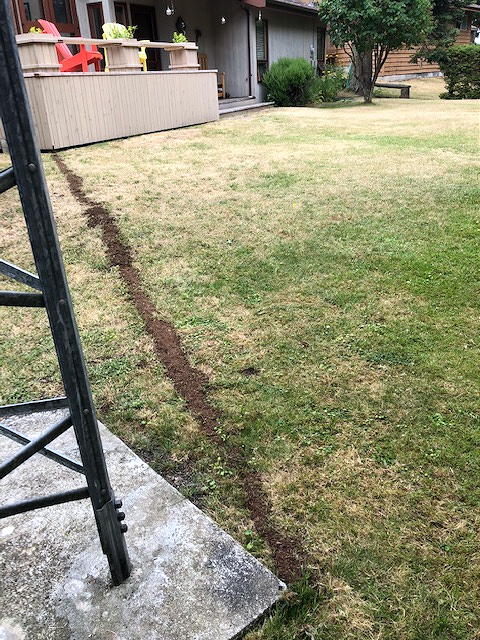
I had previously re-appropriated the loop’s coax for a nearby HF wire antenna and had been without the loop all winter.
After BCB DXer Mike Cherry (VE7SKA) on Salt Spring Island, the next island to the west of me, described some of the European action that he had experienced last winter, I am determined to not miss out during the next winter's BCB DX season!
 |
| 10' x 20' Loop & Wellbrook ALA100N Preamp |
Once getting the loop powered-up in mid-afternoon, I decided to give it a test by making a ‘deep-search’ on 1240 KHz.
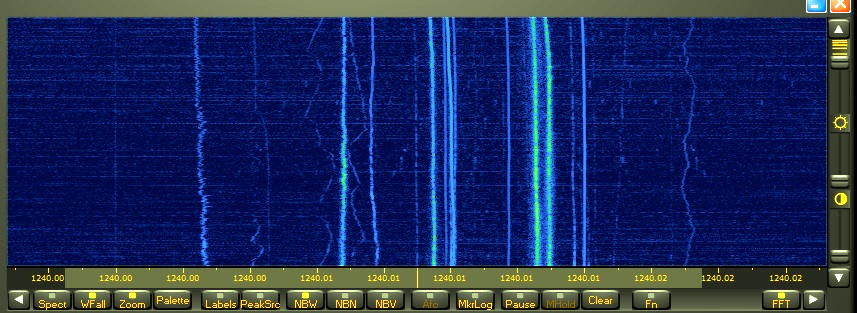
At 1500 hours local time, I wasn’t hearing any audio on 1240 but a weak carrier could be detected audibly. Using my Perseus SDR’s waterfall in its narrowest possible window, produces an extremely narrow passband, effectively increasing the sensitivity by a huge factor. This allows the waterfall to display weak signals that are presently being propagated to my location but far too weak to be heard by ear. I’m estimating that in this narrow bandwidth, it can dig about 30 dB or more into the noise, but there is a price to be paid for this extra gain .... time!
If you're used to watching your receiver’s waterfall scroll along quickly, this mode is just the opposite. It moves in very slow increments, allowing the weaker signals to build up enough to be visible before taking the next deep look. The screen capture shown below is a result of a three-hour listening period, from 1500-1800 hours local time. The entire waterfall is 25 Hz wide, with each tick representing 1Hz.
 |
| 3-Hour Daylight Deep Search |
Although no signals were clearly audible during this period, my deep-search revealed the carriers of ~28 different stations being received here in south-west British Columbia ... in the middle of a summer afternoon! It’s interesting to note that few of these signals are 100% stable and several can be seen really struggling to maintain their exact assigned frequency. In this highly narrow bandwidth view, even the worst drift amounts to no more than a Hertz, well within the required tolerance of +/- 20Hz.
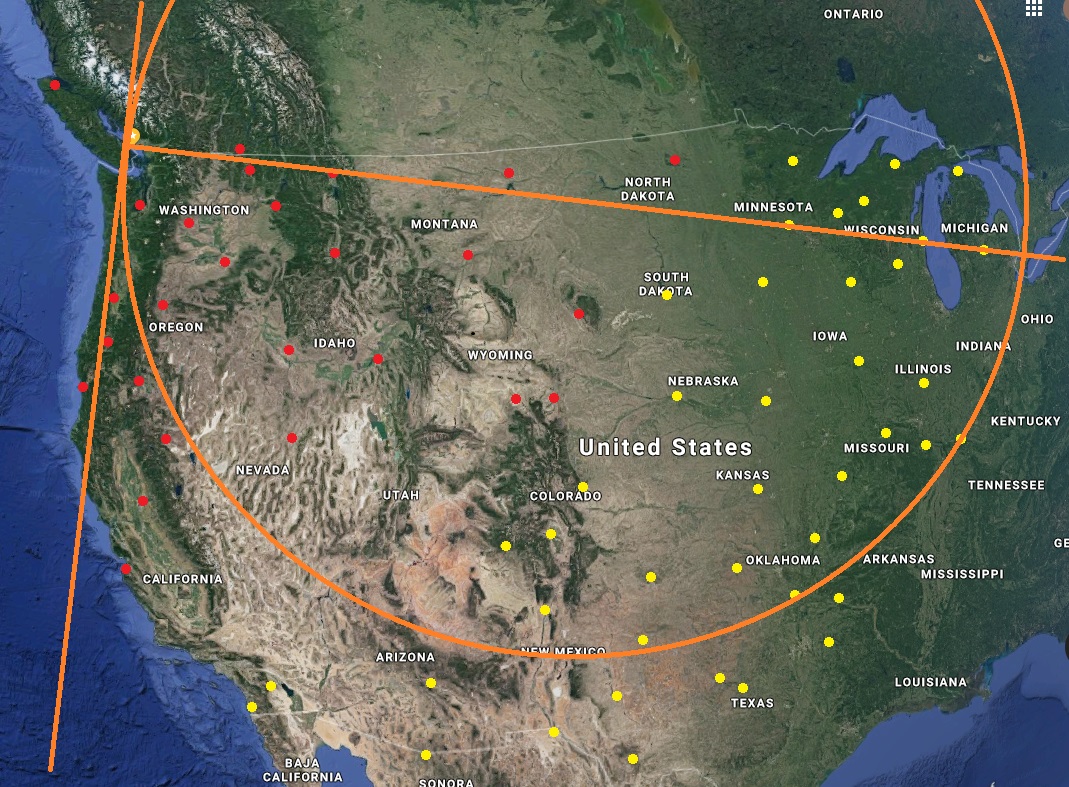
Using the always-reliable MWLIST, the locations of the most likely candidates for these 28 signals are plotted below. These are the 28 nearest stations and with my loop pointing east, a definite east / south-east flavour is evident.

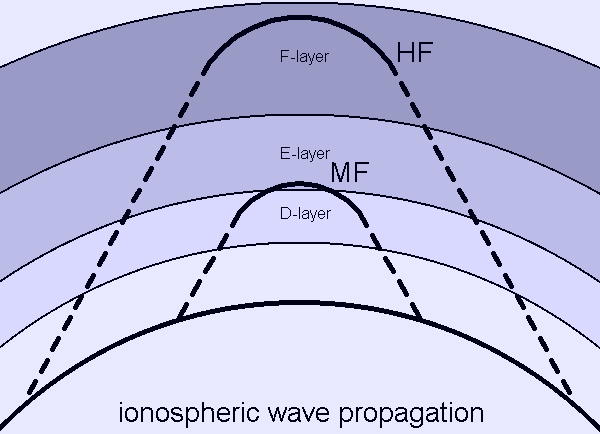
At mid afternoon, one might expect to see only groundwave-propagated signals on the broadcast band. Midday groundwave on the broadcast band can easily travel a few hundred kilometers, gradually growing weaker over the longer paths. Perhaps all of these signals are arriving via this mode as they are at least 20-30dB into the noise. I initially thought that some of the further-out signals were being reflected from a strong daytime D-layer, although most of the energy would be absorbed. Further reading shows detectable groundwave up to 1200km is possible which coincides nicely with the distances observed. Most likely what I'm seeing is a combination of extended groundwave and D-layer refraction on the furthest signals.
The second screen capture shows the same frequency for another three hours, starting about an hour before local sunset. Some of the weaker signals seen earlier now begin to grow in strength as the D-later absorption starts to decay and reveal the higher E-layer. By the end of the third hour, an additional 41 stations have appeared for a total of 69 carriers cantered on 1240 KHz. (note that my Perseus calibration is off by a few Hz)
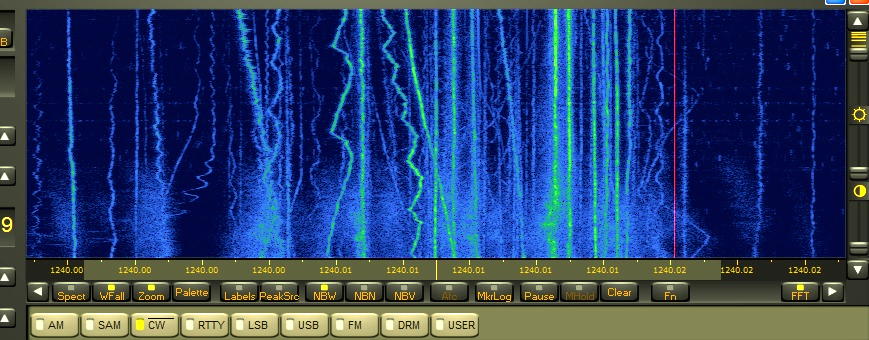 |
| 3-Hour Sunset Deep Search |
The next 41 closest stations are now plotted below in yellow, showing the most likely source of these signals. The distances illustrated are in-line with single and double-hop E-layer or possibly lower F-layer refraction.

This view shows the directional pattern of the front of the loop while pointing east, with its very broad circular lobe. In this direction, the narrow null is only seen along the coast.
It will be interesting to do a mid-winter follow-up on 1240 and compare the present summer propagation to the much better winter conditions. I expect that a some point, propagation via the higher F-layer will be present and extend skip distances out to the east coast or to South America.
In the meantime, things are almost ready for some pre-sunrise looks to the west and some overnight top-of-hour recordings ... as soon as I re-calibrate Perseus!
Steve McDonald, VE7SL, is a regular contributor to AmateurRadio.com and writes from British Columbia, Canada. Contact him at [email protected].
LHS Episode #292: Digital Operation Deep Dive
Welcome to Episode 292 of Linux in the Ham Shack. In this episode, the hosts are joined by Rob, KA2PBT, in a deep disucussion of digital mode operation on the amateur radio bands including what modes are available, the technology behind the creation and operation of those modes and even dive into current controversy behind FCC rules regarding encryption, PACTOR-4 and much more. Thank you for tuning in and we hope you have a wonderful week.
73 de The LHS Crew
Russ Woodman, K5TUX, co-hosts the Linux in the Ham Shack podcast which is available for download in both MP3 and OGG audio format. Contact him at [email protected].
Weekly Propagation Summary – 2019 Jul 15 16:10 UTC
Here is this week’s space weather and geophysical report, issued 2019 Jul 15 0223 UTC.
Highlights of Solar and Geomagnetic Activity 08 – 14 July 2019
Solar activity was at very low levels throughout the reporting period. Region 2744 (S27, Lo=209, class/area=Bxo/020 on 07 Jul) decayed to played by 08 Jul. A coronal dimming was observed in SDO/AIA 193 beginning around 14/0030 UTC from near the vicinity of old Region 2744 (S27W46). A subsequent CME signature associated with the event was observed in SOHO/LASCO C2 imagery beginning at 14//0236 UTC. The slow-moving, narrow and faint signature from the SW limb was modeled and the resulting WSA-Enlil output suggested no Earth-directed component was present.
No proton events were observed at geosynchronous orbit.
The greater than 2 MeV electron flux at geosynchronous orbit was at normal background levels on 08-09 Jul. An increase to moderate to high levels, in response to activity from a negative polarity CH HSS, was observed on 10 Jul and persisted through 14 Jul.
Geomagnetic field activity ranged from quiet to G1 (Minor) geomagnetic storm levels. An abrupt enhancement from a possible transient was observed at 08/1829 UTC. Total field increase from 4 to 10 nT and solar wind speeds increased from 300 km/s to a brief peak of 400 km/s resulting in an isolated period of active conditions. Late on 09 Jul, the onset of a positive polarity CH HSS increased wind speeds to a peak of 663 km/s and total field to 13 nT. G1 storm conditions followed a period of sustained southward Bz with values reaching as far south as -11 nT at 09/1845 UTC. A final period of G1 storm conditions was observed early on 10 Jul as influence from the CH HSS persisted. Quiet to unsettled levels on 11 Jul transitioned to quiet through the end of the reporting period as the solar wind returned to nominal levels.
Forecast of Solar and Geomagnetic Activity 15 July – 10 August 2019
Solar activity is expected to be at very low levels over the outlook period.
No proton events are expected at geosynchronous orbit.
The greater than 2 MeV electron flux at geosynchronous orbit is expected to range from normal background to high levels. High levels are expected from 15-18 Jul and 06-10 Aug; moderate levels are expected on 19-21 Jul; the remainder of the outlook period is expected to be at normal background levels. All enhancements in electron flux are expected due to the anticipation of multiple, recurrent CH HSSs.
Geomagnetic field activity is expected to range from quiet to active levels. Active levels are expected on 15-16 Jul and 05-06 Aug; unsettled levels are expected on 17 Jul, 28 Jul, 04 Aug and 07 Aug; the remainder of the outlook period is expected to be at quiet levels. All increases in geomagnetic activity are due to the anticipation of multiple, recurrent CH HSSs.
Don’t forget to visit our live space weather and radio propagation web site, at: http://SunSpotWatch.com/
Live Aurora mapping is at http://aurora.sunspotwatch.com/
If you are on Twitter, please follow these two users: 1. https://Twitter.com/NW7US 2. https://Twitter.com/hfradiospacewx
– – – – – – – – – – – – –
Be sure to subscribe to our space weather and propagation email group, on Groups.io
https://groups.io/g/propagation-and-space-weather
Spread the word!
– – – – – – – – – – – – –
Links of interest:
+ Amazon space weather books: http://g.nw7us.us/fbssw-aSWSC
+ https://Twitter.com/NW7US
+ https://Twitter.com/hfradiospacewx
Space Weather and Ham Radio YouTube Channel News:
I am working on launching a YouTube channel overhaul, that includes series of videos about space weather, radio signal propagation, and more.
Additionally, I am working on improving the educational efforts via the email, Facebook, YouTube, Tumblr, and other activities.
You can help!
Please consider becoming a Patron of these space weather and radio communications services, beginning with the YouTube channel:
https://www.patreon.com/NW7US
The YouTube channel:
https://YouTube.com/NW7US
..
Visit, subscribe: NW7US Radio Communications and Propagation YouTube Channel
 Ham Radio Deluxe |
 W5SWL Electronics |
 Ham Radio Prep |
 KB3IFH QSL Cards  Hip Ham Shirts  HamRadioAuctions HamRadioAuctions Reliance Antennas Reliance Antennas Enigma Shop Enigma Shop |  morseDX  Ni4L Antennas  R&L Electronics R&L Electronics antennas.us antennas.us QRV QRV |
- Matt W1MST, Managing Editor
