 |
 Hunting For NDBs In CLE249
 20 October 2019 | by
 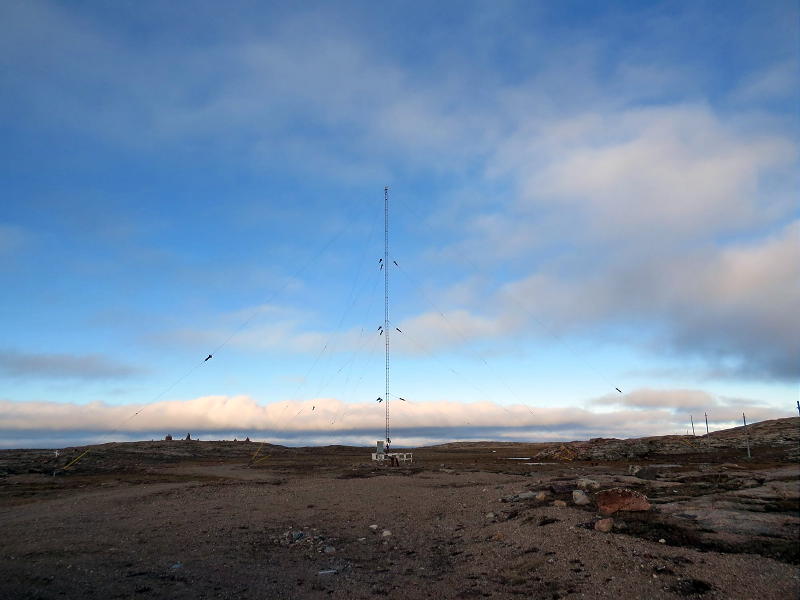 |
| YUT - 335 kHz (courtesy: VE3GOP) |
It's CLE time once again! This coming weekend the CLE hunting grounds will be 335.0 - 349.9 kHz.
For those unfamiliar with this monthly activity, a 'CLE' is a 'Co-ordinated Listening Event', as NDB DXers around the world focus their listening time on one small slice of the NDB spectrum.
If you've been meaning to participate in CLE, then maybe this weekend is a fine time to try! Lately, we've had a lot of first time submissions so you won't be alone!
As well, if you're trying to learn CW, copying NDBs is perfect practice as the identifier speed is generally slow and the letters are repeated again every few seconds!
A nice challenge in this one is to hear YUT - 335 kHz. 'YUT' is located at Repulse Bay, Nunavut, way up on Baffin Island.
'YUT' runs just 25W into a massive vertical and is well-heard throughout North America and parts of northern Europe. Listen for its upper-sideband CW identifier repeated every 10 seconds (with your receiver in the CW mode) on 335.406 kHz.
At this time of the season, summer lightning storms should be drawing down significantly and with some decent propagation there will be many stations to be logged.
When tuning for NDBs, put your receiver in the CW mode and listen for the NDB's CW identifier, repeated every few seconds. Listen for U.S. NDB identifiers approximately 1 kHz higher or lower than the published transmitted frequency since these beacons are modulated with a 1020 Hz tone approximately.
For example, 'AA' near Fargo, ND, transmits on 365 kHz and its upper sideband CW identifier is tuned at 366.025 kHz while its lower sideband CW ident can be tuned at 363.946 kHz. Its USB tone is actually 1025 Hz while its LSB tone is 1054 Hz.
Often, one sideband will be much stronger than the other so if you don't hear the first one, try listening on the other sideband.
Canadian NDBs normally have an USB tone only, usually very close to 400 Hz. They also have a long dash (keydown) following the CW identifier.
All NDBs heard in North America will be listed in the RNA database (updated daily) while those heard in Europe may be found in the REU database. Beacons heard outside of these regions will be found in the RWW database.
From CLE organizer Brian Keyte, G3SIA, comes the details:
Hello all
Our 249th Co-ordinated Listening Event is less than a week away.
Just a normal CLE using a busy range of frequencies.
First-timers' CLE logs will also be very welcome, as always.
Days: Friday 25 October - Monday 28 October
Times: Start and end at midday, your LOCAL time
Range: 335.0 - 349.9 kHz
Please join us wherever you are - just log the NDBs you can identify
having their nominal frequencies in the range (it includes 335 kHz
but not 350 kHz) and any UNIDs that you come across there too.
We last concentrated on these frequencies in CLE233 (June 2018).
Please read the 'Final Details' which will follow on Wednesday.
73 Brian
(Reminder: You could use any one remote receiver for your loggings,
stating its location and owner - with their permission if required.
A remote listener may NOT also use another receiver, whether local
or remote, to obtain further loggings for the same CLE).
- determine, worldwide, which beacons are actually in service and on-the-air so the online database can be kept up-to-date
- determine, worldwide, which beacons are out-of-service or have gone silent since the last CLE covering this range
- will indicate the state of propagation conditions at the various participant locations
- will give you an indication of how well your LF/MF receiving system is working
- give participants a fun yet challenging activity to keep their listening skills honed
The NDB List Group is a great place to learn more about the 'Art of NDB DXing' or to meet other listeners in your region. There is a lot of good information available there and new members are always very welcome. As well, you can follow the results of other CLE participants from night to night as propagation is always an active topic of discussion.
You need not be an NDB List member to participate in the CLEs and all reports, no matter how small, are of much value to the organizers.
Remember - 'First-time' logs are always VERY welcome!
Reports may be sent to the NDB List Group or e-mailed to CLE co-ordinator, Brian Keyte (G3SIA), whose address appears above. If you are a member of the group, all final results will also be e-mailed and posted there.
Please ... give the CLE a try ... then let us know what NDB's can be heard from your location! Your report can then be added to the worldwide database to help keep it up-to-date.
Have fun and good hunting!
Steve McDonald, VE7SL, is a regular contributor to AmateurRadio.com and writes from British Columbia, Canada. Contact him at [email protected].
ICQ Podcast Episode 309 – Propagation Tools and Contest Validation
In this episode, Martin Butler (M1MRB/W9ICQ) discusses Propogation Tools with Steve Nicol G0KYA and finds out how the RSGB has modernised the adjudication of RSGB Contests for faster, more accurate results with Simone Wilson M0BOX.
ICQ AMATEUR/HAM RADIO PODCAST DONORS
We would like to thank Jim Thompson (2E0FOA) and our monthly and annual subscription donors for keeping the podcast advert free. To donate, please visit - http://www.icqpodcast.com/donate
- 2019 Construction Competition Winners
- New On the Air Magazine
- Concern and Confusion in California’s Amateur Radio Ranks
- Apply now to run GB19YOTA
Colin Butler, M6BOY, is the host of the ICQ Podcast, a weekly radio show about Amateur Radio. Contact him at [email protected].
Endfed vs Nor’easter!
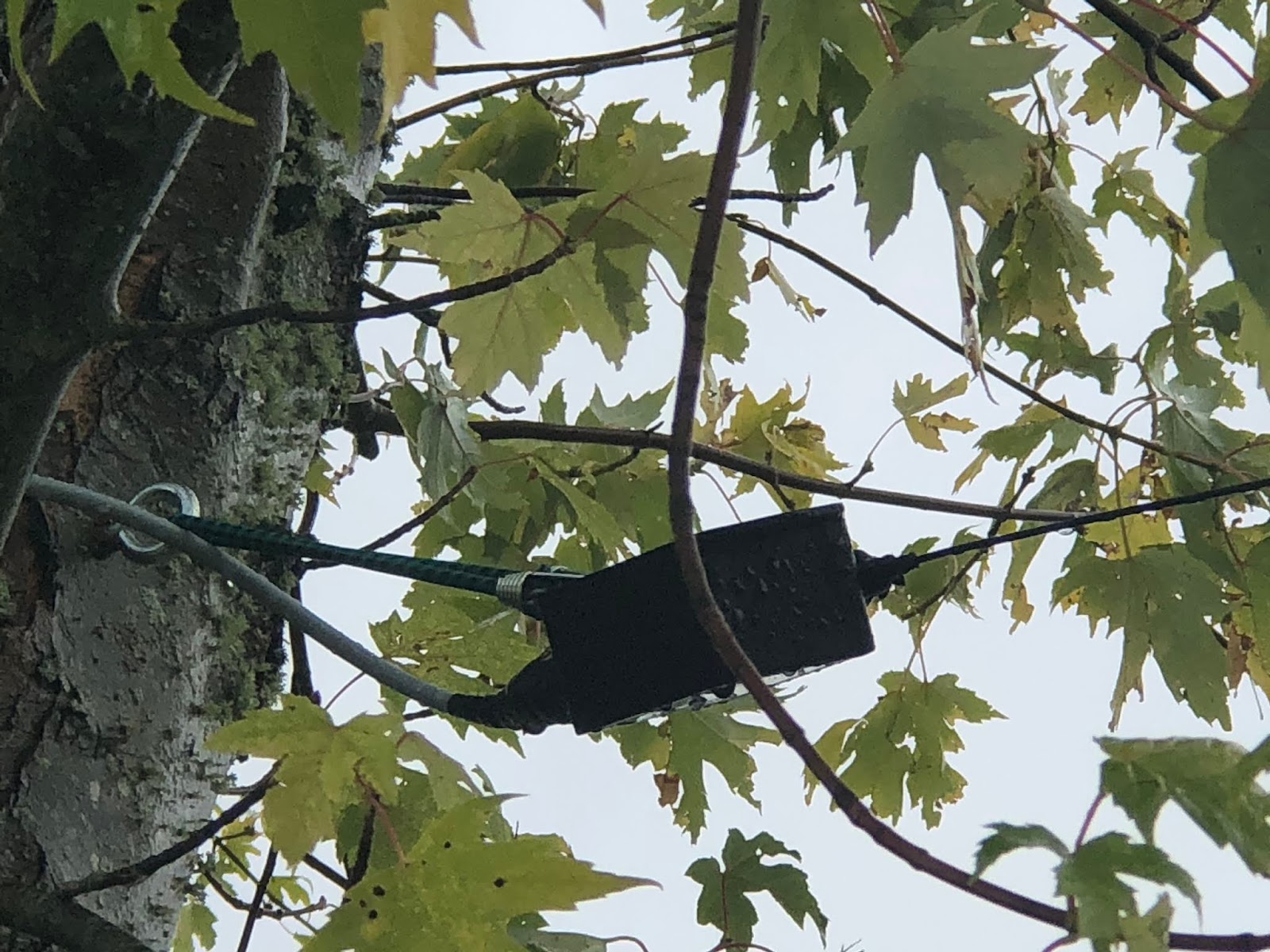
Now back to wind vs Endfed antenna, the 9:1 balun enclosure is mounted in a tree with the other end mounted at the shed. Before putting up the antenna I had to devise a way of overcoming the tree sway and the stress it would put on the antenna. I thought about using a spring but when I went to the hardware store here in town there were none I felt would flex before any stress was placed on the antenna, the springs just had to have to much tension before they would start to flex. A comment I received on my blog regarding this very issue was to use bungee cord. These were easy to come by at the hardware store and I decided to use it. My installation consisted of 2 bungee cords just incase one became effective and let go.
Today as the wind gusts picked up I noticed the tree that the 9:1 balun was on was swaying a lot but the bungee took up the flex and allowed the Endfed to hardly even move. Up to this point in time the Endfed only had to deal with a slight breaze but today it was put to the test and it passed without issue.
Mike Weir, VE9KK, is a regular contributor to AmateurRadio.com and writes from New Brunswick, Canada. Contact him at [email protected].
First SOTA Activation of W0C/SP-020 (Talus)
While looking for our next SOTA adventure, I noticed a never-been-activated, unnamed 13er (W0C/SP-020) to the west of Mount Princeton. I checked various maps and it looked like there was a 4WD forest service road that went up to the adjacent saddle. So Joyce/K0JJW and I decided to give it a try.

We took County Road 306 west out of Buena Vista, towards Cottonwood Pass. Then we turned left onto County Road 344 which goes to Cottonwood Lake. We continued past Cottonwood Lake until we found FS 348, also known as Hope Gulch Road. We followed this road for 5 miles to the saddle.

The road was easy-peasy 4WD, no problem at all with our stock Jeep Wrangler. A Suburu-class SUV can probably make it but there are a few rocky spots on the road that will require special care. There were two water crossings, one of them with about a foot of water (across Cottonwood Creek). Now this was mid-October, so the streams are not running real strong. Earlier in the year, this could be a major hazard.
Warning: water crossing at Cottonwood Creek.

FS 348 is single lane, with long stretches without an easy passing or turnaround spot. We were happy that we only saw two other vehicles on the road.
Talus
We drove a bit past the saddle (where there is a small hut/cabin) and parked where a closed side road heads off toward the summit. We hiked up this closed and then vectored off towards the summit. The hike was only 0.6 miles and 800 vertical feet. However, there was quite a bit of talus to climb over which really slowed us down. The hiking route does not seem critical but following the top of the ridge seemed to be good.

Yeah, about the talus. It isn’t any worse than other rocky summits in Colorado but it seemed to catch our attention, usually in the form of “ok, I’ve just about had it with this talus.” A contributing factor was that both Joyce and I had foot/ankle injuries in recent years. So our unofficial name for this summit became Talus.


Joyce/K0JJW took the honors of completing the first SOTA activation of this summit by contacting Bob/W0BV on 2m FM. We also both logged these stations: KD0MRC, W0RW, W6JM, W0LSD and N0AJN.

We sat there quite a while just taking in the view. Mt Princeton is due east; Mt Antero and Mt White are to the south.

You never know what your gonna get on the first activation of a summit. On this one, it turned out to be a fantastic day. The weather was sunny, temperature about 40 degrees, a little too windy at times. Late in the season, we didn’t have to worry about thunderstorms moving in and blowing us off the mountain. I liked the combination of a good 4WD road, heart-pumping but not-too-difficult hike, a first-time SOTA activation and doing it all with my favorite hiking partner (and wife).
73 Bob K0NR
The post First SOTA Activation of W0C/SP-020 (Talus) appeared first on The KØNR Radio Site.
Bob Witte, KØNR, is a regular contributor to AmateurRadio.com and writes from Colorado, USA. Contact him at [email protected].
Weekly Propagation Summary – 2019 Oct 14 16:10 UTC
Here is this week’s space weather and geophysical report, issued 2019 Oct 14 0407 UTC.
Highlights of Solar and Geomagnetic Activity 07 – 13 October 2019
Solar activity was very low. The solar disk was spotless. No Earth-directed coronal mass ejections (CMEs) were observed.
No proton events were observed at geosynchronous orbit.
The greater than 2 MeV electron flux at geosynchronous orbit was at moderate levels on 08-13 Oct and at high levels on 07 Oct. The maximum flux of the period was 1,930 pfu observed at 07/1745 UTC.
Geomagnetic field activity ranged from quiet to active levels. The period started off at nominal levels with solar wind speeds in the 350-405 km/s range. by 09 Oct, total field increased to 11 nT at 09/2135 UTC followed by an increase in solar wind speed to approximately 490 km/s as a weak negative polarity coronal hole high speed stream (CH HSS) moved into geoeffective positon. Solar wind speed remained enhanced through late on 11 Oct. The geomagnetic field responded with quiet to active conditions on 09-10 Oct and quiet to unsettled levels on 11 Oct.
Forecast of Solar and Geomagnetic Activity 14 October – 09 November 2019
Solar activity is expected to continue at very low levels.
No proton events are expected at geosynchronous orbit.
The greater than 2 MeV electron flux at geosynchronous orbit is expected to reach moderate levels on 16 and 24 Oct and again on 04-09 Nov. High levels are expected on 14-15 Oct and on 25 Oct-03 Nov due to recurrent CH HSS influence.
Geomagnetic field activity is expected to reach unsettled levels on 14-15 Oct due to possible weak CH HSS effects. Unsettled to active levels are expected on 21 Oct and 24-28 with G1 (Minor) geomagnetic storm levels likely on 24-25 Oct due to recurrent CH HSS effects.
Don’t forget to visit our live space weather and radio propagation web site, at: http://SunSpotWatch.com/
Live Aurora mapping is at http://aurora.sunspotwatch.com/
If you are on Twitter, please follow these two users: 1. https://Twitter.com/NW7US 2. https://Twitter.com/hfradiospacewx
– – – – – – – – – – – – –
Be sure to subscribe to our space weather and propagation email group, on Groups.io
https://groups.io/g/propagation-and-space-weather
Spread the word!
– – – – – – – – – – – – –
Links of interest:
+ Amazon space weather books: http://g.nw7us.us/fbssw-aSWSC
+ https://Twitter.com/NW7US
+ https://Twitter.com/hfradiospacewx
Space Weather and Ham Radio YouTube Channel News:
I am working on launching a YouTube channel overhaul, that includes series of videos about space weather, radio signal propagation, and more.
Additionally, I am working on improving the educational efforts via the email, Facebook, YouTube, Tumblr, and other activities.
You can help!
Please consider becoming a Patron of these space weather and radio communications services, beginning with the YouTube channel:
https://www.patreon.com/NW7US
The YouTube channel:
https://YouTube.com/NW7US
..
Visit, subscribe: NW7US Radio Communications and Propagation YouTube Channel
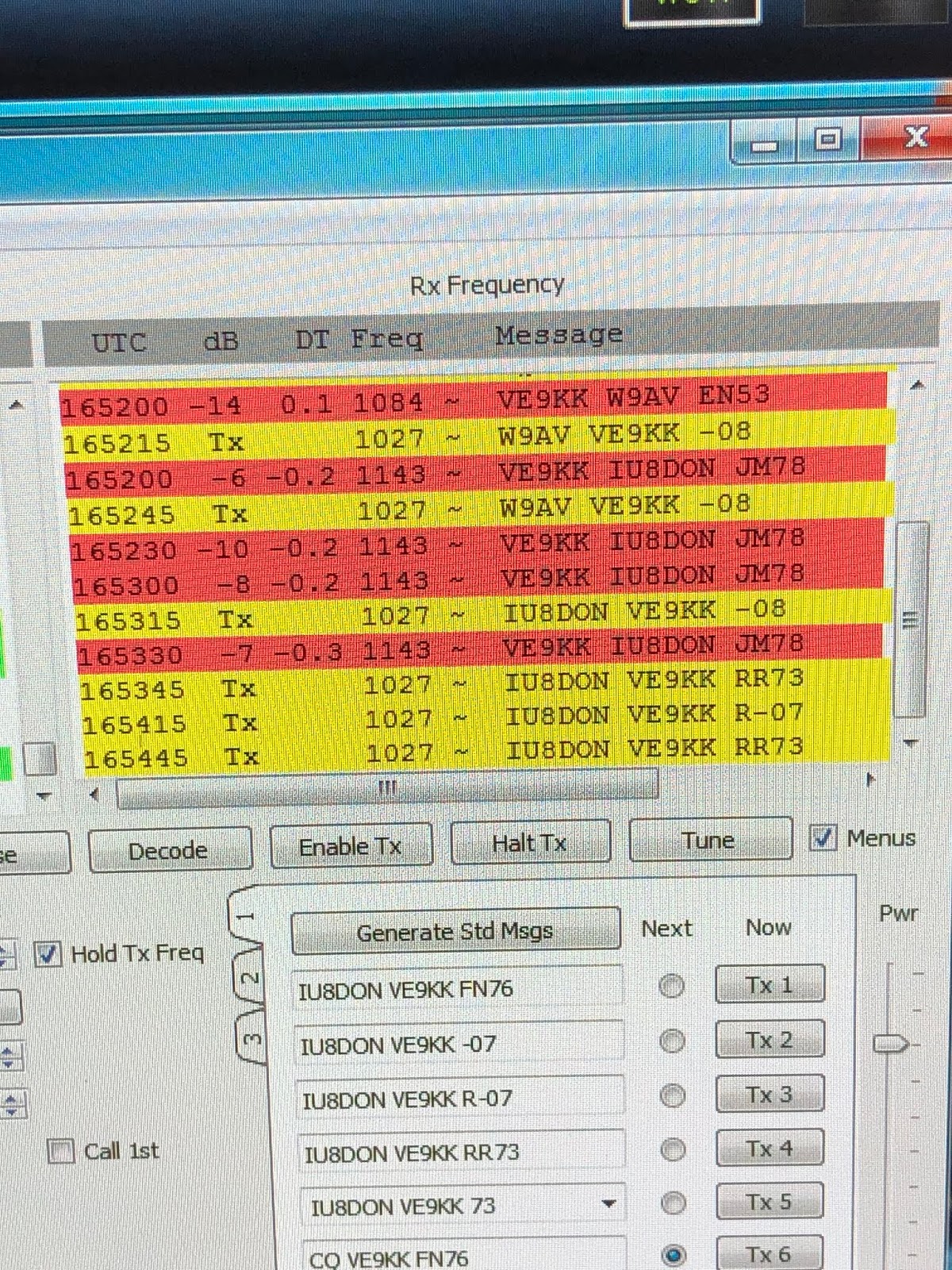
My first contact as VE9KK
Mike Weir, VE9KK, is a regular contributor to AmateurRadio.com and writes from New Brunswick, Canada. Contact him at [email protected].
AmateurLogic 135: Happy 14th Birthday ALTV
AmateurLogic.TV Episode 135 is now available for download.
October marks the 14th Anniversary of AmateurLogic.TV. We celebrate the event by awarding one lucky viewer an Icom IC-7300 transceiver with all the accessories you need for a complete HF station.
Peter’s back for the party with an update on what he’s been up to and details of his Friedrichshofen Germany Hamfest visit.
Tommy has tips for easily configuring the MFJ-1234 RigPi Stations Server.
Why fatigue your ears unnecessarily? Get the noise out with Emile’s guide to proper RF Gain adjustment.
Enjoy quick and friendly HF operation. George has the details on how to combine a HF Transceiver with a SDR Play and MFJ SDR T/R Switch for complementary interaction.
1:49:44
George Thomas, W5JDX, is co-host of AmateurLogic.TV, an original amateur radio video program hosted by George Thomas (W5JDX), Tommy Martin (N5ZNO), Peter Berrett (VK3PB), and Emile Diodene (KE5QKR). Contact him at [email protected].
 Ham Radio Deluxe |
 W5SWL Electronics |
 Ham Radio Prep |
 KB3IFH QSL Cards  Hip Ham Shirts  HamRadioAuctions HamRadioAuctions Reliance Antennas Reliance Antennas Enigma Shop Enigma Shop |  morseDX  Ni4L Antennas  R&L Electronics R&L Electronics antennas.us antennas.us Ears to Our World Ears to Our World |
- Matt W1MST, Managing Editor
