 |
 Time to get some ham bucks.
 3 January 2020 | by
  |
| Getting the AT-100pro ready to sell. |
Mike Weir, VE9KK, is a regular contributor to AmateurRadio.com and writes from New Brunswick, Canada. Contact him at [email protected].
AmateurLogic 2019 New Years Eve Live Stream Incident
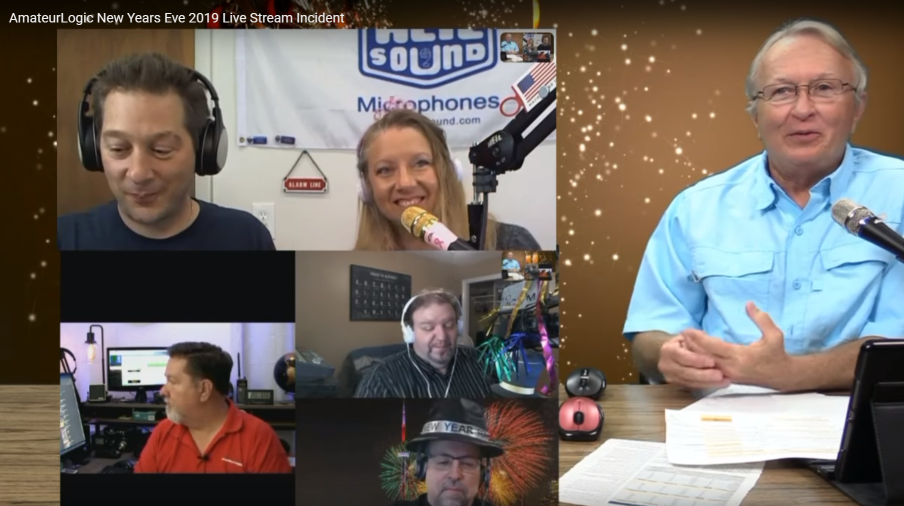
This is the raw, unedited video from the New Years Eve 2019 live stream. It is over 6 hours long contains plenty of bloopers and mishaps (the kind of stuff you’ve come to expect from us). The first 2 hours are a replay of an earlier episode and the team getting set up to go.
The live show actually began around the 2:13:30 mark.
Appearances by:
George Thomas, W5JDX
Tommy Martin, N5ZNO
Emile Diodene, KE5QKR
Andy Anderson, AA0WX
Laird Nigel P Lawrence, G0MEJ/KG0PL
Dan Vanevenhoven, N9LVS
Ray Novak, N9JA
Peter Berrett, VK3PB
Amanda Alden, K1DDL
Jeff Carrier, K0JDX
George Thomas, W5JDX, is co-host of AmateurLogic.TV, an original amateur radio video program hosted by George Thomas (W5JDX), Tommy Martin (N5ZNO), Peter Berrett (VK3PB), and Emile Diodene (KE5QKR). Contact him at [email protected].
Top Five K0NR Blog Posts for 2019

Closing out 2019, here are the top five blog posts at k0nr.com during the year. Some people may see this as a lazy way of creating one more blog post for the year without much work. This may be true, but I still claim it is a worthy effort to take a look at what content got the most attention for the year.
Leading the list is this blog post…a perennial favorite that seems to make the top five each year.
Getting Started on 2m SSB
Another popular post that just keeps on going is…
Choose Your 2m Frequency Wisely
A new post this year about VHF propagation comes in third. I am glad to see some new content getting attention.
The Myth of VHF Line-Of-Sight
A bit of a surprise that this post about two proposals for changes to the FCC licensing scheme is in the number four slot:
FCC Considers Changes to Amateur Radio Licensing
Editor’s Choice
This last one was published in December so it didn’t actually make the top five for the year. However, every time I look at this photo, it gives me a chuckle, so I am including on the list as the Editor’s Choice.

Innovation in Vehicle Labeling
Happy New Year!
73 Bob K0NR
The post Top Five K0NR Blog Posts for 2019 appeared first on The KØNR Radio Site.
Bob Witte, KØNR, is a regular contributor to AmateurRadio.com and writes from Colorado, USA. Contact him at [email protected].
Ham College 60
Ham College episode 60 is now available for download.
General Amateur Radio Exam part 31. The final episode covering the General pool. General question pool updates 3 of 3.
01:05:36
George Thomas, W5JDX, is co-host of AmateurLogic.TV, an original amateur radio video program hosted by George Thomas (W5JDX), Tommy Martin (N5ZNO), Peter Berrett (VK3PB), and Emile Diodene (KE5QKR). Contact him at [email protected].
Weekly Propagation Summary – 2019 Dec 30 16:10 UTC
Here is this week’s space weather and geophysical report, issued 2019 Dec 30 0435 UTC.
Highlights of Solar and Geomagnetic Activity 23 – 29 December 2019
Solar activity was very low. New Region 2753 (S29, L=122, class/area Bxo/010 on 25 Dec) developed on the visible disk on late on 23 December while Region 2754 (N25, L=191, class/area Axx/010 on 25 Dec) developed on 24 Dec. Both regions were inactive and decayed to plage on 26 Dec. No Earth-directed CMEs were observed during the period.
No proton events were observed at geosynchronous orbit.
The greater than 2 MeV electron flux at geosynchronous orbit was at normal levels on 27-29 Dec and reached moderate levels on 23-26 Dec. The maximum flux of the period was 462 pfu observed at 25/1810 UTC.
Geomagnetic field activity ranged from quiet to unsettled levels. A slight enhancement in solar wind parameters occurred beginning late on 25 Dec as a weak negative polarity coronal hole high speed stream (CH HSS) became geoeffective. Total field increased to a maximum of 9 nT at 25/1920 UTC while solar wind speed reached a maximum of 415 km/s at 26/1435 UTC. The geomagnetic field responded with an isolated unsettled period early on 26 Dec.
Forecast of Solar and Geomagnetic Activity 30 December – 25 January 2020
Solar activity is expected to continue at very low levels.
No proton events are expected at geosynchronous orbit.
The greater than 2 MeV electron flux at geosynchronous orbit is expected to be at normal levels on 06-14 and 23-25 Jan while moderate levels are expected on 30 Dec-05 Jan and 15-22 Jan.
Geomagnetic field activity is expected to reach unsettled levels on 30 Dec-01 Jan due to weak CH HSS activity. Unsettled to active levels are expected on 14-15 Jan due to recurrent CH HSS activity.
Don’t forget to visit our live space weather and radio propagation web site, at: http://SunSpotWatch.com/
Live Aurora mapping is at http://aurora.sunspotwatch.com/
If you are on Twitter, please follow these two users: 1. https://Twitter.com/NW7US 2. https://Twitter.com/hfradiospacewx
– – – – – – – – – – – – –
Be sure to subscribe to our space weather and propagation email group, on Groups.io
https://groups.io/g/propagation-and-space-weather
Spread the word!
– – – – – – – – – – – – –
Links of interest:
+ Amazon space weather books: http://g.nw7us.us/fbssw-aSWSC
+ https://Twitter.com/NW7US
+ https://Twitter.com/hfradiospacewx
Space Weather and Ham Radio YouTube Channel News:
I am working on launching a YouTube channel overhaul, that includes series of videos about space weather, radio signal propagation, and more.
Additionally, I am working on improving the educational efforts via the email, Facebook, YouTube, Tumblr, and other activities.
You can help!
Please consider becoming a Patron of these space weather and radio communications services, beginning with the YouTube channel:
https://www.patreon.com/NW7US
The YouTube channel:
https://YouTube.com/NW7US
..
Visit, subscribe: NW7US Radio Communications and Propagation YouTube Channel
“BEST REGARDSES” AND “BEST REGARDS’S”

Meme: Car and Woman Arguing, 73
“Best regardses” and “Best regards’s”
That’s silly, of course. We who speak and write in the English language know that you should not pluralize a word that is already in its plural form. “Best regards” means, “I wish you the best of regards.” It is implied that there is more than one regard. Perhaps there are a few, perhaps many more. It then is clear that we wouldn’t normally pluralize “regards,” into, “regardses.”
It is also silly to say that the best of regards owns something. How can a regard let alone a group of regards own anything? So, why “73’s” when written?

Old SWLer QSL Card With 73’s
The usage of “73” comes from early landline telegraph (typically railroad telegraphy landlines). Originally devised in the era of telegraphs, 73 and other numbers were used to speed up the transmission of common messages over landlines by mapping common messages to these specific numbers. And, numbers were quicker to send than the longer messages the numbers replaced.
QST, April 1935, on page 60, contains a short article on the origin of the amateur radio vernacular, 73. This article was a summation of another article that appeared in the “December Bulletin from the Navy Department Office of the Chief of Naval Operations,” published December of 1934.

A skilled landline Morse code operator, in action.
Here’s a quotation from that Navy article:
“It appears from a research of telegraph histories that in 1859 the [land-line] telegraph people held a convention, and one of its features was a discussion as to the saving of ‘line time.’
A committee was appointed to devise a code to reduce standard expressions to symbols or figures. This committee worked out a figure code, from figure 1 to 92.
Most of these figure symbols became obsolescent, but a few remain to this date, such as 4, which means “Where shall I go ahead?’. Figure 9 means ‘wire,’ the wire chief being on the wire and that everyone should close their keys. Symbol 13 means ‘I don’t understand’; 22 is ‘love and a kiss’; 30 means ‘good night’ or ‘the end.’
The symbol most often used now is 73, which means ‘my compliments’ and 92 is for the word ‘deliver.’ The other figures in between the forgoing have fallen into almost complete disuse.”
We can see, then, that “73” mapped to “best regards” or “my compliments” and was intended as a general valediction for transmitted messages. That’s why it is silly to say, “73s,” as that maps to, “best regardses” – 73s adds the plural to a plural. (And, don’t make it possessive, as in using, “73’s” – a regard cannot own something).

Cartoon: Jeeves, there is no plural for 73…
For reference and some more interesting background on this, see http://www.signalharbor.com/73.html
An example of on-the-air conversation (or, QSO—“QSO” is the shorthand Q-code for, “two-way exchange of communications”) illustrates proper usage of 73. When saying your goodbye, you would tap out the Morse code as follows:
TNX FER FB QSO. C U AGN. 73 ES HPY NEW YR.
That is interpreted as, “Thanks for the fine-business chat. I hope to see you again for another chat. Best regards and happy new year.”
This, if you choose to throw around shorthand Morse code number codes when you are speaking, you wouldn’t say, “73s.” You would say, “73.”

The Old Man Hiram Percy Maxim 1AW used 73’s on his QSL cards.
My friend, David Edenfield, opined, “This idea is beyond turning into glue from the dead horse it’s beating again. This is so petty to be concerned with this. Even the Old Man Hiram Percy Maxim 1AW used 73s on his QSL cards.”
Well, even Hiram Percy Maxim has been incorrect and incorrectly used grammar. (chuckle)
There is something to be said about teaching new amateur radio operators the best of our traditions, history, skills, procedures, protocols, ethics, and culture. There’s no rational argument that can make a case that allowing these aspects of our service and hobby to degrade over time (by the lack of Elmering) is a good way to see our service and hobby thrive and progress.
I don’t see any slippage from high standards as being a good strategy for nurturing growth, progress, and effectiveness of our service and hobby. Keeping some level of excellence in every aspect of our hobby can only be beneficial.
In this case, how many new hams that learn to repeat ham lingo know anything of the history behind the common “73?” My dead horse turned glue is educational and it is my belief that educating about origins elevates the current.
73 – NW7US

NW7US QSL Card (circa 2019)
..
Visit, subscribe: NW7US Radio Communications and Propagation YouTube Channel
Merry Christmas and Happy New Year!

The next change was the location...... Julie and I both agreed that living in downtown Toronto was nice but it was time for a change. A slower pace was very agreeable to us both, so we decided to move to the east coast of Canada. We sold our condo in Toronto and purchased a home in New Brunswick and started to pack and move. I have to be honest I have NEVER made this many decisions in a single year in my entire life.
Fast-forward to the present.....we are settled in New Brunswick and my new call is a 2 letter call VE9KK. In Ontario, 2 letter calls are very very hard to get. In New Brunswick, I had a choice of 2 letter call signs. I chose a call that had good CW qualities. I have put up an EndFed antenna the property is small and the Endfed was my desk drawer taking up space, so I decided to put it into service. I'm now in my 5th month in New Brunswick and to date, I have logged 447 contacts as VE9KK and the first months at the new QTH I was unpacking and setting the house up. My first contact was on October 13 with IU8DON and since then I have logged more contacts in two and a half months than the first 7 months of 2019 as VE3WDM, I made a total of 311 contacts so it looks like retirement is treating me well in regard to my radio hobby.
I'm Looking forward to 2020 and what are my goals.......I want to look into the CWops cw academy program as this is really the only option I have found that works and can get my code on the upswing. Get involved with the local amateur radio club in town the Moncton Amateur radio club or MAARC. I would like to explore contacting some DXpeditions both CW and FT8 and or FT4. The above goals seem like a good start for the year as I don't want to go overboard with one hopeful goal after the other.
Merry Christmas and Happy New Year to all my blog readers.
Mike Weir, VE9KK, is a regular contributor to AmateurRadio.com and writes from New Brunswick, Canada. Contact him at [email protected].
 Ham Radio Deluxe |
 W5SWL Electronics |
 Ham Radio Prep |
 KB3IFH QSL Cards  Hip Ham Shirts  HamRadioAuctions HamRadioAuctions Reliance Antennas Reliance Antennas Enigma Shop Enigma Shop |  morseDX  Ni4L Antennas  R&L Electronics R&L Electronics antennas.us antennas.us Ears to Our World Ears to Our World |
- Matt W1MST, Managing Editor
