 |
 Hunting For NDBs In CLE256
 20 May 2020 | by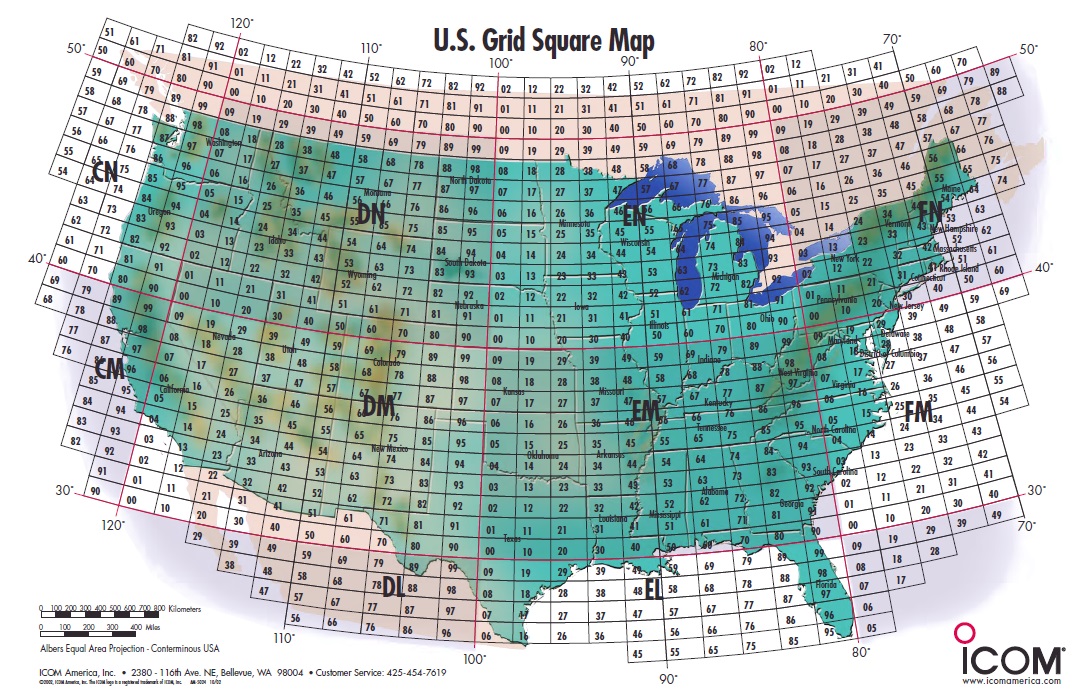
CLE 256 will be held this coming weekend and will be somewhat different than normal.
'CLE's are 'Co-ordinated Listening Events, and NDB DXers around the world focus their listening time on one small slice of the NDB spectrum ... but this one is a little different.
This event has been organized around the Maidenhead Locator system and will challenge hunters to log beacons based upon the beacon's FIELD designation. Listeners should seek to log a maximum of five NDBs in each GRID FIELD.
The grid field is actually the first two letters of the grid locator, such as 'CN', 'FN', 'DM' etc., as seen in the map above. Each field itself is divided into 100 GRID SQUARES, but individual grid squares are not relevant for this CLE ... only the fields.
Most amateurs that operate on the VHF bands are very familiar with the 'grid square locator' system and many VHF operating awards and events are focused on working different grid squares. This may all be a new adventure for many non-VHF DXers but it does present a whole new way of keeping track of your catches.
I have always kept track of the grid square locator for all NDB signals that I hear and often find that a signal being heard from one particular square will lead to other beacons being heard (often new catches) from adjacent squares, while propagation is spotlighting that region ... it often pays to keep a grid square map handy while you search the band!
If you are not familiar with the grid square system, it's all pretty simple and this CLE only focuses on the largest part of the system, the FIELD. The first thing you should do is determine your own grid FIELD location, which, for North America, can be found very easily from the map above or anywhere in the world on K7FRY's locator map.
When tuning for NDBs, put your receiver in the CW mode and listen for the NDB's CW identifier, repeated every few seconds. Listen for U.S. NDB identifiers approximately 1 kHz higher or lower than the published transmitted frequency since these beacons are modulated with a 1020 Hz tone approximately.
For example, 'AA' near Fargo, ND, transmits on 365 kHz and its upper sideband CW identifier is tuned at 366.025 kHz while its lower sideband CW ident can be tuned at 363.946 kHz. Its USB tone is actually 1025 Hz while its LSB tone is 1054 Hz.
Often, one sideband will be much stronger than the other so if you don't hear the first one, try listening on the other sideband.
Canadian NDBs normally have an USB tone only, usually very close to 400 Hz. They also have a long dash (keydown) following the CW identifier.
All NDBs heard in North America will be listed in the RNA database (updated daily) while those heard in Europe may be found in the REU database. Beacons heard outside of these regions will be found in the RWW database.
From CLE organizer Brian Keyte:
===============================================
Hello all
Here are the Final Details for this weekend's special DX Listening Event.
We'll be listening for up to 5 NDBs in as many Locator FIELDS as we can.
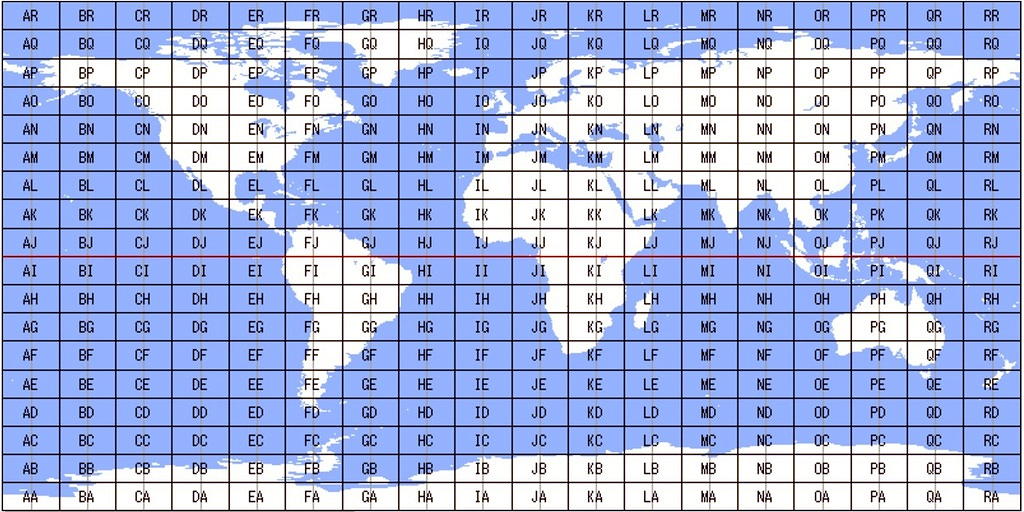
Fields are the first 2 letters of the 6 character locators ('Grid Square').
A World map of all the locator Fields is shown below:
 |
| (click map to expand) |
You can see, for example, that Field IO includes most of the British Isles.
Days: Friday 22nd May – Monday 25th May
Times: Midday on Friday to Midday on Monday, LOCAL time at the RX
QRG: Normal LF/MF frequencies (190 - 1740 kHz)
Target: UP TO 5 NORMAL NDBs IN EACH LOCATOR FIELD (see below)
(not DGPS, NAVTEX, Amateur or UNIDs)
Please also log YOUR NEAREST ACTIVE NDB - that will probably be one
of the five in your own Field.
Please post your CLE log to the List in a plain text email if possible, with
'CLE256 FINAL' at the start of its title and showing on each log line:
The full Date ( e.g. 2020-05-22, etc., or just the day number 22 )
UTC (The day changes at 00:00 UTC).
kHz - the NDB's nominal published frequency
The Call Ident.
As always, put those FOUR MAIN ITEMS FIRST on each log line, with any other optional details such as location and distance LATER in the same line.
There is no need to show the locator Fields (the harvester program will work out all of them and the nearest NDB you logged).
Your log will be easier to read if you group your loggings by Locator Field
and leave a blank separator line between the groups of up to 5 lines for each Field. If you wish, you could add the 2-letter Field ident (NOTHING ELSE) at the start of each of the separator lines.
UNIDs that you come across may also be of interest - in a SEPARATE part
of your log please.
If you send interim logs, please make sure that you also send a 'FINAL' log
showing ALL your loggings for the CLE.
We will send the usual 'Any More Logs?' email to NDB List at about
19:00 UTC on Tuesday so you can see that your log has been found OK.
Do make sure that your Final log has arrived on the list by 08:00 UTC on
Wednesday 27th May at the very latest.
Joachim and I hope to complete the combined results within two days or so.
PLANNING YOUR LISTENING
It will really help you to plan your listening if you go to the excellent
Rxx Database https://www.classaxe.com/dx/ndb/reu (Europe)
(Replace the 'reu' by 'rna' if you are in North America, 'rww' elsewhere)
THE KEY PLACE to start entering details of what you want is 'Signal
Locations - GSQs'.
Put a 2-letter FIELD id in that box to see all the NDBs in that Field that
have been logged from your part of the World (i.e. EU or NA or other).
You could choose to alter the resulting list in lots of different ways:
Select 'Only active' (bottom right).
Enter your own Country or State in 'Heard Here'.
Select a specific listener (yourself?) in 'Logged by' – BUT you might then miss a beacon that you haven’t heard so far.
Add extra locator Field(s) in the 'GSQs' box, separated by blanks.
- In ANY of the above, you can select 'Map' instead of 'List' (top right)
Add your own full locator (6 characters) in 'Distance - From GSQ' to see the distances and bearings from your location.
In 'Sort By' (bottom line) select GSQ.
Getting cleverer (!) you could use the wild card _ (an underscore) to see
details of all Fields with the same column of Longitude or row of Latitude
e.g. I_ selects all of locator column I (0 to 20 degrees west), _O would give all of row O (50 to 60 degrees north).
Good Listening
73
Brian
----------------------------------------------------------------------
From: Brian Keyte G3SIA ndbcle'at'gmail.com
Location: Surrey, SE England (CLE coordinator)
----------------------------------------------------------------------
As usual a few of us may choose to listen via a REMOTE RECEIVER,
with permission if required - its own location will be their temporary
home Field and its nearest active NDB should be logged, if known.
A remote listener may NOT also use another receiver, whether local
or remote, to obtain further loggings for the same CLE.
===================================================
- determine, worldwide, which beacons are actually in service and on-the-air so the online database can be kept up-to-date
- determine, worldwide, which beacons are out-of-service or have gone silent since the last CLE covering this range
- will indicate the state of propagation conditions at the various participant locations
- will give you an indication of how well your LF/MF receiving system is working
- give participants a fun yet challenging activity to keep their listening skills honed
The NDB List Group is a great place to learn more about the 'Art of NDB DXing' or to meet other listeners in your region. There is a lot of good information available there and new members are always very welcome. As well, you can follow the results of other CLE participants from night to night as propagation is always an active topic of discussion.
You need not be an NDB List member to participate in the CLEs and all reports, no matter how small, are of much value to the organizers.
Remember - 'First-time' logs are always VERY welcome!
Reports may be sent to the NDB List Group or e-mailed to CLE co-ordinator, Brian Keyte (G3SIA), whose address appears above. If you are a member of the group, all final results will also be e-mailed and posted there.
Please ... give the CLE a try ... then let us know what NDB's can be heard from your location! Your report can then be added to the worldwide database to help keep it up-to-date.
Have fun and good hunting!
Steve McDonald, VE7SL, is a regular contributor to AmateurRadio.com and writes from British Columbia, Canada. Contact him at [email protected].
Creativity Opportunities
In social media circles there has been much discussion about Field Day in light of COVID-19 restrictions. Many traditional club operations are going to be cancelled this year due to social distancing requirements and the need to protect ourselves and especially vulnerable members of our population, of which there are many in amateur radio.
Folks are going to continue to participate from home this year. Many people undoubtedly are going to recreate the “traditional” FD experience they are accustomed to, operating in their backyard, perhaps in a tent with temporary antennas, emergency power, a grill, and some cold 807s.
Participants operating at home must operate either as D or E class. D class stations use commercial power while E class uses emergency power sources. D class stations cannot contact other D stations for points. E class stations can contact any other class station. For those wanting to operate in their backyard with tents, emergency power, and temporary antennas, with the way the rules are currently written, they are required to operate as E class. This puts them in competition with other E stations that choose to operate in the comfort of their homes using permanent antennas. This would include antennas like a rotatable beam on an 80′ tower. So participants choosing to operate in their backyard with what would otherwise be a common field station, as 1E are at a disadvantage. It would be more fair to allow backyard stations to operate as class B.
There have also been calls for ARRL to remove the D class contact limitation. This would give D stations more opportunities to make contacts than they usually could, but considering the unprecedented situation this year and the likelihood of a large majority of D class stations, it would seem removing the restriction would make sense.
ARRL has noted they will not publish aggregated club scores. Doing so would be a benefit for clubs that are unable to have their normal FD operations and have members operating from home. There could be an “Aggregate Club Home Score” reporting category created. Considering that all FD score data is probably stored in a database, producing such a reporting category would be trivial.
Undoubtedly there are other one time tweaks and adjustments that could be made this year in light of the situation we’re in. I can’t understand why ARRL hasn’t been more flexible and creative this year and used the circumstances as an opportunity to officially recognize the flexibility and creativity of participants, and instead has ironically asked participants to be creative, but stay within the lines of the current rules.
This article was originally posted at Radio Artisan.
Anthony, K3NG, is a regular contributor to AmateurRadio.com.
Yet in Quarantine, Life Blossoms!
About a month ago, I asked,
“What is going on with you during this challenging situation?” and, “How do you use amateur radio, now that we are all stuck at home? Are you using ham radio more, now? Less?“
I am moved to say, “Thank you, to each of you who commented and even those who made a video response. I sure appreciate it!“
During that video blog (or, Vlog), back a month ago (link: Chat From a Quarantined Software Engineer – Welfare Check!), I mentioned my need for dental surgery.
I did have to have the tooth removed. It was completely split down the middle (top to bottom), down to the root. There was no justifiable way to save the tooth.
I now am missing two bottom back-most teeth, and one bottom, back-most tooth. I can report that I have healed up nicely. I am starting to enjoy a hamburger or two.
Through all of this, I’ve still been working. Also, I’ve been involved with a LOT more ham radio–especially with Morse code activities.
How has the last month treated you? After watching this new video (below), please leave a comment or two, or three; let hear from you, okay?
More than anything, please leave a comment to let me know how you are doing. I hope to hear from you.
Here’s the video:
[embedyt]https://www.youtube.com/watch?v=vFGbw7d91GA[/embedyt]
73 de NW7US dit dit
Visit, subscribe: NW7US Radio Communications and Propagation YouTube Channel
LHS Episode #346: Project Update Round Table
Hello and welcome to Episode 346 of Linux in the Ham Shack. In this episode, the hosts invite listeners on to talk about current projects--open source, amateur radio or otherwise--that they're working on. Several interesting topics evolve out of the conversation from digital modes to Internet linked radio systems to satellite operation. And there's so much more than that. Thank you for tuning in. We hope you find this episode entertaining and informative.
73 de The LHS Crew
Russ Woodman, K5TUX, co-hosts the Linux in the Ham Shack podcast which is available for download in both MP3 and OGG audio format. Contact him at [email protected].
Weekly Propagation Summary – 2020 May 18 16:10 UTC
Here is this week’s space weather and geophysical report, issued 2020 May 18 0322 UTC.
Highlights of Solar and Geomagnetic Activity 11 – 17 May 2020
Solar activity was very low. The solar disk was spotless. Beginning on 15 May, a rise in x-ray flux background was observed as two plage regions emerged on the ENE and ESE limbs, possibly the return of old Regions 2762 (N23, L=338) and 2761 (S18, L=332). No Earth-directed CMEs were observed.
No proton events were observed at geosynchronous orbit.
The greater than 2 MeV electron flux at geosynchronous orbit was at normal to moderate levels with a peak flux of 203 pfu observed at 16/0220 UTC.
Geomagnetic field activity was mostly quiet with an isolated unsettled period observed late on 12 May. Solar wind parameters were at nominal levels with solar wind speed ranging from 282-354 km/s while total field was between 1-8 nT.
Forecast of Solar and Geomagnetic Activity 18 May – 13 June 2020
Solar activity is expected to continue at very low levels.
No proton events are expected at geosynchronous orbit.
The greater than 2 MeV electron flux at geosynchronous orbit is expected to be at normal to moderate levels for the outlook period (18 May- 13 Jun).
Geomagnetic field activity is expected to reach unsettled levels on 19-20 May due to weak coronal hole high speed stream activity (CH HSS). Mostly quiet conditions are expected for the rest of the period.
Don’t forget to visit our live space weather and radio propagation web site, at: http://SunSpotWatch.com/
Live Aurora mapping is at http://aurora.sunspotwatch.com/
If you are on Twitter, please follow these two users: 1. https://Twitter.com/NW7US 2. https://Twitter.com/hfradiospacewx
– – – – – – – – – – – – –
Be sure to subscribe to our space weather and propagation email group, on Groups.io
https://groups.io/g/propagation-and-space-weather
Spread the word!
– – – – – – – – – – – – –
Links of interest:
+ Amazon space weather books: http://g.nw7us.us/fbssw-aSWSC
+ https://Twitter.com/NW7US
+ https://Twitter.com/hfradiospacewx
Space Weather and Ham Radio YouTube Channel News:
I am working on launching a YouTube channel overhaul, that includes series of videos about space weather, radio signal propagation, and more.
Additionally, I am working on improving the educational efforts via the email, Facebook, YouTube, Tumblr, and other activities.
You can help!
Please consider becoming a Patron of these space weather and radio communications services, beginning with the YouTube channel:
https://www.patreon.com/NW7US
The YouTube channel:
https://YouTube.com/NW7US
..
Visit, subscribe: NW7US Radio Communications and Propagation YouTube Channel
AmateurLogic 143: N5BOC Hotspot, Huskylens, Squelch Tapping
AmateurLogic.TV Episode 143 is now available for download.
Ray Novak, N9JA joins us for the latest information on the Icom IC-705. Tommy demonstrates his favorite new hotspot, the N5BOC Duplex Multiple Mode Digital Voice Modem. George shows how to ‘Tap That Squelch’. Get a Squelch Open signal from a rig to interface with a computer rather than relying on Vox. Great for Echolink, digital mode software and more. Mike explores the Huskylens AI Machine Vision Sensor.
1:30:24
George Thomas, W5JDX, is co-host of AmateurLogic.TV, an original amateur radio video program hosted by George Thomas (W5JDX), Tommy Martin (N5ZNO), Peter Berrett (VK3PB), and Emile Diodene (KE5QKR). Contact him at [email protected].
Hams on Ice
Having a little more free time (thanks to the lock-down), I found myself flipping through the pages of a 1959 edition of the Yasme News a few days ago when the article, “DX on 6” by Grid Gridley, W4GJO sorta jumped out at me. After all this is one of those times of the year when 50 MHz tries to live up to its billing as the “Magic Band” and I guess I’ve been on the prowl for stories about it.
The article opened right up with Bob, KG1FN on Fletchers Ice Island who was regularly working the boys as far down as Moline, Illinois on 6 meters. That was enough mystery to keep me reading. After all, the call sign didn’t seem right and I had never heard of Fletcher’s Ice Island. Was this a new DX entity that’s been hiding in plain sight?
But neither mystery was solved in this short treatise. It was written as though any decent DX enthusiast in 1959 would know the odd call sign and where to point to it on a map and it became obvious that a little more sleuthing was in order.
Searching online for KG1FN made quick work of solving both mysteries. “Hams on Ice” was the title of a January 1960 QST magazine article where the sub-title spilled the beans, “Six-Meter DX Operation at Fletcher’s Ice Island, T3”.
KG1FN was a MARS issued call sign reflecting a Greenland origin and also seemed appropriate for the “Frozen North” location though the author notes that was later modified to mean “Frozen Nose”.
And it turns out that Fletcher’s Ice Island, or T3, was discovered by U.S. Air Force Colonel Joseph O. Fletcher. It was produced by the northern coast of Ellesmere Island and was a 150-foot thick slab of ice roughly five by ten miles in size floating in the Arctic Ocean. According to the article, it had served as a scientific station and home for as many as two-dozen scientists and military personnel over the years.
It was also a prime spot for adventurous amateur radio operators who used the extreme northern location as a laboratory for radio propagation from the heart of the auroral environment. The fact that the island was in motion made working the experimental station a challenge as it was literally a moving target.
The QST article details the unusual propagation conditions observed as well as descriptions of the camp, the equipment used, radio activity, lessons learned, and a list of the numerous operators who disturbed the aether from T3.
Polar bears were also along for the ride prompting personnel to always carry a rifle, “just in case”. It’s enjoyable reading!
I wondered whatever became of Fletcher’s Ice Island and quickly discovered that it was used as a manned scientific drift station from 1952 until 1978.
Eventually, several large cracks in the ice were observed and the station was forced to relocate itself away from its original location. A few years later when the ice floe cracked again and shortened the runway sufficiently to terminate aircraft resupply operations, the station had to be evacuated.
Still, the outpost remained sporadically active until 1974, and was last visited in 1979. After being monitored by satellite for over 30 years, the iceberg eventually drifted through the Fram Straight in 1983.
Then on July 3, 1983, came a report that U.S. scientists had rediscovered the iceberg after it had been missing for six months. The ice floe was spotted about 150 miles from the North Pole and easily identified as its surface was distinctly decorated by remaining structures and an aircraft wrecked there years before. At the time of this discovery, the iceberg was only one-third of its original thickness.
Sometime after July 1983, the iceberg worked its way to the outside of the Arctic ice pack where it caught a southern current, drifting off into the Atlantic Ocean where it melted away.
References:
- Yasme News Volume 1 Number 2 October-November 1959
- QST Magazine January 1960
- Wikipedia https://en.wikipedia.org/wiki/
Fletcher%27s_Ice_Island
Jeff Davis, KE9V, is a regular contributor to AmateurRadio.com and writes from Indiana, USA.
 Ham Radio Deluxe |
 W5SWL Electronics |
 Ham Radio Prep |
 KB3IFH QSL Cards  Hip Ham Shirts  HamRadioAuctions HamRadioAuctions Reliance Antennas Reliance Antennas Enigma Shop Enigma Shop |  morseDX  Ni4L Antennas  R&L Electronics R&L Electronics antennas.us antennas.us Ears to Our World Ears to Our World |
- Matt W1MST, Managing Editor
