 |
 LHS Episode #352: Loosey Goosey
 23 June 2020 | by
Welcome to the 352nd installment of Linux in the Ham Shack. In this short topics episode, the hosts cover AMSAT, AMSAT, AMSAT, trunked radio systems monitoring with SDR, the Open Technology Fund, LibreOffice, HamPi, Google, AMSAT and much more. Thank you for listening and we hope you have a great week. Don't forget to enjoy and participate in Field Day 2020.
73 de The LHS Crew
Russ Woodman, K5TUX, co-hosts the Linux in the Ham Shack podcast which is available for download in both MP3 and OGG audio format. Contact him at [email protected].
Hunting For NDBs In CLE257
 |
| courtesy: http://www.ve3gop.com |
This time the hunting ground is the 50kHz slice from 190 - 239.9 kHz as well as any beacons on 'half-way' frequencies (see below for more info).
From CLE coordinator Brian Keyte (G3SIA), comes the following CLE info:
Hello all,
Do try not to miss our 257th co-ordinated listening event - it starts this Friday at midday. This should be an ideal CLE to try out for the first time, but everyone is welcome of course.
Days: Fri. 26th - Mon. 29th June, Midday-Midday, your local time
Frequencies: NDBs from 190 - 239.9 kHz
PLUS: Normal NDBs with carriers on 'half-way' frequencies nnn.5 kHz
from 190.5 - 999.5 kHz (some ‘gentle’ listening!)
So for all of us it is a CLE in two parts - the first part is hunting for the NDBs whose published frequencies are lower than 240 kHz.
The second part is hunting for the NDBs whose carrier frequencies are 'half-way'. E.g. 267.5 OPW, 333.5 VOG, 370.5 LB, 377.5 MO (in OCE), 381.5 SJX (in Ml), 390.5 ITR and 433.5 HEN 'Normal' NDBs - no DGPS, please.
(Most Europe listeners will hear few or none from part 1, while
listeners away from Europe will hear few or none from part 2)
The seeklists from REU/RNA/RWW will help you - you will find them from the CLE SEEKLIST link on the CLE page http://www.ndblist.info/cle.htm
Please send your final CLE log to the List, if possible as a plain text email and not in an attachment, showing 'CLE257' and 'FINAL' in its title.
(Loggings from both parts can be shown in the same list)
Please include on EVERY line of your log:
# The date (or just the day 'dd') and UTC (days change at 00:00 UTC).
# kHz - the beacon's nominal frequency.
# The Call Ident.
It is important to show those main items FIRST - any other optional details such as Location, Distance, etc. go LATER in the same line.
Don't forget to give your OWN location and details of your receiver and aerial(s), etc. Others will be interested to know, especially new members - and old ones with failing memories like mine!
Listening on the 'half-way' frequencies means we might also catch some interesting non-CLE beacons - please tell us about those too, but in a separate list. If any of them are UNIDs whose carriers seem to be on 'half-way' frequencies include them in your main list of course.
Joachim and I will be processing the incoming logs as usual - please look out for our 'Any More Logs?' email at about 19:00 UTC on Tuesday evening, with a list to let you check that your own log has been found OK.
Do make sure that your log has arrived on the NDB List at the very latest by 08:00 UTC on Wednesday 1 July.
Good listening
Brian
---------------------------------------------------------------------------
From: Brian Keyte G3SIA ndbcle'at'gmail.com
Location: Surrey, SE England (CLE Coordinator)
---------------------------------------------------------------------------
(If you wish you could use any one remote receiver for your loggings,
stating the location and owner - and with their permission if required.
A remote listener may NOT also use another receiver, local or remote,
to make further loggings for the same CLE)
--------------------------------------------------------------------------------------------------------------
- determine, worldwide, which beacons are actually in service and on-the-air so the online database can be kept up-to-date
- determine, worldwide, which beacons are out-of-service or have gone silent since the last CLE covering this range
- will indicate the state of propagation conditions at the various participant locations
- will give you an indication of how well your LF/MF receiving system is working
- give participants a fun yet challenging activity to keep their listening skills honed
The NDB List Group is a great place to learn more about the 'Art of NDB DXing' or to meet other listeners in your region. There is a lot of good information available there and new members are always very welcome. As well, you can follow the results of other CLE participants from night to night as propagation is always an active topic of discussion.
You need not be an NDB List member to participate in the CLEs and all reports, no matter how small, are of much value to the organizers.
Remember - 'First-time' logs are always VERY welcome!
Reports may be sent to the NDB List Group or e-mailed to CLE co-ordinator, Brian Keyte (G3SIA), whose address appears above. If you are a member of the group, all final results will also be e-mailed and posted there.
Please ... give the CLE a try ... then let us know what NDB's can be heard from your location! Your report can then be added to the worldwide database to help keep it up-to-date.
Have fun and good hunting!
Steve McDonald, VE7SL, is a regular contributor to AmateurRadio.com and writes from British Columbia, Canada. Contact him at [email protected].
Weekly Propagation Summary – 2020 Jun 22 16:10 UTC
Here is this week’s space weather and geophysical report, issued 2020 Jun 22 0212 UTC.
Highlights of Solar and Geomagnetic Activity 15 – 21 June 2020
Solar activity was very low throughout the reporting period. Region 2765 (S24, L=116, class/area Cao/beta on 05 Jun) was quiet and stable as it rotated around the W limb on 15 Jun.
No proton events were observed at geosynchronous orbit.
The greater than 2 MeV electron flux at geosynchronous orbit was at background levels throughout the reporting period.
Geomagnetic field activity was quiet under a mostly nominal solar wind environment.
Forecast of Solar and Geomagnetic Activity 22 June – 18 July 2020
Solar activity is expected to be very low throughout the outlook period.
No proton events are expected at geosynchronous orbit.
The greater than 2 MeV electron flux at geosynchronous orbit is expected to be at normal to moderate levels throughout the outlook period.
Geomagnetic field activity is expected to range from quiet to unsettled. Unsettled levels are likely on 04 Jul in response to a SSBC and again on 06-07 Jul due to influence from coronal hole influence. The remainder of the outlook period is expected to persist at quiet levels.
Don’t forget to visit our live space weather and radio propagation web site, at: http://SunSpotWatch.com/
Live Aurora mapping is at http://aurora.sunspotwatch.com/
If you are on Twitter, please follow these two users: 1. https://Twitter.com/NW7US 2. https://Twitter.com/hfradiospacewx
– – – – – – – – – – – – –
Be sure to subscribe to our space weather and propagation email group, on Groups.io
https://groups.io/g/propagation-and-space-weather
Spread the word!
– – – – – – – – – – – – –
Links of interest:
+ Amazon space weather books: http://g.nw7us.us/fbssw-aSWSC
+ https://Twitter.com/NW7US
+ https://Twitter.com/hfradiospacewx
Space Weather and Ham Radio YouTube Channel News:
I am working on launching a YouTube channel overhaul, that includes series of videos about space weather, radio signal propagation, and more.
Additionally, I am working on improving the educational efforts via the email, Facebook, YouTube, Tumblr, and other activities.
You can help!
Please consider becoming a Patron of these space weather and radio communications services, beginning with the YouTube channel:
https://www.patreon.com/NW7US
The YouTube channel:
https://YouTube.com/NW7US
..
Visit, subscribe: NW7US Radio Communications and Propagation YouTube Channel
ICQ Podcast Episode 327 – Transmitter Performance with Rob Sherwood NC0B
In this episode, Martin M1MRB is joined by Leslie Butterfield G0CIB, Edmund Spicer M0MNG and Dan Romanchik KB6NU to discuss the latest Amateur / Ham Radio news. Colin M6BOY rounds up the news in brief and this episode’s feature is Rob Sherwood, NC0B on Transmitter Performance.
ICQ AMATEUR/HAM RADIO PODCAST DONORS
We would like to thank Gary Bridges (WA0VMV) and our monthly and annual subscription donors for keeping the podcast advert free. To donate, please visit - http://www.icqpodcast.com/donate
- Credit Card Chip used to make Crystal Radio
- IARU Submitted Paper Raises Rising RF Noise Levels
- AO-73 Now in Fulltime Transponder Mode
- Raspberry Pi FUNcube Satellite Telemetry Decoder Now Available
- PRESENTER OPINION: Collins Driving Another Nail into the Amateur Radio Emcomm Coffin?
- G-QRP Convention 2020 Will be a Virtual Event
- Hamvention 2021 Chair Appointed
- Russian-Ukrainian Radio War Spreads
Colin Butler, M6BOY, is the host of the ICQ Podcast, a weekly radio show about Amateur Radio. Contact him at [email protected].
Weekly AmateurLogic ‘Sound Check’ Nets
Join us each Tuesday night at 8:00 CDT, 0100 UTC for the weekly AmateurLogic ‘Sound Check’ Net.
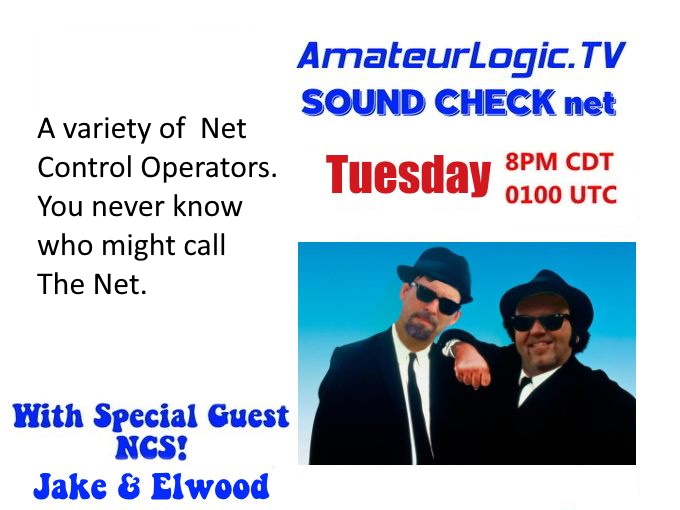
That one is unlike your usual nets. It’s a fun and very well connected net. Just pick a mode…
RF
W5PPB Repeaters
145.45 – 77 Hz tone – Sharon, MS
145.39 – 77 Hz tone – Pelahatchie, MS
Echolink
W5PPB-R – Node 39154
K8JTK-R – Node 233196
N8PC-R – Node 275408
D-Star
DCS 983A
DMR Brandmeister
TG 31983
TG 314651
YSF
K8JTK 17374
Wires-X
Room 40680
Allstar
45743
50394
NXDN
TG 31983
P25
TG 31983
Hamshack Hotline
94026 *99=PTT #=Receive
Listen at www.live.amateurlogic.tv
Or try more than one mode. Some participants check in using several modes. The current record is 5 modes.
Join in the fun this week!
Note: some modes subject to change.
George Thomas, W5JDX, is co-host of AmateurLogic.TV, an original amateur radio video program hosted by George Thomas (W5JDX), Tommy Martin (N5ZNO), Peter Berrett (VK3PB), and Emile Diodene (KE5QKR). Contact him at [email protected].
Weekly Propagation Summary – 2020 Jun 15 16:10 UTC
Here is this week’s space weather and geophysical report, issued 2020 Jun 15 0042 UTC.
Highlights of Solar and Geomagnetic Activity 08 – 14 June 2020
Solar activity was at very low levels throughout the period. Region 2765 (S24, L=116, class/area Cao/130 on 05 Jun) produced a B1 flare at 09/0311 UTC but was otherwise stable and unremarkable. No Earth-directed CMEs were observed in available imagery.
No proton events were observed at geosynchronous orbit.
The greater than 2 MeV electron flux at geosynchronous orbit reached moderate levels throughout the reporting period.
Geomagnetic field activity was at mostly quiet levels with isolated unsettled intervals on 09-10 June due to CH HSS influence.
Forecast of Solar and Geomagnetic Activity 15 June – 11 July 2020
Solar activity is expected to be at very low levels.
No proton events are expected at geosynchronous orbit.
The greater than 2 MeV electron flux at geosynchronous orbit is expected to be at normal to moderate levels.
Geomagnetic field activity is expected to be at quiet levels with unsettled conditions likely on 16-18 June and 04, 06-07 July due to recurrent CH HSS influence.
Don’t forget to visit our live space weather and radio propagation web site, at: http://SunSpotWatch.com/
Live Aurora mapping is at http://aurora.sunspotwatch.com/
If you are on Twitter, please follow these two users: 1. https://Twitter.com/NW7US 2. https://Twitter.com/hfradiospacewx
– – – – – – – – – – – – –
Be sure to subscribe to our space weather and propagation email group, on Groups.io
https://groups.io/g/propagation-and-space-weather
Spread the word!
– – – – – – – – – – – – –
Links of interest:
+ Amazon space weather books: http://g.nw7us.us/fbssw-aSWSC
+ https://Twitter.com/NW7US
+ https://Twitter.com/hfradiospacewx
Space Weather and Ham Radio YouTube Channel News:
I am working on launching a YouTube channel overhaul, that includes series of videos about space weather, radio signal propagation, and more.
Additionally, I am working on improving the educational efforts via the email, Facebook, YouTube, Tumblr, and other activities.
You can help!
Please consider becoming a Patron of these space weather and radio communications services, beginning with the YouTube channel:
https://www.patreon.com/NW7US
The YouTube channel:
https://YouTube.com/NW7US
..
Visit, subscribe: NW7US Radio Communications and Propagation YouTube Channel
There may be more than RF on your antenna!

Yesterday late afternoon I had a chance to sit down and put my feet up on the patio. I was checking out the new QST on my Ipad with the sun coming in and out from the clouds. From my position, I have a clear view of my Endfed wire. As I was gazing at my Endfed and the nice clear sky something on my Endfed antenna caught my eye there was movement on the antenna!
As I got closer my antenna was very busy with black ants going back and forth on the antenna. I was shocked by the amount of activity the tree that supports my antenna does have lots of ants. I was curious where they were going and what all the excitement was about. The opposite end of the antenna is terminated at my shed. I saw them coming down the support pole, along the roof of my shed then onto a maple tree branch that was just touching the peak of my shed roof. Not sure what they were after but whatever it was it seemed it was worth the trip.
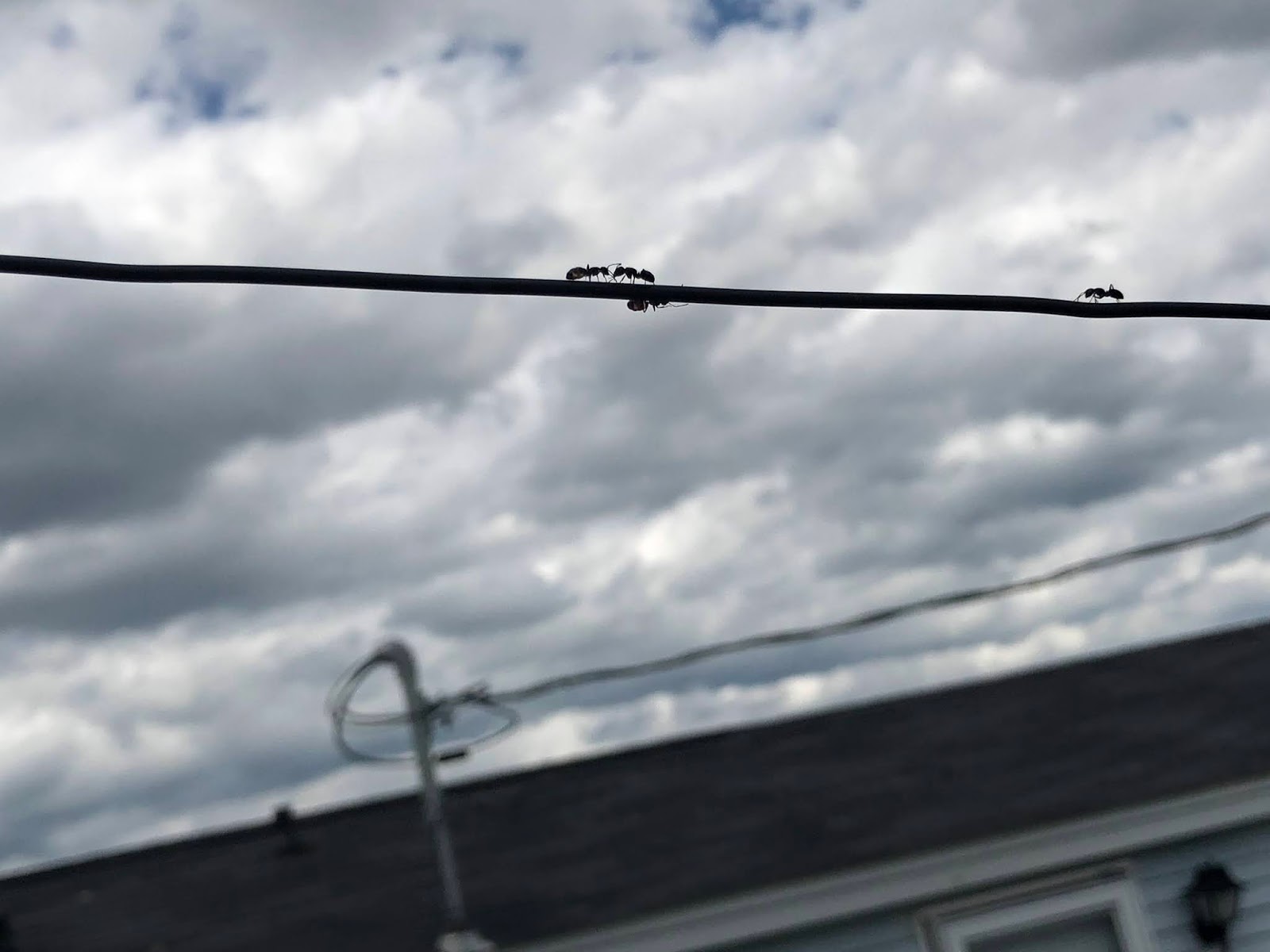 |
| Meet and greet |
Mike Weir, VE9KK, is a regular contributor to AmateurRadio.com and writes from New Brunswick, Canada. Contact him at [email protected].
 Ham Radio Deluxe |
 W5SWL Electronics |
 Ham Radio Prep |
 KB3IFH QSL Cards  Hip Ham Shirts  HamRadioAuctions HamRadioAuctions Reliance Antennas Reliance Antennas Enigma Shop Enigma Shop |  morseDX  Ni4L Antennas  R&L Electronics R&L Electronics antennas.us antennas.us Ears to Our World Ears to Our World |
- Matt W1MST, Managing Editor
