 |
 Six Meters Is the New VHF On-Ramp
 9 July 2020 | by
 Many hams start out with ham radio by using FM on the 2-meter band (and maybe the 70 cm band). Clearly, the Technician license privileges are focused on VHF with 2 meters (146 MHz) being the most popular band. I wrote about common types of equipment that hams choose to support their operating habits here: Your First (and Second) Ham Transceiver.

Some hams get interested in the other modes on VHF, with 2m SSB being one of the most popular. The wavelength is a convenient size such that mobile antennas (with either vertical or horizontal polarization) are possible. For a home station, a decent 2m yagi antenna can easily be installed. With even a modest antenna, hams routinely work hundreds of miles using SSB or CW on 2 meters. It used to be that you could purchase an all-mode 2m transceiver to get into working weak-signal VHF. Because of these things, I always considered 2 meters to be the starter band for serious VHF operating.
Six Meters – The Magic Band
While operating the ARRL June VHF Contest, I noticed a trend with activity on six meters (50 MHz). There were quite a few stations on the air that appeared to be new to VHF contesting. For whatever reason, they took advantage of the sporadic-e propagation during the contest to make VHF contacts.
There are two driving factors for this: the inclusion of 50 MHz capability on many HF transceivers and the emergence of the FT8 mode. The inclusion of 50 MHz on HF radios has been going on for some time now and hams can “try out 6 meters” by just tuning up one of their HF antennas. It may not work great, but it will usually work. Another option is to put up a simple wire antenna tuned for 6m, such as a halfwave dipole or an end-fed wire. Using FT8 is a great way to squeeze out contacts when signals are poor, so it can help compensate for the suboptimal antenna. Once the operator gets a taste of 6m operating, upgrading the antenna is a modest step that can improve their station without buying any new equipment.
This means that 6 meters has become the on-ramp to (more) serious VHF operating. This is probably been happening for a few years now and it is just taking me a while to notice it.
The post Six Meters Is the New VHF On-Ramp appeared first on The KØNR Radio Site.
Bob Witte, KØNR, is a regular contributor to AmateurRadio.com and writes from Colorado, USA. Contact him at [email protected].
LHS Episode #355: Warp Two

Hello and welcome to the 355th installment of Linux in the Ham Shack. In this episode, the hosts wrap up Field Day 2020 and then dive into other topics including: RSGB webinars, the WIA, the QSO Today Ham Expo, open-source COVID-19 tracking software, Linux Mint 20, ADS-B trackers for Raspberry Pi and much more. Thank you for listening and have a great week out there.
73 de The LHS Crew
Russ Woodman, K5TUX, co-hosts the Linux in the Ham Shack podcast which is available for download in both MP3 and OGG audio format. Contact him at [email protected].
The 13 Colonies Event continues……
Mike Weir, VE9KK, is a regular contributor to AmateurRadio.com and writes from New Brunswick, Canada. Contact him at [email protected].
The 13 Colineis Event continues……

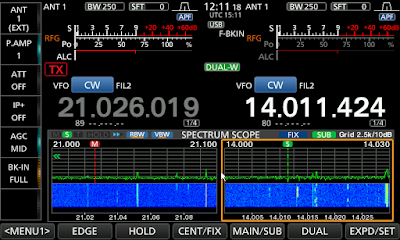
The 7610 has what is called "Dual watch" this utilizes the two completely independent receivers in the radio. This allowed me to leave VFO A (listening with my left ear) on a spotted frequency listening for a lull in the activity. VFO B (listening with my right ear) was moving around on the same band or different band hunting for a nonspotted colony station calling CQ. If VFO A was getting really crazy with callers but I wanted to stick it out for the just in case moment, I am able with a push of a button to mute VFO A. With each receiver you have filter, twin passband, NR, NB and antenna choices you can make to help out with you dealing with band conditions. Finally, as you can see from the screenshot above I was able to activate the "Dual scope" option and have a separate waterfall for 20m and 15m or you can do it for the same band as well. I have always been an Elecraft person (I still have the KX3 so I guess I still am) but I am very impressed with the 7610 a great bang for your buck!
At this point, I am looking for K2C out of RI and GB13COL in England and I want to continue using CW as all other stations were logged using this mode. At this point in time I have found that K2C spends little time on CW and as for GB13COL many have said they just cannot hear them and I concur. It 's getting down to crunch time as the 7th is the last day so let's see if the ham gods are smiling on me?
Mike Weir, VE9KK, is a regular contributor to AmateurRadio.com and writes from New Brunswick, Canada. Contact him at [email protected].
Weekly Propagation Summary – 2020 Jul 06 16:10 UTC
Here is this week’s space weather and geophysical report, issued 2020 Jul 06 0150 UTC.
Highlights of Solar and Geomagnetic Activity 29 June – 05 July 2020
Solar activity was very low. Region 2766 (N06 L=117, class/area Bxo/beta on 04 Jul) was the only active region on the visible disk. The region was in decay at the end of the reporting period.
Other activity included a DFS, approximately 18 degrees in length, which erupted in the SE quadrant beginning around 05/0630 UTC. Subsequent SOHO/LASCO C2 imagery showed the related CME signature after 05/1412 UTC. Analysis for an Earth-directed component is ongoing.
No proton events were observed at geosynchronous orbit.
The greater than 2 MeV electron flux at geosynchronous orbit was at normal background to moderate levels.
Geomagnetic field activity ranged from quiet to unsettled. Unsettled levels were observed on 01 Jul due to sustained southward Bz and on 04-05 Jul in response to a positive polarity CH HSS. The remainder of the summary period was at quiet levels under nominal solar wind conditions.
Forecast of Solar and Geomagnetic Activity 06 July – 01 August 2020
Solar activity is expected to be at very low levels throughout the outlook period.
No proton events are expected at geosynchronous orbit.
The greater than 2 MeV electron flux at geosynchronous orbit is expected to be normal background to moderate levels throughout the outlook period.
Geomagnetic field activity is expected to be at quiet to unsettled levels. A recurrent positive polarity CH HSS is expected to cause isolated unsettled levels on 06 Jul and again on 31 Jul – 01 Aug. The remainder of the outlook period is expected to be at quiet levels. Analysis and modeling of the 5 Jul CME is not complete and the presence of an Earth-directed component is possible.
Don’t forget to visit our live space weather and radio propagation web site, at: http://SunSpotWatch.com/
Live Aurora mapping is at http://aurora.sunspotwatch.com/
If you are on Twitter, please follow these two users: 1. https://Twitter.com/NW7US 2. https://Twitter.com/hfradiospacewx
– – – – – – – – – – – – –
Be sure to subscribe to our space weather and propagation email group, on Groups.io
https://groups.io/g/propagation-and-space-weather
Spread the word!
– – – – – – – – – – – – –
Links of interest:
+ Amazon space weather books: http://g.nw7us.us/fbssw-aSWSC
+ https://Twitter.com/NW7US
+ https://Twitter.com/hfradiospacewx
Space Weather and Ham Radio YouTube Channel News:
I am working on launching a YouTube channel overhaul, that includes series of videos about space weather, radio signal propagation, and more.
Additionally, I am working on improving the educational efforts via the email, Facebook, YouTube, Tumblr, and other activities.
You can help!
Please consider becoming a Patron of these space weather and radio communications services, beginning with the YouTube channel:
https://www.patreon.com/NW7US
The YouTube channel:
https://YouTube.com/NW7US
..
Visit, subscribe: NW7US Radio Communications and Propagation YouTube Channel
ICQ Podcast Episode 328 – Homebrew CAT and Programming Cable
In this episode, Martin M1MRB is joined by Chris Howard M0TCH, Martin Rothwell M0SGL, Ed Durrant DD5LP, Frank Howell K4FMH and Bill Barnes WC3B to discuss the latest Amateur / Ham Radio news. Colin M6BOY rounds up the news in brief and this episode’s feature is Homebrew CAT and Programming Cable
ICQ AMATEUR/HAM RADIO PODCAST DONORS
We would like to thank our monthly and annual subscription donors for keeping the podcast advert free. To donate, please visit - http://www.icqpodcast.com/donate
- First Ireland & Slovenia Contact made on 40 MHz Band
- Transatlantic Emergency Call
- UK Radio Ham Answers Call for Help
- Ham Radio Saved My Life!
- Presenter Article: Prominent Ham Operators Lead Major Covid-19 Pandemic Effort
- First Annual “Dream Rig” Youth Essay Contest
- Online Remote Invigilation Expanding
- GB100RS Special Event
- Wales Special Event GB0WMZ
- NRRL form Vision and Action Working Group
Colin Butler, M6BOY, is the host of the ICQ Podcast, a weekly radio show about Amateur Radio. Contact him at [email protected].
Ham College 66
Ham College episode 66 is now available for download.
Extra Class Exam Questions – Part 4
E1D – Amateur space and Earth stations; telemetry and telecommand rules; identification of balloon transmissions; one-way communications.
1:03:10
George Thomas, W5JDX, is co-host of AmateurLogic.TV, an original amateur radio video program hosted by George Thomas (W5JDX), Tommy Martin (N5ZNO), Peter Berrett (VK3PB), and Emile Diodene (KE5QKR). Contact him at [email protected].
 Ham Radio Deluxe |
 W5SWL Electronics |
 Ham Radio Prep |
 KB3IFH QSL Cards  Hip Ham Shirts  HamRadioAuctions HamRadioAuctions Reliance Antennas Reliance Antennas Enigma Shop Enigma Shop |  morseDX  Ni4L Antennas  R&L Electronics R&L Electronics antennas.us antennas.us Ears to Our World Ears to Our World |
- Matt W1MST, Managing Editor
