 |
 LHS Episode #416: The Weekender LXXIII
 18 June 2021 | by
It's time once again for The Weekender. This is our bi-weekly departure into the world of amateur radio contests, open source conventions, special events, listener challenges, hedonism and just plain fun. Thanks for listening and, if you happen to get a chance, feel free to call us or e-mail and send us some feedback. Tell us how we're doing. We'd love to hear from you.
73 de The LHS Crew
Russ Woodman, K5TUX, co-hosts the Linux in the Ham Shack podcast which is available for download in both MP3 and OGG audio format. Contact him at [email protected].
Further investigation of my ongoing RFI.
 |
| A nice RFI free evening |
In a previous post regarding my RFI issues I kinda narrowed it down to my smart hydrometer. I am now starting to move away from that theory. The RFI is still there and I have been doing some reading regarding our smart meter and the frequency they use to transmit data does not jive with an HF harmonic and I have been logging the RFI and there are some on/off times for the RFI and when I visit the meter during off times the noise my AM radio picks up is still there and just as strong. I have therefore removed the smart meter as an issue.
About a month ago I received an email from a fellow ham who was dealing with some RFI and it seemed to be on a 12 hour on/off cycle. This got me thinking of a timer operated device, the ham had contacted hydro and they came by but really found no issues well none that seemed to connect to a 12 hour on/off cycle. I got to thinking and asked him to check with neighbours if they recently purchased a grow lamp system. A short time later he emailed me informing me that his neighbour in fact did purchase a grow lamp device. When the device was unplugged his RFI issue went away. He is now filtering up the grow system to remove his RFI issue.
 |
| RFI filled day |
Now back to my RFI issue, I have started to log the on/off times for my RFI and it for sure is not on a precise 12 hour on/off cycle BUT it seems to turn off at night. Many times between 23:00 to 23:30. Other times I have seen it off at 21:00 but I can say that it is off each night and the off time my vary. As for the on time it can vary from 07:30 to 10:00. I have also had occasion were it has been off most of the day as well. My understanding is that the device is being turned off/on by the owner and not a timer. Because most of the time the on time is about 12 hours I am thinking it too is a grown lamp.
I have asked the folks on both sides of me and have been told that neither have a grow system. I do understand they may not be telling me the truth as it really is none of my business. One of my neighbours I have been in his home and I can say that I have not seen a grow system anywhere. I have even wondered close to their homes when I have the RFI and I pick up nothing.
 |
| Sometimes the RFI is not to bad |
I do have an MFJ 1026 noise cancelling unit and for this device to work you need to have a listening antenna that hears the same RFI as the main antenna. I have been playing around with noise antennas for a few weeks and my result will be in my next post.....I was very surprised and confused with the results.
Mike Weir, VE9KK, is a regular contributor to AmateurRadio.com and writes from New Brunswick, Canada. Contact him at [email protected].
AmateurLogic 157: Cheap Touch, Charge & Chat
AmateurLogic.TV Episode 157 is now available for download.
A $22 Raspberry Pi Touchscreen with case and fan. Is it worth it? The awesome VC4S Intelligent Battery Tester, Charger, Conditioner. VARA File Transfers and Chat over HF and FM gets the job done.
1:24:20
George Thomas, W5JDX, is co-host of AmateurLogic.TV, an original amateur radio video program hosted by George Thomas (W5JDX), Tommy Martin (N5ZNO), Peter Berrett (VK3PB), and Emile Diodene (KE5QKR). Contact him at [email protected].
LHS Episode #415: Open Research Institute Deep Dive 2

Welcome to Episode 415 of Linux in the Ham Shack. In this episode, we welcome back Michelle Thompson, W5NYV, from the Open Research Institute. We had an interview about the ORI and its affiliated projects early after the inception of the institute back in 2018. This update involves some longstanding projects, grants and new affiliations of the ORI including the P4DX project, M17, AmbaSat, Aqua Phage and more. We hope you enjoy this update episode and have a great week.
73 de The LHS Crew
Russ Woodman, K5TUX, co-hosts the Linux in the Ham Shack podcast which is available for download in both MP3 and OGG audio format. Contact him at [email protected].
Single-Yagi EME

After being absent from 2m EME (moonbounce) for the past couple of years, I decided to spark-up again this spring to see if my simple system was still up to the task.
Pretty much every month, during the moon’s sweep through its northern declination, I get several days with moonrises right out in front of the house overlooking Georgia Strait. This is the large body of saltwater separating the British Columbian mainland (and the rest of North America) from Vancouver Island to my west.
Having an ‘over the ocean’ moonrise offers several advantages for me as it pretty well guarantees an extra 6db minimum of system gain (both on transmit and receive modes) and provides a noise-free environment for the antenna to look into.
Because of this advantage I’ve been able to get away with a very minimal system consisting of a single 9el Yagi and a small FM ‘brick’ amplifier which yields around 120W of output. The antenna is tower-mounted at 60’ and controlled in azimuth only. Without being able to track the moon as it rises, the Yagi is broad enough to give me about 2 hours of moon-time on each session before I start to lose signals. With most EME stations using four or more Yagis and high power, most of the heavy-lifting on my two-way work is being done by the other station. With the extra sea-gain here, my single 9el Yagi performs more like an array of four similar Yagis.
There always seems to be new stations to work whenever I get on the band and this spring was no exception. All told, I had 20 contacts, with 12 being new 'initials', bringing my total initials count to 130. The remaining 8 contacts were with stations I have worked previously. I was also able to add 2 new states, New Hampshire and Wisconsin, bringing my 2m WAS total to 30.
Conditions were poor to average, with one day in particular being excellent, when at one point I had a pileup of three callers!
Most of the stations contacted are always surprised to learn of my small system and comment that my station is the smallest one they have worked. I have worked a couple of two-Yagi stations over the years with one of them being worked several times.
Here are the cards that have arrived so far for this spring’s session:
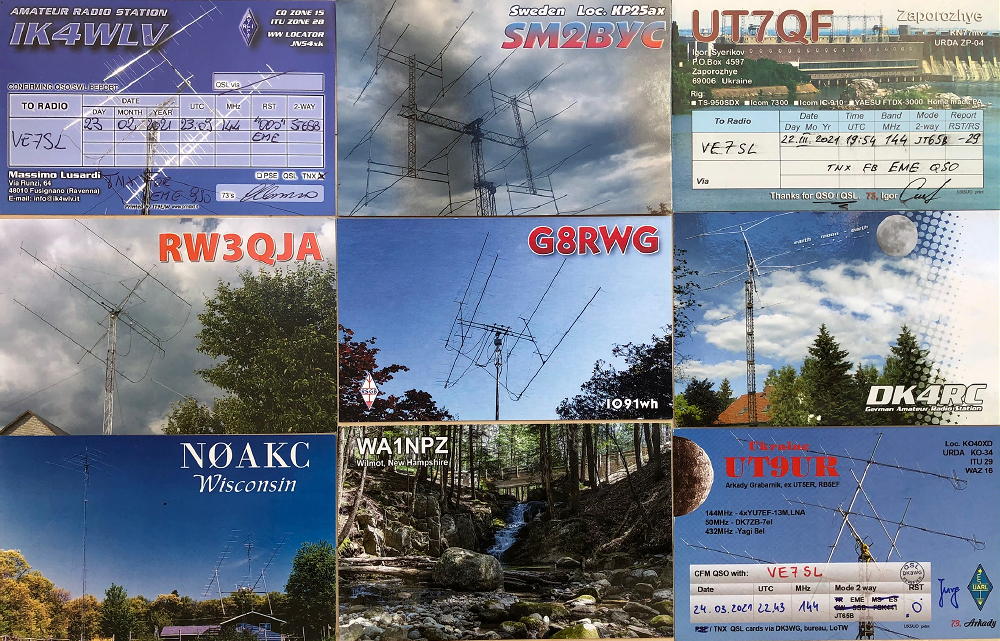
If you haven’t given single-Yagi EME a try I would encourage you to test it out as you might be surprised at your results. Even without the added sea-gain, many of my contacts were loud enough to be easily workable with 6db less gain ... and there are dozens of big capable stations out there just waiting for new initials!
Steve McDonald, VE7SL, is a regular contributor to AmateurRadio.com and writes from British Columbia, Canada. Contact him at [email protected].
AmateurLogic Shorts 7: Windows Sandbox
A test environment for Windows that protects your PC against potentially dangerous programs you might need to run.
Please Subscribe and click the Like and Share buttons if you enjoy our content.
Note AmateurLogic Shorts are only available on YouTube.
George Thomas, W5JDX, is co-host of AmateurLogic.TV, an original amateur radio video program hosted by George Thomas (W5JDX), Tommy Martin (N5ZNO), Peter Berrett (VK3PB), and Emile Diodene (KE5QKR). Contact him at [email protected].
ICQ Podcast Episode 352 – Hubs, Clubs and Virtual Meetings USA Style and Gateways On The Air Event
In this episode, Martin (M1MRB) is joined by Chris Howard (M0TCH), Martin Rothwell (M0SGL), Ed Durrant (DD5LP) and Bill Barnes (WC3B) to discuss the latest Amateur / Ham Radio news. Colin (M6BOY) rounds up the news in brief and in the episode we feature have a double feature Hubs, Clubs and Virtual Meetings USA Style and Gateways On The Air Event
ICQ AMATEUR/HAM RADIO PODCAST DONORS
We would like to thank Scott Wright, K0MD, and our monthly and annual subscription donors for keeping the podcast advert free. To donate, please visit - http://www.icqpodcast.com/donate
- Publicize your Field Day with these ARRL resources
- SRAL Hold Webinar for Young People
- Action Against Solar Panel Optimizer Causing Radio Interference
- Netherlands Use of Ham Radio Handheld Microphone While Mobile
- HamSCI Science Experiment
- Covid-19 Special Event - TM57COV
- Bahrain and Kyrgyzstan join IARU
Colin Butler, M6BOY, is the host of the ICQ Podcast, a weekly radio show about Amateur Radio. Contact him at [email protected].
 Ham Radio Deluxe |
 W5SWL Electronics |
 Ham Radio Prep |
 KB3IFH QSL Cards  Hip Ham Shirts  HamRadioAuctions HamRadioAuctions Reliance Antennas Reliance Antennas Enigma Shop Enigma Shop |  morseDX  Ni4L Antennas  R&L Electronics R&L Electronics antennas.us antennas.us Ears to Our World Ears to Our World |
- Matt W1MST, Managing Editor
