 |
 LHS Episode #443: The Weekender LXXXIII
 10 December 2021 | by
It's time once again for The Weekender. This is our bi-weekly departure into the world of amateur radio contests, open source conventions, special events, listener challenges, hedonism and just plain fun. Thanks for listening and, if you happen to get a chance, feel free to call us or e-mail and send us some feedback. Tell us how we're doing. We'd love to hear from you.
73 de The LHS Crew
Russ Woodman, K5TUX, co-hosts the Linux in the Ham Shack podcast which is available for download in both MP3 and OGG audio format. Contact him at [email protected].
Routes
Alex Hill, G7KSE, is a regular contributor to AmateurRadio.com and writes from Cumbria, UK. Contact him at [email protected].
ICQ Podcast Episode 365 – The Right Tool for the Job
In this episode, Colin Butler (M6BOY) is joined by Dan Romanchik KB6NU, Martin Butler M1MRB and Ed Durrant DD5LP to discuss the latest Amateur / Ham Radio news. Colin (M6BOY) rounds up the news in brief and in the episode's feature The right tool for the Job.
We would like to thank Walt Washburn (KT0D) and our monthly and annual subscription donors for keeping the podcast advert free. To donate, please visit - http://www.icqpodcast.com/donate
- Using an Arduino to Upgrade a 1970s Ham Radio
- New Law Hits AIS Beacons
- 10-year-old Radio Ham Launches his 3rd High-Altitude APRS Balloon
- US Virgin Island Amateur Radio Group Bolsters Repeater Infrastructure
- Indonesian Radio hams sign MoU with Defense University
- Norway Introduce Programs to get Kids into Ham Radio
- Spain Seeks to Attract Youngsters to Amateur Radio
- New Web-Based RSGB EMF Calculator
- Ofcom Consultation on Protecting 23.6-24 GHz
- The Next ICQ Digital Talk Group Met-up
Colin Butler, M6BOY, is the host of the ICQ Podcast, a weekly radio show about Amateur Radio. Contact him at [email protected].
Ham College 83
Ham College episode 83 is now available for download.
Extra Class Exam Questions – Part 21.
E5B Time constants and phase relationships: RL and RC time constants, phase angle in reactive circuits and components, admittance and susceptance.
George Thomas, W5JDX, is co-host of AmateurLogic.TV, an original amateur radio video program hosted by George Thomas (W5JDX), Tommy Martin (N5ZNO), Peter Berrett (VK3PB), and Emile Diodene (KE5QKR). Contact him at [email protected].
New GQRP videos released
From the recent GQRP club convention, video recordings are now available to view:
Just go the GQRP Club YouTube channel and you should find:
* Charlie, ZL2CTM, talking about his approach to RF Construction
* Tony, G4WIF, sharing his experiences of building and using RF Test Equipment:
* Farhan, VU2ESE, talking about his latest BITX transceiver for 2m
* Steve, G0KYA, sharing his experiences of building and using the End Fed Half Wave antenna:
* Pete, N6QW, talking about building a valve (tube) transmitter in the 21st century
* John, M0JAV, sharing the latest information and answering questions about EMF Assessments:
* Steve, G0FUW, talking about getting started with surface mount devices
* Michael, G0POT, sharing his experiences of operating from hill tops
* Roy, W7EL, talking about antenna modelling using EZNEC
* Anthony, K8ZT, sharing his experiences of operating with QRP
* Alan, W2AEW, talking about a range of RF test equipment
* Bonus Session, Operating Panel with Peter, G3XJS and Carl, GW0VSW
https://www.youtube.com/channel/UClhe-ybLZzpnJh80VmFuS-A
If your not a member of the GQRP club, why now join today. From only £6 (UK) inc 4 issues of Sprat, and a just a few more shekels if you are in DX land: http://www.gqrp.com/join.htm
Steve, G1KQH, is a regular contributor to AmateurRadio.com and writes from England. Contact him at [email protected].
Feel the heat of a cluster
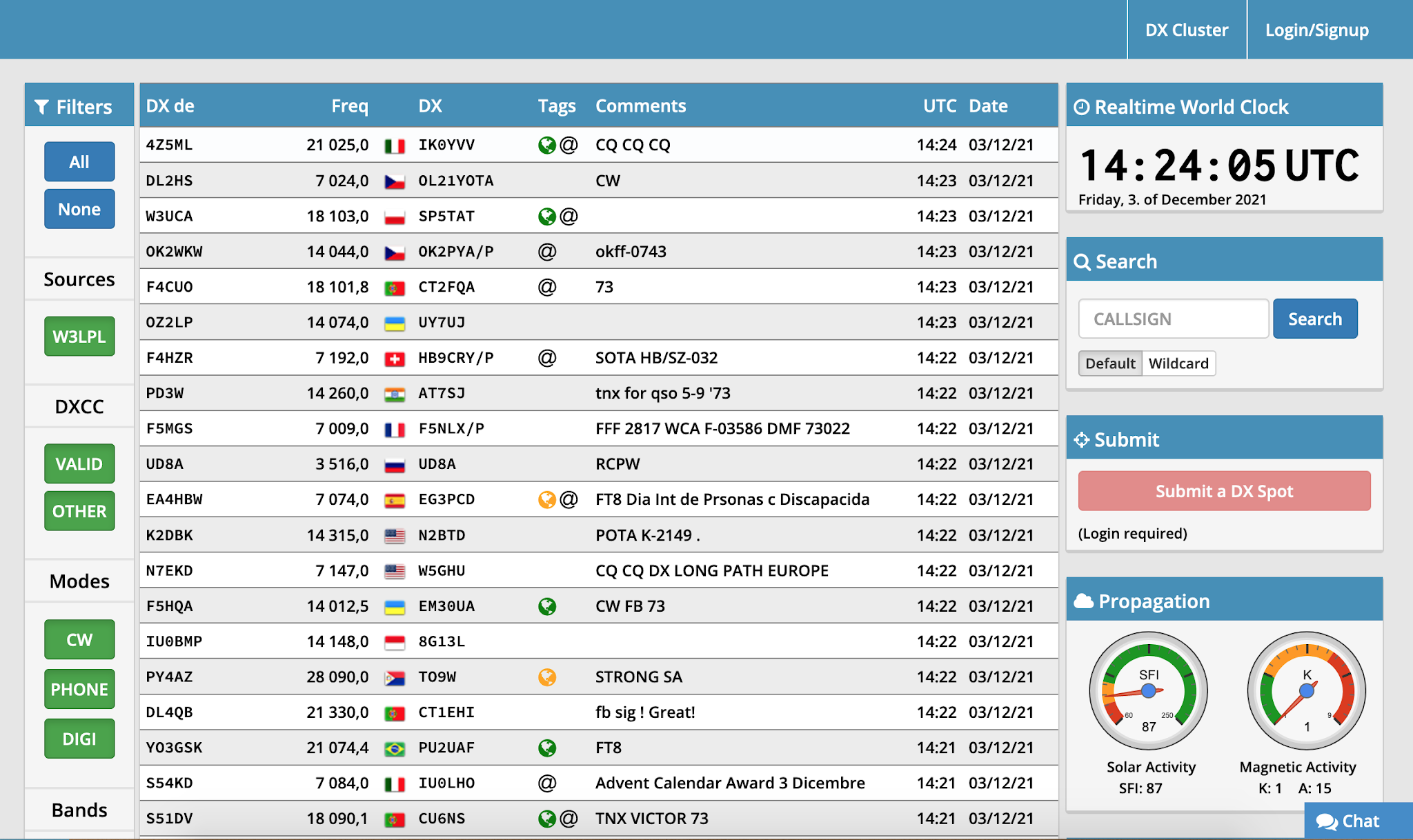
A member from a club I belong to the Maritime Contest Club posted on our groups i.o. site his choice for a DX Cluster. Oh, before I get too far along, the link above to the Maritime Contest Club has some great information and links regarding contesting if you are interested. Back to the cluster, his choice was DX Heat. I checked it out and really liked it and up to that point my choice was DX Summit. I do like DX Summit and have been using it for some time. Most clusters offer the same thing, with just a few cluster specific features. For example, DX Summit does have a tab called Daily DX. There is a subscription fee and I imagine it's very informative, but I have to manage where and what I am a paid member of. These days you can doll out a lot of cash if you pick all that interests you.
Anyway, I digress.....back to the cluster. What I have really come to like about DX Heat is everything is on the home page. You can filter what you see on the cluster with convenient options on the home page. For example, you can choose to see only CW, on a certain band and from spotter only in North America (all other continents also available) Holding your mouse and clicking on the spot you are given 3 options QRZ lookup, very interesting stats on the spotted contact or be taken to a Web SDR to tune in and listen.
There is also the commonly found UTC clock, propagation forecast, call sign lookup and call sign spot features common to most clusters. But there is also a handy and accurate band activity, and you can select the continent you want to look at. I chose NA and you can see a visual of what bands according to the cluster spots are open and how hot the band is. This I have found has given me some surprise openings on 10m and 6m.
So check it out and see what you think?
Mike Weir, VE9KK, is a regular contributor to AmateurRadio.com and writes from New Brunswick, Canada. Contact him at [email protected].
Feel the heat of a cluster
A member from a club I belong to the Maritime Contest Club posted on our groups i.o. site his choice for a DX Cluster. Oh, before I get too far along, the link above to the Maritime Contest Club has some great information and links regarding contesting if you are interested. Back to the cluster, his choice was DX Heat. I checked it out and really liked it and up to that point my choice was DX Summit. I do like DX Summit and have been using it for some time. Most clusters offer the same thing, with just a few cluster specific features. For example, DX Summit does have a tab called Daily DX. There is a subscription fee and I imagine it's very informative, but I have to manage where and what I am a paid member of. These days you can doll out a lot of cash if you pick all that interests you.
Anyway, I digress.....back to the cluster. What I have really come to like about DX Heat is everything is on the home page. You can filter what you see on the cluster with convenient options on the home page. For example, you can choose to see only CW, on a certain band and from spotter only in North America (all other continents also available) Holding your mouse and clicking on the spot you are given 3 options QRZ lookup, very interesting stats on the spotted contact or be taken to a Web SDR to tune in and listen.
There is also the commonly found UTC clock, propagation forecast, call sign lookup and call sign spot features common to most clusters. But there is also a handy and accurate band activity, and you can select the continent you want to look at. I chose NA and you can see a visual of what bands according to the cluster spots are open and how hot the band is. This I have found has given me some surprise openings on 10m and 6m.
So check it out and see what you think?
Mike Weir, VE9KK, is a regular contributor to AmateurRadio.com and writes from New Brunswick, Canada. Contact him at [email protected].
 Ham Radio Deluxe |
 W5SWL Electronics |
 Ham Radio Prep |
 KB3IFH QSL Cards  Hip Ham Shirts  HamRadioAuctions HamRadioAuctions Reliance Antennas Reliance Antennas Enigma Shop Enigma Shop |  morseDX  Ni4L Antennas  R&L Electronics R&L Electronics antennas.us antennas.us Ears to Our World Ears to Our World |
- Matt W1MST, Managing Editor
