 |
 Sometimes three strikes is a good thing
 2 May 2010 | by
 For those of you outside the US who might not be familiar with baseball, there’s a common saying that says “three strikes and you’re out”. This refers to the fact that you are allowed to “miss” a pitch three times before you are no longer allowed to bat. (For you purists, given that this isn’t a baseball blog, I’m going to ignore foul balls, etc.) Taken figuratively, the expression is often used to mean that you only get so many tries at something before you have to stop. In my case, I had the opposite happen over the last week.
About a week ago I wrote about how I’d contacted my first new DXCC entity of 2010, BX5AA in Taiwan. Strike one. Earlier this week, I wrote about my second new DXCC this year, VR2XMT. Strike two. Now I’m very happy to be able to write about strike three.
On Friday morning, I was again working from home, this time because I had some reports to complete that had to be done by the end of the day. It’s often easier to do these kinds of things from home since I get disturbed less often. (And yes, I actually got everything done.) P29TL, Tom had been spotted quite a bit recently on 20m, and while I’d heard him a bit earlier in the morning, he wasn’t really coming in strong enough to work. On top of that, given the location (Papua, New Guinea) the folks on the west coast had a much better path to him and were apparently working him easily. As with my contact with VR2XMT a few days earlier, I turned down the volume on the radio while I worked on my reports, until I realized that I could hear Tom more clearly and there were fewer folks calling him. In fact, the folks that were working him seemed to be mostly on the east coast, meaning that the band conditions had changed. Sure enough, I called him a few time (he was using upper sideband on 20m), and after a while he replied to my call and gave me a 5×5 signal report (I gave him 5×7). Strike three!
Fortunately, in the DXing game, I’m not limited to just three strikes, so I’m looking forward to working some more “new ones” this year. It just goes to show that even though over the last couple of weeks the conditions have taken a dip, it’s still possible to make some really good contacts. (For reference, PNG is around 9,000 miles from my location.)

David Kozinn, K2DBK, is a regular contributor to AmateurRadio.com and writes from New Jersey, USA. Contact him at [email protected].
My NRD-525 and other goodies are on the block…
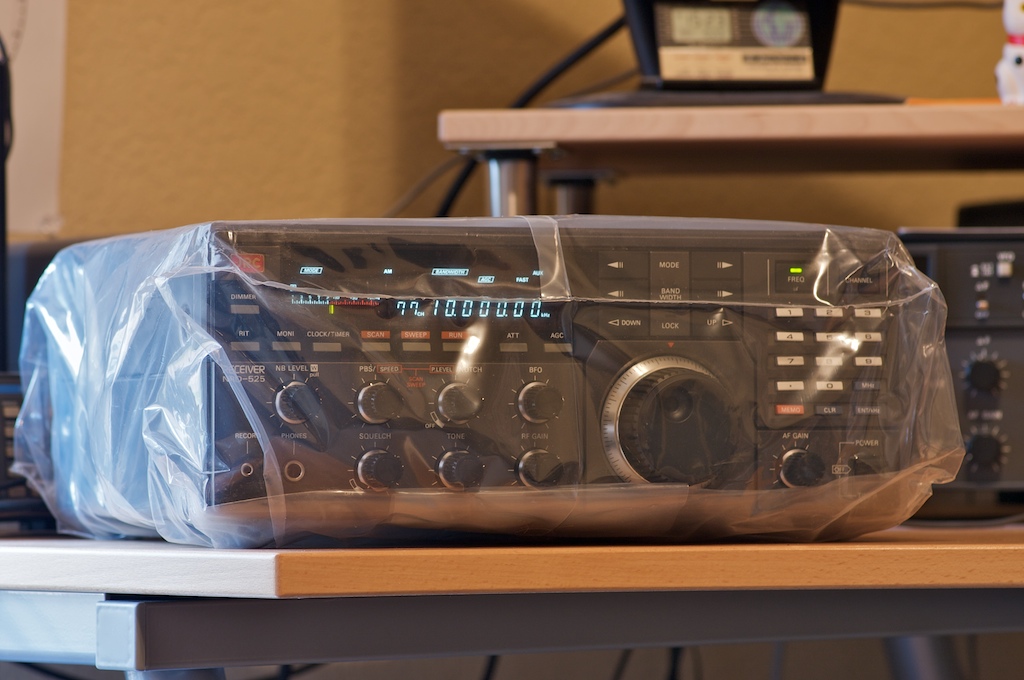
Fiscal realities are forcing me to sell off more of my JRC collection, this time a mint, new-in-box, untouched-by-human-hands NRD-525 HF Receiver along with likewise mint CMK-165 VHF/UHF Converter and CFL-232 500 Hz Crystal Filter. All three now on eBay as separate auctions.
The battery charger that wasn’t
I’ve bought loads of radio and electronic stuff from Hong Kong and China on eBay and most of it has been okay. But I’ve had the occasional duff purchase, like the stubby dual band antenna allegedly made by Diamond which I’m pretty sure was a fake.
 I bought a Motorola GP300 radio body at the Blackpool rally a couple of weeks ago but I needed accessories like a battery pack, charger and speaker mic. Ebay was the obvious place to look for them. The 1800mAH NiMH battery pack was fine, and a good price. The speaker mic is obviously a clone of the original Motorola design but a lot less solidly made, but I have received good audio reports using it so no complaints there. However I was a bit suspicious about the “overnight charger” purchased from RadioFactory because after 6 hours of charging the battery pack was really hot.
The GP300 battery ran out while I was on Watch Hill this afternoon so I need to charge it back up, but before I do I thought I would take a look inside. The case is conveniently designed so that you can pull it apart after pushing back four flexible plastic clips. The circuit board then just lifts out. I got quite a surprise after I did!
 The top of the circuit board is printed with component outlines but most of the components marked are not present, and many of the components that are there don’t correspond with the outlines. In the middle of the board is an unidentified component that looks as if it has overheated.
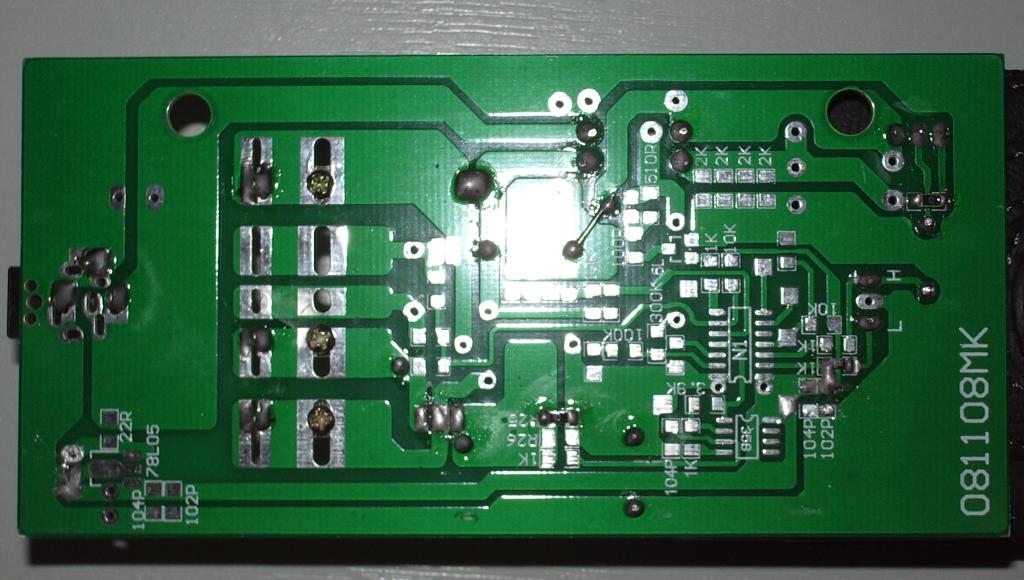 On the underside of the board, again, most of the components that are supposed to be there are missing. Some of the tracks are bridged together with solder blobs or a wire link. I haven’t got the time or, more importantly, the clarity of mind to work out exactly what the circuit on the board actually is, but it doesn’t look much like something capable of charging a 7.2V battery pack from a 12V wall wart.
I’m not quite sure what to do about this. I have the plastic case and the charger contacts, which as I know from the charger I made for the TH-205E are the hardest parts of a battery charger to make. So I could simply make up another constant current charger circuit on Veroboard and put it into the existing case. Or I could simply cut my losses and buy another Motorola charger from a reputable source. I’m sure that one of my readers will know of one.

Julian Moss, G4ILO, is a regular contributor to AmateurRadio.com and writes from Cumbria, England. Contact him at [email protected].
Watch Hill
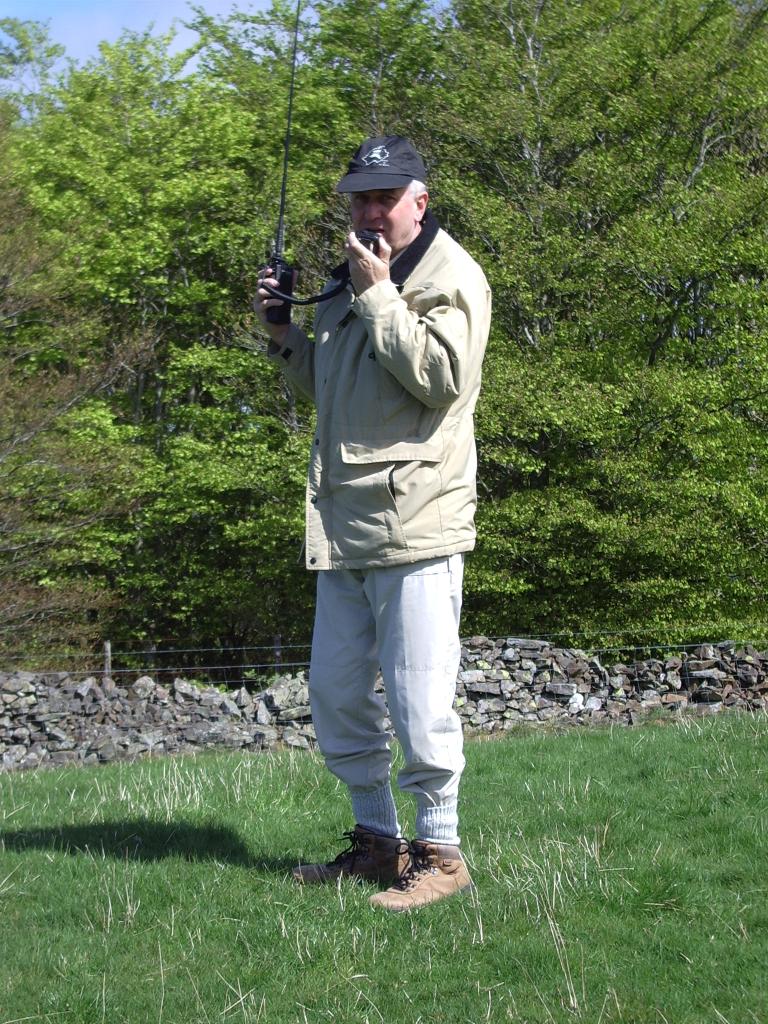 It was a fine sunny morning. I remembered – having worked a couple of activators yesterday – that it was the Summits On The Air (SOTA) Activity Weekend, so I thought we would go to Watch Hill, G/LD-054, and see what I could work from there.
Compared to all the people who have slogged up thousands of feet to get to their summits Watch Hill is a bit of a cheat. It’s a 15 minute stroll from the nearest car park, with only the last couple of hundred metres being a bit steep. But as it is a less than 10 minute drive from home it’s a popular walk for Olga and I and we often take a picnic lunch up there.
I took with me the Motorola GP300 and the Kenwood TH-205E with the 5/8 telescopic whip. Getting the 4 contacts required for a SOTA activation can be a challenge from there, as it is a fairly low hill and there isn’t a huge amount of 2m FM activity round here. Many have tried and gone away disappointed. However on Sunday morning the Workington Radio Club has a 2m FM net. I broke into that and soon had 5 contacts logged. Future would-be activators of Watch Hill please note.
I also made a summit to summit with 2M0NCM/P on Lamachan Hill SS-061 in Dumfries and Galloway, and then caught Geoff G4WHA/P who was just stopping for lunch on Wether Hill, WOTA summit LDW-103. I wouldn’t have heard him from home, so that was a nice WOTA chaser point for me.
The Motorola produced great, loud audio which is ideal for listening on a windy hill-top, and I got an unsolicited report of “BBC quality” audio on my transmissions, so it seems to be working well. However I noticed that some stations seemed to chop up a bit. I’m not sure if they were weak and the squelch is very sharp or whether their deviation is a bit wide for the Motorola IF filters. I will need to investigate this further.
The TH-205E came in handy after the Motorola gave a few beeps to warn, I think, that the battery was exhausted. There is no visual indication of battery state on the Motorola so I had no advance warning. The station I was working said that he could hear a carrier but no audio after the battery went. Still, it does seem to be a nice radio and rugged enough for this type of use.

Julian Moss, G4ILO, is a regular contributor to AmateurRadio.com and writes from Cumbria, England. Contact him at [email protected].
40 Meters Tonight: A Box of Chocolates

Anthony Good, K3NG, is a regular contributor to AmateurRadio.com and writes from Pennsylvania, USA. Contact him at [email protected].
The shack is back
I finally completed phase 1 of the shack renovation. G4ILO is back on the air!
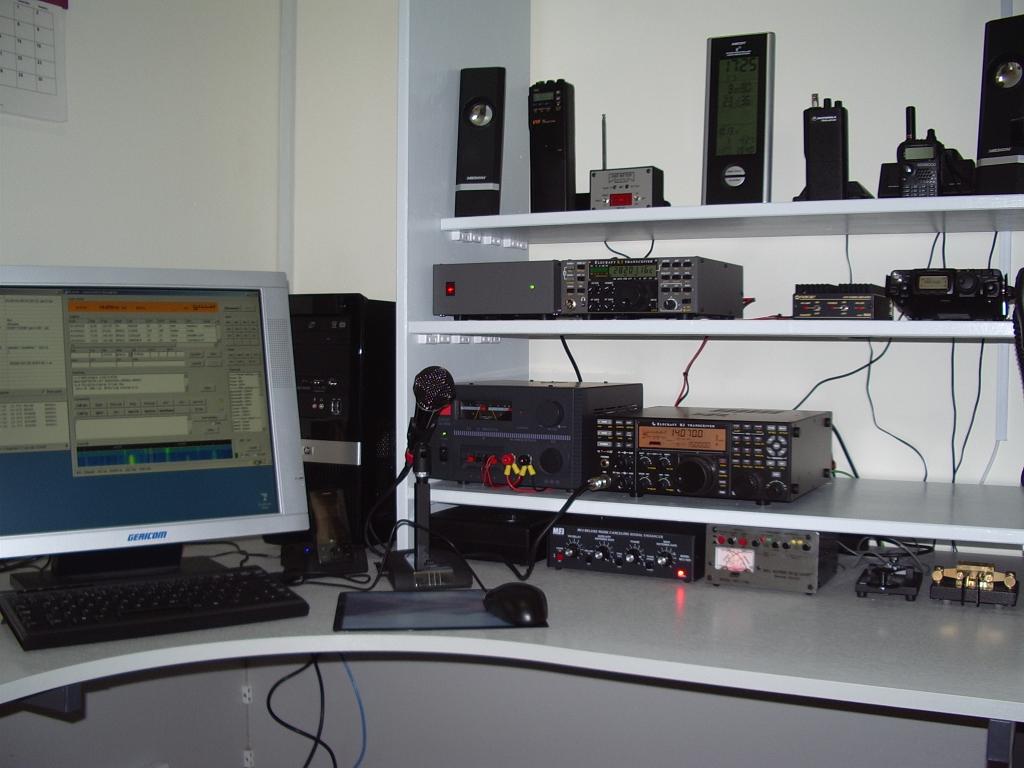 The floor is now covered in wood laminate, and there is a shelf unit on the desk that displays all my radio equipment “ready to go”.
On the “ground floor” is the VHF antenna rotator, the MFJ noise canceling unit, the tuner for the MFJ magnetic loop and my two Morse keys.
On the next level is my Diamond GSV3000 power supply and my Elecraft K3. There is space for a new addition to the right of the K3. This will not be a P3 panadapter, the pictures of which haven’t excited me at all, nor will it be the recently announced Elecraft 500W linear amplifier – as if I could use one with my attic antennas!
The shelves above the K3 lift out to make it easier to access the back of the radio for changing cables. On the second storey is my QRP K2 with its matching power supply. The K2 is really there just for display, as it isn’t actually connected to any antennas, though I could easily swap an antenna from the K3 to the K2 if I wanted to. The K2 power supply runs a few other items including the FT-817ND, seen on the right with the Microset R50 144MHz amplifier. The 817 is doing duty as my 2m rig at the moment – I have given up the transverter due to a number of issues including poor memory ergonomics of the K3 and the fact that it is convenient to be able to monitor or even operate on 2m while the K3 is otherwise occupied.
The top shelf holds the Medion computer speakers that deliver decent-sounding audio out of the K3, my KK7UQ PSK IMD Meter and my collection of VHF/UHF hand-held radios and their chargers.
The opposite wall is still a hodge-podge of shelves screwed to the wall. Phase 2 is to install a custom designed system of shelves and cupboards so the boxes of “junk” can be hidden away behind closed doors. There is a firm that has a web site where you can design your own unit from standard modules and it arrives as a giant flat pack which you assemble. Olga is designing it as she is much better at that sort of thing than me.
I’m not very skilled at joinery and my home made shelf unit doesn’t look all that professional but it’s better than what I had. Having all (well, most of) my radios at my fingertips I feel for the first time in my life like I have an actual radio station. I made a few contacts today including a PSK31 QSO with Greece on 12m, two SOTA stations on VHF and a nice slow morse contact with Helge, LA1PRA on 80m.

Julian Moss, G4ILO, is a regular contributor to AmateurRadio.com and writes from Cumbria, England. Contact him at [email protected].
This Weekend In RadioSport | Lucky 7QP
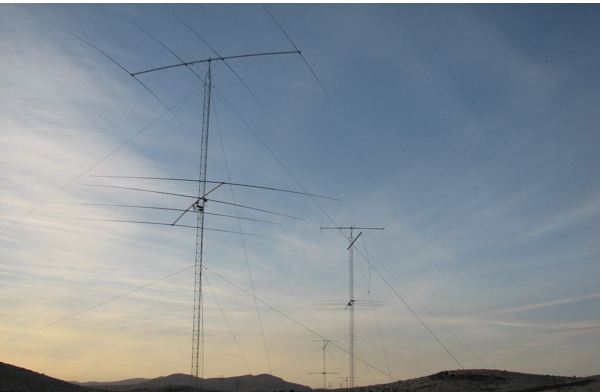 RadioSport USA | 7th Call Area QSO Party.
The party includes seven states and a whole lot of ham radio fun through the weekend. This event is one of my favorites because it is regional and low power friendly while Cycle 24 figures itself out. Has anyone noticed the astonishing decline in sunspot numbers? Perhaps it is part and parcel or is Cycle 24 completely different, whatever the case, it is an amazing scientific phenomena.
I plan on deploying my vertical tomorrow morning after walking Radio Dawg. She really needs a little exercise afterward fire up the radio and go for ionospheric fun. I’ll focus on the high bands 20, 15, and 10m while sending Morse Code straight off the paddles. It’s been awhile and CQ WPX CW is around the corner.
Rules (link).
SFI = 79 | A-index = 3 | K-index = 1 | Sunspot count is 0 @2111UTC.
See Also.
Radio-sport dot net | While N4PN Rules NEQP, W0BH Looks For Fifth Straight Single Op Victory In 2010.
P.S. The Beach Boys Amateur Radio Club meets this evening for our founder’s photograph. The only requirement for membership is a Hawaiian print shirt. 73s.

Scot Morrison, KA3DRR, is a regular contributor to AmateurRadio.com and writes from California, USA.
 Ham Radio Deluxe |
 W5SWL Electronics |
 Ham Radio Prep |
 KB3IFH QSL Cards  Hip Ham Shirts  HamRadioAuctions HamRadioAuctions Reliance Antennas Reliance Antennas Enigma Shop Enigma Shop |  morseDX  Ni4L Antennas  R&L Electronics R&L Electronics antennas.us antennas.us QRV QRV |
- Matt W1MST, Managing Editor
