 |
 AES 10, SGC -2
 20 June 2010 | by
 After using the tuner for about year, one camping trip it stopped tuning altogether. I popped it open and the PIC chip was hot and the tuner was down for the count. In disgust I tossed the SG-211 in a closet for a year and forgot about it. I decided to give the tuner another chance and sent it to SGC to have it repaired for the flat $55 rate. Reading online reviews, I figured the unit might tune better with new firmware which was probably updated since this unit was manufactured. I got the SG-211 back about two months later; the tech said the PIC was bad and they ended up replacing the whole circuit board with a reworked board. Upon getting it back I tested it with the FT-817 and it couldn't find a match on any band with any antenna. The "reworked" board was a mess. You could tell someone spent a lot of time messing with this board when they were repairing it; it looked like it had been through a war. There were cold solder joints on the antenna terminals and on many of the matching network capacitors. I sent the unit back to SGC again and in a few more weeks it was repaired. The tech said a relay was burnt, probably from high power. I never had the unit connected to anything other than the FT-817 which runs only five watts. I got the unit back and it worked, though it still can't tune its way out of paper bag when connected to a 50 ohm load and it takes forever to find a match on several bands.
Fast forward a year later. I'm looking for a remote antenna tuner for a 100 watt setup so I can get rid of open ladder line coming into the shack. I had been working on a homebrew remote balanced antenna tuner for some time, but it's obvious I'm not going to complete the project in the next decade, so I'm just going to break down and buy a commercial unit. I look at Icom's remote tuner and it looks like you have to mate this with an Icom rig, so I shy away from it. MFJ offers a unit, though from the reviews it sounds like one of their indoor autotuners thrown into an outdoor box. I like MFJ to an extent, but you just never know what the solder job is going to look like inside any of their products and I don't want to risk it with an outdoor unit. SGC offers the SG-237 which is in a nice package and gets good reviews. After my experience with the SG-211, I'm not sure why I did it, but I went ahead and bought one. Call me stupid, but I thought I would give a "Made in America" company a second chance. The unit arrived and I hooked it up to my 60m dipole fed with ladder line. It tunes most of the bands fairly well, but on 80 meters it can't find a match anywhere. Grumble. I mounted the tuner outside in an enclosure as its permanent home and shortened the ladder line. Then it would match on the lower end of 80m, but it was still befuddled with the middle and high end. I futzed around adding sections of ladder line and after several iterations it would begrudgingly match the entire band though it would often need coaxing from the bottom of the band up through to get a match on the top end. So it worked "good enough".
Fast forward a week later. I had been on a business trip for a week, and I came back and connect up the power to the remote tuner. I key up on several bands and I can tell the remote tuner isn't trying to match at all. Grumble. I go outside to troubleshoot it. Everything is connected correctly and the unit is getting power. I disassembled the outdoor setup, brought it inside, connected it up on the bench and it indeed won't tune at all. I popped the tuner open and it's definitely sensing RF but it doesn't sense any SWR, so it thinks everything is hunky-dorey, no need to tune. No burn marks and nothing popped inside, so I've got a doorstop that lights an LED.
I contacted SGC over email and spent several days troubleshooting the unit. After getting to the limit of what we could do over email they said to return it for repair or talk with AES where I bought it and see if they would exchange it. Having experienced SGC's glacial repair speeds before, I called up AES and spoke to the service department. The guy there didn't even ask for any details like my account or order number, he said just box it up, send it in and they'll get a new one out to me. I did just that and AES shipped a new unit rather quickly.
The new SGC unit works, but I'm afraid to do much with it. After such a bad experience with two different models, this unit is likely going to be used only for Field Day and other select outings, and I'll always have a backup manual tuner around. I certainly won't put it into permanent use.
I have to give kudos to AES for their outstanding service over the years. I've never been disappointed with them.

Anthony Good, K3NG, is a regular contributor to AmateurRadio.com and writes from Pennsylvania, USA. Contact him at [email protected].
ICQ Podcast Series Three Episode Thirteen (20 June 2010) – Pratical D-STAR
Series Three Episode Thirteen of the ICQ Amateur / Ham Radio Podcast. News Stories include:
- Slow Scan TV on 10 MHz
- ACMA cancels Amateur Radio licence
- VK licence figures show strength
- New 80m SDR Receiver
- Two-way contact achieved on 8.97 kHz
- Feedback added to RSGB blog
- Ham enthusiasts abuzz over traffic ticket
- Feds scrambe in Wireless spectrum crunch
- Amateur's spectacular Channel crossing
- GB3LW back on the air
- Intruders in Amateur Radio Bands
- Croatia 5 MHz and 500 kHz
- London to Brighton cycle ride
- Google Exam Practice Test
- Optimizing wire antennas online
- Apple iPhone Apps
Your feedback, upcoming events and Chris Howard (2E0CTH) talks about pratical D-STAR.
Colin Butler, M6BOY, is the host of the ICQ Podcast, a weekly radio show about Amateur Radio. Contact him at [email protected].
DVAP fun and games
As you might recall, I upgraded the firmware on the DVAP the other week. I hadn’t used it much since the upgrade. This evening I thought I’d play a little D-STAR. I found that I would start transmitting and then I would lose connection and my audio would be lost. One or two other people have been experiencing the same thing. Indeed, Ron, KA2HZO that I was speaking to this evening was having exactly the same issue.
Ron downgraded his DVAP firmware back to 1.01 and found that performance improved. I’ve done the same and things seem better. I had experienced the problem from time to time myself on 1.01 but it seems less frequent.
Of course, it could just be an issue with the internet connection – something else on the PC which the newer version is slightly less tolerant of. I’m sure it will be resolved in due course. But for now, I’ve downgraded to the v1.01 of the DVAP firmware.
Update: 21st June Had an e-mail last night from Nidge, G0WFS. He’d experienced the same problems as me with his DVAP running under v1.04 of the firmware. He reverted back to v1.01 and all is well again. So it looks like there are some issues with v1.04. That doesn’t mean it won’t work for you, but if you do have problems, a simple reversion to the v1.01 firmware should have you back up and running reliably in an instant.

Tim Kirby, G4VXE, is a regular contributor to AmateurRadio.com and writes from Oxfordshire, England. Contact him at [email protected].
An interesting Es day
There’s been plenty of VHF Es buzzing around here today. It started off, literally with a buzz on 50MHz as I was driving down to the Post Office in the next village this morning. I heard some TV buzz on 50MHz, almost certainly out of Eastern Europe. A few stations started coming through including YU1EXY, the Belgrade University club station.
After that, I had plenty of things to do and didn’t get to the rig again until around 1530z. There seemed to be a contest going on 50MHz. I worked LZ9W (KN12) and YT2F(KN03) as well as an EA6.
There were some reports of 144MHz Es too. At one stage, I could hear DLs working Es that I couldn’t hear any trace of. At 1735 though, I heard LZ2ZY (KN10) briefly. He was working into Belgium at the time and I didn’t hear him work any Gs. G4MKF, not too far from me, worked a station that I couldn’t hear at all, but the opening seemed pretty fleeting. Though it was a shame not to work LZ2ZY, it was great to hear him!

Tim Kirby, G4VXE, is a regular contributor to AmateurRadio.com and writes from Oxfordshire, England. Contact him at [email protected].
Polar Bear Summer Picnic Event Jun 2010
My favorite QRP group is the Polar Bear QRP gang! We have a good time and enjoy outdoors activities and trying to connect with one another at least once a month with some kind of activity. To escape some of the heat, I got an early start on the day. I wanted to try out a new mini-bac antenna configuration and knew it would take some time to get it up into the trees. BOY WAS THAT AN UNDERSTATEMENT! It was 110 ft doublet with a 40 ft feedline that was setup as a ladder line. Not an easy one to get up single-handed. Thanks to some tall trees, was able to get it up about 40-45 feet in the pine trees. It loaded great on 40m, but was disappointing on 20m so I ended up setting up my W3EDP in an L from my 20 ft Jackite pole to a nearby cedar tree at about 35 feet. The sun chased me into the treeline where I settled in to chase bears.

Abandoned mini-back doublet feedline hangs in foreground
My xyl Connie took a picture that shows the mini-back feedline hanging in the breeze after I shifted positions and setup the W3EDP in the shade. Grrrrr!

Osprey perched right above my head…cell phone picture
Was able to work a couple of the Polar Bears, Mike W3MC in MD and Guy N7UN up in the mountains on a trail(?) in NJ. I heard VA2SG but he was at ESP level briefly then faded away. I did hear a few others working him though. WA8REI was working Guy but I could not hear him at all and ended up tail ending their QSO to connect with N7UN.
Got to work a few others through the QSB and poor signal strength on 20m including Pastor Les, K4NK in SC, KE5SBZ, Ed in TX, N1FJ in MA, and Phil W3HZZ in Atlanta so it was a nice way to spend a few hours outdoors in the heat.
Connie brought me a picnic lunch and we enjoyed the osprey and bald eagle show as they fished Lake Fredrica.

Had to drink extra coffee to copy speedy W3MC's signal

This is the life… outdoors and ham radio…making QSO's…PTL!
Kelly McClelland, K4UPG, is a regular contributor to AmateurRadio.com and writes from Florida, USA. Contact him at [email protected].
RadioSport History | Chatting Up With N6AA
 I enjoyed our hamfest in Santa Maria, California this morning and my opportunity to chat up with Richard Norton, N6AA.
We talked about what it takes to move to the next level and he shared a few stories about his 9Y4VT operation as well. The key to successful RadioSport, according to N6AA, is operate as much as possible, guest operate where possible, and call CQ alot even if one is low power, low profile.
Richard mentioned both the art and science of the game will surely follow as one pursues a Box score. I wanted to listen for hours however his duties were first given the hamfest, perhaps, next time N6AA will continue recounting his adventures to 40 zones stretching across the globe.
73 from the shack relaxation zone.
P.S. I purchased a Palomar R-X Noise Bridge and a 2009 ARRL Periodicals CD-ROM with QST, QEX, and the National Contest Journal.

Scot Morrison, KA3DRR, is a regular contributor to AmateurRadio.com and writes from California, USA.
Unsquelched
I did a quick lash-up of the UHF FM transmitter module I received a few days ago which I was planning to use in a low-power Echolink node, mainly just to see if it worked. It did, but I discovered a small snag. The audio output isn’t squelched.
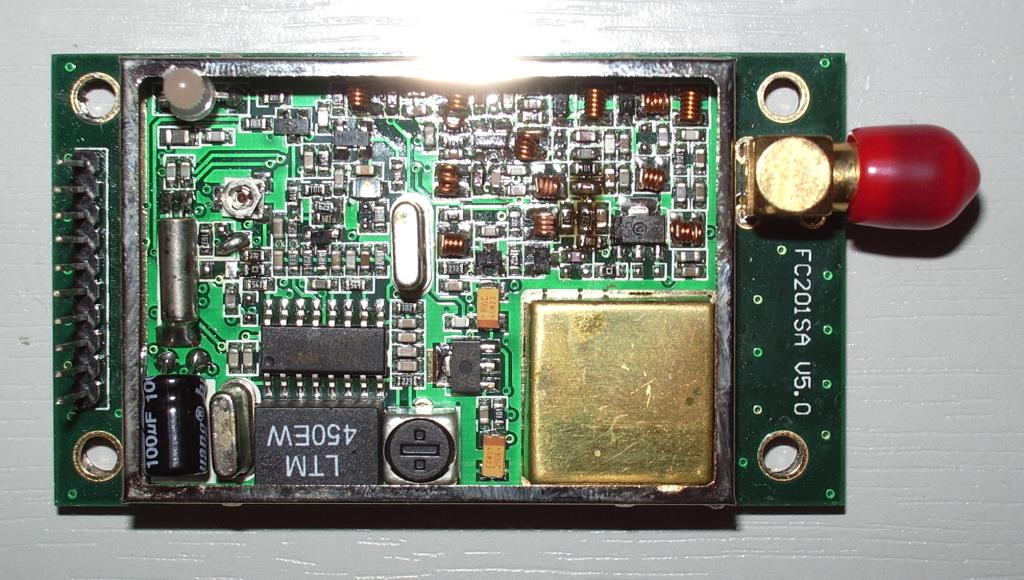 The Echolink software requires either normal squelched FM audio or a carrier operated squelch signal on one of the serial port control lines. As neither of those is provided I guess I am going to need to generate a squelch signal derived from noise. But as I am not knowledgeable enough about electronics to design my own circuit I am going to have to find one first. This appears easier said than done, though there seem to be a surprising number of patents on the subject.
It isn’t an urgent problem as I’m not in any hurry to build this project. I’ll probably have more enthusiasm for it once the gloomy autumn weather starts.

Julian Moss, G4ILO, is a regular contributor to AmateurRadio.com and writes from Cumbria, England. Contact him at [email protected].
 Ham Radio Deluxe |
 W5SWL Electronics |
 Ham Radio Prep |
 KB3IFH QSL Cards  Hip Ham Shirts  HamRadioAuctions HamRadioAuctions Reliance Antennas Reliance Antennas Enigma Shop Enigma Shop |  morseDX  Ni4L Antennas  R&L Electronics R&L Electronics antennas.us antennas.us QRV QRV |
- Matt W1MST, Managing Editor
