 |
 It’s all down to your ears
 15 July 2010 | by
 There was a lot of excitement on the Elecraft email reflector over the fact that the majority of participants in the World Radio Team Championship 2010 (WRTC 2010) were using Elecraft K3s. There was even more glee when it was discovered that Scott Robbins W4PA, former Ten-Tec product manager, and Tim Duffy K3LR of Team Icom had taken K3s. This was like the President of Coca Cola serving Pepsi at his anniversary party!
 There have not been many comments now the results are out, which show that the top two teams, from Russia and Estonia respectively, were using FT-1000MPs. The USA team of N6MJ and KL9A in third place used K3s, as did K5ZD and W2SC who came fifth, but the fourth placed S50A and S57AW again used FT-1000MPs as did the Lithuanian entry in seventh place.
So let’s get this straight: the winning stations and several others in the top ten used a now obsolete radio that was introduced in 1996 which has frequently been criticized as inferior to the K3? I suspect the fact that many international competitors took K3s may have more to do with the fact that the Elecraft radio is small enough and light enough to be taken on an aircraft as hand baggage. And I suspect that the reason for the success of the stations using FT-1000MPs is that there is more to winning a contest than having a receiver with the best performance numbers.
Anyone want to swap an Elecraft K3 for an FT-1000MP? (Only joking.)

Julian Moss, G4ILO, is a regular contributor to AmateurRadio.com and writes from Cumbria, England. Contact him at [email protected].
The End of the Internet
For those who don’t believe that the internet is flat.

Julian Moss, G4ILO, is a regular contributor to AmateurRadio.com and writes from Cumbria, England. Contact him at [email protected].
Handiham World for 14 July 2010
Welcome to Handiham World!
A volunteer summer
Eliot, KE0N, gets the remote base project underway
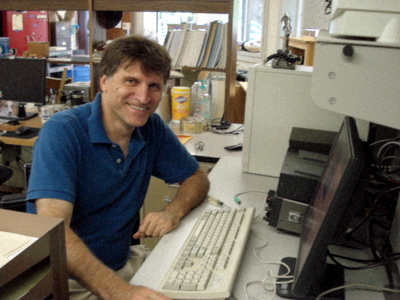
Eliot, KE0N, at the new remote base control point.
The Handiham Remote Base at Courage North has proven to be reasonably reliable and quite popular with the Handiham membership. Just in case you need a refresher, our Camp Courage North location is in far northern Minnesota near the headwaters of the Mississippi River. The station is at the location where we held many Handiham Radio Camp sessions over the past two decades. It consists of a Kenwood TS-480SAT, a rig control interface and computer, an LDG auto tuner, and a G5RV antenna. The station runs W4MQ software to control the radio and SKYPE to port the audio both to and from the remote control operator. Users sign in with their approved credentials and are able to control the radio, changing the frequency and other parameters, and use the radio for both transmit and receive functions. The idea is to provide a real radio for many of our members who cannot otherwise get on the air because of antenna restrictions or other impediments to installing an HF station. Some of our members who do have their own stations also appreciate being able to operate from a completely different location. In addition to the W4MQ software interface, up to five users without transmit privileges can listen to the radio by connecting to W0EQO-L on Echolink. If no transmit control operator is present, Echolink users may control the radio’s receive frequency using the text box feature of Echolink, simply by sending a frequency in the text and pressing enter. This feature is useful for a quick check of propagation conditions here in the Midwest. For example, a user might enter the number 10 to hear what The National Bureau of Standards station WWV sounds like here in Minnesota.

Since only one transmit control operator can run the station at a time, there is a need for a second remote base. That is why we are pleased to have the able assistance of Eliot, KE0N, and Lyle, K0LR, who are working together to help me with this second Handiham remote base. Our new callsign will be the traditional Handiham headquarters call of W0ZSW. We hope to have the station in operation by the end of July, and when Eliot visited Handiham headquarters yesterday to work on the project, he made a lot of progress. In case you were wondering, the radio we have chosen is a Kenwood TS-570S. This radio, which has the capability of operating 160 through 6 m, will be coupled through an MFJ autotuner to a W0OXB 300 foot “special” wire antenna at an average height of 45 feet. This arrangement will allow us to offer 160 m through 6 m capability from the new remote base location. The existing remote base station at Courage North operates only 80-10 m using a 102 foot wire antenna, so we think that this will be a significant addition to our member services. The rig control computer is a Windows machine configured and supplied by KE0N, and the interface is a RIGblaster Pro. The radio is equipped with the VS3 speech module for blind users.
Lyle, K0LR, engineer for the Courage North station, is helping us with the station configuration. Our goal is to copy all of the user credentials from the first remote base to the new remote base so that users will have easy access to either station. This will also help us with tech support issues, and as you might guess we hope to keep those at a minimum!
One advantage of having two remote base stations separated by a significant distance is that there will be more choice for operating when conditions are bad in one spot but not in another. In the event that one station goes down, the other one would still be available. Redundancy is a good thing if you want to keep a service like this up and running.
No project worth its salt ever gets through the installation process without a few glitches and a visit from our associate engineer “Murphy”. Sure enough, Murphy’s presence was felt when the necessary DB9 serial cable turned out to be missing in action. We still have some issues to figure out with port forwarding and a static IP address, for those of you who understand what that stuff means. Nonetheless, we are pleased with the progress to date and feel that we are on target to have this member service available very soon.
For Handiham World, I’m…
Patrick Tice
[email protected]
Handiham Headquarters spruced up

The Handiham headquarters entrance in the Camp Courage Reception Center.
You have seen photos of our headquarters before, but things are looking pretty good now at the Cyril Rotter Technology Center. Antennas rise to the left of the round building, and the 300 foot wire antenna is invisible high up in the trees to the left. The double doors can open wide to accommodate electric scooters or wheelchair users.
QSL cards
Since it is strictly “slow news” for ham radio this time of year, how about telling us about some favorite QSL cards you have either sent or received over the years? A photo or scan would be helpful, if you have one.
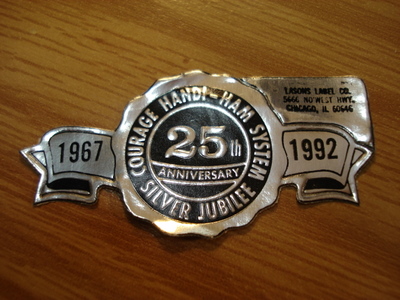
This photo shows a Handiham 25th anniversary sticker that we produced in 1992. The idea was to stick these onto your existing QSL cards and send them out to help promote the Courage Handiham System. They are pretty rare, so if you have a card with one of these Silver Jubilee stickers, hang onto it!
So what do you have? Send it to [email protected] with your comments.
Feedback

Howard, KE7KNN, writes:
Hello, Pat.
Could you please remind our readers and listeners that we need people to take part in the Handiham nets, both the daily net and the Wednesday evening net. Summer is a particularly slow time and we need more participants. Remember that these nets are open to everyone and that you do not need to be a Handiham member. So bring a friend and join us — you may even find the Handiham net a place to make new friends!
73,
Howard, KE7KNN, Handiham Net Manager

Pat Tice, WA0TDA, is the manager of HANDI-HAM and a regular contributor to AmateurRadio.com. Contact him at [email protected].
Up the Amazon
The September issue of PC Pro (a British computer magazine) arrived today. Featured on the front cover was an article exposing the rip-off prices charged by music download sites. Madonna’s Celebration (which I presume is a popular music album) would set you back £11.18 at MSN Music or £11.99 at Spotify but would cost you only £2.98 from Amazon.
Included with the magazine was a DVD which contained a free copy of Paragon System Backup 2010. As I didn’t have any backup software for 64-bit Windows I thought this was fortuitous, so I decided to install it. But after handing over my email address in exchange for a free registration code it failed to install. The developers had used the ridiculously overpriced, overcomplicated and error-prone InstallShield (programmers will know what I mean) to create the setup wizard and only a few seconds into the install it threw up an error message about being unable to initialize the Javascript runtime and died.
I tried the obvious things like checking that Java was installed, running the installer in administrator mode, and even Googling the error message and trying the suggested remedy of registering the Javascript DLL, all to no avail. So I decided that I was not going to rely on backup software from a company that could not even produce an installer that would run on a brand-new computer, and consigned Paragon to the Recycle Bin (both literally and virtually.)
I spent a couple more hours downloading, being unimpressed by and then uninstalling a number of other free backup programs. I even discovered that there was a backup program included with Windows, but for some reason the version that comes with Windows 7 Home Premium has been hobbled by only being able to back up to writeable DVDs or removeable hard drives, not my network attached backup server. After being advised that the backup would take 6 or 7 DVDs I decided against it.
In the end I decided to stump up for a copy of Acronis, which most people seem to regard as hands-down the best backup software you can get. It can create disk images from which you can restore even if Windows won’t run and it has a continuous backup option that backs up your files while you work so you can revert back if you mess up a file. It even has a “Try and Decide” sandbox that lets you safely try out software you aren’t sure about to see if it will do anything nasty to your hard drive.
The Acronis website informed me that this paragon (small p) of backup software would cost £39.95. After checking some reviews, in my usual lazy fashion I typed “acronis trueimage” into the Google search box to find my way back to the website, and Google helpfully included three “shopping results” in its list of related sites. Included there was an offer of Acronis TrueImage Home 2010 from Amazon for £17.99.
Eh? I can buy online and pay £40 for an electronically delivered product the manufacturing and delivery costs of which are near zero, or I can have a physical product that has been mastered onto CD and put into a printed box, possibly with a manual, which has then been driven to a warehouse and stored waiting for me to buy, after which it will be put into a cardboard mailer and sent through the post to be delivered to my door, for less than half the price (with SuperSaver free delivery.) Sorry, I don’t see the logic in that, but thanks very much Google and Amazon.

Julian Moss, G4ILO, is a regular contributor to AmateurRadio.com and writes from Cumbria, England. Contact him at [email protected].
Special event station N2H at hacker convention

Ed Piskor's QSL card for N2H
The station has a great QSL card (above) which was drawn by Ed Piskor of Wizzywig Comics. Ed shows on his blog how he created the QSL card. I will have to try and catch N2H on the air to get one of those cards.
Great to see amateur radio involved in the hacker scene.
For above image note: Ed Piskor / CC BY-NC-ND 3.0


Alan Steele, VA3STL, is a regular contributor to AmateurRadio.com and writes from Ottawa, Ontario. Contact him at [email protected].
One day: Two different types of QSO
Last Saturday, I made two QSOs (a quiet day, then!) but what interested me was the difference between them. Both highly enjoyable, but of very different natures.
Sitting out in the sun, before breakfast I was listening to my IC-E92ED handheld, monitoring the local 2m repeater, GB3WH and the D-STAR reflector REF005A. Tyler, WX4TX from Knoxville, TN popped up on D-STAR and we had a great chat. Tyler was some distance from his local D-STAR gateway, but was running 50W and a beam antenna pointing at the gateway. The connection was solid, with a few moments of R2-D2 audio as the propagation went up and down. We had a good relaxed chat about the different styles of breakfast in our respective countries – Tyler was planning a Buttermilk and Cornbread breakfast!
A few hours later, I was briefly in the shack, doing some work on the computer – monitoring 70.200. I heard a little SSB a little LF of the calling frequency. It turned out to be a Spanish station operating from the coastal area near Alicante. He was using 10w to a small beam and I was surprised to work him with my small station. Interestingly it sounded like propagation was favouring the Oxfordshire area as he was hearing the GB3RAL beacon at Harwell, me and not much else! Shortly after our QSO he faded out and I’m sure that the propagation moved to favour another area of the country.
Two different types of contact – but both very enjoyable. Diversity is one of amateur radio’s strengths!

Tim Kirby, G4VXE, is a regular contributor to AmateurRadio.com and writes from Oxfordshire, England. Contact him at [email protected].
Android envy
I’m suffering from a severe case of Android envy. I was just checking the latest post in Jeff KE9V’s excellent blog (glad you haven’t forsaken the blogosphere in favour of podcasts, Jeff) which mentions in passing that Google has just released AppInventor, a free simple application builder for the Android platform.
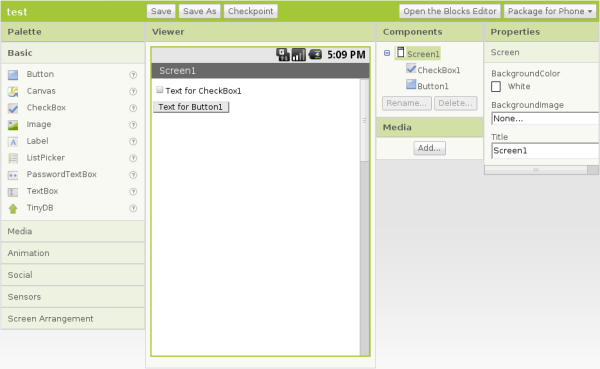 What piques my interest particularly is that AppInventor includes building blocks that allow you to talk to things like the GPS, so you can write location-aware apps, perhaps even apps that are APRS related.
I own a Windows Mobile smartphone. I also own a currently uninstalled copy of Microsoft Visual Studio, which can create apps for the phone. I once wrote an app to sync the clock to an internet time server. But like everything to do with Windows it’s all just too darn complicated and my ageing brain doesn’t feel like getting to grips with it.
The AppInventor approach looks much easier and more fun. I see an Android in my life before too long.

Julian Moss, G4ILO, is a regular contributor to AmateurRadio.com and writes from Cumbria, England. Contact him at [email protected].
 Ham Radio Deluxe |
 W5SWL Electronics |
 Ham Radio Prep |
 KB3IFH QSL Cards  Hip Ham Shirts  HamRadioAuctions HamRadioAuctions Reliance Antennas Reliance Antennas Enigma Shop Enigma Shop |  morseDX  Ni4L Antennas  R&L Electronics R&L Electronics antennas.us antennas.us QRV QRV |
- Matt W1MST, Managing Editor
