 |
 TV series invites amateur radio enthusiasts to take part
 24 July 2010 | by
 Call me cynical, but I had a feeling I wasn’t going to like reading this story on the excellent Southgate ARC News site.
So, the producers want to invite amateur radio enthusiasts onto a doubledecker bus for some sort of dating show.
What could possibly go wrong in terms of publicity for amateur radio!
Wouldn’t. Touch. It. With. A. Bargepole.

Tim Kirby, G4VXE, is a regular contributor to AmateurRadio.com and writes from Oxfordshire, England. Contact him at [email protected].
Travel with Radios and Antennas
Every now and then, there is a question on one of the e-mail lists or forums about traveling by air with radios and antennas. In my experience, most travel headaches can be minimized by adhering to a couple of simple rules:
- Make it easy for the security (and Customs, if international) inspectors. Pack everything neatly so it’s easy to search, even if you’re not present (checked baggage). Label everything. Include documentation and instructions on how to quickly disassemble things if needed. Be courteous if searched. This is not the time to “educate” inspectors about amateur radio.
- Carry your radio and computer as hand luggage. I think everyone knows this by now.
- Put antennas into a sensible container and check them. I’ve heard of golf club carriers, ski bags, fishing rod carriers, and cardboard boxes. I use a 4-inch thin-wall PVC drain pipe that’s about 48 inches long. It has a black rubber cap on one and a drain plug on the other. This may have problems in the automatic baggage-handling systems of some airports like O’Hare. The sporting equipment bags are better because the airlines know how to handle them. It makes sense to use a carrier that might be similar to other baggage going to your destination. But, in reality if you just call it your “ski bag” or “golf bag” at the counter, the agent will never ask what’s in it (aside from the usual security questions). Also ensure that this bag is acceptable on all your flights, including island hoppers.
- Keep as low a profile as possible, but don’t be weird or break the law. Practice moving fluidly with all of your gear. Expect to be questioned and prepare for it.
If the trip is international, every country is different. So, it’s helpful to have either a resourceful, intelligent local fixer or at least to discuss your plans with someone who has been there before. However, most countries that receive a lot of tourists and have relatively easy reciprocal licensing requirements will not pose any problems.
Ethan Miller, K8GU, is a regular contributor to AmateurRadio.com and writes from Maryland, USA. Contact him at [email protected].
CW DX pranks
One of the perpetual frustrations of being in a rare (in ham radio terms) location (or just having a big signal from an exotic location) is handling the ensuing “pile-up” of stations calling you, separating them so you can hear them and keeping them from interfering with your signal. The sought-after (“DX”) operator must maintain control of the pile-up or pandemonium breaks loose. A tried and true technique for controling a pile-up is to spread callers out in frequency above the DX operator’s frequency, which should remain clear, except when the DX is transmitting, of course. This is called “working split” and on CW (Morse code mode), the DX operator indicates this condition by appending “UP” to his calls.
For unknown reasons, this concept is lost on some operators, who call repeatedly on the DX’s frequency much to the consternation of everyone else who is trying to make contact. Sometimes, it’s an honest mistake and after some “helpful” operators send “UP UP UP UP” a few times (also on the DX’s frequency), the offender catches on. But, in just about every pile-up these days, there’s always one or two operators at the shallow end of the pool of clue. Tonight’s JT5DX pile-up on 20 CW (listening from the mobile on the way home from work) was no exception.
I’m never sure whether to laugh or hang my head in shame when this happens…but, now and then one of the other operators in the pile-up will answer the poor clueless soul impersonating the DX and give him a contact! It shuts them right up and is usually good for a laugh. I do feel a little bad every time I hear it…but, if they don’t get it when the pile-up police send “UP UP” and the DX sends “UP”, how can you explain it to them?!
Ethan Miller, K8GU, is a regular contributor to AmateurRadio.com and writes from Maryland, USA. Contact him at [email protected].
K8GU/M (or how convert your 1999 Ford Escort into a real head-turner)
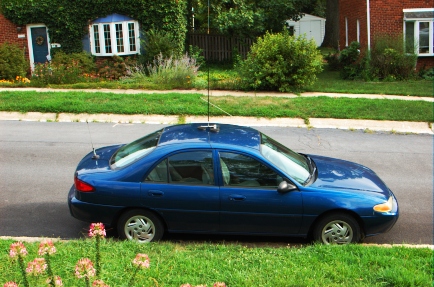
When we got married, the Escort I was driving had gone to my parents in exchange for a larger vehicle with an automatic transmission and a 6-cylinder engine (all three points nods to Sarah, although I admit that it was a much better ride for the kind of driving we did). With the transfer of the Escort, my HF mobiling days were on hold, although I kept the gear.
In order to finance a DSLR a couple of years ago, I sold-off some ham gear I wasn’t using, notably the HF mobile equipment. I didn’t manage to sell the tri-magnet mount I borrowed from N8ET for the 2004 MnQP and a rather dismal attempt at WiQP. This mount had an interesting life, which included being destroyed at 75 mph on I-94 north of the Wisconsin Dells. I drop-shipped a replacement to N8ET, but had the good fortune of finding similar donut-shaped magnets and some heavy adhesive vinyl at Ax-Man Surplus. So, with a little epoxy and elbow grease, I fixed the mount while I was still in Minnesota. It lived to ride again in several QSO parties before my futile efforts to sell it. I raised the requisite capital for the DSLR before the mount sold. So, I kept it.
When we moved the DC area, it quickly became apparent that we were going to have to relinquish our delightful position as a one-car couple and the Escort returned to our lives, probably to the chagrin of my father and delight of my mother. Dad later passed along a Yaesu FT-5100 and mag-mount VHF/UHF mobile antenna which I promptly installed. But, I really longed for HF CW in the car like the good old days. So, a few weeks ago, I plunked-down $30 for some knock-off Hamstick-type HF antennas for 20 and 40 and put the Yaesu FT-840 back in the car. (Astute observers will note that I have a 100% Kenwood fixed station and a 100% Yaesu mobile station. The IC-290H and the DJ-580T are anomalies that I permit to persist in my life for various reasons.)
There is nothing like listening to JAs via long-path on the way to work…and getting funny looks from the other commuters at the same time. A car full of teenagers waved once. Friends and relatives have called it everything from “a space ship” to “a hunk of junk” (thanks, Rachel).
Ethan Miller, K8GU, is a regular contributor to AmateurRadio.com and writes from Maryland, USA. Contact him at [email protected].
Handiham World for 21 July 2010
Welcome to Handiham World:
A volunteer summer continues as Larry Huggins, KA0LSG, makes the cover of Worldradio

Larry Huggins, KA0LSG, is right there on the cover of the latest Worldradio magazine. Way to go, Larry!
The photo is from Handiham Radio Camp, where Larry volunteered as an instructor. In the Worldradio article, you can read about the blind-accessible HT that Larry demonstrated to our Operating Skills group. The article is my annual accessible radio roundup, a quick overview of radios and their accessibility features. It is entitled “What’s New for the Operator With Disabilities”, and is a feature of my regular “With the Handihams” column.
“Regular readers know that from time to time I devote a column to what’s new in amateur radio equipment and software that is accessible to people with disabilities. Most of the questions I get have to do with what is blind-accessible, both for radio hardware and computing. Our largest single accessible technology user group is amateur radio operators who have some kind of reading disability, usually blindness or some degree of vision loss. I think this is probably a long-term trend as more baby boomers encounter age-related deterioration of their eyesight. Macular degeneration is relatively common in older folks and because of its onset late in life can catch them off guard and leave them wondering if they can still use a computer or even get on the air effectively anymore.”
There are always questions about accessible handheld radios, so this part of the article is timely:
“Handiham volunteers Larry Huggins, KA0LSG, and Ken Silberman, KB3LLA, both found the new Wouxun 2m/70cm KG-UVD1P HT at Dayton, and Larry actually had his radio along to demonstrate to us at Handiham Radio Camp.”
Read more on the Worldradio website.
Our thanks to CQ Publications for helping us get the word out about accessible technology.
For Handiham World, I’m…
Patrick Tice
[email protected]

Pat Tice, WA0TDA, is the manager of HANDI-HAM and a regular contributor to AmateurRadio.com. Contact him at [email protected].
Misinformation
The web is a great way to get information about subjects like ham radio that you might never find if you had to rely on books. Unfortunately it’s also a good way to get wrong or obsolete information. For example, people looking for advice on how to make their first contacts via amateur satellites will find many articles that explain in great detail how to work through satellites that have long been defunct – even on the Amsat website!
There are numerous websites that explain about SSIDs used for APRS. (An SSID is the numeric suffix to the call, for example G4ILO-7, which is used to distinguish an operator’s APRS devices and also to give an idea of what type of device it is.) They are all wrong! Bob Bruninga, WB4APR, the inventor and ultimate authority on APRS, released an updated set of recommendations on 9 June this year to provide more flexibility for current usage.
The new recommendations are:
-0 Your primary station, usually fixed and message capable.
-1 Additional station, digi, mobile, weather station etc.
-2 Additional station, digi, mobile, weather station etc.
-3 Additional station, digi, mobile, weather station etc.
-4 Additional station, digi, mobile, weather station etc.
-5 Network sources (smartphones etc.)
-6 Special activity, e.g. satellite operations, camping, 50MHz etc.
-7 Handheld radios and other human portables.
-8 Boats, RVs or second mobile.
-9 Primary mobile.
-10 Internet gateways, Echolink, Winlink, AVRS, APRN, etc.
-11 Balloons, aircraft, spacecraft, etc.
-12 APRStt, DTMF, RFID devices, trackers etc.
-13 Weather stations.
-14 Truckers or other full time drivers.
-15 Additional station, digi, mobile, weather station etc.
These are recommendations and not set in stone, but they are intended to help people know what type of device or application is being used, particularly in situations where someone doesn’t have a graphical map display and can’t see an icon.
Due to these recommendations I am now using G4ILO-5 for my Windows smartphone running APRSISCE. My VX-8GR remains G4ILO-7. My main 2m station is G4ILO-0 or just plain G4ILO, and my HF station is G4ILO-1.
Of course, this page could also become out of date in the future so I am including this link back to the original document in case Bob should make any further changes.

Julian Moss, G4ILO, is a regular contributor to AmateurRadio.com and writes from Cumbria, England. Contact him at [email protected].
Bill in VK
Regular readers of my blog may have detected a loss of interest in HF band operating over the last few months. I have got tired of listening to signals through the harsh noise that it is never possible completely to eliminate, I got bored with the sameness of contacts using PSK31 and I got angry at having to battle with the renegade ROS mode if I wanted to use Olivia or other digital modes. My hopes were set on Sporadic E on the VHF bands but this year’s season has been disappointing with no major openings on 144MHz extending this far north as far as I am aware.
Most of my radio activity in recent weeks has been focussed on APRS, first on establishing a VHF gateway and in the last few days getting going on HF. As I haven’t felt much like actually sitting at the radio making contacts this has proved to be a good way to make some use of my HF equipment, a mode of operation that doesn’t constantly remind me of the limitations of using attic antennas from a poor and noisy location.
I recently set up my private Echolink node again. I now have a Kenwood TM-D710 transceiver, a dual band 2m/70cm rig with dual receivers, a built-in APRS TNC and support for Echolink. However I’m still using the FT-817 on low power into a dummy load for my Echolink node for now. Before I could run a public Echolink node I would need to buy a proper dual band antenna instead of the 2m Slim Jim I’m currently using and apply for a permit from Ofcom. I’d then lose the use of the Kenwood for local 2m contacts and WOTA chasing, while the number of stations that could actually access the node due to my poor location could be counted on the fingers of one hand. So despite its built-in support it doesn’t seem worth using the Kenwood for Echolink.
The node was on yesterday afternoon and I was sitting downstairs in the conservatory with the TH-F7E having a contact with John G4LRS from near Sheffield. After I finished with John I was called by VK6FSBB (if I remember it correctly) a Foundation licensee from Australia called Bill. Bill called because he had heard that my home location was Cockermouth. He was originally from the Workington area (Maryport in fact, though he had lived in Flimby, Seaton and various other places in West Cumbria) but had moved to Australia 45 years ago. He had held a ham radio license for only eight months and I was the first contact he had ever made into this area.
Bill had played rugby for various local amateur teams and mentioned various employers he had worked for, though as an incomer to the area I didn’t know any of them. When I tried to explain where exactly I lived, I realized that the town must have changed beyond recognition from the days when Bill knew it. Things like the A66 bypass simply weren’t there.
I could have talked for longer, but dinner was nearly ready and Bill’s hand-held was only just making it into whatever repeater he was using to access the Echolink network in Australia so sometimes he dropped out after a lot of loud hissing like an old analogue mobile phone call. It may not have been a direct contact on HF and it wouldn’t count for any awards, but to be Bill’s first contact back to the place of his birth after 45 years made this VK contact a special one by any standards, one to remember long after I’ve forgotten many humdrum HF QSOs.

Julian Moss, G4ILO, is a regular contributor to AmateurRadio.com and writes from Cumbria, England. Contact him at [email protected].
 Ham Radio Deluxe |
 W5SWL Electronics |
 Ham Radio Prep |
 KB3IFH QSL Cards  Hip Ham Shirts  HamRadioAuctions HamRadioAuctions Reliance Antennas Reliance Antennas Enigma Shop Enigma Shop |  morseDX  Ni4L Antennas  R&L Electronics R&L Electronics antennas.us antennas.us QRV QRV |
- Matt W1MST, Managing Editor
