 |
 Maplecon 2010 Report
 26 August 2010 | by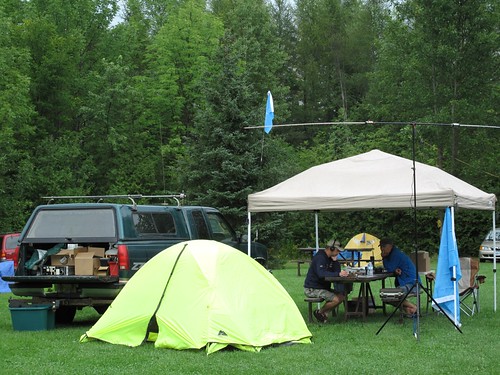
The Youkits' demonstration shelter
I attended the first Maplecon last weekend, which was a gathering of Canadian QRPers. The venue was Emily Provincial Park campground. Gerry, VA3GLT, and myself headed down on Saturday morning, despite the convention’s start on the Friday, as both of us had commitments in the afternoon and evening of Friday 20th Aug. We had an early start and drove down the 401 highway to Port Hope then turned off and travelled North to the park. By noon we arrived and had put up the tent and an antenna.
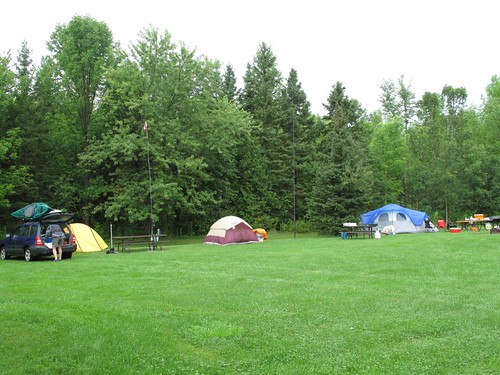
The campsite. Notice that vertical antennas on poles were popular
The antenna for this event was a freshly homebrewed doublet made from some TV twin-feed I bought a few years ago and now decided to use. It was split 16′ 7″ down to form two arms of the doublet, and the remaining 23′ or so of twin feed was the feedline. At the end of the twin feed we installed a homebrew 4:1 current balun, which I had built a few years ago. The antenna was raised between two trees high enough that the feedline dropped vertically down and just reached into the tent. A short run of coax was used from the balun to my Elecraft K2. It tuned on 40m, 20m, 17m, 15m and surprisingly 80m (given the length of the antenna is would be a pretty inefficient). I could not get a tune on 10m. Possibly if I took out the 4:1 balun I may have made it.
There was a just short of thirty attendees at the convention and we chatted with quite a few. There were three tables set out as stalls, one with QRP rigs, one with QRP-ARCI information and one with Youkits radios. I would have like to have spent more time looking at the QRP equipment table, but things felt a little rushed as we had arrived late. We had a lovely barbecue lunch prepared by Jeff, VE3JFF, and his family after which I had a chat with Yimin and Fred, VE3FAL from Youkits about their new line of QRP radios. That will be covered in a future post as I made a recording of that conversation.
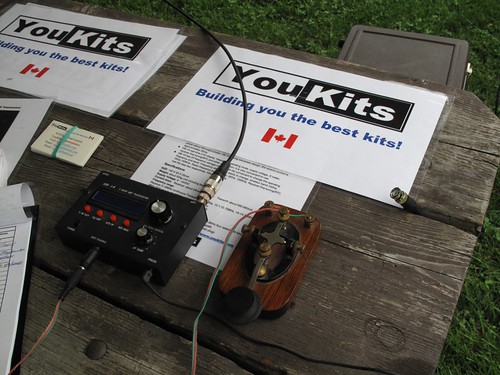
Youkits' HB1A
There was an antenna competition on so I spent a little time in the tent in the afternoon trying to make contacts on PSK31. Beside the antenna and the K2 I was using a little Asus notebook, a homebrew interface for digimodes and a large battery pack. It is so large that Martin, VA3SIE accused me of being a secret QRO operator! (That hurt Martin).
I had little success with contacting stations on 20m PSK until finally just before dinner when we made a contact with a weak station that was calling CQ. I replied and was acknowledged by Mirek, SP9ONC in Kozy, Poland. He was running QRP from a TS-2000 and and we exchanged details. I was really pleased that my first contact was DX and a QRP-QRP contact too. Soon after came my second contact Fred, KD8AQ in Mt Pleasant, TX and we had a nice chat. As the call for the chilli dinner had gone up earlier I had to break off that conversation.
Dinner was provided by the Ottawa Valley QRP Club and that was the second good meal. The chilli was tasty and Martin, VA3SIE, had brought some British delicacies for dessert, including Battenberg cake, which I had not eaten in many years as it does not often appear on shelves in Canadian stores.
After dinner there was the antenna competition, door prizes and a raffle for a ‘shack in a box’. For the antenna competition Michael, VE3WMB, won the prize for the best technical design with a folded over vertical antenna, and I won for the best performing antenna with the DX contact with SP9ONC. I was extremely pleased to find my prize was a Norcal BLT tuner which will very likely become the tuner for that doublet in future.
There were plenty of door prizes including several transceivers. Gerry, VA3GLT, was lucky to get the first of two HB1A transceivers that had been generously donated by Youkits. There were so many door prizes that I think all attendees went away with something. I won a set of pliers and a year’s subscription to QRP Quarterly, the QRP ARCI’s excellent magazine. So when my current subscription is up I can use that.
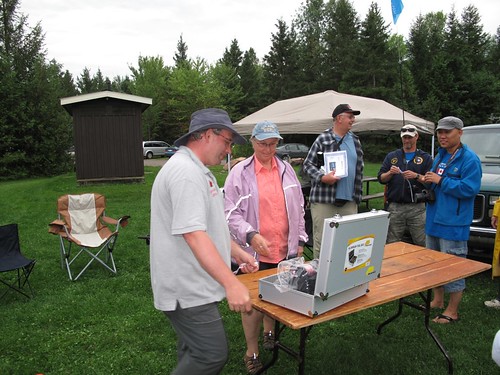
The 'shack in the box' prize is presented. The prize was a transceiver, battery pack and case.
After all the prizes had been given out there was chatting into the evening and then Gerry, Martin and myself went back to the tent and made two more contacts on 20m. These were Tom, KJ4QDZ , in Lillian, AL and Virgil, WA5TLP, in Willston, ND. Not too many contacts but enough to make me happy with the performance of the antenna.
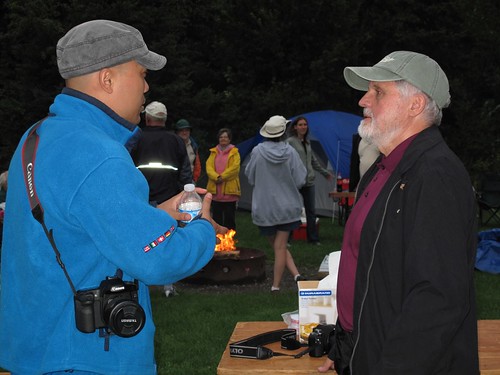
Yimin of Youkits chatting with Gerry, VA3GLT after the prizes were awarded
Over Saturday night and Sunday morning there was a lot of rain. So after breakfast next morning there were a lot of people leaving. Gerry and I thought it was prudent to take the tent down during a brief lull in the rain so there was no making contacts, just collapsing and packing a wet tent. We thanked Jeff, VE3JFF, for all his hard work that had resulted in a successful first Maplecon 2010, said goodbye to those that remained and we headed home before noon on Sunday.
Will there be another Maplecon next year? Well after the prize giving it was discussed by all and it was unanimous to have another. So here is looking forward to Maplecon 2011.


Alan Steele, VA3STL, is a regular contributor to AmateurRadio.com and writes from Ottawa, Ontario. Contact him at [email protected].
Cut the quotes, please
Why do some people find it necessary to put some irrelevant quote after their signature in forum and mailing list postings? When you see posts from these people several times a day it becomes incredibly irritating.
One person whose posts I seem to encounter frequently has two quotes after his signature: “Whoever said nothing is impossible never tried slamming a revolving door!” and “A government big enough to give you everything you want, is strong enough to take everything you have.”
I can’t say I ever found the first one very funny but it has got very old after the 100th viewing. And I didn’t join a ham radio mailing list to learn about people’s political opinions, whether or not I agree with them. So please, just stop doing it.

Julian Moss, G4ILO, is a regular contributor to AmateurRadio.com and writes from Cumbria, England. Contact him at [email protected].
Handiham World for 25 August 2010
Welcome to Handiham World!
Telling the story: Mike Runholt, KC0YFV, on ARRL website

Photo: Mike, KC0YFV, left, and Bill, N0CIC, take down one of the wire antennas following a memorable radio camp session at Courage North. This radio camp was the last of a long run of week-long camp sessions at the Courage North location. In 2010, the radio camp session moved to Camp Courage, about 40 miles west of Minneapolis, Minnesota. Courage Center owns both camps. The Handiham System headquarters is at Camp Courage.
Mike Runholt, KC0YFV, has written an excellent article about the Handiham System and Radio Camp. It appears this week on the ARRL website. You can reach Mike at his callsign at ARRL.net if you wish to comment on the story.
“The pontoon slowly motors around the lake. A group of hams gathers around the radio. “CQ, CQ 80 meters this is W0EQO, KC0YFV at the mike, maritime mobiling from Courage North in Lake George, Minnesota, over.” So begins a typical contact at the Handiham Radio Camp sponsored by the Courage Handiham System, a program of the Courage Center. You have probably seen our quarterly ad in QST and wondered what we do.”
Read the entire story on the improved and newly-redesigned ARRL website.
Our thanks to Mike for telling the Handiham story so well. Good work, Mike! And, hey, Bill, you look good in that photo, too. Are you the wire tangler or the wire untangler?

Pat Tice, WA0TDA, is the manager of HANDI-HAM and a regular contributor to AmateurRadio.com. Contact him at [email protected].
A new use for old technology
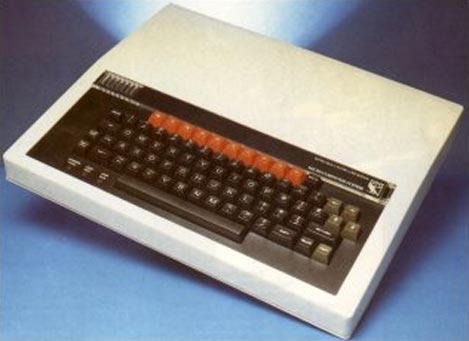
The National Museum of Computing at Bletchley Park has found a use for 30-year-old BBC Micros – teaching students how to write programs. One ICT teacher said: “The computing A-level is about how computers work, but if you ask anyone how it works they will not be able to tell you. Modern computers go too fast. You can see the instructions happening for real with these machines. They need to have that understanding for the A-level.”
I often think back wistfully to the days of programming early microcomputers where each instruction or subroutine you wrote had a direct effect on the hardware. Even the way things appeared on the screen were a direct result of my own coding. Today, Windows manages all input and output and actually prevents the programmer from directly accessing the hardware. In modern programming you never see a machine instruction. It’s all done using high-level language commands to set the properties of “objects” – software “black boxes” that simplify and speed up complex programming tasks but hide the mechanics of their operation. You couldn’t write modern software the old way, but I still miss the simplicity of early computing.
I have pretty similar reasons for being concerned at what developments like SDR and D-Star will do to the ham radio hobby. The technology is so complex that the average amateur will have no understanding of how they work, only how to use them. I miss the days when you could open a schematic and follow the path of a signal from one end to the other.
Of course, you can still buy kits to build simple radios. I hope that there will always be a place in our hobby for simple, analogue radios that the average amateur can understand, and I don’t mean just in a museum.

Julian Moss, G4ILO, is a regular contributor to AmateurRadio.com and writes from Cumbria, England. Contact him at [email protected].
Duh: Learning Curve #1
This is the first of a weekly (Lord willin’) post of some of the lessons learned in the last week of playing radio in the field and on the workbench. I will be sharing my good and some of the not so good lessons with ya so ya don’t fall into the same holes that I have.
Our monthly Polar Bear QRP Club outing was last weekend, and I hustled to put together a new C Pole antenna using Niel W0VLZ’s description. After gathering all the parts I set about preparing them. With the 100F temperatures and high humidity, that was a chore since I don’t have a garage with my condo and use my back porch as the workshop. I also have a less than full set of tools and to trim the 3/4 inch PVC pipe to fit the bases of the 16.5 ft Black Widow Crappie poles I had to resort to my Buck knife.
LESSON: Plan ahead and borrow the tools I need!!! YIKES.
I was a bit surprised how heavy the treated 1×4 lumber was. It certainly is not an antenna that is well suited to portable ops where it has to be carried very far.
LESSON: Think about how something is to be used BEFORE using it!
Got the C pole components loaded into the car and transported to the nearby lakeside park in our development. It is a nice quiet spot with towering pine trees and without too many curious visitors, so its a nice QRP portable site. Got my new Coleman shelter set up and went to work on the C Pole. Oops… another lesson. In preparing the PVC to fit into the crappie poles, I only tested the two pvc poles fit into ONE of the two crappie poles. After lugging the framework, antenna wire, coax, balun, and poles about 100 yds to my site, I discovered crappie pole #2 had a big drop of fiberglass inside the open end of the pole and the PVC would not fit at all.

K4UPG Polar Bear Site Aug 2010

C Pole Aborted Setup by Ninja wannabe K4UPG
LESSON: Check ALL the parts and do a trial setup BEFORE lugging the stuff across the wet grass and wasting time attempting to set it up.
LESSON: Don’t use a new antenna for the first time when the goal is get on the air and have fun!
For the Polar Bears, it was a frustrating weekend for most of us. Propagation was spotty and noise level was as high as the heat. At least I did reconnect with my antenna lovin’ PB friend Aaron, N9SKN/2 working from his hotel parking lot in NJ and had a couple nice ragchews including Julio NP3CW who was 599 and despite two guys calling CQ on top of us was able to be copied well. Great QRP signal Julio.
As you can see, I went ninja and tied a piece of old tee shirt around my head as a sweatband. Actually I was emulating our Alpha Bear, Ron WB3AAL after I read of his early Appalachian Trail exploits and saw a photo of him in his youth and ninja radio mode. Well I tied it TOO TIGHT and left it on TOO LONG and came home with a painful big red stripe on my forehead that lasted for several hours and hurt like all git out.

Ouch Head for the Web… Don't try this at home! Grrrrrrr!
LESSON: Baby Polar Bears should not try to be like the Alpha Bear and wear an unapproved homebrew sweatband. These can be hazardous to one’s health and well being. Don’t try this at home kids!

Beef n Pepper Jack Cheese Wrap K4UPG style
p. s. For our Summer Picnic Events, we are supposed to send a picture of our sammich that we have for lunch. So here is mine!
Until next time…
72,
Kelly K4UPG Polar Bear #173
Kelly McClelland, K4UPG, is a regular contributor to AmateurRadio.com and writes from Florida, USA. Contact him at [email protected].
A DAB of interference
I think it is important when operating a ham radio station from home to ensure that none of your own domestic equipment suffers from interference. It’s a sign that everything is OK, and if a neighbour should complain then it helps to prove the point that it is not your fault if you can demonstrate that your own TV, phone, stereo etc. are not affected by your transmissions. I’ve been surprised at the amount of power I’ve been able to run using antennas in the attic without experiencing any problems.
Last night I decided to use the digital DAB band of my radio tuner to listen to the Promenade Concert on BBC Radio 3 because Olga complained of hearing some high pitched noise (inaudible to me) on the analogue FM band, when played through a stereo amplifier and a pair of large 40 year old IMF monitor speakers. For a few minutes it was fine, then there were a couple of interruptions to the broadcast which I guessed were caused by the transmission of my APRS beacons. I think that the DAB transmissions are quite close in frequency to 2m so I shut down the 2m APRS gateway and we enjoyed the rest of the concert without interruptions. I imagine that the neighbours, if they listen to radio at all, will use analogue FM just as we normally do, but it is a bit of a concern that just 10W of 2m FM can cause interference to anything.
The only other known problem caused by my radio transmissions is a neighbour’s security lights. I imagine this is a common problem. I installed an identical looking PIR controlled security light at the front of the house a few years ago after a couple of drunk youths wandered up our cul de sac one night and decided to uproot some of the plants in a neighbour’s garden. I found that I could turn the lights on with as little as 5W on 20m. The solution was to leave our lamp turned off and hope that the neighbour thought it was the wind blowing the bushes around that was triggering his ones. Fortunately it is often windy here and I didn’t used to go on the air in the evening all that often.
But my APRS gateway runs from morning to night and runs 50W output on 30m so the problem will become more evident as the nights draw in unless I adopt the simplest solution which is to shut it down (or switch to receive only) at nightfall. Breaking cover by admitting to a neighbour that I have been causing this to happen risks opening a can of worms that could put me off the air entirely, and remedying the problem would be expensive as his lights are part of a professional security installation that I would not be allowed to tamper with even if I wanted to.

Julian Moss, G4ILO, is a regular contributor to AmateurRadio.com and writes from Cumbria, England. Contact him at [email protected].
HF APRS mobile with F/OE1CWJ

Julian Moss, G4ILO, is a regular contributor to AmateurRadio.com and writes from Cumbria, England. Contact him at [email protected].
 Ham Radio Deluxe |
 W5SWL Electronics |
 Ham Radio Prep |
 KB3IFH QSL Cards  Hip Ham Shirts  HamRadioAuctions HamRadioAuctions Reliance Antennas Reliance Antennas Enigma Shop Enigma Shop |  morseDX  Ni4L Antennas  R&L Electronics R&L Electronics antennas.us antennas.us QRV QRV |
- Matt W1MST, Managing Editor
