 |
 Handiham World for 22 September 2010
 22 September 2010 | by
 Welcome to Handiham World!
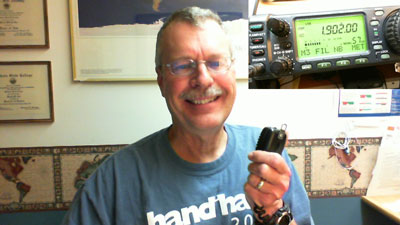
Happy Autumn!
Now that autumn has returned and the equinox is upon us, conditions on the amateur radio bands begin to favor some of the longer wavelength parts of the HF spectrum like 160, 80, and 40 m. True, there is still a great deal of interference from thunderstorms that pop up in the warmer climates, but the interference isn’t nearly so bad as it had been during the height of summer. The longer nights also mean less ionospheric D-layer absorption on those bands, which translates into more opportunities for long-distance contacts. In short, from this point forward we will see rapidly changing conditions on some of the bands where regional HF nets typically meet on a daily basis. This, as you might expect, can lead to potential interference as skywave propagation begins to move out from a few hundred miles to over 1000!
With more and more of our Handiham members earning their General Class tickets and becoming more involved with HF operation, we now have an opportunity to learn how the HF bands change from season to season. As always, we recommend doing plenty of tuning around and listening on the various bands to learn when there are band openings and how the more experienced operators are taking advantage of them.
One of my favorite bands has always been the 75 m band, and I have made plenty of random contacts but also enjoy checking into my favorite regional net, PICONET, on 3.925 MHz Monday through Saturday. Interestingly enough, this net has long been associated with Handihams — way longer then I have been with the Handiham program. Propagation on 3.925 MHz during the 9 AM to 11 AM central time “morning net” is generally the best, because during the previous overnight hours thunderstorms have quieted down and the bands are generally less noisy. As the day wears on, D-layer absorption increases and signal levels drop. There is also an afternoon session, from 4 PM to 5 PM, in the summer. In the winter, the PICONET expands its afternoon session to 3 PM to 5 PM, since conditions for sky wave propagation are better. But this can pose a problem: Skywave is so good that a New York net on the same frequency can now be heard in the Upper Midwest. No doubt the New York stations are also hearing us. Generally this overlap of nets isn’t a problem, but sky wave can work against you when the band “goes long” and stations from over 1000 miles away begin to sound as loud as the stations a hundred miles away. This situation calls for flexibility on the parts of net participants. If it is possible to use a directional antenna, a rarity on 75 m, interference can be mitigated by turning the antenna to favor only the stations in your area. Switching between wire antennas that favor particular directions might also help, as well as using a wire antenna instead of a vertical antenna. The wire antenna will most likely have a higher angle of radiation that will favor closer stations, while the vertical will have a lower angle of radiation that will favor the stations over 1000 miles away. Flexibility on the part of the net control stations is also called for. If interference is a problem, a net control station should consider cutting the net a little short or changing frequency just a bit. Of course this is not always easy when you have a net running and if you, as the net control station, want to change frequency everyone will have to understand the plan and change with you. It can be a challenging job for a net control station to herd everyone to another nearby frequency without having some strays!
160 m is especially useful over the winter months. While there are not as many structured nets on that band, you can run into “regulars” — stations that often get together on the same frequency about the same time every evening. In the summer 160 m is good for propagation in a regional area during the nighttime hours. In the winter, like the 75 m band, 160 m lengthens out and long-distance contacts are possible. If you are planning to try to earn a certificate like Worked All States on 160 m, winter conditions are your friend. Most evenings at 8 PM Central Time there is an informal get-together on 1.902 MHz. Most net participants are members of the Handiham affiliated Stillwater Amateur Radio Association.
40 m is a good band summer and winter and during sunspot lows and sunspot highs. It benefits by reduced thunderstorm interference during the winter months. You can work DX on the 40 m band, and an advantage it has over 160 m and 75 m is that a wire antenna for 40 m will be able to fit into most suburban lots. Furthermore, a vertical antenna for 40 m can be quite efficient and requires less inductive reactance to make it tune, as compared to a 75 or 160 m vertical. As always, cutting ground losses through an extensive radial system will yield good results.
Of course the sunspot cycle is on the way up and we can expect more DX to appear on 14 MHz and higher frequencies, but please don’t forget about 160 through 40 m. With winter conditions approaching here in the northern hemisphere, opportunities for fun on these bands are not to be missed!
I hope to hear you on the air soon.

Pat Tice, WA0TDA, is the manager of HANDI-HAM and a regular contributor to AmateurRadio.com. Contact him at [email protected].
Arnie Coro and the Super Islander
Looking back over some older email list posts today I came across an interesting exchange of posts on the QRPp list.
In early August Arnie Coro CO2KK announced latest progress on the ‘Super Islander Version 5 QRP transceiver project’. Key design criteria include using “as much as possible parts that could be recycled from easy to find sources of electronic components” such as toroids from PC boards salvaged from failed compact flourescent globes, and other treasures from broken VCRs, TVs and fax machines.
Via the short Wikipedia bio of Arnie Coro I discovered a link to more than seven years of transcripts of his weekly radio program ‘DXers UNnlimited’ broadcast by Radio Habana Cuba. Earlier transcripts are here. He also has a blog last updated in June. They’re practical and full of useful ideas.
One transcript is reproduced on dxzone.com and is an undated description of the project detailing what appears to be the first valve version of the project – I think designed by his friend Pedro, CO7PR. It brings home in a softly stated way the challenges and barriers facing radio enthusiasts in countries which for one reason or another don’t enjoy relatively high wages to afford factory made gear, and who have to be much more resourceful in making do with what they have available to get on the air.
A rude dismissive comment on the QRPp list prompted a firm but calm response from Arnie.
“Yes amigos, it is very easy for people having access to the money and the possibility of buying factory built radios or even well designed kits with full instructions and each and every part required… even washers , to just sign a check or complete and electronic transaction that will bring to their homes a nice piece of equipment…
But that is not the case for many of us, that do enjoy very much the amateur radio hobby, and think not only about ourselves, but also about those that may benefit from also well designed, easy to assembly and to adjust radios that can be built using locally available parts.
Try to find even the lowest cost ceramic filter for building a single sideband rig in no less than 130 countries around the world and you will meet with the fact that they are impossible to locate, and the same goes for ferrite and powdered iron toroids, IF transformers, RF power transistors, small relays , RF connectors, resistors and capacitors, not to mention quartz crystals and integrated circuits !”
SolderSmoke named Arnie ‘Homebrew Hero’ earlier this year.

Arnie Coro CO2KK
Arnie ended one of his missives to the QRPp list with this plea:
“Maybe one day the International Amateur Radio Union could sponsor a similar project to help promote amateur radio among young persons that live in poor nations where buying a factory made transceiver may be equal to the full salary of a worker during five years or more !!!”
I remember that one of the first QRP designs I ever built (back in the late 1970s) was a simple VXO controlled 6 W 20 m transceiver that appeared in QST (Dec 1978). It was later suggested as a prototype IARU transceiver as ham aid for developing nations.
Arnie’s idea appears much more economical and self reliant, drawing on the potential of recyclable components. It’s also a design thought through from a Cuban perspective rather than a first world one.
You can even hear an interview with Arnie Coro recalling the Bay of Pigs invasion in 1961. [audio]
Stephen Rapley, VK2RH, is a regular contributor to AmateurRadio.com and writes from New South Wales, Australia. Contact him at [email protected].
Obligatory Viral Tower Climbing Video Article
If you read this blog and you haven’t seen it yet, you don’t have a pulse or you’ve been busier than Lindsay Lohan’s legal team this week and haven’t read any email, blogs, tweets, or forums. This video of a tower climber ascending a 1700 foot tower has been making its way on the Intertubes:
http://www.youtube.com/v/uhtgsAXmz7U?fs=1&hl=en_US
The narrator is friendly enough and sounds more refined than many of the roughneck tower guys I’ve met and worked with, but I have to question the brains-to-balls ratio of the climber. While it may not be required to be clipped in at all times, it’s a very good idea, especially at the transitions. I can’t fathom why a climber wouldn’t clip a lanyard to the tower when pulling themselves on to the very top. He even putzes around untethered when standing next to the beacon light, digging out a carabiner. The other climber comes up next to him and clips in before he does. It would take only one gust of wind or an unexpected move or slip up by the other climber to kill the camera equipped climber.
You can climb untethered and gain some time, but what use is an extra 10 or 15 minutes one day for losing perhaps 40 or 50 years of your life?


Obligatory Viral Tower Climbing Video Article
The narrator is friendly enough and sounds more refined than many of the roughneck tower guys I've met and worked with, but I have to question the brains-to-balls ratio of the climber. While it may not be required to be clipped in at all times, it's a very good idea, especially at the transitions. I can't fathom why a climber wouldn't clip a lanyard to the tower when pulling themselves on to the very top. He even putzes around untethered when standing next to the beacon light, digging out a carabiner. The other climber comes up next to him and clips in before he does. It would take only one gust of wind or an unexpected move or slip up by the other climber to kill the camera equipped climber.
You can climb untethered and gain some time, but what use is an extra 10 or 15 minutes one day for losing perhaps 40 or 50 years of your life?

Anthony Good, K3NG, is a regular contributor to AmateurRadio.com and writes from Pennsylvania, USA. Contact him at [email protected].
Take your hand-held to work day: 1st October
The South African national radio society, SARL have come up with what I think is a really inspired idea! They are promoting ‘Take your Handheld to Work Day’ on 1st October. They are asking amateurs across South Africa to take their handhelds to work on the 1st October and demonstrate amateur radio to their friends and colleagues during tea and lunch breaks.
In support of that, I’m planning to make sure that I try and connect to some South African repeaters during the day using Echolink and see if I can make a contact or two. It would be great if others did the same in support of this superb idea.
And of course, handhelds don’t just have to be VHF/UHF. Perhaps FT817s and some simple low power morse activity could feature to show the HF side of the hobby too.
You can read more about the SARL initiative here
Well done SARL. I wonder if some other societies will follow suit – I hope so!

Tim Kirby, G4VXE, is a regular contributor to AmateurRadio.com and writes from Oxfordshire, England. Contact him at [email protected].
A view on privacy
If you’ve used Google Maps then you have probably tried the Street View feature that lets you look around a place on the map as if you were actually there. Unless you are in Germany, that is. Germany remains the largest European country that is not covered by the Street View service. The German government has forced Google to offer an opt out service that allows people to request that their houses are blurred out of the pictures in the same way faces and vehicle registration plates are. Some privacy campaigners in Germany would prefer that appearing in Street View should be an opt-in feature.

Street View has been available as an option on the aprs.fi APRS tracking site for a few months now. It’s fun to virtually travel along with an APRS user and see what they see. But Street View has a serious use too. If you’re house hunting then it would be a great way to see whether you like the neighbourhood, for example. When Olga and I went to Prague last month the taxi driver from the airport wasn’t sure exactly where our rented apartment was but because I’d “visited” the area in Street View a few days earlier I recognized where we were and was able to direct him right to the door. (Incidentally the Czech government has also called a halt to further data collection in the Czech Republic pending talks with Google.)
I don’t know what people think they are achieving by insisting on being able to opt out of Street View. It shows nothing that you can’t see just by being there. What are they trying to hide? Anyone can take pictures of an area, upload them to the internet (without blurring anyone’s face or vehicle registration number) and link them in a way that anyone searching for pictures of that place will find them. All Google has done is go about it in a more methodical way. Are we going to have controls on publishing photos on the internet now?

Julian Moss, G4ILO, is a regular contributor to AmateurRadio.com and writes from Cumbria, England. Contact him at [email protected].
Edible Hats

 Ham Radio Deluxe |
 W5SWL Electronics |
 Ham Radio Prep |
 KB3IFH QSL Cards  Hip Ham Shirts  HamRadioAuctions HamRadioAuctions Reliance Antennas Reliance Antennas Enigma Shop Enigma Shop |  morseDX  Ni4L Antennas  R&L Electronics R&L Electronics antennas.us antennas.us QRV QRV |
- Matt W1MST, Managing Editor
