 |
 ICQ Podcast Series Three Episode Twenty-One – Operating in Australia (10 October 2010)
 10 October 2010 | by
 Series Three Episode Twenty-One of the ICQ Amateur / Ham Radio Podcast. News Stories include:
- Chinese Antarctic base on-air
- Amateur Radio can prevent age-related dementia
- Isle of Man ARS on-air for JOTA
- Ham radio repeater at risk
- GB7DE D-Star gateway offline
- RSGB launch amateur radio survey
- Power Line Adapters interfere with ambulance frequencies
- Austrian Military Radio Society 50th anniversary
- Green Comet approaches Earth
- EU Radio Spectrum Policy
- New web-based HF SDR receiver
- Irish radio amateur achieves 10-band DXCC
Your feedback, upcoming events, and Martin (M1MRB) discusses operating in Australia with Adrian (M0GLJ).
Colin Butler, M6BOY, is the host of the ICQ Podcast, a weekly radio show about Amateur Radio. Contact him at [email protected].
2010 California QSO Party
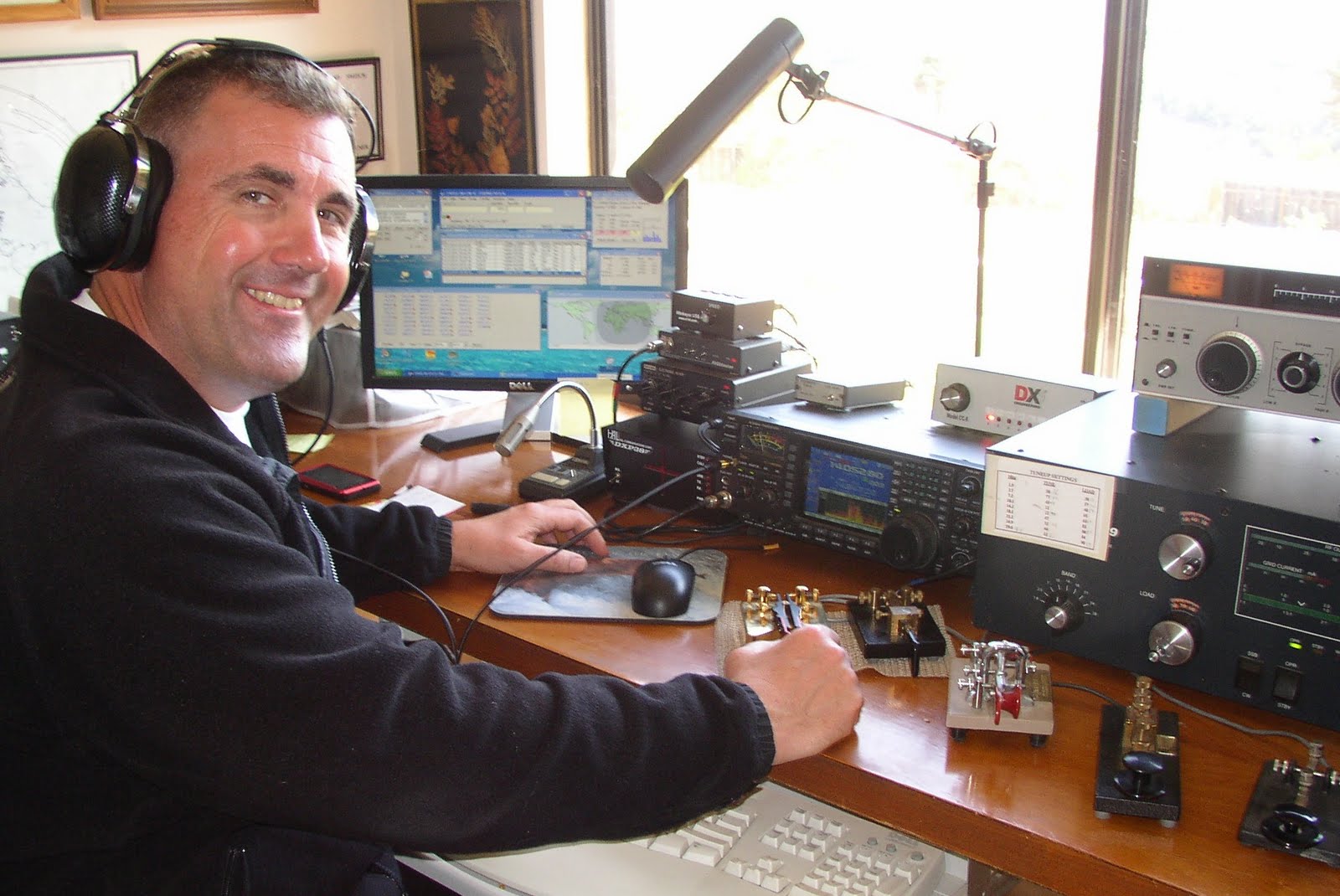 Photograph 1 taken Sunday afternoon as rate drops in half and I’m logging California counties on 20m with the yagi pointed due east.
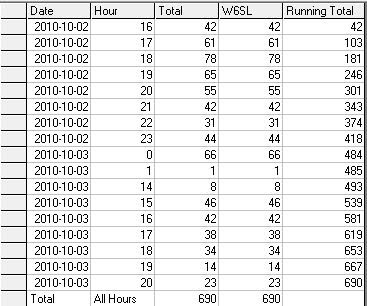 Photograph 2 illustrates my rate per hour through 17 hours of operation. What a blast operating CW through CQP weekend as 3 point Qs drove my score into six digits.
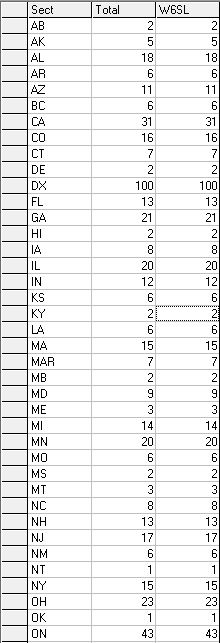 Photograph 3 is a list of sections worked and one notes band conditions were long especially on 15 and 20m however 10m never ionized over the weekend. I miss 10m activity and hope the band will finally play next year?
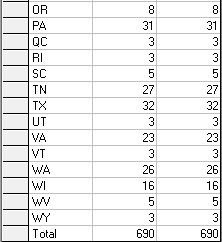 Photograph 4 is a continuation of sections worked and I did not log Nebraska, North Dakota, South Dakota, Nevada, or Utah in addition two Canadian sections as well.
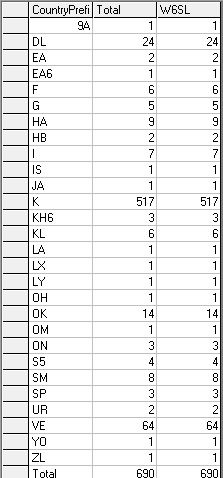 Photograph 5 breaks down my country total and each European counted as new one against my DXCC pursuit. What a joy finally hearing stations across the Atlantic on the wireless set!
California QSO Party.
Rest is important going into any RadioSport event and fatigue does not help one’s morale when butt-in-the-chair time is a priority. I was wiped out when Saturday evening rolled across the ionosphere and called it at 0100 UTC when CW signals blurred my brain. I slept 12 hours then returned to the keyer catching long skip into Europe on Sunday morning.
I recognized many stations who filled the log at the shackadelic in Shell Beach and, what a hoot, logging Dave, K2DSL and Victor, KD2HE both of whom journal their wireless activities on the Internet.
Likewise, logging Bill, N6ZFO who was booming through the ICOM wireless on Sunday morning from Lake County. A great signal from his location. I want to thank the North California Contest Club for sponsoring a stellar event. The California QSO Party is world class!
KA3DRR/6 CQP Score.
40m = 92Qs and 1 Section.
20m = 376 Qs and 25 Sections.
15m = 222 Qs and 26 Sections.
Total Qs = 690
Total Sections = 52
Total Points = 107, 640
Spirit of Ham Radio.
Likewise John, W6SL is a stellar example when speaking about the spirit of ham radio and the friendship that follows our hobby. He opened his operating chair and put me in the pilot seat of his accomplished station. John is a 5 band DXCC operator with 300 plus entities to his credit. He is one who patiently waits for a new country recently logging Andorra not an easy feat from the west coast given the mountainous terrain surrounding this country.
The spirit of ham radio moves through the ether in mysterious ways. I was speaking with Dick Norton, N6AA about moving to the next level in RadioSport during an annual swap fest in Santa Maria, California. He mentioned guest operating just as W6SL walked within range of our conversation. John asked about my guest operating interest and invited me over without hesitation.
I enjoyed operating a wireless set using an amplifier and competitive grade antenna systems through last weekend because of John, W6SL.
Conclusion.
Rest is important going into an event. RadioSport is fun and reasonably defined goals make a difference in the operating chair. I logged new countries, grid squares, and counties through last weekend while learning about propagation using competitive grade antennas.
The spirit of ham radio endures through men like John, W6SL, Bill, N6ZFO, and organizations like the Northern California Contest Club.
73 from the shackadelic.

Scot Morrison, KA3DRR, is a regular contributor to AmateurRadio.com and writes from California, USA.
2m Moxon antenna by VA3OMP

VA3OMP's 2m Moxon antenna
Back in August I was doing some simplex D-Star and D-RATs testing with Greg, VA3OMP on 145.67MHz. He lives in the West part of Ottawa in Kanata and I live in the South in Greely so to improve the link between us Greg constructed a 2m Moxon. The antenna is built out of solid aluminium rod and as you can see he put some craftsmanship into building it. Greg kindly agreed that I could post the pictures and details here.
To determine the measurements Greg used the design program at the Moxon antenna project website. Here are the dimensions.

Moxon antenna design for 145_67 MHz
Greg reported the built antenna had an SWR of 1.6 :1 at the design frequency.
Here are set of pictures showing the construction.

Moxon ends secured with Plexiglas

Moxon ends secured (bolt side)

Feedpoint before sealing

Feedpoint sealed

Complete Moxon
Thanks to Greg, VA3OMP, for supplying and sharing his photographs and construction details. All photographs are copyright to Greg Speakman, VA3OMP.


Alan Steele, VA3STL, is a regular contributor to AmateurRadio.com and writes from Ottawa, Ontario. Contact him at [email protected].
New dual-band mobile from Wouxun?
Ham radio forums have been alive with buzz in recent days about the pending release of the KG-UV920R, a new dual-band 2m/440 mobile radio from Wouxun. Ed Griffin from Wouxun.US is in China until October 25th and was not available for comment, but a photo of the radio appears on his website. An anonymous but reliable source said that the radio is not yet in production, but that it could be available by early 2011 pending FCC certification.
How much will it cost? The same reliable source did not have a firm answer but expected the price to be less than $300. They also said that they expected a 2m/220 version in addition to the 2m/440 version. When you start looking through the feature set (remote front panel, cross-band repeat), that’s quite a bit less than a comparable radio from other manufacturers. Obviously, a lot can change between now and the final production release. The specs and price could very well change significantly. Hopefully Ed will stop by soon and provide us with some more information.
What do you think of Wouxun’s apparent entry into the mobile radio market? Will you buy one?
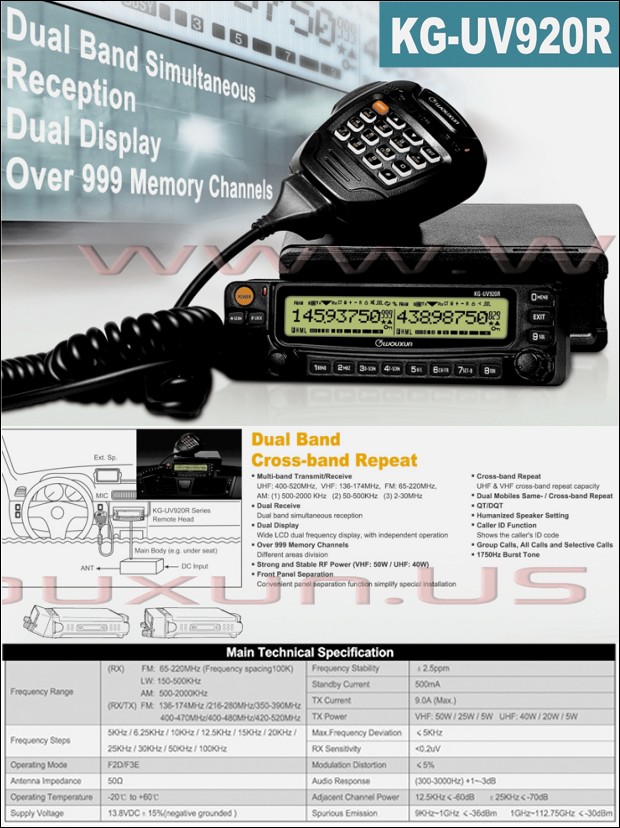 (Images above from Wouxun.US and re-formatted for viewing)
Matt Thomas, W1MST, is the managing editor of AmateurRadio.com. Contact him at [email protected].
No more sunspots after 2016?
I have just updated the smoothed sunspot number data file for VOAProp with the latest predicted values up to the year 2020. It’s one of those jobs I still do even though I long ago lost interest in the program, having come to the conclusion that the most interesting thing about HF radio propagation is its unpredictability.
Although NOAA updates its sunspot number predictions every month, I only update the data file every few months as the changes are too insignificant to make any difference to the VOAProp output. Since the last time I updated the file NOAA scientists seem to think that the maximum of the next cycle will occur a little later and be a tad higher than previously predicted, with a maximum SSN of 84.6 in the middle of 2013. They also don’t expect the next minimum at the end of 2019 to be as low as the last one.
This view is not shared by solar astronomers Matthew Penn and William Livingston of the National Solar Observatory in Arizona. They have been studying the magnetic strength of sunspots since 1990 and have observed that in that time it has fallen by nearly a third. If the trend continues, the astronomers believe, then by 2016 it will have fallen to the level below which the formation of sunspots is believed to be impossible. Though this prediction seems far fetched, it becomes a little more believable when writing about it on a day when there are once again no sunspots.
A period with almost no sunspots has occurred before, and not so long ago either, between 1645 and 1715, known as the Maunder Minimum. This period was also known as the Little Ice Age due to the fact that lower than average temperatures occurred in Europe. Time to sell our radios and invest in heating appliances, perhaps?
If nothing else, this example should show us that healthy scepticism, not credulity, is the sensible response to any scientific prediction. If you don’t care for what one bunch of boffins say, don’t worry, another bunch will be along in a few months claiming to prove just the opposite. It’s about time the global warming alarmists woke up to this.

Julian Moss, G4ILO, is a regular contributor to AmateurRadio.com and writes from Cumbria, England. Contact him at [email protected].
Back on track, via the scenic route
The FoxTrak APRS tracker board is finished, and works, but I took the long way round getting there. Building the board was by far the easiest part of the project. Setting up and testing it was a trial of patience, ingenuity and lateral thinking.
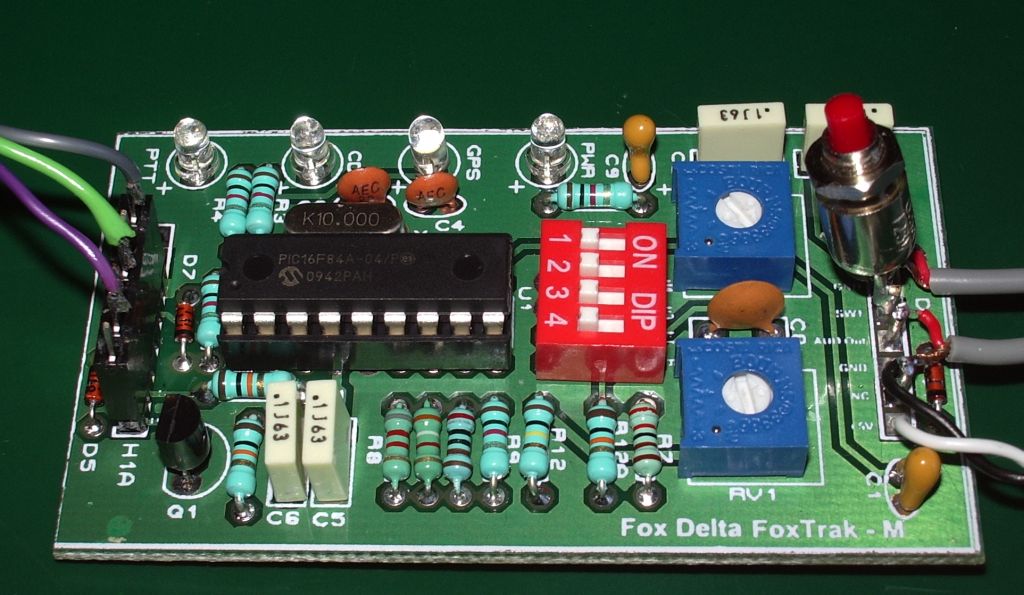
After building the tracker it has to be programmed with your call and a few other options by connecting it to a computer and running some configuration software. The documentation was not specific and I was not sure if I could just connect it to a serial port. The tracker is just a 16F84A PIC which works at TTL logic levels, but a PC serial port produces RS-232 at +/- 12V. What’s more, the FoxTrak website mentions a null modem adapter with MAX232 chip which is a TTL to RS-232 level converter, suggesting this might be required. However I had a USB to TTL serial adapter module that I bought some time ago for another project so I decided I should be able to use that. I did, and the configuration software was unable to detect the tracker.
After thinking about it for a few hours I decided to take a chance and use a normal serial connection. I used a Prolific USB to RS-232 serial adapter. That worked, and I was able to program my settings into the tracker.
The next step was to calibrate the tones produced by the tracker. 1200baud packet uses mark and space tones of 1200 and 2200Hz. Due to some hardware limitation of the 16F84A PIC, the tones are actually spaced about 1050Hz apart and the calibration software uses a default setting that puts them as near equally spaced over a centre frequency of 1700Hz as possible so the error in the generated tone frequency is shared equally between mark and space. To generate constant tones so you can measure them using a frequency counter you must connect to the tracker using a terminal program and send Esc T 0 or Esc T 1. I tried this using Windows HyperTerminal and nothing happened.
I now wasted quite a lot of time as I didn’t know what was supposed to happen. I didn’t know whether the PTT LED would illuminate when the test tone was produced so I didn’t know whether the absence of a tone was because the PIC hadn’t received the command to send it or some other reason. Eventually I decided that perhaps HyperTerminal wasn’t talking to the tracker so I tried another terminal program called RealTerm. This time Esc T 0 immediately produced a nice waveform on my oscilloscope which also counted the frequency for me and told me the tones were within 1Hz of the documented frequency for the default calibration value. Good, or so I thought.
Now I wanted to feed the audio output into a radio and see if my Kenwood TM-D710 would decode the packets it produced. I had wired a push-to-make switch in the “Transmit Now” position but what I didn’t know was whether the tracker would transmit a packet when it had no GPS data. I don’t have a GPS I can use with it at the moment, but even if I had, I would have trouble getting a fix inside the shack due to the high electrical interference levels.
The tracker wouldn’t transmit anything without a valid GPS fix, but it occurred to me that it must be possible to write a program that pretends to be a GPS and outputs NMEA packets to a serial port in order to test GPS applications. I didn’t want to write such a program, but other people had the same idea and Google found me several GPS emulators. Unfortunately the so called “free downloads” required a fee of $30 to $40 to use them. Blow that, I’d rather spend that money on a real GPS receiver.
An enquiry on the APRS Yahoo! group and another few hours wait and I was pointed in the direction of two free GPS simulators: gpsfeed+ and NMEA Generator. With these I was able to send fake GPS positions to the tracker board. The GPS light came on, as did the PTT light whenever a position was sent. At last!
Around this point I wanted to change a couple of the settings I had programmed in to the tracker. I re-ran the configuration software and found that when I tried to write the new settings back to the PIC it failed with a mismatch error. Reading back the settings they were now corrupt. I could not seem to clear the problem and wondered if I had blown something up.
I tried another USB to serial converter, one with an FTDI chipset which is normally more reliable in transceiver control applications. That could not even detect the tracker board. Oh dear! As a last hope I tried the Prolific adapter again and, having in the process switched both the computer and the tracker off and on again it worked this time. It seems that if you are going to configure the tracker it’s best to do it first before trying anything else. I was glad to have found a solution and that it was still working but I had wasted quite a lot of time getting to that point.
The next problem was getting the packets transmitted by the radio. I tried the Motorola GP300 first of all but for some reason it went into transmit as soon as I inserted the 2.5mm jack into the socket. So I tried the Kenwoods. Both the TH-F7E and its grandparent the TH-205E use the same type of connections. But on those I could not get PTT to work at all. I could really have done with some diagrams of how to wire up the tracker to these radios. I was, however, able to transmit some audio by manually pressing the radio PTT and then pressing the Transmit Now button on the tracker to send a packet. From this I was able to determine that no matter what audio level I used the TM-D710 would not decode the packets from the tracker.
I tried what must have been an infinite number of different level settings without success. Yet the tracker packets sounded exactly the same as ones I was receiving off-air which were being decoded. I remembered that I had the VX-8GR which also has a packet TNC so I decided to see if that could receive them. The Yaesu decoded the tracker packets over a wide range of audio level settings, even when the transmission was undermodulated. So what didn’t the Kenwood like about them?
I decided to set up AGW Packet Engine to decode packets via my FT-817 which was conveniently connected up to a sound card. That decoded nothing either. Clearly something was wrong with the AFSK output from the FoxTrak board. Even though my VX-8GR could decode it, it was going to be of no use to me if its packets would not be decoded by my gateway.
Finally, on the basis that there was nothing left to try, I decided to try different calibration settings to vary the tone frequencies. After another fight with the serial adapters I programmed in a calibration value of 36 which should result in a mark tone of 1200Hz and a space of 2250Hz and was rewarded by beeps from the TM-D710 indicating that packets were being decoded. They were also appearing in the monitor log of the AGW Packet Engine. The VX-8GR was still decoding them, too. Success at last!
I am relieved that it works after all this effort. Now all that remains to be done is to acquire a serial GPS, figure out the radio PTT connections and box the FoxTrak up with a suitable battery pack to make it into a usable unit. That will take a while, since some of the bits and pieces (including the GPS) will be coming from China.
It is interesting that the calibration setting which resulted in the best decoding is one farthest from the default, which does not place the mark and space tones so that the difference between the actual and the correct tone frequencies is equally spaced between them. A few months ago I heard a mobile drive through the area beaconing on APRS and none of its packets were decoded. I wonder how many people build or buy these trackers – either the FoxTrak or the original TinyTrak which it is a clone of – and leave the settings to default not realizing that they are unintelligible to many radios?

Julian Moss, G4ILO, is a regular contributor to AmateurRadio.com and writes from Cumbria, England. Contact him at [email protected].
Handiham World for 06 October 2010
Welcome to Handiham World!
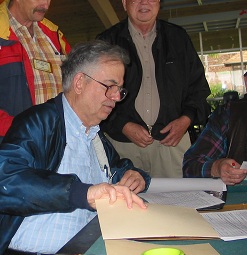
Photo: John Hoenshell, N0BFJ, enjoys being a VE and handles the paperwork at radio camp sessions and also volunteers during VE sessions at Dayton HAMVENTION. He believes that team members with disabilities can participate in a successful session.
Can a VE session be more than just a process of overseeing test takers in a room and handling their FCC paperwork?
This morning I had a different, but VE-related, question from one of our blind members. She was asking how she might participate in a VE session if she became a volunteer examiner. She mused that being a VE sounded interesting and that she would like to participate, but she wondered if it would be practical since she couldn’t see a room full of test takers. Since this topic comes up from time to time, I thought I’d take another look at what a VE session is about. While I am by no means an “expert” VE by experience, I can relate to testing in general – I was trained as a teacher, after all – and I have observed people with disabilities for decades. I have been present at many VE sessions over the years, especially at Handiham radio camps, but have only relatively recently become a VE myself.
I got to thinking about the very best VE sessions I had observed. What made them stand out from the others? It was more than the success of the candidates, though that always helps. It was more than the team arriving prepared and being able to process the paperwork efficiently, too. It was more than promoting the session and arranging a good location, though those things were important.
But what was it?
Well, let’s discuss the typical VE session a bit.
Our blind Handiham member is right in assuming that a blind VE cannot observe a room full of test takers as a sighted person might do during a VE session. That does not mean that a blind VE cannot participate. At our radio camp VE sessions, I suggest that blind VE team members sit at the tables where the exam is being read by volunteer readers to blind test takers. This assures that the exam is being proctored so that all rules are followed. A sighted VE simply looking at a room of test takers cannot know what is being said at each table in this kind of an adapted test session. Blind VE team members understand how tests are given to blind candidates and are potentially better at this kind of observation than anyone else.
The paperwork table is probably one place a blind VE would not be as useful. In every VE session, the team leader should try to match skills & capabilities with the tasks at hand. If there are no blind test takers to proctor, a blind VE might instead be part of the meet & greet team, setting candidates at their ease and answering the usual questions about what to expect during the testing, any rules of conduct (no smoking, quiet please, bring test to table at the side of the room when finished, etc.) As testing progresses and candidates start to turn their exams in for grading, a blind VE can then be stationed outside the testing room to answer questions that candidates might have. Typical information requested ranges from when they can use their new privileges if they pass an element upgrade to the location of the rest rooms.
Another job that every VE team has is communicating test results to the waiting candidates. There is no reason a blind VE cannot help with this job – and a savvy VE team leader will know who is best-suited for the hardest job – the delivery of the bad news. If a blind VE can handle telling a candidate that they didn’t pass but can do so in such a way as to help that person accept the news in a positive way, the entire VE team will be grateful! You don’t have to see to help candidates, successful or not, learn more about your ham radio club. Post-testing is a great time to talk with candidates and invite them to club and ARRL membership, and yes, even Handiham membership if they have a disability.
For the excited new Technicians and Generals, you might start a conversation about which radios are best, pointing out the availability of the club’s repeater system or the best ways to check out the the HF bands during the improving sunspot cycle.
In the end, a successful VE session is one that provides an opportunity for the candidates not only to pass their exams, but to leave the test site with the information and enthusiasm that will carry over to participation in the club and regional activities as well as getting on the air! When you look at a VE session as more than just three team members overseeing a room of test takers, you can easily find places for blind VE team members to be a part of this most rewarding of volunteer activities.
I hope to hear you on the air soon.

A dip in the pool
No one told you there was going to be a quiz, right? I thought it would be fun to pick a question out of the question pool and see how many of us can remember the right answer. Ready? Here we go:
E6A02
What type of semiconductor material contains more free electrons than pure germanium
or silicon crystals?
A. N-type
B. P-type
C. Bipolar
D. Insulated gate
Did you pick answer A, N-Type? That’s the right choice, and easy to remember if you think of “N” standing for “negative” and an excess of electrons in a material would give it an overall negative charge.

Pat Tice, WA0TDA, is the manager of HANDI-HAM and a regular contributor to AmateurRadio.com. Contact him at [email protected].
 Ham Radio Deluxe |
 W5SWL Electronics |
 Ham Radio Prep |
 KB3IFH QSL Cards  Hip Ham Shirts  HamRadioAuctions HamRadioAuctions Reliance Antennas Reliance Antennas Enigma Shop Enigma Shop |  morseDX  Ni4L Antennas  R&L Electronics R&L Electronics antennas.us antennas.us QRV QRV |
- Matt W1MST, Managing Editor
