 |
 I am CAD afflicted
 25 October 2010 | by
 Yep, it is confirmed now for sure. Compulsive Antenna Disorder has haunted me since I was first licensed and ran a coax fed 80 meter dipole on multiple bands without a tuner. The first time the symptoms were noticed by my family and friends was when I got a couple OO tickets for out of band harmonics. Hmmmm… what’s up with that? So a bit of reading and the antenna tweaking began and that’s when it all started.
Soon thereafter I tried to load up a nifty pin from my Junior Prom Boutonnière that reminded me of a triple stacked halo for 1296 Mc (MHz for the newer ones amongst us). Then it was the handheld yagis for 432 Mc that we used with some military surplus gear that used dynamos so we could chase tornadoes. (We thought if it bounced off the moon, it should bounce off of a tornado!) The saucer sled that became a parabolic for listening to satellite telemetry and on it goes… Compulsive Antenna Disorder has had a firm grip on me for some time now.

Am I dreaming? Thanks wiki images!
As a QRP operator, I am always looking for more antenna power. I know that somewhere out there simply MUST be a silver bullet, that magic QRM and pileup busting antenna that makes my 2 watts output sound like a full gallon.
I can say one thing for sure, I know a lot of non-silver bullet antennas, as I have a box full of them.
But they still make a few QSO’s at times and I’m having fun along with a bit of frustration and disappointment as I deal with my CAD affliction.
I’m told that much like telegraph key collectivitis there is no known cure or relief. I share in your grief brothers and sisters…
72,
Kelly K4UPG PB #173
Kelly McClelland, K4UPG, is a regular contributor to AmateurRadio.com and writes from Florida, USA. Contact him at [email protected].
Fraternity?
Over the last few days a North American ham has been operating a beacon at the top end of the 30m band on the frequency that has been used for many years for HF APRS. At times this has made HF APRS operation impossible. After some difficulty, due to the fact that the beacon operator’s contact information was incorrect, someone managed to get in touch with him to point out the problems he was causing and ask politely if he would move the beacon. This is part of the reply that was received, copied verbatim from an APRS mailing list:
“Last week I moved the beacon when some other hams we’re bitching at me about ‘their’ all important!!! ham activity…… PSK, RTTY what ever!!! .
I move AGAIN then another cry baby bunch CRIES about ‘THEIR’ ALL IMPORTANT activities like weak signal CW QRRS CW whatever!
We have to SHARE the frequencies I will think about the QSY ….. if I get Bitching from so other ham ‘group’ like the DX cluster folks who are ‘DXing’ fish in a BARREL for some ALL IMPORTANT ‘certificate’ What am I to do??? I am an experimenter /builder when do I get to use a frequency????????
WHY is ‘APRS’ more important than MY activity? I look in the regs and I see NOTHING about one ham activity has priority over another!”
I have left out the individual’s details as I don’t want to start a personal attack that could be counterproductive by leading him to entrench his position. But whatever happened to good manners, politeness and consideration for one’s fellow amateur? When, as a young teenager, I first began listening on the amateur bands, I used to be impressed by the politeness and courtesy of the conversations I heard. No longer is amateur radio a gentleman’s hobby.
This OM is quite correct that we have to share the frequencies. It is a common courtesy that if a frequency is in use then you don’t use it, even if you have a net that has been meeting on that frequency every day since Marconi invented the spark transmitter.
But in the digital parts of the bands which can be used for more than conversations between two or more people, checking whether a frequency is in use may involve more than just sending “QRL?” or listening for a couple of minutes. Activities like APRS, packet radio, Winlink and so on are effectively nets that operate 24/7. If you don’t hear anything for a while that may just be because propagation isn’t sending anything your way at the moment.
This is how Chris, G4HYG prepared to select the frequency to use for APRS over PSK. He recently wrote: “Before I released the HF version of APRS Messenger I spent some time checking various frequencies on the 30m band. I found that the section from the 300 bd APRS frequency to the band edge appeared to be clear. I then started a period of monitoring the band from 10.1494 to 10.150 on a receiver with a digital mode program running with a very slow waterfall to catch anything I heard. This ran for a month from mid January to mid February.” It’s a pity the developer of the ROS digital mode that has caused so much disruption to other established activities could not have been as thorough and considerate in selecting operational frequencies.
To those who will trot out the response that activities like APRS have no more right to use a particular frequency than anything else I would say first of all that some types of activity need a specific frequency where other users can find it. It isn’t a matter of one activity being more important than another. If you had to hunt to find what frequency everyone is using today, some types of worldwide net operation would not be possible. In any case, a frequency that was clear in, say, North America might well be occupied in Europe. Allowing legitimate activities sole use of an established frequency by gentleman’s agreement is the only option. There is still plenty of room for other activities including ad-hoc beacons.
In activities like APRS, many dozens of stations all use the same frequency, making this a very efficient use of bandwidth. If users are driven off these frequencies or prevented from using these modes the result would be even less space left for other activities.
What people who object to this argument really mean is “I don’t have any interest in that mode and I don’t give a fig about those who do.” Is ham radio a fraternity? Yes, we are like a family of brothers who are forever breaking each other’s toys and beating the shit out of one another.

Julian Moss, G4ILO, is a regular contributor to AmateurRadio.com and writes from Cumbria, England. Contact him at [email protected].
ICQ Podcast Series Three Episode Twenty-Two – RSGB Convention & JOTA (24 October 2010)
Series Three Episode Twenty-Two of the ICQ Amateur / Ham Radio Podcast. News Stories include:
- Dundalk ARS morse and 4m nets
- £10m SSTL Space Lab in Guildford
- New Nevada radio station includes ham radio
- K3LR to receive Barry Goldwater Amateur Radio Award
- Comms support for Chilean mine rescue
- Radio listener arrested
- Ham sentenced for jamming police
- AMSAT-UK FUNcube SDR USB Dongle
- Experimental Web Radio from New Zealand and Europe
- New slow Morse transmission near Dartford
- BT to replace Comtrend PLT units
- Happy Birthday Ippy
- Amateur bands to be used for London 2012 Games
Your feedback and Martin (M1MRB) reports on the RSGB Convention and JOTA.
Colin Butler, M6BOY, is the host of the ICQ Podcast, a weekly radio show about Amateur Radio. Contact him at [email protected].
ICQ Podcast Series Three Episode Twenty-Two – RSGB Convention & JOTA (24 October 2010)
Series Three Episode Twenty-Two of the ICQ Amateur / Ham Radio Podcast. News Stories include:
- Dundalk ARS morse and 4m nets
- £10m SSTL Space Lab in Guildford
- New Nevada radio station includes ham radio
- K3LR to receive Barry Goldwater Amateur Radio Award
- Comms support for Chilean mine rescue
- Radio listener arrested
- Ham sentenced for jamming police
- AMSAT-UK FUNcube SDR USB Dongle
- Experimental Web Radio from New Zealand and Europe
- New slow Morse transmission near Dartford
- BT to replace Comtrend PLT units
- Happy Birthday Ippy
- Amateur bands to be used for London 2012 Games
Your feedback and Martin (M1MRB) reports on the RSGB Convention and JOTA.
Colin Butler, M6BOY, is the host of the ICQ Podcast, a weekly radio show about Amateur Radio. Contact him at [email protected].
Two more QRSS reception reports
Here are two more recent reception reports of my QRSS signal.

N8YE capture of QRSS signal from VA3STL
Steve, N8YE, sent one from South Eastern Ohio (above) from 20th Oct 2010 and my signal looks nice and strong. Also, I saw the my signal this evening in KL7UK/5 Bartlesville OK grabber (see below).

From KL7UK grabber 23rd Oct. at 0215


Alan Steele, VA3STL, is a regular contributor to AmateurRadio.com and writes from Ottawa, Ontario. Contact him at [email protected].
Cross Country Wireless SDR update
Cross Country Wireless has just announced an updated version 2 of its low cost SDR Receiver. The new version has an RF preamplifier using a power MOSFET after the RF bandpass filter which is claimed to improve sensitivity – which was a criticism of the earlier version – and reduce local oscillator output at the antenna port.
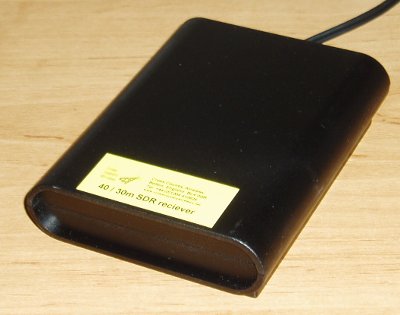 The designer Chris, G4HYG, claims that the receiver will now display a CW carrier at a level of -135 dBm on the waterfall of SDR-Radio using a 48 kHz sound card. The level of the local oscillator at the antenna port is now specified as -65 dBm, though a more typical measurement is -70 dBm. This should make it an ideal choice as a panadapter for radios such as the Elecraft K3. In fact, Chris recently stated that most orders for the receiver have been for use as panadapters, in conjunction with a sound card and suitable software such as PowerSDR-IF.
The cost of the standard SDR is £49.95. For panadapter use you will need a custom crystal for your radio’s IF which increases the price to £59.95. The SDR has two (switched) local oscillators so the other one could be specified to cover 40m or 30m for use as a conventional receiver. It’s also available as a built and tested board for assembly into your own case (at a significant saving.) If you built a USB sound device into the same box then it would be rather neat.

Julian Moss, G4ILO, is a regular contributor to AmateurRadio.com and writes from Cumbria, England. Contact him at [email protected].
LHS Episode #050: Ham Radio is Dead
 As I was roaming around the Intertubes, I came across an article at AmateurRadio.com written by Jeff, KE9V. I had been an avid listener of Jeff’s “Cornbread Road” podcast while he was publishing it as a podcast. The format was different enough to keep me interested. When it went away, I was highly disappointed.
As it turns out, his recent article disappointed me quite a bit as well. I don’t want to give much away, but suffice it to say the outlook Jeff paints is fairly bleak. At the same time, some of the points are valid and overall the essay was fairly thought provoking. Because of that, Richard, Bill (KA9WKA) and myself decided to discuss Jeff’s recent article. We also have our usual assortment of announcements, banter, gripes and response to feedback. So settle in for an interesting episode. We all had a good time. We hope you do, too.
73 de The LHS Guys (and Bill)
Russ Woodman, K5TUX, co-hosts the Linux in the Ham Shack podcast which is available for download in both MP3 and OGG audio format. Contact him at [email protected].
 Ham Radio Deluxe |
 W5SWL Electronics |
 Ham Radio Prep |
 KB3IFH QSL Cards  Hip Ham Shirts  HamRadioAuctions HamRadioAuctions Reliance Antennas Reliance Antennas Enigma Shop Enigma Shop |  morseDX  Ni4L Antennas  R&L Electronics R&L Electronics antennas.us antennas.us QRV QRV |
- Matt W1MST, Managing Editor
