 |
 LHS Show Notes #052
 28 November 2010 | by
 Episode 50: A milestone!
Announcements:
- Russ talks about his California trip: attending the Large Installation Systems Administration conference (LISA).
- The 50th episode is a milestone – Richard explains why. See also The Internet Archive.
- Lord Drachenblut reminds us of the upcoming Indiana LinuxFest in Indianapolis, Indiana. If you’d like to register, use the promotional code LHSPODCAST50 (all capital letters) and you’ll get a $15.00 discount on the ticket.
- Music in this episode is from 20lb Sounds, fronted by Dan Lynch of Linux Outlaws fame.
Topics:
- Scott, AD7MI, posted an article on his blog about moving to an all-Linux ham shack. Richard and Russ discuss the article, including Shackbox Linux, Ham Radio Deluxe, CQRLog, and more. Ultimately, Fldigi and CQRLog resulted in “100% Linux Nirvana”.
- Scott also asks what we think would be the ideal Linux-based ham shack. Russ describes his shack, which he thinks IS ideal. Our hosts then discuss various soundcard interfaces:
- Most sound cards work fine, and Russ recommends the SoundBlaster series over all, but suggests staying away from the SoundBlaster Audigy SE (model CA0106) sound cards as they don’t seem to work well (or at all) under Linux.
- Richard likes his Yaesu FT-897D. Most modern rigs allow a fixed-audio level connection to the computer sound card, as well as computer rig control. Russ has the Kenwood TS-570D, and it, too, is well-supported in the Linux ham libraries.
- Russ and Richard discuss the fact that most hams don’t log VHF/UHF contacts, other than in contests or toward an award.
- The FCC, created by the Communications Act of 1934, included the requirement to maintain a log book in the rules. Sometime between 1983 and 1986, this requirement was dropped as the FCC determined that the information was of little use to them. (If someone can point us to a reference that identifies when the exact rule change occurred, please let us know. I was unable to find the specific change online. -Ed.)
Feedback:
- Leif, KC8RWR, writes that Internet over EME (earth-moon-earth) isn’t likely to work due to the high latency involved. (This may be in reference to a comment in Episode 48.) NASA and DARPA are involved in a Deep-Space Internet project.
- Leif also asks “Isn’t Morse code dead?” and wasn’t it replaced by “Gerke Code”? Our hosts discuss.
- Craig, KB5UEJ, writes that he thinks Russ’ audio is louder and muddier than Richard’s in episodes 46 and 47. Russ agrees that the audio on a few of the recent episodes did suffer, but should be much improved now.
- Grant, KC9SJQ, comments that he doesn’t see a link to Russ’ screencast about SSL anywhere. Yes, it somehow disappeared, but Russ is working on it. He’ll either find the file or redo it.
- William, KB9TMP, sends his comments about Episode 48 where we discuss KE9V’s article that questioned the relevance of amateur radio.
- Craig, KB5UEJ, commenting about WSPR, says that you can run less than 5W on an FT-897 by reducing the audio drive from the computer to the radio. Richard points out that the reduction is often not uniform across the audio freqeuncies used, so some intelligibility may be lost. He had that problem with packet, but he’ll try it with WSPR.
- Matt wants to know the artist and title of a song in Episode 48. The song was “Endline (Choose Nothing)” by I Am Not Lefthanded from the album “Yes Means No”. Check out the show notes for Episode 48 for a link to the song.
Donations:
- Scott, AD7MI, sent a donation just before we recorded! Thanks, Scott.
- If you’d like to help the podcast, please consider making a donation. It’s easy! Just a click on the Donate button on the web site.
Contact Info:
- Contact Richard at [email protected], Russ at [email protected], or both at the same time at [email protected].
- Listen to the live stream every other Tuesday at 8:00pm Central time. Check the LHS web site for dates.
- Leave us a voice mail at 888-455-0305 or 417-200-4811, or record an introduction to the podcast.
- Sign up for the LHS mailing list.
- Sign up for the MAGNetcon mailing list.
- Thanks to Dave from Gamma Leonis for the theme music.
Music:
- Redemption Song performed by 20lb Sounds.
- Jimmy Carter, also by 20lb Sounds.
Russ Woodman, K5TUX, co-hosts the Linux in the Ham Shack podcast which is available for download in both MP3 and OGG audio format. Contact him at [email protected].
The 1W CW v 1W WSPR question – and the excellent KC1XX receiver
Last weekend I enjoyed running my 1W WSPR system up on 7MHz and was surprised by just how far it went. I wondered how a 1W CW signal would fare this weekend on the same band, given the activity in the CQWW CW contest. The activity of course is both a good thing; plenty of people to call and a bad thing; lots of interference.
After I’d finished writing my Practical Wireless column today I tuned up 7MHz and checked the output was set at 1W. I did what the low power guys recommend and called the loud ones. After all, if they’re way over S9, I shouldn’t be *that* many dB down!
First in the log was EA2EA, quickly followed by DF0HQ. RX4W, 9A1A, YL9W and OG2A all get the ‘Golden Ears’ award! By that stage I’d lost interest, having proven that it worked, but made a note to try 7MHz later when it opened to the USA.
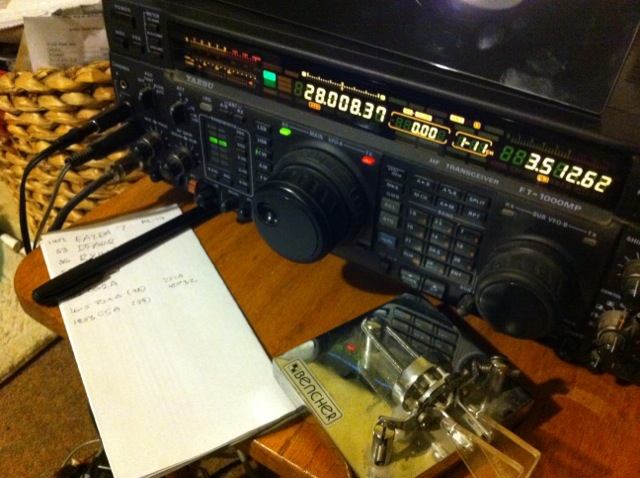
I was curious whether 28MHz would be open. Certainly not in a major way, but I could hear some African activity and some meteor bursts from European activity. I kept tuning up and down waiting to see what would appear. What appeared was PJ4A. They took a little working, but after a minute or two I had them in the log. Also coming in from the Caribbean were ZF1A (great to hear, as I’ve operated from there!) and KP3Z though I only heard those two briefly. Some US stations were heard, though not worked; KC1XX, W4SUL, AD4ES and K1TO amongst others. An hour or so later, I checked the band again and was interested to hear C5A coming through. To my surprise, and how often does this happen when you run 100W to a vertical, they came back first call.
After supper, I thought it was time to see if I could work the US on 7MHz with 1W. KC1XX was the poor unfortunate I picked. But we did it! It took a few repeats but the team there pulled all the information out and I was glad to hear that they took a lot of care to make sure they’d got the information ok. Next time guys, I promise I’ll call with higher power and make an easier QSO for you.
I enjoyed the 1W challenge. No doubt Justin will be pleased I played ‘real radio’, but I suspect that my next 1W operation will probably be on WSPR again!

Tim Kirby, G4VXE, is a regular contributor to AmateurRadio.com and writes from Oxfordshire, England. Contact him at [email protected].
Jam tomorrow
I have not been keeping up with the development of the controversial ROS digital mode as for reasons given in earlier posts I decided it was not something I wanted to use. However a recent post in the Yahoo digital modes group brought to my attention a development that seems rather alarming. The ROS software has recently included an anti-jamming switch the purpose of which is described as “improves rejection against strong CW and Beacons interferences.”
Polite usage of the amateur bands require that you check the frequency is in use before making a call so no-one should be jamming anybody. Furthermore, no-one should be using ROS in the CW or beacon sub bands. So what exactly is the purpose of this switch and why should anyone need it?
Perhaps an inkling of what may be going to happen can be drawn from some of the comments relating to the performance of the anti-jam switch, for example:
- “The New ROS/2000 passed the test successfully during the CW Contest last weekend.”
- “More test with the New ROS/2000 in other hostile environment. This time during a PSK63 Contest on Sunday.”
As I said all along (indeed, this was my original objection to the use of this mode) ROS is just too wide for use in the narrow digital allocations of the HF bands. There just isn’t the space for it, unless it remains a niche, occasionally used mode, which clearly its developer and supporters don’t intend it to be. As another comment in the ROS forum states: “The bands will fill up once people realize how good this mode is.”
The development of anti-jam techniques suggest that ROS is being readied to engage in war with users of other modes. When users can’t find a clear frequency they will just operate on top of other modes. The principal claimed advantage of the wide ROS mode is that it enables contacts to be made under similar weak signal conditions to JT65A but that it permits keyboard chats to take place rather than the basic exchange of signal reports and locators. So it appears that a vast swathe of spectrum space is going to be made unusable for other modes simply so that people can exchange brag files.
We need strict regulation of digital modes on the amateur bands. The days of gentlemen’s agreements are over. There are too many modes competing for limited spectrum space, and too many hams who aren’t gentlemen.

Julian Moss, G4ILO, is a regular contributor to AmateurRadio.com and writes from Cumbria, England. Contact him at [email protected].
Linux in the ‘Shack Advocacy
Years ago here in the States, a company called Folgers aired TV commercials in which they replaced the coffee in fine restaurants with Folger’s Crystals, an instant coffee. The premise was the product was so good, patrons wouldn’t know the difference. I’m sure the advertising campaign was a boon to Folgers as years later you will once in awhile hear someone say about secretly replacing something with Folger’s Crystals.
For years Linux advocates have been promoting the use of Linux in the hamshack, often bragging how their shacks are 100% “Windows free.” As I have mentioned in past blog articles, I’ve attempted several times over the past eight or more years to migrate totally to Linux in the shack and have been unsuccessful each time. I’m no dummy when it comes to Linux. I have used it since 1995 when nearly all tasks were done in the bash shell and XWindows was a cumbersome novelty that was difficult to configure and was scorned by many. Being able to copy and paste something from one app to another or configure something by right-clicking it was a luxury light years away.
Each time I get involved in these discussions about Linux in the shack (the most recent on QRP-L.org), several people will say that Linux does have enough amateur radio applications to replace Windows. But there’s a caveat that none of these evangelists seem to grasp: the functionality of Linux logging and contesting applications doesn’t come close to Windows counterparts. I often use three applications as the “yardsticks” by which Linux logging and contest applications should be measured against: Ham Radio Deluxe, DXLab, and N1MM. These are all free programs so there can’t be any debate about evil corporations making a profit developing the software. The self-proclaimed “world’s best Linux logging program”, CQRLog, is a fine program with a very clean interface that does basic logging, award tracking, and rig control. It’s a great program if that’s all you want to do, but it’s not an equivalent to HRD or DXLab. On the contesting front, I don’t know of any Linux program that comes close to what N1MM does. Quite simply, if one intends on using Linux exclusively in the hamshack they have to lower their expectations and requirements for logging and are between a rock and a hard place when it comes to contesting.
Digital aficionados are in luck, however. Fldigi is a wonderful multi-protocol digital modem program that is as good as or even better than Windows digital modem programs. Unfortunately the arcaneness of the Linux sound system can cause much heartache and sorrow, but the program itself is superb.
Frequently in these discussions the instability of Windows will be mentioned. If one believed all of the rants about how bad Windows is, one would think a Windows box with an uptime of several hours is a rare thing and Windows machines are plagued with thousands of viruses a day and running anything beyond Solitaire is an exercise in torture. Patching and updating is an endless treadmill requiring hours of attention each week. I’m not sure where this view comes from, but desktop Windows has been quite stable since XP and reasonably maintained Windows servers can be expected to run for years with few problems.
Replacing restaurant coffee with Folger’s Crystals fooled restaurant patrons because it actually had the same taste, appearance, and aroma of restaurant coffee. Linux ham applications right now can replace Windows digital modem functionality, but those wanting a full-bodied cup of logging or contesting applications are out of luck. I wish Linux amateur radio advocates would realize that not everyone is willing to live with limited functionality in order to use a non-Windows operating system. Linux may be a viable alternative operating system, but the current crop of amateur radio applications are not slam-dunk alternatives to Windows applications like some claim.


Allow WSPR to ‘frequency hop’
Not too much time to spend here today, but I just saw an interesting blog from Sivan, 4X6IZ about getting WSPR to ‘frequency hop’. In other words, you could operate on several bands at the same time!
Clever!

Tim Kirby, G4VXE, is a regular contributor to AmateurRadio.com and writes from Oxfordshire, England. Contact him at [email protected].
Happy Thanksgiving
Just wanted to wish everyone a very happy Thanksgiving. If you are traveling across the country, across town or just across the room (like me), please be safe about it.
Have a great holiday weekend!
Jerry
Jerry Taylor, KD0BIK, is a regular contributor to AmateurRadio.com and writes from Colorado, USA. He is the host of the Practical Amateur Radio Podcast. Contact him at [email protected].
Tiny transmitter
I think I may have discovered one of the best kept secrets in radio. I have been thinking, off and on, about how to make a very low power 2m FM transmitter in order to get weather data into my APRS system wirelessly. A circuit using the Motorola MC2833P chip is quite easy to build, and I even have one in my parts box, but a custom crystal to multiply up to 144.800MHz would cost about £25 to be made which just isn’t worth it.

One day I was browsing looking at various APRS articles and came across a tracker someone had built using a VHF transmitter module from Radiometrix. I had come across this site before but thought that a) these modules were only for transmitting digital data not the AFSK that we use, b) they were not manufactured for amateur frequencies and c) they were not available in one-off quantities for individual private purchasers. I submitted an enquiry, stating that I was interested in purchasing one TX1 low power (10mW) module on 144.800MHz if the price was within my amateur budget, and was amazed to be informed that they would be happy to offer the module for £13.00 plus carriage and VAT, with a lead time of five days. In total it came to not much more than £20 which is amazing considering many professional electronics suppliers specify a minimum order value greater than that.
The picture of the module is much larger than it actually is – the pins are the standard 0.1in spacing. As I am nowhere near actually needing to use it at the moment, I hooked it up on the breadboard to give it a quick test. The module does indeed accept an audio input: as described in the data sheet you should bias the input pin and then feed it with audio at a couple of volts amplitude via a blocking capacitor. I lashed it up to my FoxTrak APRS tracker and a braaap was received and decoded by my 2m APRS gateway which was enough of a test to be going on with.
There are several other products with interesting ham radio applications on the Radiometrix website. The HX1 is a high power (300mW) version of the module I bought. With the addition of a PA I could turn my FoxTrak into a standalone tracker. Even by itself it would probably have quite a decent range from the fell tops. Also of interest is the SHX1 which is described as “a small multi-channel 25kHz narrow band VHF transceiver with up to 500mW RF power output, usable for 144MHz band amateur applications.” I think you could build a little hand-held transceiver with one of these, just for fun.
Many of these products aren’t in the online shop so you can’t find out the price or buy online, which is probably just as well as I could see myself ordering some more of these toys for something to play with over Christmas. I would certainly be interested to hear from anyone who has used, plans to use or has some ideas for using any of these little radio modules from Radiometrix.

Julian Moss, G4ILO, is a regular contributor to AmateurRadio.com and writes from Cumbria, England. Contact him at [email protected].
 Ham Radio Deluxe |
 W5SWL Electronics |
 Ham Radio Prep |
 KB3IFH QSL Cards  Hip Ham Shirts  HamRadioAuctions HamRadioAuctions Reliance Antennas Reliance Antennas Enigma Shop Enigma Shop |  morseDX  Ni4L Antennas  R&L Electronics R&L Electronics antennas.us antennas.us QRV QRV |
- Matt W1MST, Managing Editor
