 |
 A short vertical for 160 meters
 9 January 2011 | by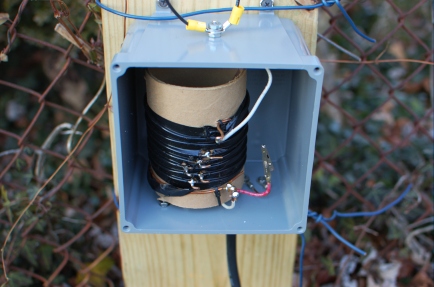
160 meters, Topband, …the names conjure all sorts of visions of grandeur, enigmatic propagation modes, and big antennas in the minds of hams everywhere. Since I have lived on suburban lots for the past five and a half years and in an apartment for two years before that, it has been the better part of a decade since I’ve had my own permanent 160-meter antenna system at my “home” station. (Despite this, I did manage to get 160-meter WAS from NO9Z’s station and if my Rhode Island and Delaware contacts ever upload to LoTW, I’ll request the certificate from ARRL.)
So, the story at hand. Just before the November Sweepstakes contest, I put up a secondary 80-meter antenna—the open-wire fed dipole I used at K8GU/9. Its performance was underwhelming and the vertical seemed to play just fine. But, I got busy and just left it up in the trees. Somewhere in the annals of the Blog, I may or may not have described this antenna, which was designed to also operate on 160 by shorting the feeder and feeding the whole mess against ground. I never used this functionality because I had to lay radials on top of the patio and that was a pain to take them up and put them down.
The North American QSO Party was this weekend and I’ve been participating in the NCCC Sprint Ladder, both of which include 160 meters. Around about last Thursday, after the NS Ladder, I decided it might be fun to have 160 for the NSL and NAQP. So, I ducked out of the office early on Friday afternoon and set about stripping the old tuning network from the K8GU/9 incarnation of the antenna.
We have a lot of AM broadcast stations in the DC area. And, because of that, antenna analyzers are not always too useful on the low bands. So, knowing already that the antenna was near self-resonance after my K8GU/9 efforts, the first thing I did was just hook the antenna up to a TS-930 and give it a 5-10 watts fed against my nearby 80-meter vertical’s radial field. Sure enough, the VSWR was about 3 at 1.999 MHz and off-scale at 1.801 MHz. So, I inserted the loading coil from the old matching box. The coil is just #14 THHN solid wire in approximately the optimum-Q configuration of diameter to length and wound on a cardboard shipping tube. (As is clear from the photograph, it’s not really pretty nor the lowest-loss possible. But, it was great for what I had on-hand.)
The coil has four taps on it. I clipped the fourth tap, shorting the bottom half of the inductor and did the VSWR sweep, finding a dip at 1.950 MHz or so. Each successive tap brought the minimum lower and lower. With no taps clipped, it was tuned to the bottom of the band. I got lucky (erm, did a lot of tweaking at the previous QTH).
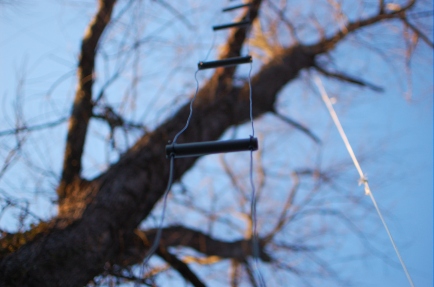
The best news of all of this is that there is enough RF actually being radiated (not just as heat, either!) to make some contacts! Further good news is that even though the antenna is between three and five feet from my 80-meter vertical, with the W3NQN filters, I can operate SO2R on both bands simultaneously. Of course, the RX noise level may just be hiding the trash. I haven’t tried the K9AY because I had that portion of the station torn-up during the conversion of all my DC accessories to PowerPoles and the preamp popped a fuse in my RigRunner when I plugged it back in.
The bottom line is that it’s not a full-sized 4-square, but it gets me on 160 from my lot in a way that’s compatible with my operating style.
Ethan Miller, K8GU, is a regular contributor to AmateurRadio.com and writes from Maryland, USA. Contact him at [email protected].
A matter of timing
I’m finding it hard to love the new Kenwood TH-D72. Despite the fact that it has a more sensitive GPS, a proper TNC that you can interface to computer APRS or packet software and is firmware upgradeable, I’m steadily coming round to the opinion that the VX-8GR is the better performing, more usable radio.
Things I don’t like about the TH-D72 is that it is bigger and heavier, has a screen that gives far less information at a glance than the corresponding screens on the Yaesu and has poorer ergonomics. I have also been harbouring a suspicion that its packet modem was less sensitive. Today I think I discovered the reason.
I recently built a Fox Delta weather station that outputs AFSK packet directly into a radio. I noticed that although my Kenwood TM-D710 and my VX-8GR decode it’s S9+ packet bursts the TH-D72 didn’t. I thought it might just be a case of adjusting the deviation but I tried the weather station on two different radios adjusting the audio level from nothing to definitely clipping and could not find a setting at which the D72 would decode anything.
Recently I set up a low power APRS repeater in the shack. It is a sound card TNC (TrueTTY) driving a low power UHF radio (the FT-817ND) running into a dummy load, which is connected to the aprsg gateway software. This gates everything that is going on in APRS within a specified radius to UHF so that I can monitor activity and reply to messages using an APRS HT anywhere I am in the house. This has been working fine with the VX-8GR but last night I forgot to switch it off and the battery was dead so I tried monitoring using the TH-D72 instead. Nothing was copied!
Again I tried an entire range of audio levels into the radio but while the VX-8GR and the TH-D710 both decoded the packets over a wide range of settings the D72 didn’t decode anything. I was using TrueTTY into my USBlink home-made VOX-based digital interface. I wanted to try different software (AGWPE) and a different sound card but Windows got confused having different USB sound devices connected to it and it is also a dog at handling serial ports. I have real serial ports occupying COM2 to COM5, a pair of virtual ports mapped between COM8 and COM9, and other USB serial devices I have used in the past have been assigned to COM1,6 and 7. AGWPE can only use COM1 to COM9 and trying to change the USB serial device to use one of the three currently unused ports in this range resulted either in Windows complaining that the port was in use even though it didn’t show in Device Manager or the application saying that the port did not exist even though it did show in Device Manager. Eventually things seemed so screwed that I restored back to this morning and gave up.
Having restored the system and checked that everything worked again one more idea occurred to me. TrueTTY allows you to specify the exact sample rate used by the sound card, to compensate for timing errors. Instead of 11025Hz I tried 11000Hz and while the D710 and the VX-8 still decoded the packets the D72 still didn’t. I then tried 11050Hz and lo and behold, the D72 started decoding!
It’s impossible to make a suggestion that there is something wrong with a radio in the owners’ groups on Yahoo as so many people can’t bear to consider the fact that something they bought is anything less than perfect and will come up with any alternative explanation they can think of. So I’m sure that the problem I have described will be blamed on the AFSK modulation being slightly off-frequency which, of course, it is.
However in the real world a radio will be used to receive transmissions from people whose modulation is off and don’t know it or may not even have any way of adjusting it. A modem that is more tolerant of these deviations from the precisely correct will decode more signals than one that expects the modulation to be spot on and in that respect the VX-8GR is by far the most easy-going and most sensitive of all the APRS radios.
It’s just frustrating to hear braaaps and not see them decoded, so I think the Yaesu is going to be the one of these two APRS hand-helds that I hang on to.

Julian Moss, G4ILO, is a regular contributor to AmateurRadio.com and writes from Cumbria, England. Contact him at [email protected].
Interesting Meteor Scatter article – Geminids 2010
Through a link on the Southgate Amateur Radio blog, I found an interesting article written by Dr David Knight of the Norman Lockyer Observatory radio club at Sidmouth. The article details experiments that David performed during the Geminids meteor shower in December 2010 on a frequency close to 144MHz.
David monitors a high-power transmitter close to the Alps on 143.049.
I’m very interested to read about this transmitter and of David’s experiments. It sounds as if the transmitter he uses could be a useful propagation monitor for me. I’ll have a listen and see what can be heard in ‘flat conditions’.
Have a read of David’s paper here
One trace is annotated with a suggestion that the reflected signal is from a satellite in low earth orbit. I was intrigued by this. I’ve heard many reflections from meteors and of course aircraft. I wonder if a satellite or the ISS could reflect sufficient signal?

Tim Kirby, G4VXE, is a regular contributor to AmateurRadio.com and writes from Oxfordshire, England. Contact him at [email protected].
Microlight QRP
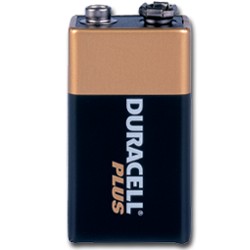
Keen followers of SOTA will have read about this on the SOTA Reflector, but during the last couple of months Richard G3CWI has been activating summits using a 30m transceiver powered by a 9V PP3/MN1604 battery. This apparently is in response to a challenge set by another keen SOTA activator: Kjell, LA1KHA (who visited us in October 2009.)
I couldn’t find many details of the challenge, so I’m just assuming that it was simply to see how many activations could be made using a radio powered by one of these small batteries. Kjell is believed to be using a Small Wonder labs RockMite but Richard built his own transceiver especially for the challenge. The receiver uses a two-crystal ladder filter at the signal frequency, an NE602 mixer, a low noise AF amplifier and active lowpass filter using CMOS op-amps. The transmitter has a crystal oscillator, bipolar buffer, bipolar amplifier and FET class E PA giving 300mW output and an internal Tick1 keyer.
With this transceiver Richard has now activated 10 summits making more than 100 contacts, still using the original PP3 battery! Having established that a PP3-powered transceiver is adequate for reliable activating Richard is now looking for ultra-lightweight HF antennas to get the weight of his portable station down to the absolute minimum.
I think this is a fascinating challenge and hope that Richard will write up the experience in more detail one day, perhaps in his RadCom Portable column or in the G-QRP Club magazine Sprat. This is really what QRP is all about, reducing the equipment to the bare essentials. It also shows the value of CW as the only mode that allows you to use such simple equipment.

Julian Moss, G4ILO, is a regular contributor to AmateurRadio.com and writes from Cumbria, England. Contact him at [email protected].
Handiham World for 5 January 2011
Welcome to Handiham World!

You know how people seem to be drawn to making resolutions at this time of year? Losing weight, balancing the checkbook (if you even use one anymore), keeping the house clean, and all the usual things that seem to be hard to get done and awfully easy to leave until tomorrow – those are the usual New Year’s resolutions. Well, on New Year’s Day I was listening to National Public Radio, and I heard a discussion of resolutions, and I thought that they came up with a brilliant suggestion. Since making and keeping resolutions seems to be so difficult, why not quit making resolutions for yourself and instead just make them for other people?
Now, THERE’S an idea! Since I am so lousy at keeping my own resolutions, I will instead tell YOU what you should do. Not only will it be easier for me, you will benefit by my great wisdom and while I sit and drink coffee and eat donuts, YOU can be the one working out at the gym and eating celery. What could possibly go wrong?
So here are my New Year’s resolutions for you:
| You will get on the air every day, if you possibly can. I call this idea DOTA, which stands for “Daily On The Air”. Not only is this a good way to stay in touch with your friends, it is also a necessity if you want to be familiar with your equipment. I was discussing this with Linda, N7HVF, recently in an email exchange. We both agreed that it is hard to remember how to use some of the feature on your equipment if you don’t get on the air regularly, preferably every day. | |
| You will follow the Amateur’s Code to the best of your ability. The Amateur’s Code appears as regularly as clockwork in each new edition of the ARRL Handbook. It was written by Paul Segal, W9EEA, in 1928, and it is as good a set of guidelines today as it was then. To refresh your memory, the amateur is considerate, loyal, progressive, friendly, balanced, and patriotic. In the months ahead, we will be looking at each of these guidelines individually and discussing each in more depth. I will be happy to have my brand-new 2011 ARRL Handbook available to help us as a reference. It’s an awesome book, and the entire contents – every bit of text – is searchable in PDF on an accompanying compact disk. I’m sure they still have a good price on the Handbook at ARRL.org in case you want to pick one up. | |
| You will attend your local radio club meetings and do something to participate, whether it is writing an article for the club newsletter, taking a leadership post, being part of an ARES group, volunteering to plan or run an operation on Field Day, helping another club member with a project, or maintaining the club’s equipment, repeater, or website. | |
| If you are not a member of a radio club, you will find one and (hopefully) join up. | |
| You will be an ambassador for Amateur Radio by welcoming questions from non-hams about our hobby and by stepping up to the plate to showcase ham radio whenever you can, whether it is at a trade show, school classroom, or through a media outlet. | |
| You will resolve to give back as much as you get out of ham radio. Get in the habit of saying “yes” when someone asks you to serve, participate, help, whatever. One good way to do this is to be a net control station when someone asks for help covering their net session. | |
| If you are a member of the Handiham Radio Club, you resolve to participate in the Handiham nets as much as you can, and also help by suggesting club activities and then participating. | |
| Finally, you will practice good operating skills, and you will start by always using your callsign correctly and never saying “73’s” instead of the correct “73” when you finish a QSO. |
I hope these New Year’s resolutions keep you busy. If anyone has resolutions for me, I am holding my hands over my ears right now and saying, “Nyaa, nyaa, nyaa, I can’t heeeear you!”
Patrick Tice, WA0TDA
Handiham System Manager
[email protected]
Shortwave America – alive and growing in 2011

October 21st, 2008 – That’s the day Shortwave America was born. Several inspirations take responsibility for this now popular web publication coming to life, along with necessity being the mother of invention and the sharp mind of a seasoned writer in possession of a dream.
Dan Hensley, KC9NCF, has been an avid lover of radio communications since he was young. His father and mother were both licensed in the radio service long ago, and his father moved on to amateur radio in the 80s. It was in the late 80s that Dan was exposed to commercial radio by Doug Zelden; otherwise known as “Rabbi Doug” who was his grade school teacher and also a semi-regular character on the “Kevin Matthews” show back when WLUP AM – 1000 was still on the air. Doug was responsible for introducing Dan to Kevin and the gang at AM 1000. Ed Tyll then noticed Dan and had him in the studio twice, and then as a regular guest during his late night show via telephone.
In the early 2000’s, John and Jeff of “The John & Jeff Show” got to work with Dan for a short while. It was December of 2006 when Dan got his FCC Technician license, then following up with his General Class License at the last Handiham California Radio Camp in 2008.
Since that October day in 2008, Shortwave America has seen continued growth and has served the mission of keeping radio alive through station loggings, radio related observations, silliness and sarcasm. Mix all of this together with interviews of popular radio personalities, creative flow, ingenuity, hard work, devotion, and what you get is a recipe for success.
This past year, Shortwave America has been featured twice on the longest running short-wave radio show known to mankind; “The Happy Station Show” which was revived by Keith Perron at PCJ Radio. Shortwave America also saw the following highlights in 2010: The creation of a Numbers Station Monitoring Resource that became popular with everyone at Enigma2000 and the Spooks List, a focus on Communications Freedom In Iran that saw Canadian radio host, Shabnam Assadollahi as both an interview subject and a special guest with her interview of Dr, Mehrdad Emadi who is the Senior Economic Adviser to the European Union. As part of that communications freedom focus, Shortwave America also interviewed Mehrdad Emadi and Homayoun Mobasseri of NEDA For A Free Iran.
Pam Mark Hall, a popular Christian Contemporary Music Musician from long ago even promoted that three part series and became a fan of Shortwave America. There was a special focus on RadioReference in the context of their live audio feeds, a piece that went viral involving an 1800 foot tall radio tower climbing video, daily increasing international readership, and a piece that inspired a viral spoof of DXer’s Unlimited host, Arnie Coro.
Shortwave America has become popular with the users of a popular internet HF radio forum called HF Underground and its owner, Chris Smolinski; who also owns the Spy Numbers Database. Shortwave America has seen praise from the likes of Mr. Fahey who was responsible for uncovering and discovering the transponder used by the Chinese Government for operating what is known as “Firedrake” and then isolating the audio channels. That piece was done when it was publicized that the China Radio International Censor tape was publicly released. Other praise has been given by a veteran cryptographer, Pirate Radio Weekly, The Southgate Amateur Radio Club who featured Shortwave America in a piece about residents of Peoria, Illinois becoming upset about a ham who is building several towers in the area, Lisnews, and a list of other sources.
An important piece for Shortwave America that contributed to its growing popularity was “History Of The California Repeater Wars – Part 1” that included audio captured directly by Dan during one of the more disgusting skirmishes on the W6NUT repeater in Los Angeles. During the production of this piece, WA6ITF of Amateur Radio NEWSLINE was interviewed and generously provided some information as part of the focus of that work.
Shortwave America has become so wildly popular that it now has over nine thousand loyal readers and is looking to expand by way of an official website, an on-line product store, and will start giving access to six or more popular radio shows focusing on amateur and short-wave radio. Shortwave America has recently added two listening galleries that readers can use to listen to short-wave stations on-line and will soon feature an amateur radio listening gallery. The first listening gallery is devoted entirely to Radio Netherlands Worldwide. All listening galleries are located at the top of the Shortwave America homepage.
Shortwave America plans more interviews, a podcast, the possible addition of an international liaison team to assist in language translation and relations with readers from across the world. Shortwave America has recently added a reader’s hotline where readers, the general public, and members of the radio community can leave messages about anything that is radio related from breaking news stories to questions, comments, criticism, ideas, discoveries, and any other radio subject matter. You can call the Shortwave America hotline at: 1-206-666-8235.
Eventually, the hotline will become a toll-free 800 number if there is enough interest in it. A reader’s poll was just recently closed, and the stats there will be calculated to determine what the readers want to see, what can become a reality and how best to achieve those goals. Shortwave America is quickly becoming competitive with the most popular mainstream sites such as hfradio.org, RadioReference, hamisland, and will hopefully rival QRZ and E-Ham.
(Information from Shortwave America)

Pat Tice, WA0TDA, is the manager of HANDI-HAM and a regular contributor to AmateurRadio.com. Contact him at [email protected].
Handiham World for 5 January 2011
Welcome to Handiham World!
You know how people seem to be drawn to making resolutions at this time of year? Losing weight, balancing the checkbook (if you even use one anymore), keeping the house clean, and all the usual things that seem to be hard to get done and awfully easy to leave until tomorrow – those are the usual New Year’s resolutions. Well, on New Year’s Day I was listening to National Public Radio, and I heard a discussion of resolutions, and I thought that they came up with a brilliant suggestion. Since making and keeping resolutions seems to be so difficult, why not quit making resolutions for yourself and instead just make them for other people?
Now, THERE’S an idea! Since I am so lousy at keeping my own resolutions, I will instead tell YOU what you should do. Not only will it be easier for me, you will benefit by my great wisdom and while I sit and drink coffee and eat donuts, YOU can be the one working out at the gym and eating celery. What could possibly go wrong?
So here are my New Year’s resolutions for you:
| You will get on the air every day, if you possibly can. I call this idea DOTA, which stands for “Daily On The Air”. Not only is this a good way to stay in touch with your friends, it is also a necessity if you want to be familiar with your equipment. I was discussing this with Linda, N7HVF, recently in an email exchange. We both agreed that it is hard to remember how to use some of the feature on your equipment if you don’t get on the air regularly, preferably every day. | |
| You will follow the Amateur’s Code to the best of your ability. The Amateur’s Code appears as regularly as clockwork in each new edition of the ARRL Handbook. It was written by Paul Segal, W9EEA, in 1928, and it is as good a set of guidelines today as it was then. To refresh your memory, the amateur is considerate, loyal, progressive, friendly, balanced, and patriotic. In the months ahead, we will be looking at each of these guidelines individually and discussing each in more depth. I will be happy to have my brand-new 2011 ARRL Handbook available to help us as a reference. It’s an awesome book, and the entire contents – every bit of text – is searchable in PDF on an accompanying compact disk. I’m sure they still have a good price on the Handbook at ARRL.org in case you want to pick one up. | |
| You will attend your local radio club meetings and do something to participate, whether it is writing an article for the club newsletter, taking a leadership post, being part of an ARES group, volunteering to plan or run an operation on Field Day, helping another club member with a project, or maintaining the club’s equipment, repeater, or website. | |
| If you are not a member of a radio club, you will find one and (hopefully) join up. | |
| You will be an ambassador for Amateur Radio by welcoming questions from non-hams about our hobby and by stepping up to the plate to showcase ham radio whenever you can, whether it is at a trade show, school classroom, or through a media outlet. | |
| You will resolve to give back as much as you get out of ham radio. Get in the habit of saying “yes” when someone asks you to serve, participate, help, whatever. One good way to do this is to be a net control station when someone asks for help covering their net session. | |
| If you are a member of the Handiham Radio Club, you resolve to participate in the Handiham nets as much as you can, and also help by suggesting club activities and then participating. | |
| Finally, you will practice good operating skills, and you will start by always using your callsign correctly and never saying “73’s” instead of the correct “73” when you finish a QSO. |
I hope these New Year’s resolutions keep you busy. If anyone has resolutions for me, I am holding my hands over my ears right now and saying, “Nyaa, nyaa, nyaa, I can’t heeeear you!”
Patrick Tice, WA0TDA Handiham System Manager [email protected]
Shortwave America – alive and growing in 2011
October 21st, 2008 – That’s the day Shortwave America was born. Several inspirations take responsibility for this now popular web publication coming to life, along with necessity being the mother of invention and the sharp mind of a seasoned writer in possession of a dream.
Dan Hensley, KC9NCF, has been an avid lover of radio communications since he was young. His father and mother were both licensed in the radio service long ago, and his father moved on to amateur radio in the 80s. It was in the late 80s that Dan was exposed to commercial radio by Doug Zelden; otherwise known as “Rabbi Doug” who was his grade school teacher and also a semi-regular character on the “Kevin Matthews” show back when WLUP AM – 1000 was still on the air. Doug was responsible for introducing Dan to Kevin and the gang at AM 1000. Ed Tyll then noticed Dan and had him in the studio twice, and then as a regular guest during his late night show via telephone.
In the early 2000’s, John and Jeff of “The John & Jeff Show” got to work with Dan for a short while. It was December of 2006 when Dan got his FCC Technician license, then following up with his General Class License at the last Handiham California Radio Camp in 2008.
Since that October day in 2008, Shortwave America has seen continued growth and has served the mission of keeping radio alive through station loggings, radio related observations, silliness and sarcasm. Mix all of this together with interviews of popular radio personalities, creative flow, ingenuity, hard work, devotion, and what you get is a recipe for success.
This past year, Shortwave America has been featured twice on the longest running short-wave radio show known to mankind; “The Happy Station Show” which was revived by Keith Perron at PCJ Radio. Shortwave America also saw the following highlights in 2010: The creation of a Numbers Station Monitoring Resource that became popular with everyone at Enigma2000 and the Spooks List, a focus on Communications Freedom In Iran that saw Canadian radio host, Shabnam Assadollahi as both an interview subject and a special guest with her interview of Dr, Mehrdad Emadi who is the Senior Economic Adviser to the European Union. As part of that communications freedom focus, Shortwave America also interviewed Mehrdad Emadi and Homayoun Mobasseri of NEDA For A Free Iran.
Pam Mark Hall, a popular Christian Contemporary Music Musician from long ago even promoted that three part series and became a fan of Shortwave America. There was a special focus on RadioReference in the context of their live audio feeds, a piece that went viral involving an 1800 foot tall radio tower climbing video, daily increasing international readership, and a piece that inspired a viral spoof of DXer’s Unlimited host, Arnie Coro.
Shortwave America has become popular with the users of a popular internet HF radio forum called HF Underground and its owner, Chris Smolinski; who also owns the Spy Numbers Database. Shortwave America has seen praise from the likes of Mr. Fahey who was responsible for uncovering and discovering the transponder used by the Chinese Government for operating what is known as “Firedrake” and then isolating the audio channels. That piece was done when it was publicized that the China Radio International Censor tape was publicly released. Other praise has been given by a veteran cryptographer, Pirate Radio Weekly, The Southgate Amateur Radio Club who featured Shortwave America in a piece about residents of Peoria, Illinois becoming upset about a ham who is building several towers in the area, Lisnews, and a list of other sources.
An important piece for Shortwave America that contributed to its growing popularity was “History Of The California Repeater Wars – Part 1” that included audio captured directly by Dan during one of the more disgusting skirmishes on the W6NUT repeater in Los Angeles. During the production of this piece, WA6ITF of Amateur Radio NEWSLINE was interviewed and generously provided some information as part of the focus of that work.
Shortwave America has become so wildly popular that it now has over nine thousand loyal readers and is looking to expand by way of an official website, an on-line product store, and will start giving access to six or more popular radio shows focusing on amateur and short-wave radio. Shortwave America has recently added two listening galleries that readers can use to listen to short-wave stations on-line and will soon feature an amateur radio listening gallery. The first listening gallery is devoted entirely to Radio Netherlands Worldwide. All listening galleries are located at the top of the Shortwave America homepage.
Shortwave America plans more interviews, a podcast, the possible addition of an international liaison team to assist in language translation and relations with readers from across the world. Shortwave America has recently added a reader’s hotline where readers, the general public, and members of the radio community can leave messages about anything that is radio related from breaking news stories to questions, comments, criticism, ideas, discoveries, and any other radio subject matter. You can call the Shortwave America hotline at: 1-206-666-8235.
Eventually, the hotline will become a toll-free 800 number if there is enough interest in it. A reader’s poll was just recently closed, and the stats there will be calculated to determine what the readers want to see, what can become a reality and how best to achieve those goals. Shortwave America is quickly becoming competitive with the most popular mainstream sites such as hfradio.org, RadioReference, hamisland, and will hopefully rival QRZ and E-Ham.
(Information from Shortwave America)
Pat Tice, WA0TDA, is the manager of HANDI-HAM and a regular contributor to AmateurRadio.com. Contact him at [email protected].
What do I want to achieve in amateur radio this year?
At the beginning of each year I always think it’s fun to try and set some goals for the year. Sometimes I find my focus changes and I end up not doing them, but it’s always interesting to look back on
Here’s what I’m thinking of at the moment:
1 – Activity. Try to maintain my rule of calling CQ each day on one band or another and to let no CQ call go unsanswered – even if it’s just a quick hello.
2 – 70MHz. I seem to have spent more time on 70MHz than ever before in the last year. I’m currently enjoying 70MHz FM, but I hope to focus on CW/SSB during the Sporadic E season. Although the FT847 gives me some CW/SSB capability at low power and a poor receiver. I want to improve on that. It may involve a transverter driven from the FT817, or perhaps modifying the FT847. Keen to do *SOMETHING* to improve what I can hear on 70MHz.
3 – 50/144/432MHz. I’m keen to install a collinear antenna for these three bands. The intention is to erect a small mast on the house which will also support a TV antenna for the boys’ TV. On top of the mast can go a collinear for 50/144/432 MHz. I’m hoping that I can use this antenna for Sporadic E on 50MHz as well as regular FM operation on 144 and 432MHz. Currently I have no vertically polarised antenna for 144 and 432MHz and it would be useful to be able to scan the FM channels to monitor propagation more closely, as the repeater channels very often show hints of openings before there is adequate activity on SSB.
4 – 1296MHz. I’m getting more intrigued by 1296MHz and would like to get some sort of capability on the band in the year. Not sure whether this may just be simple 1296MHz FM from a handheld or something else. We’ll see. I can do so simple 1297MHz receive using a scanner, so it will be interesting to see if that yields any results.

Tim Kirby, G4VXE, is a regular contributor to AmateurRadio.com and writes from Oxfordshire, England. Contact him at [email protected].
 Ham Radio Deluxe |
 W5SWL Electronics |
 Ham Radio Prep |
 KB3IFH QSL Cards  Hip Ham Shirts  HamRadioAuctions HamRadioAuctions Reliance Antennas Reliance Antennas Enigma Shop Enigma Shop |  morseDX  Ni4L Antennas  R&L Electronics R&L Electronics antennas.us antennas.us QRV QRV |
- Matt W1MST, Managing Editor
