 |
 Oh, so that’s where you were
 15 January 2011 | by
 Some of you may have noticed that I haven’t published anything here for a bit over a month. I was also pretty much absent from several of the other “social web” places that I frequent (Facebook, Twitter, etc.) and in fact got a couple of private notes asking if everything was OK. (Thanks to those who asked for your concern.) The short version is that everything is just fine. Here’s the longer version:
Around a week after I published my last update, I managed to come down with a kidney stone just about a year after the last time I had one. I’ll skip the details, but suffice it to say that I wasn’t very comfortable for a while and blogging, ham radio, and pretty much everything else not essential to feeling better got put aside. Complicating things was the fact that along with Sharon, Justin, and Brett, I was supposed to leave for vacation on the evening of December 25th, and the doctor was pretty adamant that I shouldn’t be traveling unless I had passed the stone. Fortunately, it did pass just a couple of days before that, and given everything we had to do before leaving I never had time to do an update.
The trip itself was something we’d planned for a long, long time, figuring that with the kids getting older (they are both in college), it would become increasingly difficult for all of us to get away. Our trip started in Barcelona where we spend three days sightseeing followed by a twelve-day Mediterranean cruise with stops in Palermo, Athens, Rhodes, Alexandria/Cairo, and Malta. I’m not going to go into detail here about the trip, but I did want to post a couple of pictures that are on topic for this blog.
 First, as we were driving from Cairo to the pyramids in Giza, I looked out the window of the bus and saw this antenna. Actually, although I didn’t notice it at the time, in addition to the beam that’s right in the middle of the picture, there’s also what appears to be a wire dipole just to the right of that. Unfortunately, I don’t know specifically where this picture was taken other than we were in Cairo at the time, so I don’t know who that might belong to. (Any Egyptian hams reading this?)
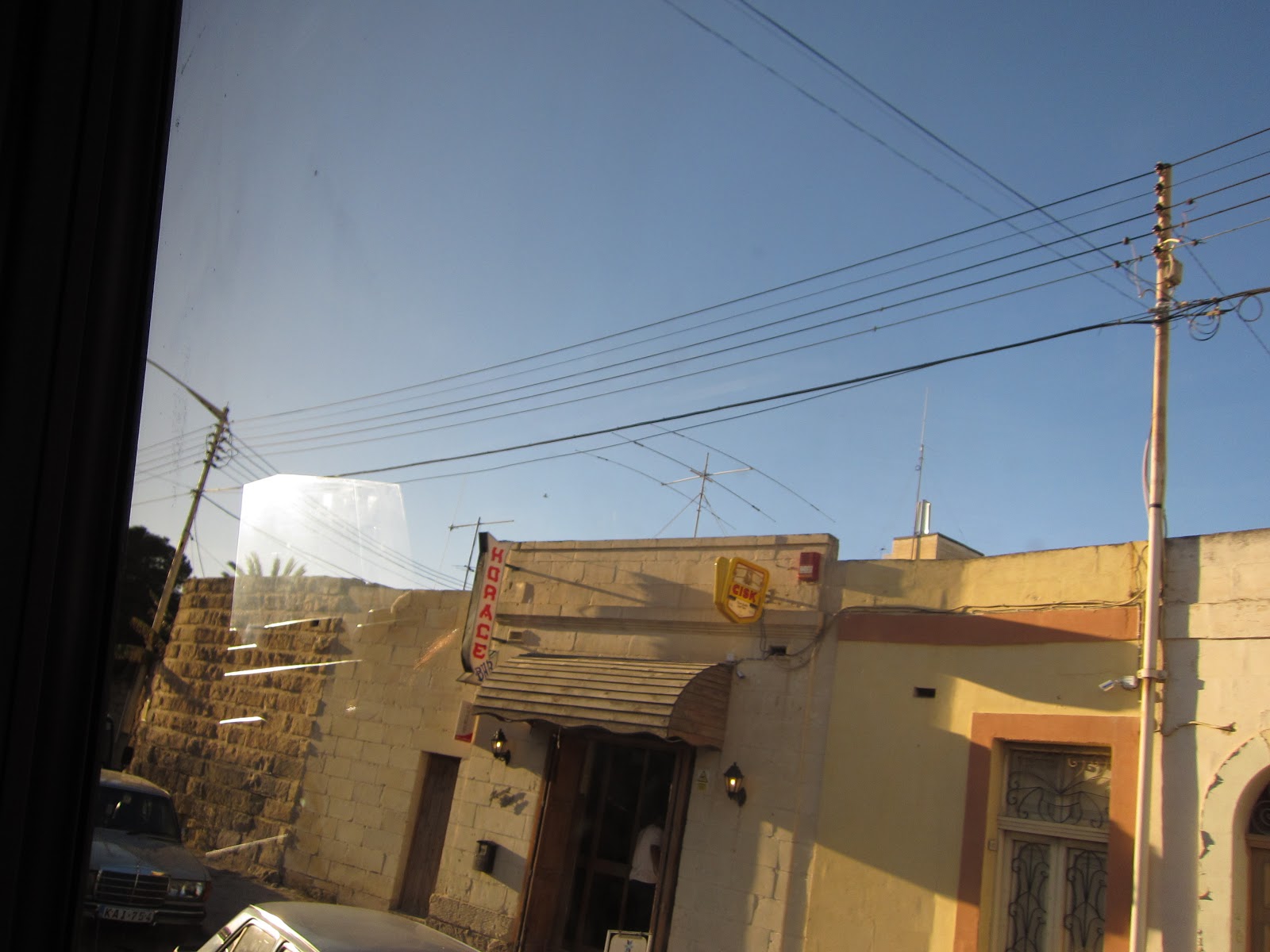
I know exactly who the next antenna belongs to: The Malta Amateur Radio League. I know this because just a second or two before I took this picture, we passed a big sign that said “Malta Amateur Radio League”. Unfortunately, we were on a bus driving from the city of Mdina to the capital city of Valleta, so I couldn’t stop to get a picture of the sign, but I did get a picture of the antenna on the roof of their building. I apologize for the lousy picture but I’m glad that I was able to even get this shot before we had completely driven past. We only had six hours in Malta, so I didn’t have a chance to try to get back to the MARL shack to see if there was anyone around, but I can say that Malta was absolutely beautiful and I hope to get back there some day for a longer visit.
I guess I should mention that I didn’t do any ham radio while we were away at all. We had a very tight schedule almost everywhere other than some very relaxing days at sea, and given the difficulties of transporting gear with me (in addition to everything else we brought), licensing, and the fact that unfortunately Royal Caribbean Cruise Lines explicitly prohibits the use of ham radio on board the ship, I decided that it didn’t make much sense to try to operate. As a result, it was just over a month between the last HF contact I made in December (before I was ill), and the next one that I made in January after I returned.

Oh, so that’s where you were
Some of you may have noticed that I haven’t published anything here for a bit over a month. I was also pretty much absent from several of the other “social web” places that I frequent (Facebook, Twitter, etc.) and in fact got a couple of private notes asking if everything was OK. (Thanks to those who asked for your concern.) The short version is that everything is just fine. Here’s the longer version:
Around a week after I published my last update, I managed to come down with a kidney stone just about a year after the last time I had one. I’ll skip the details, but suffice it to say that I wasn’t very comfortable for a while and blogging, ham radio, and pretty much everything else not essential to feeling better got put aside. Complicating things was the fact that along with Sharon, Justin, and Brett, I was supposed to leave for vacation on the evening of December 25th, and the doctor was pretty adamant that I shouldn’t be traveling unless I had passed the stone. Fortunately, it did pass just a couple of days before that, and given everything we had to do before leaving I never had time to do an update.
The trip itself was something we’d planned for a long, long time, figuring that with the kids getting older (they are both in college), it would become increasingly difficult for all of us to get away. Our trip started in Barcelona where we spend three days sightseeing followed by a twelve-day Mediterranean cruise with stops in Palermo, Athens, Rhodes, Alexandria/Cairo, and Malta. I’m not going to go into detail here about the trip, but I did want to post a couple of pictures that are on topic for this blog.
First, as we were driving from Cairo to the pyramids in Giza, I looked out the window of the bus and saw this antenna. Actually, although I didn’t notice it at the time, in addition to the beam that’s right in the middle of the picture, there’s also what appears to be a wire dipole just to the right of that. Unfortunately, I don’t know specifically where this picture was taken other than we were in Cairo at the time, so I don’t know who that might belong to. (Any Egyptian hams reading this?)
I know exactly who the next antenna belongs to: The Malta Amateur Radio League. I know this because just a second or two before I took this picture, we passed a big sign that said “Malta Amateur Radio League”. Unfortunately, we were on a bus driving from the city of Mdina to the capital city of Valleta, so I couldn’t stop to get a picture of the sign, but I did get a picture of the antenna on the roof of their building. I apologize for the lousy picture but I’m glad that I was able to even get this shot before we had completely driven past. We only had six hours in Malta, so I didn’t have a chance to try to get back to the MARL shack to see if there was anyone around, but I can say that Malta was absolutely beautiful and I hope to get back there some day for a longer visit.
I guess I should mention that I didn’t do any ham radio while we were away at all. We had a very tight schedule almost everywhere other than some very relaxing days at sea, and given the difficulties of transporting gear with me (in addition to everything else we brought), licensing, and the fact that unfortunately Royal Caribbean Cruise Lines explicitly prohibits the use of ham radio on board the ship, I decided that it didn’t make much sense to try to operate. As a result, it was just over a month between the last HF contact I made in December (before I was ill), and the next one that I made in January after I returned.
David Kozinn, K2DBK, is a regular contributor to AmateurRadio.com and writes from New Jersey, USA. Contact him at [email protected].
Monitoring the Graves transmitter (143.049) using the Easygram software
Since I discovered the Graves transmitter on 143.049 a week or so ago, I have been listening quite a lot. There are plenty of meteor reflections to listen to and it’s also interesting to note that there are some weak but steady signals audible in addition to the meteor reflections. My guess is that these are reflections from aircraft – after all there are plenty in the air between here and Dijon.
Today, I installed the Easygram software on my laptop. I have used this software previously for beacon monitoring and other analysis. I quickly configured up the software and was able to see consistent traces from the transmitter. I can’t see any evidence of Doppler shift on the ‘steady, constant’ signal, which I would expect to see if an aircraft was involved – so perhaps it is tropo after all (Having said all of that, I am listening to the transmitter whilst writing this, and I can distinctly hear aircraft scatter on it!).
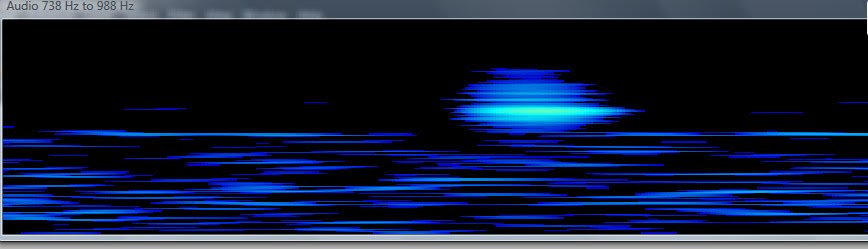
Here’s an example of an image from Easygram which shows a meteor ping from the transmitter. If you look closely at the image, there is a faint trace line towards the centre of the screen – this is the weak, steady signal, probably the tropo signal from the transmitter.
Here is the location of the transmitter shown on Google Maps

Tim Kirby, G4VXE, is a regular contributor to AmateurRadio.com and writes from Oxfordshire, England. Contact him at [email protected].
K144XV comments
The K144XV eventually turned up late on Thursday afternoon. After the board modifications had been performed, installing the transverter module was easy following Elecraft’s exemplary instructions. I had to remove the KIO3 module in order to remove the KXV3 transverter module and replace it with the KXV3A, which has a couple of additional connectors for the internal transverter, then replace the KIO3. I also had to replace the side panel of the K3 with one that has some extra holes for securing the transverter. The stiffener that runs across the top of the case is also replaced by one with a cutout where it passes over the K144XV.
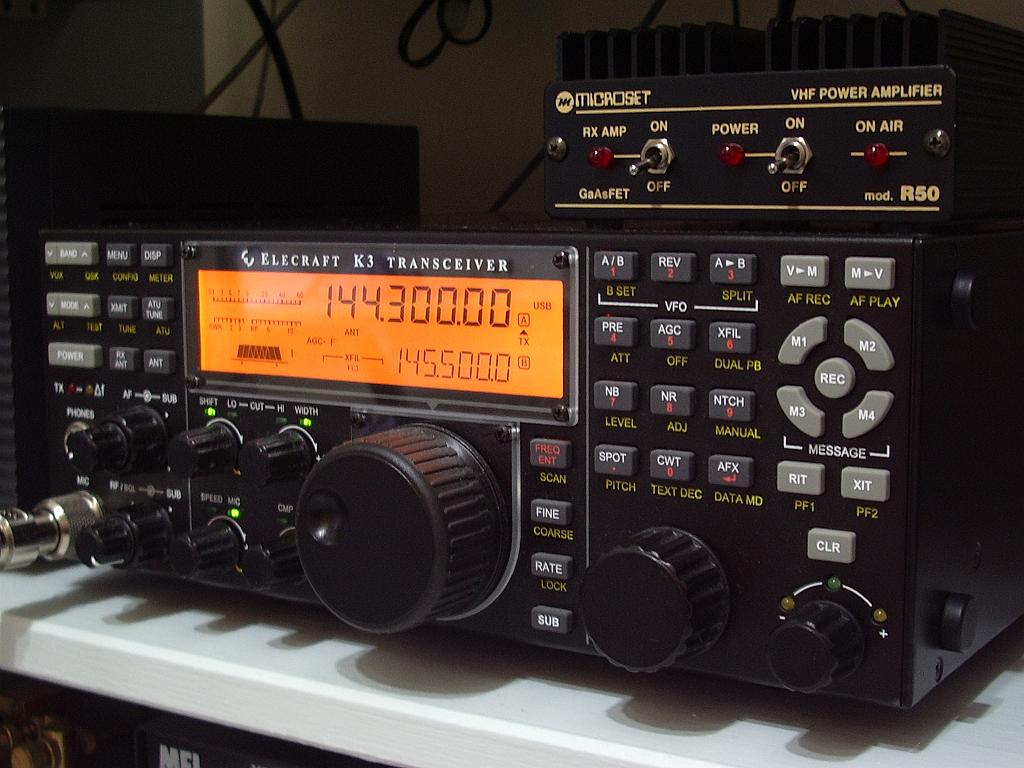
Due to the lateness of the hour I was a bit tired and also focussed on getting the job finished so the shack could be restored to normality so I never even thought about taking some pictures. The module comes as a complete screened box not a bare board as shown in some of the pictures on the Elecraft website. It is quite a little beauty and the way it all fits into the K3 is a work of art.
Although described as a 10W module the instruction manual states that you should get at least 9W with 1.0mW input to the transverter. I actually got about 11W so the power output comfortably exceeded spec. At my noisy location I can’t make any meaningful observation about sensitivity – any half decent 2m radio will be sensitive enough. But I did notice that S meter readings are extremely low. I see no movement at all on a clear frequency despite the noisy location and a repeater that lights all the signal strength bars of my TM-D710 registered just S4 on the K3. I never take any notice of S meters anyway so I’m not unduly bothered. The amplifier “brick” I will use with this has its own built-in preamp which will boost S meter readings if I want.
The 2m amplifier I have was designed to be driven by an FT-817 so it only requires an input of 5W. I found that I needed to reduce the drive to the transverter to a mere 0.15mW to achieve this level of output. I don’t know how accurate the low level output power settings of the K3 are but the relationship between 28MHz drive in and power out is definitely not linear. However the signal on SSB sounded pretty clean when monitored on the FT-817.
The calibration of the transverter local oscillator is done using software, not by trying to tweak a trimmer capacitor by a fraction of a hair’s breadth, which is a blessing. There are two local oscillators in the transverter to provide coverage of the full US 2m band (144 – 148MHz) using the same 28MHz – 30MHz range (interestingly the top 2MHz is not disabled in European rigs.) The transverter module is calibrated at the factory and you have to enter the calibration values into the K3 using the configuration menu. I checked the result using my FC-1 frequency counter and also my FT-817 and it appeared to be accurate to within 100Hz which is about as good as I can get. Later I listened on the GB3VHF beacon frequency and waited for the beacon to come out of the noise. I believe this beacon’s frequency is GPS locked. The frequency appeared to be out by 120Hz so I was able to adjust the calibration value and get it spot on.
The signal to noise ratio on a weak FM signal is definitely better on the K3 than with my other 2m rigs but I don’t see the K144XV as being the solution for people whose primary interest 2m FM. One reason is that a 2m mobile rig is cheaper and allows you to monitor and work 2m FM at the same time as using your K3 for something else. Another is that the K3 doesn’t really handle channelized operation very well. The memory system has improved considerably since the early days but using the VFO to scan through memories rather than a click stop rotary control doesn’t work for me, especially due to the laggy response of the K3 to the turning of the knob.
But I think the K144XV is an excellent option if you want to work 2m DX. The receiver sounds quiet and clean and having all the QRM fighting and weak signal detecting tools of the K3 available on 144MHz is a real bonus. Now I just have to wait for some 2m SSB activity to try it out!

Julian Moss, G4ILO, is a regular contributor to AmateurRadio.com and writes from Cumbria, England. Contact him at [email protected].
How WW2R does WSPR
I’ve known Dave Robinson, WW2R/G4FRE for very many years. He’s one of the most enthusiastic and innovative radio amateurs I know. Talking to Dave is to be inspired about some project or another.
I was just looking on Dave’s website to catch up on something completely unrelated to this post, when I found Dave’s page on how he tackled operating on 7 and 10MHz WSPR with a homebrew station. I’m sure you’ll find it as fascinating as I did.
» Read about WW2R’s WSPR station

Tim Kirby, G4VXE, is a regular contributor to AmateurRadio.com and writes from Oxfordshire, England. Contact him at [email protected].
K3 mod fun
Today I have been waiting for Parcel Farce to deliver a K144XV internal 2m transverter board for my K3. I hate doing modifications to the K3. First there is the hassle of disconnecting all the cables that are plugged in the back. I have to disconnect practically everything in the shack in order to remove the shelf above the K3 so I can see what I am doing.
I also dislike making modifications to the K3 itself. It makes me nervous thinking of the cost and expense if I mess something up and it doesn’t work. I’m starting to think that if I want to stick with the K3 it would be better to sell this 3 year old one and get a new current model. Because there have been so many modifications now since my serial number 222 was produced. I haven’t done many of the mods because I don’t think they make a worthwhile difference or because they involve obtaining an exchange board from Elecraft and the cost of doing this including shipping, VAT and tax collection fee is more than it is worth. But the internal 2m module seemed in the end to be the best solution for providing a capability for 144MHz SSB, even though it involved exchanging my KXV3 transverter interface board for a KXV3A.
In order to install the K144XV it is necessary on older K3s like mine to mount a socket on the main board to provide power. This involves removing the bottom panel of the rig. I thought that while I was doing that I would do another mod to increase the IF output which would be necessary should I ever want to use a P3 panadapter with the rig. The mod involves changing one resistor, oddly specified at 13K. An enquiry on the Elecraft reflector about whether the value was that critical resulted in the kind offer from Ian GM3SEK to send me a couple of SMT resistors so I could do the mod. Without Ian’s help I would have had to leave the mod until I got a P3 and Elecraft sent the replacement part because SMT resistors aren’t something you can buy from Maplin in quantities of one or two off.
I had shied away from doing mods involving SMT parts before but I found that it wasn’t too hard. However I did need to use a high magnification lens in my head-mounted visor. I was initially alarmed to see that the resistor I had to change wasn’t one of the fairly big SMT resistors that are normally used in kits using these type of parts, it was a really tiny one. I used two soldering irons, one at each side, and then flicked the resistor off. After cleaning the pads with a bit of solder wick I then took one of the replacements using a trimming tool with a bit of Blu-Tack on the end and held it in place while I took a blob of solder on the end of my smallest bit and tacked one side of the resistor into place. Then I did the same to the other side. Job done.
Although the high magnification makes it possible to see the tiny parts, it can’t do anything about shaky hands. My hands seemed fairly steady this morning but it is a different picture through a high magnification lens and you don’t need to move far to shift the component out of its precise spot, which of course I did. I decided this is no job to be fussy about. The resistor was slightly skew-whiff, but it was attached to the board and my ohm meter said everything was OK. Perhaps I could get a job working for MFJ. 🙂
The package from Elecraft still hadn’t arrived so I decided to pull up the instructions for installing the K144XV from Elecraft’s website to see what was involved. As I mentioned, I needed to install a terminal to provide 12V to the transverter module. This is a bit of a kludge as the K144XV wasn’t even a planned option at the time my K3 was made so there isn’t a proper place for this terminal. You have to solder it in using a “via” that wasn’t actually designed for this use. Unfortunately that via had been used by one of the leads of a wire-ended capacitor used in another mod to improve the low frequency audio response.
The instructions mention this possibility and suggest an alternative via. However that via was obscured by the components used to perform yet another mod, this time the hardware AGC modification. Lacking the confidence to remove and replace SMT parts I had used wire ended components to do this mod. There was no alternative but to remove the mod and do the SMT version. Elecraft had provided both types of components and fortunately I hadn’t lost the SMT ones. However they had not provided any spares and I was conscious that one false move sending a resistor pinging off to oblivion would result in a K3 I would be unable to use until I could find a replacement. That didn’t help the shaking hands one bit!
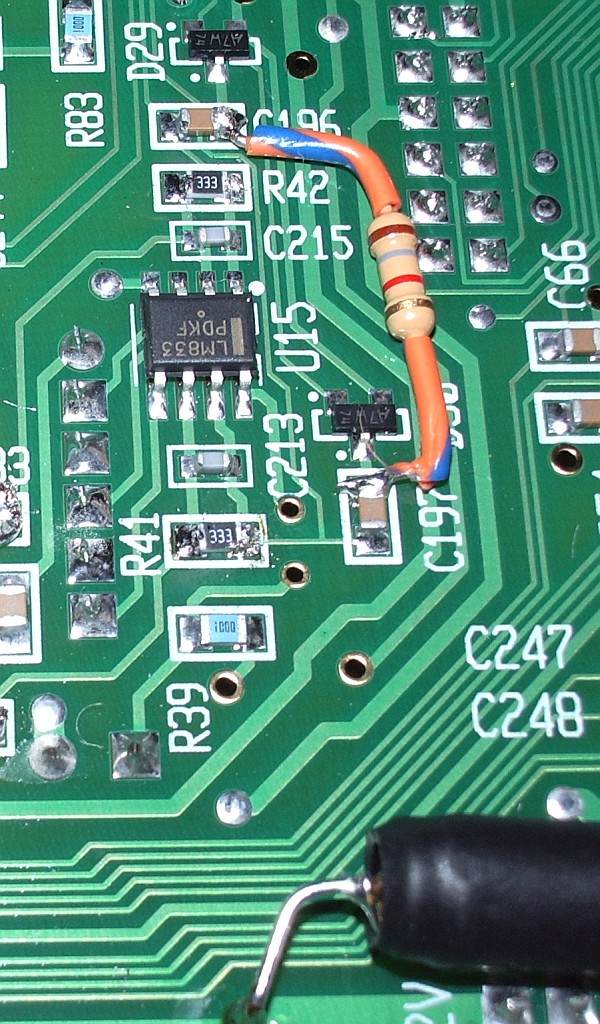
Fortunately it all went well, with the results shown in the picture. (The resistors I had to replace are the ones marked 333.) So that’s done. But still no transverter. Where the hell are you, Parcel Farce?

Julian Moss, G4ILO, is a regular contributor to AmateurRadio.com and writes from Cumbria, England. Contact him at [email protected].
Tracking the ISS
Perhaps like me, you enjoy watching the International Space Station pass overhead. It’s wonderful to see – a testament to humankind’s ingenuity. If you look carefully, even with the naked eye you can discern the shape of the massive solar panels that look like ‘wings’ on the side of the spacecraft.
As radio amateurs, we can listen for radio operation from space. Voice contacts have been heard over the last few days, so you may want to listen on 145.800MHz when the spacecraft is in range.
When is it in range? I just noticed this handy Google ‘Gadget’ which shows when the ISS is passing over a particular area!

Tim Kirby, G4VXE, is a regular contributor to AmateurRadio.com and writes from Oxfordshire, England. Contact him at [email protected].
 Ham Radio Deluxe |
 W5SWL Electronics |
 Ham Radio Prep |
 KB3IFH QSL Cards  Hip Ham Shirts  HamRadioAuctions HamRadioAuctions Reliance Antennas Reliance Antennas Enigma Shop Enigma Shop |  morseDX  Ni4L Antennas  R&L Electronics R&L Electronics antennas.us antennas.us QRV QRV |
- Matt W1MST, Managing Editor
