 |
 Handiham World for 26 January 2011
 26 January 2011 | by
 Welcome to Handiham World!

Can ham radio help promote science education?
Last night many of us watched the proceedings from Washington, DC as Congress and the President gathered for the State of the Union address. I don’t think any of us were surprised to hear some of the comments about how the United States needs to stay competitive in a new world where science, technology, engineering, and math are more important than ever. It seems to be something that everyone can agree on. These four subjects are sometimes referred to by their acronym, “STEM”. There has been much talk lately about how to energize and motivate our young students to learn more science and math, which will ultimately lead to a better understanding of technology and perhaps more students of science and engineering later on down the road. For quite some time now the United States has been importing highly educated scientists. I live in a neighborhood that is close by a well-known Fortune 500 company that employs a lot of scientists. It is no surprise to me that some of them have come from other parts of the world.
“What”, you may ask, “does this have to do with ham radio?”
Well, if you think about it, ham radio encompasses STEM – science, technology, engineering, and math – all in one fun and interesting activity. All of us know that ham radio has many different facets. You can have an interest in public service communications and earn your Technician license in order to participate in the types of communications exercises and responses that serve the public interest. Following 9/11, many people did just that because interest in public service was so strong. That fundamental reason for the existence of the Amateur Radio Service is still there and still attracts and holds many participants.
There are, however, lots of amateur radio operators who simply like to do other things. Some may be interested in just getting on the air to make contacts and make friends in the process. Others may get on the air because they are competitive and like to participate in contests and chase awards. One traditional interest area is in engineering, which will frequently involve designing and building one’s own equipment. It is also necessary to recognize that writing software is another amateur radio activity that holds the interest of a small but important minority. All of us know that every level of the amateur radio licensing process involves learning some science and math. The Extra Class exam takes math understanding to a much higher level than what might be found in the typical population. I guess we could say that ham radio does sometimes serve as an entry point to learning about how science, technology, engineering, and math can be applied to an activity that is both fun and educational. Furthermore, the options for learning in amateur radio are virtually open-ended. I feel that I will never, ever stop learning new things in amateur radio. Because it is a technical activity by its very nature, it will always be evolving and there will always be a necessity to learn about new technologies and the science and engineering that make them possible. In ham radio, I can learn in a “hands-on” way that will reinforce the knowledge and make it more useful to me.
We saw a definite surge in the interest of the general public about amateur radio after the twin towers fell in New York City. Today we face another crisis where our students are falling behind in science and math. Perhaps amateur radio has a role to play in recruiting more people, young and not so young, to learn more about these vital subjects and in the process to make our country and our world a better place. And when you talk about making the world a better place, what could be a better way to start than by communicating via amateur radio worldwide?
One final thought: When I am asked about what I think is the most important thing that I can contribute in my local amateur radio club, my answer is always the same. Teaching. Every time our club holds classes, I volunteer to teach at least some of them. Amateur radio operators who teach in the public schools have even more opportunity than I do to position amateur radio as a fun learning activity. ARRL has long supported outreach to teachers and has many useful resources. If amateur radio can be used to help promote learning in the four STEM topics, it can be one more tool in the successful teacher’s toolbox.
Patrick Tice, WA0TDA
Handiham System Manager
[email protected]
Proposal for a Skype study hall
We have an ongoing need for some kind of forum in which technical assistance or study assistance can be offered to our members. One idea that crossed my mind was to run a Skype conference with up to 10 participants. This would allow a number of people to discuss some topic of interest in a small group setting in a more private forum than one could find on EchoLink, for example. Does anyone out there have any ideas or experience with this kind of a project? I have taken several webinars where we are all connected in a small group audio session. Generally there is also a shared computer screen operated by the presenter of the webinar. I think a Skype audio forum for a small group would work pretty well. We are mainly interested in audio because we will pretty much always have blind participants and would not want to bother showing screens. In order to make this work, participants would have to sign up for a free Skype account and share their Skype contact information with the presenter.
One use for something like this might be to get questions about the remote base stations out there into a discussion group. Participants could discuss any issues they might have and benefit by learning what others have done to get something working. The same could be said about EchoLink or any other technical topic. The thing about a conference like this that is completely different than an e-mail exchange or even two people talking on the telephone is that the conversation is spontaneous and when you put more heads together you are more likely to get a variety of useful and creative responses.
We could probably start with a scheduled conference at a particular time each week and see how it goes. If anyone is interested in this idea and is willing to get in on the ground floor while we test it out, please let me know at [email protected]. Of course we will have to work out details like whether we should start a new Skype account specifically for this purpose and if so, what we should call it. One of the things that has always been true about ham radio is that “hams helping hams” advances our hobby and makes us all feel good. A Skype conference might just be another way to do that.
Tapes reach the end of the line – sort of
This question was put out this morning on the Handiham Radio Club list, but I want to let those of you who are not members of our radio club know what we are discussing. I want to get your opinion on tape cassettes. Over the years we have offered various manuals and other audio books on tape. I’m sure all of you know that the use of cassette tape has gone down each year, and now we are at the point of filling very few member requests for anything at all on cassette tape. We still do have a small but significant number of users who get the monthly magazine digests on tape. Most of our members are able to simply download the material from our website. In fact, prices have not changed for tapes in years. Nancy and I feel that it is time to discourage the use of tape manuals by increasing the price to reflect the fact that these are special order items that must be custom made one at a time. It is no longer the old days when we had bins of instruction manuals on tape and it was simply a matter of picking one out and mailing it. A typical cassette tape manual on a single tape is priced at five dollars, which is the minimum price for a tape order. However, some are three tapes long and sell for six dollars. This amounts to giving them away, considering all of the effort that needs to go into them. (It has never really been about the cost of the tape itself. The work and mailers add most of the cost.)
Can any of you tell me what a similar book would cost from another agency or provider? While we are happy to help folks find what they need in terms of resources, it doesn’t seem fair to put a lot of effort into an old medium like cassette tapes just because a few people don’t want to change to digital.
Thank you for your thoughts on this matter. We look forward to hearing from you. Unless you are replying via the radio club list, you should send me an email. Please don’t just hit “reply” to this message. I get a lot of mail, and I will be watching for an email to [email protected] with Tapes in the subject line. When I get replies to newsletters that are sent via the distribution list, they will probably be last to be looked at, and then only to change subscription properties.

Pat Tice, WA0TDA, is the manager of HANDI-HAM and a regular contributor to AmateurRadio.com. Contact him at [email protected].
Handiham World for 26 January 2011
Welcome to Handiham World!
Can ham radio help promote science education?
Last night many of us watched the proceedings from Washington, DC as Congress and the President gathered for the State of the Union address. I don’t think any of us were surprised to hear some of the comments about how the United States needs to stay competitive in a new world where science, technology, engineering, and math are more important than ever. It seems to be something that everyone can agree on. These four subjects are sometimes referred to by their acronym, “STEM”. There has been much talk lately about how to energize and motivate our young students to learn more science and math, which will ultimately lead to a better understanding of technology and perhaps more students of science and engineering later on down the road. For quite some time now the United States has been importing highly educated scientists. I live in a neighborhood that is close by a well-known Fortune 500 company that employs a lot of scientists. It is no surprise to me that some of them have come from other parts of the world.
“What”, you may ask, “does this have to do with ham radio?”
Well, if you think about it, ham radio encompasses STEM – science, technology, engineering, and math – all in one fun and interesting activity. All of us know that ham radio has many different facets. You can have an interest in public service communications and earn your Technician license in order to participate in the types of communications exercises and responses that serve the public interest. Following 9/11, many people did just that because interest in public service was so strong. That fundamental reason for the existence of the Amateur Radio Service is still there and still attracts and holds many participants.
There are, however, lots of amateur radio operators who simply like to do other things. Some may be interested in just getting on the air to make contacts and make friends in the process. Others may get on the air because they are competitive and like to participate in contests and chase awards. One traditional interest area is in engineering, which will frequently involve designing and building one’s own equipment. It is also necessary to recognize that writing software is another amateur radio activity that holds the interest of a small but important minority. All of us know that every level of the amateur radio licensing process involves learning some science and math. The Extra Class exam takes math understanding to a much higher level than what might be found in the typical population. I guess we could say that ham radio does sometimes serve as an entry point to learning about how science, technology, engineering, and math can be applied to an activity that is both fun and educational. Furthermore, the options for learning in amateur radio are virtually open-ended. I feel that I will never, ever stop learning new things in amateur radio. Because it is a technical activity by its very nature, it will always be evolving and there will always be a necessity to learn about new technologies and the science and engineering that make them possible. In ham radio, I can learn in a “hands-on” way that will reinforce the knowledge and make it more useful to me.
We saw a definite surge in the interest of the general public about amateur radio after the twin towers fell in New York City. Today we face another crisis where our students are falling behind in science and math. Perhaps amateur radio has a role to play in recruiting more people, young and not so young, to learn more about these vital subjects and in the process to make our country and our world a better place. And when you talk about making the world a better place, what could be a better way to start than by communicating via amateur radio worldwide?
One final thought: When I am asked about what I think is the most important thing that I can contribute in my local amateur radio club, my answer is always the same. Teaching. Every time our club holds classes, I volunteer to teach at least some of them. Amateur radio operators who teach in the public schools have even more opportunity than I do to position amateur radio as a fun learning activity. ARRL has long supported outreach to teachers and has many useful resources. If amateur radio can be used to help promote learning in the four STEM topics, it can be one more tool in the successful teacher’s toolbox.
Patrick Tice, WA0TDA Handiham System Manager [email protected]
Proposal for a Skype study hall
We have an ongoing need for some kind of forum in which technical assistance or study assistance can be offered to our members. One idea that crossed my mind was to run a Skype conference with up to 10 participants. This would allow a number of people to discuss some topic of interest in a small group setting in a more private forum than one could find on EchoLink, for example. Does anyone out there have any ideas or experience with this kind of a project? I have taken several webinars where we are all connected in a small group audio session. Generally there is also a shared computer screen operated by the presenter of the webinar. I think a Skype audio forum for a small group would work pretty well. We are mainly interested in audio because we will pretty much always have blind participants and would not want to bother showing screens. In order to make this work, participants would have to sign up for a free Skype account and share their Skype contact information with the presenter.
One use for something like this might be to get questions about the remote base stations out there into a discussion group. Participants could discuss any issues they might have and benefit by learning what others have done to get something working. The same could be said about EchoLink or any other technical topic. The thing about a conference like this that is completely different than an e-mail exchange or even two people talking on the telephone is that the conversation is spontaneous and when you put more heads together you are more likely to get a variety of useful and creative responses.
We could probably start with a scheduled conference at a particular time each week and see how it goes. If anyone is interested in this idea and is willing to get in on the ground floor while we test it out, please let me know at [email protected]. Of course we will have to work out details like whether we should start a new Skype account specifically for this purpose and if so, what we should call it. One of the things that has always been true about ham radio is that “hams helping hams” advances our hobby and makes us all feel good. A Skype conference might just be another way to do that.
Tapes reach the end of the line – sort of
This question was put out this morning on the Handiham Radio Club list, but I want to let those of you who are not members of our radio club know what we are discussing. I want to get your opinion on tape cassettes. Over the years we have offered various manuals and other audio books on tape. I’m sure all of you know that the use of cassette tape has gone down each year, and now we are at the point of filling very few member requests for anything at all on cassette tape. We still do have a small but significant number of users who get the monthly magazine digests on tape. Most of our members are able to simply download the material from our website. In fact, prices have not changed for tapes in years. Nancy and I feel that it is time to discourage the use of tape manuals by increasing the price to reflect the fact that these are special order items that must be custom made one at a time. It is no longer the old days when we had bins of instruction manuals on tape and it was simply a matter of picking one out and mailing it. A typical cassette tape manual on a single tape is priced at five dollars, which is the minimum price for a tape order. However, some are three tapes long and sell for six dollars. This amounts to giving them away, considering all of the effort that needs to go into them. (It has never really been about the cost of the tape itself. The work and mailers add most of the cost.)
Can any of you tell me what a similar book would cost from another agency or provider? While we are happy to help folks find what they need in terms of resources, it doesn’t seem fair to put a lot of effort into an old medium like cassette tapes just because a few people don’t want to change to digital.
Thank you for your thoughts on this matter. We look forward to hearing from you. Unless you are replying via the radio club list, you should send me an email. Please don’t just hit “reply” to this message. I get a lot of mail, and I will be watching for an email to [email protected] with Tapes in the subject line. When I get replies to newsletters that are sent via the distribution list, they will probably be last to be looked at, and then only to change subscription properties.
Pat Tice, WA0TDA, is the manager of HANDI-HAM and a regular contributor to AmateurRadio.com. Contact him at [email protected].
First emissions on 60m
On looking through the mail at lunch time I saw that I had received a letter from Ofcom. My NoV permitting me to operate on the 60m experimental band had arrived!
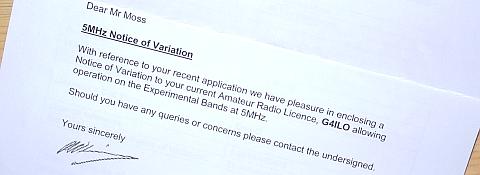
Until now I hadn’t been bothered about operating on 60m because I couldn’t see how I could possibly find room for an antenna for that band. However a couple of weeks ago I heard someone activating a SOTA summit in the Lake District on 60m and was frustrated that I could not reply to them. So I decided to put in an application for permission to operate and here I am.
I don’t have an antenna that is resonant on 60m so I tried tuning up my multiband dipole using the K3 auto ATU. After a lot of persuasion it managed to find an acceptable match on the higher frequency channels but it gave up on the lower ones. So I should be able to manage some activity on the new band.
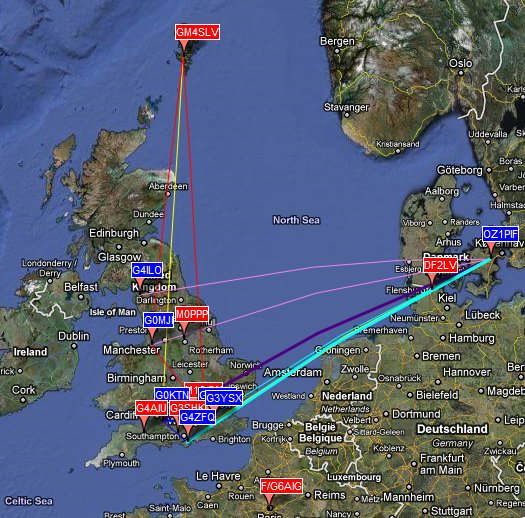
Fortunately, the channel allocated for beacon and WSPR use is one of the ones I was able to match. And today just happened to be a 60m WSPR activity day. So I fired up the WSPR software and beaconed on 60m using 2 watts, increasing to 5 watts in the evening when propagation went long and most of the traces faded out. The 5 watts did me no good at at all, but my 2 watt signal was heard by 7 different G stations all around 400km distance from me plus F/G6AIG at 760km. I received 6 different G stations including G4ZFQ at 458km running 20mW, plus OZ1PIF (my best DX at 984km) and LA3JJ.
Tomorrow is QRP day on 60m when everyone is supposed to run 500mW or less. I have not decided yet how little power I will run but I will be WSPRing on 60m all day. Hopefully there will be a few more people who manage to spot me.

Julian Moss, G4ILO, is a regular contributor to AmateurRadio.com and writes from Cumbria, England. Contact him at [email protected].
What does it sound like to listen to 2m from space?
The people best qualified to answer that question are the astronauts who’ve operated on ham radio from the International Space Station. Some weeks ago, I saw people talking about a video made by Col. Doug Wheelock, KF5BOC who was a very enthusiastic operator of NA1SS from the International Space Station. I had a chance to see the video today. It’s fascinating on all sorts of levels!
During the video you’ll see the inside of the ISS and be able to hear what it sounds like to operate from the International Space Station.
I particularly love the segment where Doug talks to the station near Houston and offers to come over and give a talk to the club. Wow!!!

Tim Kirby, G4VXE, is a regular contributor to AmateurRadio.com and writes from Oxfordshire, England. Contact him at [email protected].
Icom IC-910H Transceiver for sale

I have an Icom IC-910H 144MHz/432MHz multimode transceiver for sale. I will only ship to the UK (or certain other European countries if the buyer agrees to the cost of an insured courier.) More details are on the Equipment for sale page of my website.

Julian Moss, G4ILO, is a regular contributor to AmateurRadio.com and writes from Cumbria, England. Contact him at [email protected].
Round the back way

Back in the early QRP days of Elecraft, there were some K2 owners who were such CW diehards they were uncomfortable with having a radio that possessed a microphone socket. One or two of them described to the Elecraft email reflector how they had blanked off the offending socket. Despite the evidence in the picture on the right, I have not joined this fraternity. I have simply started using the rear microphone and PTT connector on my K3. I have thought for some time that the front panel connector is an accident waiting to happen, and I finally decided to make the move before it did. (And before anyone comments about the dust in the photo let me just say that one of the few benefits of deteriorating eyesight as you get older is that you don’t notice it!)
Front panel microphone sockets are pretty much the norm in ham radios. However in most radios they are secured directly to the metal front panel or, in the case of radios with a plastic fascia to the metal chassis behind it, using a locking nut which tightens the chassis against the ring cast into the socket so that it is rock solid. You could tug at the microphone cable all you want or bash the connector with a hammer and you would be unlikely to cause any damage to the radio itself.
In the K3, the microphone connector comes soldered to the front panel board. There is no possibility of securing it to the metal front panel. The ring that would normally sit on the outside of the mounting hole actually slips through the hole in the front panel so all the rigidity is provided by the PCB. The front panel hole limits movement up and down or side to side to a certain extent. But it does not provide any protection from movements fore and aft. I wonder about the effects of constant small side to side movements on the soldered joints connecting the pins to the board. And I feel sure that if I accidentally leant on the microphone plug, supporting my weight as I tried to make some connection round the back, I could damage the front panel PCB by snapping the microphone socket right off.
As the outer body of the microphone connector is not physically attached to the radio itself it is not electrically grounded. Whilst installing the K144XV transverter board I noticed that grounding is provided by a piece of bare wire that loops round the threaded part of the connector and is soldered to the front panel board. This may have been a modification that I did myself when I assembed my K3 three years ago. What this wire loop does not do is prevent the outer metal part of the microphone connector from turning relative to the insulated centre bearing the 8 pins that are soldered to the PCB.
Because of the perceived risk of damaging the front panel board by accidentally putting my weight on the microphone plug I have been in the habit of disconnecting the microphone whenever I need to lean over the K3 to grope round the back. So the microphone connector has been on and off rather a lot. Recently I observed a tendency for nothing to happen when I pressed the PTT on my desk mic after reconnection. It then became apparent that the outer metal part of the plug has become slightly loose and can be twisted several degrees relative to the centre. I’m pretty sure this is due to the plug body not being secured to the chassis of the radio so there is nothing to take the strain of tightening and untightening the microphone plug. Hence my decision to give up using the front panel socket and move round to the back before the problem got any worse.
My shack is very cramped so I had shortened the cable on my Heil desk mic to eliminate unnecessary length when plugged in to the front of the K3. Consequently it would not reach round to the back. Rather than rewire the microphone I decided to make an extension cable using a line 8-pin socket, retaining the option of using the front connector if I want. I purchased the line connector quite inexpensively from an eBay seller (where else?)
These connectors are much easier to work with than the mini-DIN connectors I have recently been using rather a lot. The pin numbers are clearly visible, but it’s a good job I checked: in the connector I had the pins had been installed in the metal socket offset by one pin position so pin 1 was labelled pin 7 etc! This could easily have been confusing and so my brain cells got a bit more exercise than expected making sure I got the connections right.
I changed the microphone configuration in the menu to use the rear mic socket and so my microphone is now plugged in round the back. It would be interesting to know whether any other K3 users have had problems with this front panel socket. Once, I would have posted about it on the Elecraft email reflector, but that would only result in several replies from kool-aid drinkers saying that it hasn’t happened to them so it must be my fault.

Julian Moss, G4ILO, is a regular contributor to AmateurRadio.com and writes from Cumbria, England. Contact him at [email protected].
Do One-Way Transmissions Still Have a Place in Amateur Radio?
The FCC has called a hearing to determine whether the license of K 1 M A N should be renewed. If you’re not familar with the ongoing saga, you can read the FCC order which gives the Reader’s Digest version. It’s both entertaining and sad at the same time, like watching angry women smack each other up on daytime TV talk shows.
Periodically this ongoing fiascocase is in the news, and it seems each time the topic of ARRL one-way transmissions (a.k.a. “broadcasting”) invariably comes up in the conversation. Technically the term broadcasting in the FCC amateur radio rules means one-way transmissions to the general public, however most folks appear to use the term broadcasting to refer to one-way transmissions to amateurs, like ARRL’s daily transmissions. I’ve heard arguments that what ARRL does isn’t much different than what K 1 M A N does. They both do one-way transmissions which is allowed by the FCC, but that’s where the similarity ends. K 1 M A N was cited by the FCC for control operator issues, interference, and broadcasting inappropriate content. Broadcasts in previous years often included rants and just plain off-the-wall content. The broadcasts certainly didn’t showcase the best in amateur radio.
Some radio amateurs argue against broadcasting in general (including ARRL broadcasts) because it interferes with QSOs. This undoubtedly does happen, and reading the FCC order, this was certainly the case with K 1 M A N. But the FCC text makes the case that interference was deliberate. ARRL broadcasts have interfered with ongoing QSOs in the past, but ARRL broadcasts on published schedules and frequencies, and ARRL has been doing it for six decades. Broadcasting on six or seven HF bands, it’s just not practical to have to seek a clear frequency on each band before each broadcast.
While there is nothing in the rules about the content of broadcasts, I think one also has to take into account just what is being broadcast and who, if anyone, is benefiting from it. I copy ARRL CW bulletins once in awhile just to brush up on my CW. The bulletins have news value and general appeal to most radio amateurs. The same could not be said of K 1 M A N broadcasts.
Playing devil’s advocate for a moment, I can argue that amateur radio broadcasting is no longer necessary. In the past the only way to get late-breaking amateur radio news was over the air, but today the Internet can provide news bulletins and code practice, and much more efficiently and conveniently. While this is technical true, I think it would send the wrong message to the public who (wrongly I think) often compares amateur radio and the Internet. Furthermore, with modes like CW, Hellschreiber, and RTTY, amateur radio is known for preserving old technical traditions. Eliminating broadcasting in favor of newer technology ironically (and perhaps sadly) would be antithetical to amateur radio.
Overall, I think abuses of one-way broadcasting in amateur radio are few and far between and the benefits of broadcasting outweigh the interference issues. QSOs undoubtedly will continue to occasionally get stepped on by ARRL bulletins and code practice. I’m sure we’ll have another egomaniac abuse the one-way transmission privilege in the future, but we can deal with that when it happens.
One final note on the K 1 M A N hearing; judging by past rants and broadcasts, I expect the defendant’s closing summation will sound something like this song (make sure you get into the first 40 seconds or so)….


 Ham Radio Deluxe |
 W5SWL Electronics |
 Ham Radio Prep |
 KB3IFH QSL Cards  Hip Ham Shirts  HamRadioAuctions HamRadioAuctions Reliance Antennas Reliance Antennas Enigma Shop Enigma Shop |  morseDX  Ni4L Antennas  R&L Electronics R&L Electronics antennas.us antennas.us QRV QRV |
- Matt W1MST, Managing Editor
